Consider it your morning meditation. Or an opportunity to learn something about cell motility.
Pharyngula
Evolution, development, and random biological ejaculations from a godless liberal

Consider it your morning meditation. Or an opportunity to learn something about cell motility.

I don’t understand how this happens. You’ve got a good academic position. You’re bringing in reasonable amounts of grant money. You’re publishing in Nature Genetics and Nature Structural and Molecular Biology. And you don’t even understand the basic concepts in your field of study.
For instance, here’s a press release titled “Cause of genetic disorder found in 'dark matter' of DNA”.
For the first time, scientists have used new technology which analyses the whole genome to find the cause of a genetic disease in what was previously referred to as "junk DNA". Pancreatic agenesis results in babies being born without a pancreas, leaving them with a lifetime of diabetes and problems digesting food. In a breakthrough for genetic research, teams led by the University of Exeter Medical School and Imperial College London found that the condition is most commonly caused by mutations in a newly identified gene regulatory element in a remote part of the genome, which can now be explored thanks to advances in genetic sequencing.
Regulatory elements are not and have never been considered junk DNA. The researchers have identified a regulatory region called PTF1A that has allelic variations that cause a failure of the pancreas to form. That’s really interesting! But then you read what they have to say about it, and they are completely oblivious to the literature on genetic structure and gene regulation. Isn’t that something you’d expect them to have studied thoroughly before even proposing this project?
Or how about this press release, “Un-junking junk DNA”. It’s gotten to the point where I just cringe when I see the phrase “junk DNA” in a press release, because it is a sure sign of flamboyant ignorance to come.
"This study provides answers for a decade-old question in biology," explained principal investigator Gene Yeo, PhD, assistant professor of Cellular and Molecular Medicine, member of the Stem Cell Research Program and Institute for Genomic Medicine at UC San Diego, as well as with National University of Singapore. "When the sequence of the human genome was fully assembled, under a decade ago, we learned that less than 3 percent of the entire genome contains information that encodes for proteins. This posed a difficult problem for genome scientists – what is the other 97 percent doing?"
The role of the rest of the genome was largely a mystery and was thus referred to as "junk DNA." Since then sequencing of other, non-human, genomes has allowed scientists to delineate the sequences in the genome that are remarkably preserved across hundreds of millions of years of evolution. It is widely accepted that this evidence of evolutionary constraint implies that, even without coding for protein, certain segments of the genome are vital for life and development.
So many misconceptions. No, noncoding DNA is not synonymous with junk DNA; junk DNA was not so called because its function was mysterious; it is absolutely no surprise that some regions of the genome are vital, even without coding for proteins — haven’t they heard of tRNA or miRNA? Developmental biologists have been yapping for decades about the importance of the switches that control gene regulation…are we just ignored?
I worry that this is a symptom of a serious rot in science education — that we’re turning out great technicians and masters of the arcane art of grant writing who don’t actually understand biology, and in particular have no perspective on what the questions actually are. They may be excellent middle managers, but the comprehension and vision are lacking.
I have a suggestion. If you’re going to do research that leads you to say anything about junk DNA, I urge you to read carefully one or all of the following books: The Origins of Genome Architecture


For those of you going to Skepticon: apparently they’re going to divide us into two teams, the reds and the blues, to compete at who are the better secularists. They should not do this, because now I’m plotting how to subvert the whole thing.
It is my people’s traditional folkway.


My last article triggered a great deal of furious response. Some of it was outrageously stupid: this one, in particular, is the frontrunner for blithering idiocy.
Sometimes I wonder if PZ Myers is capable of empathy at all. This anti-war message, coming ironically from someone who has essentially declared war on others to promote his own values, is more insulting to veterans than to decision-makers, all the while dressing itself as morally righteous.
You don’t need to be pro-war to be pro-veterans, but it is especially abhorrent to chastise others for fighting for what they value when you insist that anyone who doesn’t fight for what YOU value is the enemy.
Right. Because what I do when I disagree with someone is conscript an army of riflemen and shoot them, followed by blowing up their house and bankrupting their country. But let me ignore the truly stupid comments, of which there were so many, and talk a bit about the one rather more intelligent rebuttal.
This is the argument of the form, “What about Nazi Germany, and the atrocities they were committing?” Another good example is “What about the Confederate States and slavery?” And I have to agree — the world is an uncoordinated, tragically short-sighted mess, and all too often we let horrendous circumstances accumulate until suddenly we’re confronted with a situation so dire that only violence can resolve it. We could not let genocide continue or slavery to persist, and we let the problems smolder until we reached a breaking point. My argument is not that we should have laid down our arms and let Jews be murdered or blacks languish in servitude, but that in every case war is a belated and expensive solution, and always a mistake. Sometimes we’re stuck with going to war, because we are stupid. Because we often lack the international tools to stop destructive behavior any other way.
Another point: it’s easy to damn the CSA and the Nazis. Are Americans as willing to recognize the evil violence we perpetrate? If we agree that it was acceptable for us to use violence to stop the Holocaust or slavery, are we also willing to concede that therefore it is acceptable for others to use violence against us, to stop the drones, to end our nuclear threat, to stop our meddling in other countries? I don’t think so, and at least I’m consistent in saying that violence doesn’t solve the problem. How are you going to justify other wars, where good and evil are not so clear? Was the Vietnam War a just war? The Franco-Prussian War? The Thirty Years War? The Peloponnesian War?
And finally, step back and back and back. Take a human perspective for a change, rather than a nationalistic one.
We sent young men, little more than boys, to slaughter other young men in Europe and in the South. Did the German soldiers have mothers? Did the Southerners? Did most of them go to war telling themselves they must preserve the right to murder Jews or blacks? Most of them, on both sides, were doing what they thought they must to defend the homeland, to promote their way of life, and to be men of honor. On both sides. Both sides were absolutely convinced that they were in the right, and so we had two large masses of people flailing viciously at each other until one side or the other collapsed in submission, and I’m sorry, victory was not determined by who was right, who was fairer to humanity, who had the most noble values. It was a contest where right was determined by bloody, brutal might.
How can you say that the soldiers of one side deserve honor and the other does not? And if you’re going to claim that both deserve respect, than what a bloody stupid flailing exercise in futility war is.
You can obviously state that there is a difference in cause: fighting for the right to enslave or kill some of your own citizens, or to enslave or kill your neighbors, is clearly an unethical, even evil, goal. But you do not persuade people to live ethical lives by killing them, or shooting their neighbors. We do not seek to convince people at gunpoint, but only to stop them from carrying out criminal action. And unless you are prepared to police the planet with a gun, that is not a satisfactory solution — a lasting peace can only come from a long-term effort at education and equality, not a burst of gunfire.
But if you’re going to equate education and argument with gunfire and militarism, well then, we’re back to the idiot I quoted at the beginning.
Other good perspectives: Ta-Nehisi Coates pointing out the Civil War was just one flash point in a long smoldering human failure. And good god, read about the Battle of the Somme. There is no moral justification for that slaughter.

Today is the day when nations around the world pause to celebrate their most colossal failures, the events that killed the greatest numbers of their citizens, that broke and crippled their men after they’d been intentionally trained to dehumanize other human beings. We love to take our young people, especially our young men and boys, and grind them up in bloody battles, and then once a year we remind ourselves of what we do, and we congratulate people for it. Dulce et decorum est pro fucking patria mori and all that.
Meanwhile, our veterans hospitals are crumbling (and desperately needed) and we talk about more wars with Iran or whoever crossed us most recently, and doesn’t have nuclear weapons with which to smack us back. But we’ll go to all the effort of saying “Thanks, gramps” to people who suffered in terror and terrified other sufferers right back. All so a few people can get richer, and so politicians can thump their chests and claim to be braver than other politicians.
I think the only way to honor veterans of war is to make sure there are no more veterans. They are not heroes, but victims. There is nothing brave or heroic about picking up a gun and threatening to kill someone for a matter of principle, or even worse, because someone else is ordering you to do so — and the repercussions of celebrating violence tear our society apart.
For example, four women in Dallas met for their state chapter of Moms Demand Action for Gun Sense in America — a quiet lunch in a local restaurant. Texas gun advocates got word of the meeting, and gathered in the parking lot outside.

Brave heroes, all. In what world could such a gathering, intending to intimidate unarmed mothers, occur without the men involved withering in shame and guilt? Our world, obviously, where righteous terror with weapons in hand is celebrated. Perhaps these men will meet again in years to come, to remember the honor of being among the heroes who drew their weapons in the parking lot of the Blue Mesa Grill in 2013.
Just like right now, we honor those who carried arms against the young men of other countries, where right now, citizens honor those who carried arms to resist our young men. When are we going to wake up and realize that this is all madness, that it’s not a point of pride to be trained to kill, that we gain nothing and lose all when we settle disagreements with threats of lethal force.
How can we stop? Perhaps it would help to celebrate the right heroes.
I was horrified by this story of the Nazi scientific enterprise. The Nazi regime killed millions, members of despised ethnic groups, gays, and political dissidents, and some of their bodies were appropriated by the science establishment for medical studies. As the article reveals, sometimes scientists would go out to the prisons and mark certain individuals as desirable for their research; one, for instance, wanted to study the effects of stress on the menstrual cycle, so young women in a state of terror for their lives were particularly desirable (these are the studies our Republicans now cite when they want to claim that raped women don’t get pregnant!). It’s a terrible tale of scientists closing their eyes to the consequences of their work, and worse, actively participating in murder.
It tells of a young couple, Harro and Libertas Schulze-Boysen, who worked for the resistance against the Nazis, were caught and executed, he by hanging, she by the guillotine, and their bodies ended up on the anatomy table. Charlotte Pommer, a medical school graduate working as an assistant in the Institute of Anatomy, walked in to the lab to work and recognized the bodies waiting for her.
“I was paralyzed,” Pommer later wrote of the sight of the bodies. “I could hardly perform my task as an assistant to Professor Stieve, who did his scientific study as always with the greatest diligence. I could barely follow.”
Pommer was 28. Libertas Schulze-Boysen was 29 when she died. In her last letter to her mother, she said she’d asked for her body to go to her family. “Don’t fret about things that possibly could have been done, this or the other,” she wrote. “If you can, bury me in a beautiful place amid sunny nature.”
Pommer stopped working for Stieve—and left the field of anatomy—because of what she saw that day in his laboratory. She went on to help resist the Nazis herself, by hiding the child of a man who participated in the “July Plot” to assassinate Hitler in 1944. In the spring of 1945, just before the war’s end, Pommer was herself sent to prison.
So on this Veterans Day, I choose to honor the conscientious objectors and the Charlotte Pommers of the world, rather than the participants in war. They are the real heroes, the ones who made the greatest sacrifices to better humanity.
Meanwhile, look at what the media find important today: the poppy on Google UK’s search page isn’t big enough. But Bing puts a big photo of a poppy on their search page. Jesus fuck, millions dead in wasteful war and the big issue today is whether a photo of a flower is big enough to honor them properly.
I’ll tell you the answer: no, it isn’t.

The 1970s. Hanging out with my buddies after school. Driving around, trying to look grown up. This song comes on, we immediately turn up the radio to the loudest volume, and we’re all playing air guitar. Now it’s being played in a concert hall, for President Obama, with Heart doing the honors? (They rock it well, but I missed the rawness of Robert Plant’s voice.) I’m feeling old.
That song came out when Richard Nixon was president. I hope his corpse is crying bloody tears as the vibrations shake his tomb.
(via 3 Quarks Daily)


It all started with the wine last night — a dark red, with cherry and chocolate notes. The chocolate I can take or leave, but cherry…cherry is my flavor, and it reacted with the phlegmy mass building up in my sinuses to leach cherry dreams into my brain. This damned cold made my sleep fitful, as well, so unlike my usual nights, when I sleep deeply and blissfully so my dreams all dissipate before they pass into my awareness, I drifted shallowly in the Lethe, my head bobbing above the surface, and I remembered all, a rare experience.
Weird thing, most of the dreams I remember have salmon in them, as does this one. But it’s not got much salmon. It’s mostly about the cherry trees. OK, maybe a fair amount of salmon.

What if the National Association of Science Writers convened a panel on sexual harassment and discrimination, and no one cared? This report on sexual harassment and science writing at NASW is strangely, delicately neglectful, from the beginning where it irrelevantly claims that the Bora Zivkovic story no longer dominates science blogs (So has sexual harassment vanished? Or should we be asking where it will rise up again?), to the bizarrely abrupt segue in which they “Return You to Our Regularly Scheduled Program”, which is all about calculating the number of habitable worlds in the galaxy and more self-promoting fluff from SETI. Apparently, the concerns of women in science is of dwindling concern and a distraction from the Important Subjects of Speculative Astronomy.
The middle is equally weird. It has two sections: Hearing from Women, a two paragraph summary of what the women on the panel said, followed by Hearing from Men, with four paragraphs dedicated to the reactions (admittedly sympathetic) of the men in the audience, which are described as “some of the most powerful and significant statements”. At least the women’s section closed with an ironic comment: “The medical profession is now also heavily female, she [Ginger Campbell] said, but there, too, invisibility is everywhere.” How true that is.
I would like to have read more about “Hearing from Women”, but not only could the writer not be troubled to include more of the women’s statements, but she didn’t even bother to link to any of the panelists. I can correct that, at least: Christie Aschwanden, Deborah Blum, Florence Williams, Kate Prengaman, Kathleen Raven, Maryn McKenna, and Emily Willingham. Isn’t that odd that an article purportedly about this panel didn’t even link to the panelists’ professional pages, neglected to even name one of them, yet still made that special effort to capture men’s opinions on it?
You should read Emily Willingham’s assessment of the article. It’s not at all flattering.
Start looking for the invisible women, and it’s amazing how often you can find these curious omissions. Here, for instance, is a student at Michigan State plugging the virtues of social media for advancing your career in science (and I agree with him!), but he’s especially promoting reddit as a tool…which is problematic if you’re a woman, or have a reputation as a feminist. He touts reddit as the “best bang for the buck” for “thousands of young men and women” and obliviously shows this graph of internet readers who use reddit, titled “Young males are especially likely to use reddit.”
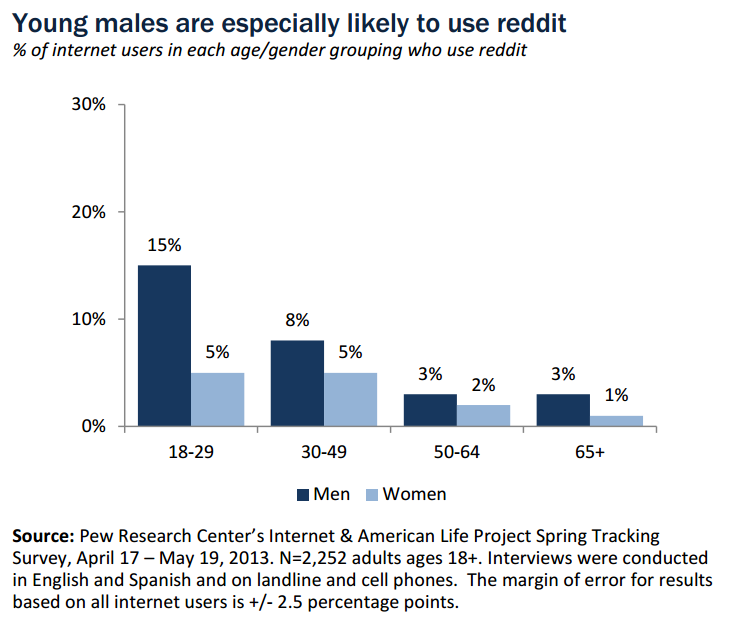
Apparently we can just ignore the pale blue bars that show that women represent somewhere less than a third of the audience you’ll reach on reddit. We’re not even going to notice the discrepancy, even if it leaps out at you as the most significant factor illustrated by the chart, and even if the title itself calls attention to it. The sexism problem on reddit isn’t even worth mentioning in an article about promoting science.
But that’s the big question that ought to be asked. Why isn’t it? Because invisible people aren’t as important.
Finally, here’s something that’s at least stirring and loud. It’s from a television show (as we all know, fictitious politicians are far more honest and bold than the real ones) in which a woman points out all the subtle signifiers the media and other politicians use to put her in her place.
Are you saying that Governor Reston is sexist?
Yes. I am. And it’s not just Governor Reston speaking in code about gender. It’s everyone, yourself included. The only reason we’re doing this interview in my house is because you requested it. This was your idea. And yet here you are, thanking me for inviting me into my “lovely home.” That’s what you say to the neighbor lady who baked you chocolate chip cookies. This pitcher of iced tea isn’t even mine. It’s what your producers set here. Why? Same reason you called me a “real live Cinderella story.” It reminds people that I’m a woman without using the word.
For you it’s an angle, and I get that, and I’m sure you think it’s innocuous, but guess what? It’s not. Don’t interrupt me when I’m speaking. You’re promoting stereotypes, James. You’re advancing this idea that women are weaker than men. You’re playing right into the hands of Reston and into the hands of every other imbecile who thinks a woman isn’t fit to be commander-in-chief.
Don’t you ever forget, ladies, that the most important parameter of your existence is how well you fit your stereotyped role. But don’t worry, no one will ever let you forget it.

I am not a fan of the convergent evolution argument for humanoid aliens. I can well believe that it’s likely that intelligent aliens exist out there in the universe, but I’m not even going to try to predict what they look like: there are too many alternative paths that are possible. But for some reason, many people like to insist that it’s reasonably likely that they’d resemble us in general, if not in detail, and they’ll then go on to extrapolate that behaviorally and culturally they’ll share many properties with us. Usually, as with Simon Conway Morris and now George Dvorsky, this argument relies entirely on the premise of convergent evolution.
It annoys the hell out of me, because it requires waving away or consciously ignoring basic principles of evolution. Here’s how Dvorsky illustrates the concept:
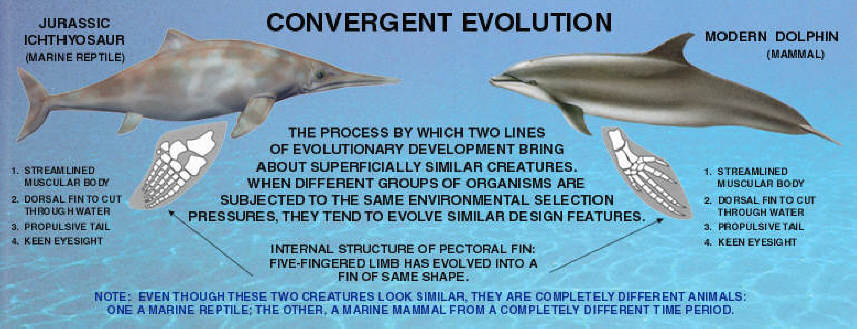
I’ve seen versions of this illustration a thousand times. Gosh, look, dolphins and ichthyosaurs all have paddle-shaped fins and streamlined bodies! Therefore, this is evidence that aquatic forms all converge on similar morphologies. And therefore, intelligent, terrestrial organisms will also converge on an ideal form for their niche, which is ours also, therefore we represent a morphological ideal.
I hate the argument because it isn’t applicable to alien species. In both cases shown above, the organisms involved belong to the same subphylum, the Vertebrata, and the same superclass, the Tetrapoda. They share a common ancestor, and the same starting point. When you start with a terrestrial creature that looks like this, with four limbs and a suite of similar traits…
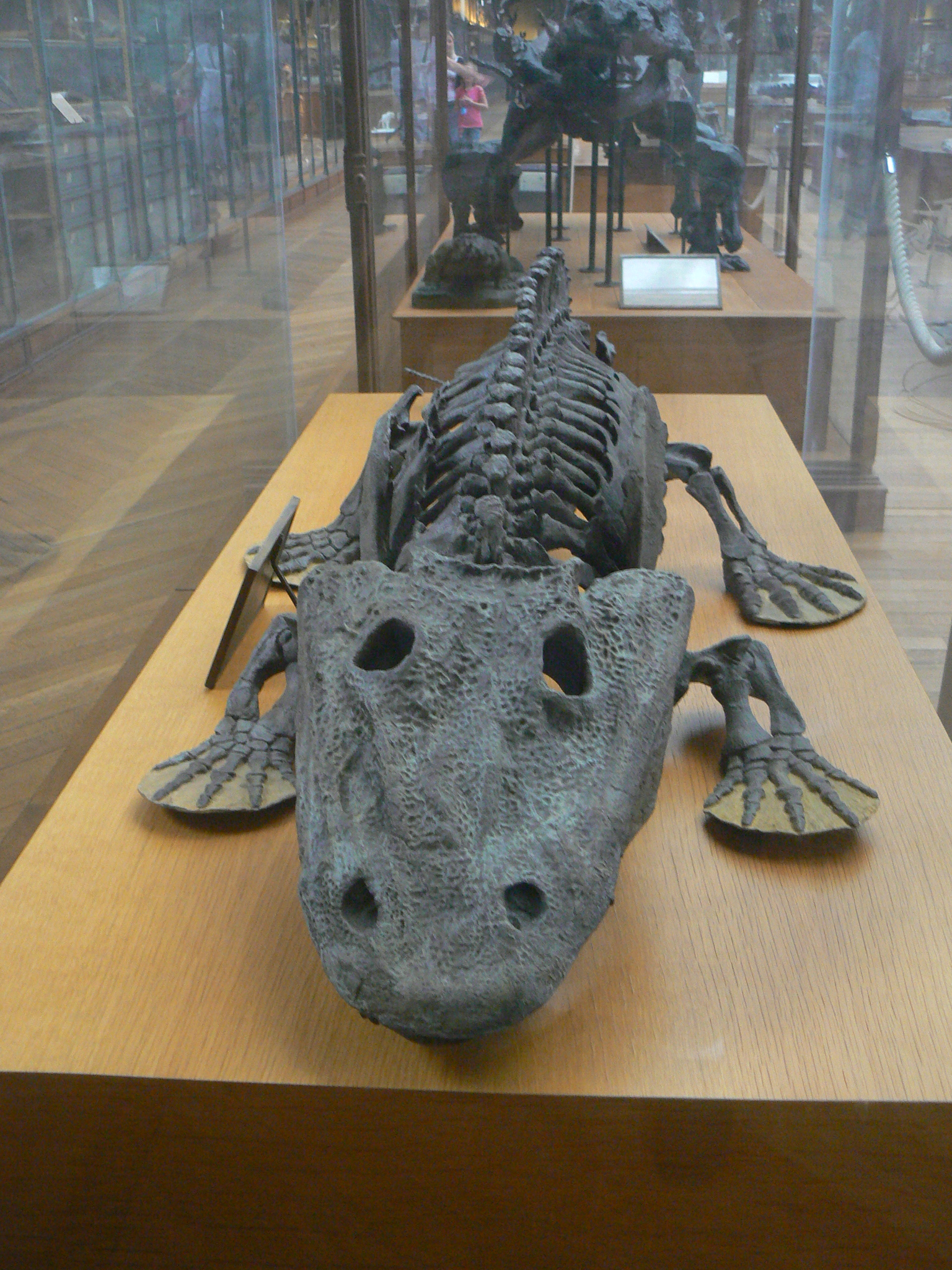
…and then let it re-adapt to a marine life as a free-swimming, active predator after long detours into mammalian and reptilian forms, is it any surprise that they converge on similar structures? They are both constrained by their ancestry! The four-finned torpedo does not necessarily represent an ideal form that will be recreated on every planet we ever someday visit, but is instead a compromise, a form that can be generated from a four-limbed vertebrate with a minimum of fuss.
But what if we look at organisms with more remote ancestry? A whole different phylum, perhaps? If we start down the evolutionary road with a conchiferan sort of creature, a mollusc…
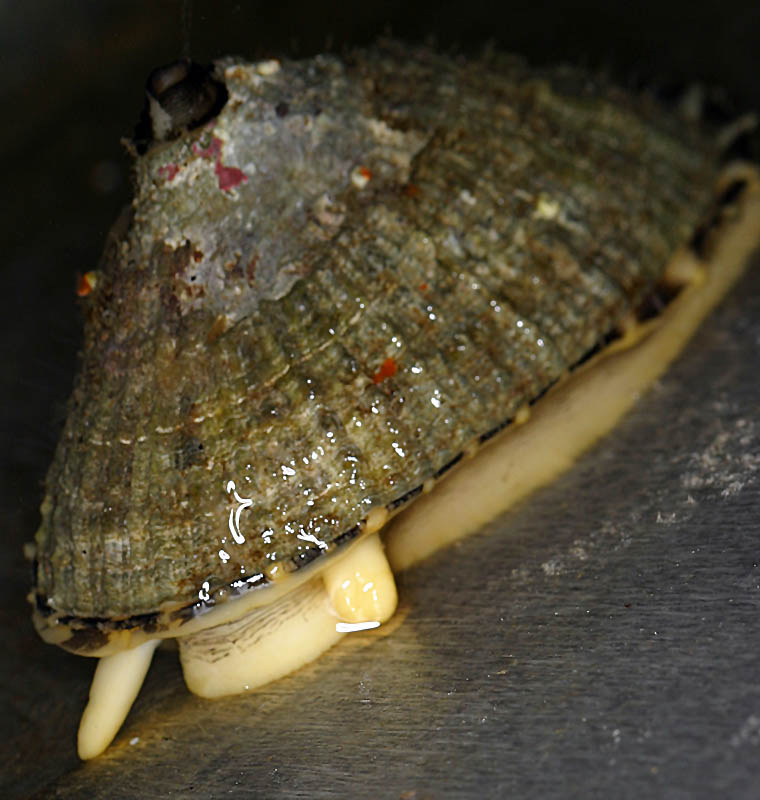
…which later evolves into a free-swimming, active predator, you get this:

That’s something that looks completely different from a fish-like ichthysaur or dolphin; it’s got a completely different shape, a completely different set of feeding behaviors, a completely different internal organization.
We could ask the same question of other phyla. Where are the sleek torpedo shaped crustaceans sporting a nice dorsal fin and quartet of paddles? Show me a marine annelid that has followed this same path.
Now keep in mind that life on another planet will share no ancestry with anything on Earth. If our history is any example, they will be the product of a few billion years of single-celled tinkering, with a riotous adaptive radiation of multicellular forms that will explore a small fraction of morphospace…and every step will be contingent on prior states.
You can only make this ludicrous convergence argument if you think 1) contingency is relatively unimportant, that 2) adaptation is extremely powerful and will always drive a species towards an optimum, and that 3) the shape of a relatively tiny subset of species on this planet represent that optimum. There is a fourth requirement as well: you must be oblivious to the fact that (2) and (3) contradict each other.

