Ken Ham, black person who is a pale shade of beige

Ken Ham is claiming that he doesn’t see color — that there is no such thing as a white person or a black person, and that he, goofy Australian bible-thumper, is not white. A scientist (well, a competent scientist) would say that the conventional clustering of traits associated with being black or white is artificial and does not align at all well with genuine biological groupings, but that is something different.

There is no genetic sequence unique to blacks or whites or Asians. In fact, these categories don’t reflect biological groupings at all. There is more genetic variation in the diverse populations from the continent of Africa (who some would lump into a “black” category) than exists in ALL populations from outside of Africa (the rest of the world) combined!

There are no specific racial genes. There are no genes that make blacks in the USA more susceptible to high blood pressure, just as there are no genes for particular kinds of cancers that can be assigned to only one racial grouping. There is no neurological patterning that distinguishes races from one another, nor are there patterns in muscle development and structure, digestive tracts, hand-eye coordination, or any other such measures.

But at the same time, the cultural construct of race is very real and has devastating effects on people. You cannot deny that American black people are socially handicapped by the color of their skin, just as American white people have benefitted immensely from history and policies that favored them.

… if you look across the USA you can see that there are patterns of racial difference, such as income inequalities, health disparities, differences in academic achievement and representation in professional sports. If one thinks that these patterns of racial differences have a biological basis, if we see them as “natural,” racial inequality becomes just part of the human experience (remember a book called The Bell Curve?). This fallacy influences people to see racism and inequality not as the products of economic, social, and political histories but more as a natural state of affairs.

OK? So it’s complicated. There are lineages that generate real genetic groups that do not correspond to folk notions of race, so the biological justifications for discrimination are bullshit; but race is also a categorization used to give one group privileges and another oppression. You don’t get to deny the existence of discrimination by race, just as you don’t get to claim biology gives you an excuse to deny the social effects of racist history.

That’s what Ken Ham and other people are trying to do with the color-blind fallacy: they want to sweep away the historical blame for biases and claim that no, they aren’t the recipients of all kinds of advantages from our racist history. There’s no legacy of oppression that we need to correct. We’re all the same! Except that some people just happen to get stopped more often by the police, are more frequent victims of police shootings, have inherited a history of poverty, and are targeted for voter suppression. But other than that, they’re all the same!

Ken Ham has a long and oblivious history on this issue. Here’s an opinion piece he wrote last year on this topic. It starts with a grain of truth and just gets weirder and weirder.

From a genetic standpoint, today’s scientists have abandoned the word “race” for humans — and so should everyone else. I urge President Obama, Al Sharpton, Jesse Jackson and others to abandon the word “races” and use “people groups” instead — to emphasize we are all one race, one blood and one family, and get away from any racist connotations.

It’s a fact of science that all humans are the same basic color, just different shades. The main substance in our bodies that determines skin color is melanin. There are no truly “white” people or “black” people. Humans have different shades from light brown to very dark depending on how much and the type of melanin. It’s a fact that all humans are colored people. (By the way, albinism — a lack of the pigments — is a rare condition that can occur in all people groups.) I challenge the president and others currently weighing in on race matters that we are all colored people — just different shades of brown.

Note what’s fundamentally off about this piece: he’s telling black leaders, and only black leaders, to stop referring to race because he is actually the same color as they are. He isn’t; yes, all humans use melanin primarily as the pigmentation molecule, but we also are able to perceive difference in skin color, and we can and have chosen to use those differences to oppress certain groups.

This is a patent attempt to absolve himself of any vestige of white guilt, or any obligation to exert himself to correct it.

It’s a white guy telling black people, Hey, I’ll make you a deal: if you pretend my skin color hasn’t given me any advantages, I’ll pretend your skin color doesn’t give you any disadvantages. What a deal! It’s only fair!

And really, Ham has been going on about demanding that we ignore racism for a long time. Here’s an article from 2007 in which he asks, Are there really different races?. His answer is no, because the Bible doesn’t say it.

He also loves to quote mine biologists.

Darwinian evolution was (and still is) inherently a racist philosophy, teaching that different groups or “races” of people evolved at different times and rates, so some groups are more like their apelike ancestors than others. Leading evolutionist Stephen Jay Gould claimed, “Biological arguments for racism may have been common before 1859, but they increased by orders of magnitude following the acceptance of evolutionary theory.”

No, first of all, evolutionary biology does not teach that different races evolved at different times and rates. Racism teaches that, and some biologists try to justify racism with biology. That’s the point of that quote: it’s not that Darwin invented racism — medieval pogroms and colonialism and slavery all long preceded Darwin — but that after Darwin, racists believed that they now had biological arguments to defend their beliefs, and those increased once they found ways to abuse the Darwinian rationale. And he doesn’t seem to note the irony in citing a godless, non-Christian scientist who is berating bad abuses of good science.

Ham’s whole essay is a long, rambling mess, in which he tries to argue that because the Bible doesn’t explicitly endorse racism against dark-skinned people, Christianity is absolved of all guilt. Again, let’s just close our eyes to reality: let’s pretend there were no Christian ministers interpreting the Bible to justify slavery, or arguing that the Curse of Ham (no relation) meant that all Africans were condemned to lives of servility and inferiority.

Also bizarrely, he tries to argue that the old miscegenation laws had no religious basis: the Bible only prohibits Christians from marrying non-Christians, which is OK, but doesn’t use the language of race. Right. The Bible, which promotes the Hebrews as his chosen people and sends them marching across Palestine committing genocide, did not have any kind of ethnic bigotry in it because it does not identify the people by the color of their skin.

But, you know, I’m an old white dork arguing with another old white dork about the legitimacy of ignoring the history of racism and the real effects it has on people’s lives. Maybe I should shut up and get the opinions of black people (oh, excuse me, I mean people who have just a slightly different shade of melanin-tinted skin than I do, but which entail no historical and current injustices).

Sincere Kirabo:

Identity politics are a form of political engagement that highlights issues and perspectives relevant to shared aspects of an identity. “Identity” is based on cultural context, social history, and lived experiences. Harris’s assessment of identity politics is suspect for three reasons.

First, it’s impossible to ignore his appeal to “Homo sapien,” which is a sly way of asserting “all lives matter” in the face of noticeable, disproportionate treatment of groups of people. How fortunate must one be to utter this without a hint of irony? Within the context of this discussion, his statement is akin to declaring “I don’t see color. I just see people.” Just like the idea of colorblindness is an act of racial avoidance, so too is the belief that “We’re all just people.”

This sounds cool in theory, but we don’t live in a utopia where every conceivable human identity across all economic, social, and political class barriers is unappraised. Until that day arrives, one can’t ignore that some groups of people are less valued than others based on gradations of identity.

Sikivu Hutchinson:

At a recent teacher training I conducted on creating safe spaces for LGBTQI high school students, a teacher asked why it was necessary to “call attention” to issues of sexuality and difference when LGBTQI students were already marginalized? Shouldn’t educators just treat everyone with the same dignity and respect “regardless” of sexual orientation? Educational justice activists have long argued that the colorblind ethos of classroom instruction disingenuously ignores how the values and mores of the dominant culture indoctrinate us into binary norms. In her book Other People’s Children, educational justice writer Lisa Delpit argues that mainstream classrooms are structured around an implicit “culture of power” which disenfranchises students of color. Consequently, a “treat everyone with dignity and respect” approach that isn’t based on a critical consciousness about how the dominant culture works undermines intersectional identities. In the classroom, everyday assumptions about interpersonal and romantic relationships “invisibilize” queer students. Classroom discussions about traditional straight families headed by heterosexual parents and caregivers perpetuate the idea that good, normal family units are straight family units. Assumptions that everyone has been brought up in a conventional family structure based on a universal nuclear family norm that is uncritically faith-based, brand queer, foster, homeless and secular youth as other.

Anthony Pinn has a whole book on this subject: When Colorblindness Isn’t the Answer: Humanism and the Challenge of Race. He explains the way white supremacy wants to perpetuate the illusion that this is not a problem.

we look for ways to speak to this injustice, to force change to a deadly system because “Black Lives Matter”. We want everyone to know this, act on it, and establish new social-political dynamics that make this recognition a safeguard against abuse. Of course, in doing this work we fall back on strategies drawn from the civil rights movement — march, make noise, call attention to circumstances and challenge the moral consciousness of the nation. I, like so many, benefited from this 20th century strategy, but it can’t be denied that the fundamental logic of life in the United States hasn’t changed as a consequence of those civil rights movement efforts.

That is the genius of white supremacy: it mutates and transforms, and it gives up a little in order to present the illusion of fundamental change. It finds ways to blame victims for the violence perpetuated against them. No, white supremacy and its child, white privilege, are the source and the cause. There is a desperate effort to find something in the past of the victim that will justify murder as the safeguarding of order and wellbeing. Yet, nothing can sanction the murder of black men and women whose crimes seem ill defined at best.

You know, maybe the opinions of a guy who thinks the earth is only 6,000 years old aren’t the product of rational, evidence-based thinking.

Hey! Wonder Woman was all right!

For a comic book movie, anyway. There were inconsistencies that bugged me, but didn’t detract from the main story. Like, where is this mysterious island of the Amazons? We know that the good guy got there by stealing a Fokker E.III from the Germans in Turkey and flying out to sea, which puts it somewhere within about 100 miles of the Turkish coast in either the Mediterranean or Black Sea. But then they leave the island by sailboat, and after an overnight trip, are sailing up the Thames to London. Just magic, I guess.

It was also extraordinarily annoying that a major plot issue requires that Wonder Woman’s mother had, for mysterious reasons, refused to tell her important facts about her history that would have come in awfully handy in the climactic battle — instead, she gets them from the villain’s monologing.

Dr Maru, one of the bad guys, is seriously underserved. She’s terribly scarred, but there’s no explanation why she is making horrible poison gases. Her ending is unresolved; Wonder Woman refuses to drop a tank on her (again, mysterious reasons), and we don’t know what happened to her after that. Wonder Woman II?

The story is framed by scenes of Diana Prince working in a museum (?) in modern times, archiving an old WWI photo. That leaves an awful lot of story to be filled in, all of 1918-2017 (she looks awfully good for a centenarian), which promises opportunities for many interesting period pieces. Unfortunately, just before the movie started, we got to see the preview for the Justice League movie, which looks terrible, another dark, murky, grim ensemble story where it rains constantly and everyone is bashing bad guys at night. Please don’t chain the Wonder Woman story to that awful Snyderish mess!

I could go on, but I’ll leave it at that. There were things that annoyed me, but you can see that they were mostly peripheral to the story. Which is, basically, that Wonder Woman is a badass social justice warrior who hears about this big war in which millions of civilians are dying, and she decides she needs to leave her idyllic island paradise and end the war, which she thinks she can do, because her head is full of this mythic nonsense that leads her to believe that all she has to do is kill one Big Bad, and everyone will lay down their weapons (see maternally willful ignorance, above). She is instead going to learn that humans are miserably complicated, both good and evil, and that killing the monster she thinks is the sole source of evil isn’t going to solve every problem.

There is also much heroic charging of machine gun nests, batting away artillery shells with her shield, stabbing of German soldiers with pointy god-killer sword, crushing of snipers by hitting towers so hard they explode (hey, she’s pretty devastatingly brutal at points, so why the hesitation to smoosh Dr Maru? Probably because she has no problem slaughtering faceless mobs of men (misandry!) but sees a toxic mass-murdering damaged woman as deserving a little sympathy), and essentially turns combat into ballet with tracer fire and explosions.

So that was fun.

Undermining the comic book movie trope that beating the one big bad guy will solve all of the conflicts was also nice to see. There’s potential here for a series that contains some moral complexity, spiced up with explosions.

And, of course, the real treat was to see a woman acting heroically, with the men in this story scampering along behind, dazzled by her confidence and strength. That’s a stock role for a comic book story, but usually it’s filled by a heroic manly man.

Turns out a woman can be a hero, and do the job well. But you knew that all along.

Open thread

We are currently struggling with technical difficulties — we’re up, we’re down, we’re taking forever to load, pages pop up instantly, you just don’t know what you’re going to get when you visit freethoughtblogs today. So for those who brave the hostile technology, say what you want, while we hammer on the infrastructure.

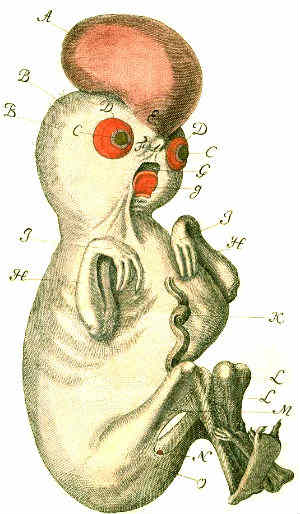
Behold, the Hühnermensch!

I had no idea how deeply Eugene McCarthy had descended into absurdity. He’s arguing that humans have hybridized with…chickens.

Also with dogs, apes, goats, cows, and turtles.

His ‘evidence’ consists of mythological accounts (satyrs are evidence of goat-human hybrids, for instance), and terrible stories of women who had grossly deformed stillborn babies with peculiarly warped features that, if you impose your biases on them, can be seen to vaguely resemble other animals. These are always severe teratological defects, but McCarthy always interprets them as hybrids. The Hühnermensch, or chicken-baby, drawn above is an example. That’s not a comb growing out of its head, but its brain — this is a condition called exencephaly. It often occurs as a precursor to anencephaly, because usually that bubble of extruded brain matter will degenerate. His ape-human ‘hybrids’ are all photos of anencephalic stillbirths.

It’s a rather disgusting section of McCarthy’s work, not just because the pages have lots of images of tragic and almost always lethal birth defects, but because he misinterprets them as evidence that the mother, who has already suffered enough with the loss of a baby, must have also become pregnant by having sex with an animal.

He’s just an ignorant and terrible person.

If only we could all find the doorway in our hearts

I’m about to depart for the airport to pick up my best beloved and bring her back home after a week long absence, which means I’m going to be tied up with driving for the next six hours (it’s OK, it’s worth it). I’m going to recommend some reading for you while I’m occupied.

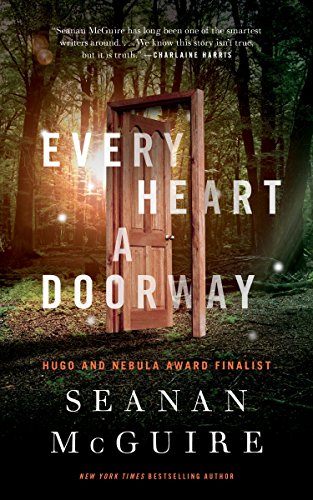
I was blown away by Every Heart A Doorway, by Seanan McGuire. It’s a genuinely original fantasy story that steals from a lot of familiar fantasy tropes. You know there are all these stories about kids who are magically transported to a strange and unfamiliar world, like Narnia or Oz or Wonderland? What if this was a relatively common occurrence, with many strange worlds that are much weirder or scarier than the familiar fantasy lands? And most importantly, what happens to the children who have been shaped in their formative years by alien places with inhuman residents?

That’s the focus of the story: these children would be really different, with a different sense of self and different yearnings and different behaviors, and they’ve returned to our culture, which can’t even deal with something as mundane and normal as gay kids. What you find is that most of the parents of these children can’t cope and want to somehow reshape and indoctrinate the children to be more ‘conventional’, causing all sorts of misery for everyone involved. The lucky ones find themselves at a school in this story, run by a woman who had stumbled through a portal to a fantasy land and returned, who now runs her home as a refuge for these strange children.

So the main character, Nancy, is ace, and this is a minor metaphor for her true strangeness, which is that she lived in a world of ghosts who disliked the business of the living, so she has learned to retreat into statue-like stillness. The character I identified with most was Jack, who was trained on a world of mad scientists and horrible experimentation. Jack, by the way, is a girl — try not to impose your gender expectations on any of the people in the book, because you’ll probably get them wrong, or at best will be focusing on irrelevancies.

Also don’t think that a school that favors tolerance and openness will be free of tension and conflict. The whole story is about the way all these different people, different to a degree much greater than anything we experience in everyday life, have to struggle to resolve those differences, and how unhappiness can find a home anywhere you let it.

It’s fabulously well-written and thoughtful — it’s not really escapist fare. It’s also the first in a series which I’m looking forward to. Also, this is not your usual fantasy story that inevitably gets drawn out into an overlong trilogy of ten books or whatever. The main characters in this one achieve resolution of their various conflicts, for good or ill (no spoilers, but for some there are no happy endings, and for others, what they consider a happy ending might not make you happy at all), and I think the next book will focus on different kids or different sides of the story. I don’t know! Isn’t that wonderful when you find a book that doesn’t always trundle down familiar tracks?

Wait, what? Who is welcoming exemption from ethical review?

This will not end well. Social scientists are happy to see human studies rules relaxed.

If you took Psychology 101 in college, you probably had to enroll in an experiment to fulfill a course requirement or to get extra credit. Students are the usual subjects in social science research — made to play games, fill out questionnaires, look at pictures and otherwise provide data points for their professors’ investigations into human behavior, cognition and perception.

But who gets to decide whether the experimental protocol — what subjects are asked to do and disclose — is appropriate and ethical? That question has been roiling the academic community since the Department of Health and Human Services’s Office for Human Research Protections revised its rules in January.

The revision exempts from oversight studies involving “benign behavioral interventions.” This was welcome news to economists, psychologists and sociologists who have long complained that they need not receive as much scrutiny as, say, a medical researcher.

I would have expected social scientists to be even more acutely aware of the bias of self-interest than us clueless nerds over in the other sciences. If there’s anything we should have learned from the history of scientific experimentation it’s that scientists do not provide good ethical oversight of their own research. Some do seem to know that.

“Researchers tend to underestimate the risk of activities that they are very comfortable with,” particularly when conducting experiments and publishing the results is critical to the advancement of their careers, said Tracy Arwood, assistant vice president for research compliance at Clemson University.

Yes. Onerous and annoying as they are, we have human research review committees to specifically provide input from outside the blinkered perspective of the researcher. That’s necessary. Not everyone sees it that way.

A vocal proponent of diminishing the role of institutional review boards is Richard Nisbett, professor of psychology at the University of Michigan and co-author of the opinion piece in The Chronicle of Higher Education.

Social science researchers are perfectly capable of making their own determinations about the potential harm of their research protocols, he said. A behavioral intervention is benign, he said, if it’s the sort of thing that goes on in everyday life.

“I can ask you how much money you make or about your sex life, and you can tell me or not tell me. So, too, can a sociologist or psychologist ask you those questions,” Dr. Nisbett said.

He’s a psychology professor, and he thinks that in a study in which a professor is asking personal questions of a student, there are no social pressures on the student, and they are completely free to ignore the question? Jesus. I guess I wouldn’t trust any papers published by that guy, then.

If those questions are really benign, then shouldn’t the study proposal fly through the institutional review board process without a hitch?

I mean, I could propose a whole bunch of experiments that involve having students drink lots of vodka before undergoing various cognitive tests, and drinking to excess is the sort of thing students do in everyday life, so it must be benign, and why should I get an IRB to rubber stamp something that the students are doing anyway, am I right?

You don’t want to know what I could argue biology experimenters ought to be able to do without outside assessment because students are already doing it anyway.

Where is the money going?

If you read these tales of the horrifying reality of the academic job market, you will learn that adjunct professors are paid a pittance, and often have to do piece work, teaching multiple classes at multiple colleges to make ends meet. They’re getting paid next to nothing for what ought to be the central work of the university. So the money isn’t going into their pockets.

And then you learn that many universities are relying almost entirely on adjuncts to do their teaching.

It is insane to see that my department has only 3 FULL TIME PROFESSORS and 20 ADJUNCTS!!!

So the cash must all be flowing into the pockets of those 3 professors? Nope. Most tenured professors are making a comfortable middle class income, but aren’t getting rich. Tenure means stability, not wealth. If you’re looking for a profession that will give you opportunities to rake in fabulous sums of money, don’t look to the professoriate.

The students must be laughing themselves to the bank with all of their cheap educations, right? No, you know that’s wrong: skyrocketing tuition costs have been the order of the day, and students are graduating with legendary debts, debts that would have been unheard of for my generation. Money is pouring in, but it’s not going to the educators.

It’s going to academic parasites like Elsevier. It’s going to academic bureaucracies that have lost sight of what their institution is for: we have big advertising goals that are not necessarily in alignment with making the best damn university we can. We sink cash into college athletics, without assessing whether it actually benefits our mission. The highest paid state employee in most states is the college football or basketball coach, which is utterly nuts.

If you look at the methodology behind college rankings, it’s all stuff like graduation rates (here comes the pressure for grade inflation) and class sizes (hiring lots of cheap adjuncts actually benefits your rankings) and peer evaluation (them that has a good reputation gets a good reputation). It would be really interesting if US News & World Report announced that they were going to multiply colleges’ final score by the full-time/part-time faculty ratio; a lot of schools’ much sought after rankings would tumble down rapidly.

But there are many vested interests that are working hard to avoid having anyone gaze at the teacher-student interactions that ought to be the center of any evaluation of a university’s quality.

Gentlemen, this will be your last day on Earth

The plans have been leaked. We now know what will happen at the woman-only screenings of Wonder Woman. Gal Gadot is going to turn to the audience, and…

“Man’s time is over,” she said. “They have done all that they will do, all they are capable of doing.” And then she grabbed Chris Pine by the hair and slit his throat with a big double-edged axe that we’re pretty sure was not in the comics but that’s Hollywood for you.

“This is the labrys,” she told the audience as Chris Pine sputtered and choked on his own blood. “A symbol of woman’s power. It cuts away that which is false. It is a problem and a solution. Look under your seats.”

Each woman pulled a similar double-edged axe from under her seat. We do not know where they came from. We did not put them there. The Alamo Drafthouse did not arm the first Amazon Death Squad. We want to make that perfectly clear.

I’m hoping my wife likes me enough to keep me around to do the cooking and cleaning, but if she doesn’t, I have to look at the current occupant of the White House and agree, we fucked up badly.