Welcome to the universe, Larry!

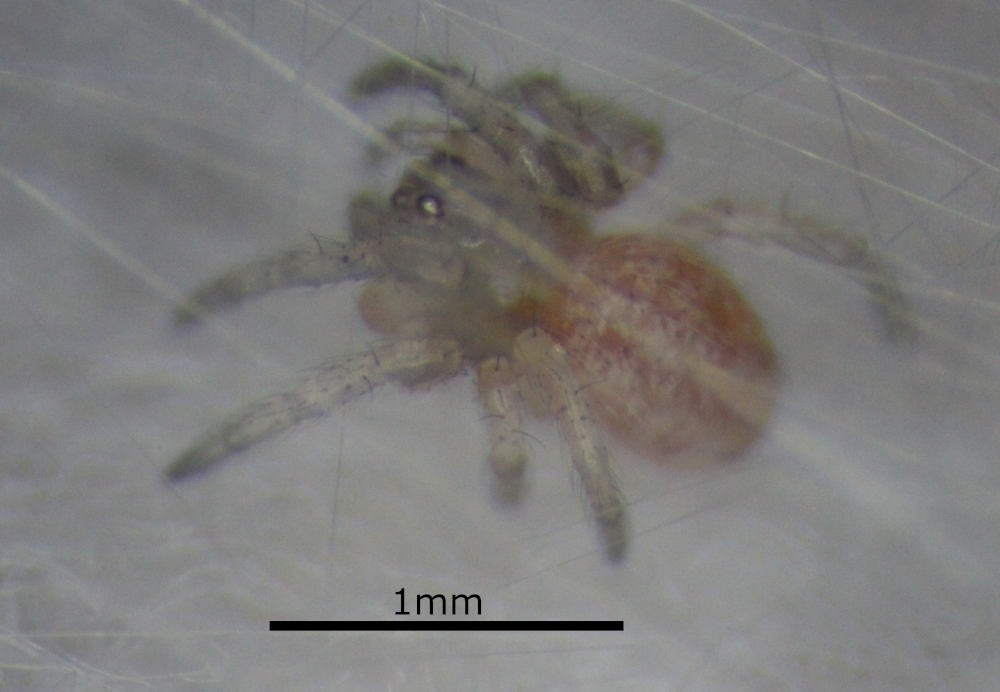
Perhaps you recall the majestic Larinioides I found at Pomme de Terre park almost two weeks ago? It laid a large pink egg sac in the container we had it in, as a present before we released it back into the wild.

Today, or perhaps last night, they started hatching. Here’s a baby Larinioides spiderling, freshly emerged, and looking a bit stunned.
They’re back in the incubator until I see that a few more hatch out, and then they’ll be released to the world.

Doctors discover plasticity! Shock horror!

Teenagers are acquiring bone abnormalities from cell phone use! It’s the perfect story, combining contempt for social media and technology and young people with an apparent appropriate comeuppance for those sins.

Mobile technology has transformed the way we live — how we read, work, communicate, shop and date.

But we already know this.

What we have not yet grasped is the way the tiny machines in front of us are remolding our skeletons, possibly altering not just the behaviors we exhibit but the bodies we inhabit.

New research in biomechanics suggests that young people are developing hornlike spikes at the back of their skulls — bone spurs caused by the forward tilt of the head, which shifts weight from the spine to the muscles at the back of the head, causing bone growth in the connecting tendons and ligaments. The weight transfer that causes the buildup can be compared to the way the skin thickens into a callus as a response to pressure or abrasion.

The phenomenon is called an EEOP, or enlarged external occipital protuberance, and in a study of 1200 people, they found that about a third have this feature…and that it is more common in men and younger people. They assume from the differences in frequency at different ages that this is an emerging, recent change, which may be reasonable, but I’d like to see a better analysis of the causes.

The authors also assume that this is an undesirable change, with loaded language and an attempt to imply this feature causes serious problems.

Alarmingly, a survey of university staff and students revealed that participants spend an average of 4.65 hours/day using a hand held mobile device, and that 68% of the participating students reported neck pain.

Why is mobile device use alarming? Also note: they do not show a correlation between the presence of EEOPs and neck pain. We’re simply supposed to assume there’s a causal relationship, I guess, between exostoses and this vaguely defined term, “neck pain”. They have not shown that these bony bumps are a problem, but they are ready to raise the alarm.

Clearly, our findings should raise concern as morbidity and disability due to musculoskeletal disorders impose increasing physical, social and financial burdens on individuals and societies. Accordingly, the mitigation of poor postural habit through prevention intervention may be prudent.

Again, they have not demonstrated morbidity or disability. They’ve found that lots of people have these “bumps” that are easily detectable in x-rays, and maybe it’s because people are peering at their cell phones or playing the video games, so there must be a problem. They’ve only shown that the phenomenon exists!

To which I would point out the example used in the Washington Post article: hard work causes a healthy plastic response by your tissues, building up calluses. Are we alarmed by the growth of calluses in working people? Or do we recognize that this is a normal protective response by our bodies to environmental stresses? If you adopt an unusual posture in your work, your bones, cartilages, and tendons also mold themselves to fit.

They also show that 40% of college-age people are exhibiting this “problem”. I’d say that if it’s that common, while these same people seem to be functioning well and are actively and voluntarily engaging in the activity that putatively causes it, it probably isn’t a problem. It may also become the new normal. When over half the population expresses it, will doctors change their diagnoses and note of the new minority, “Oh, you’re missing your occipital exostosis. I’m going to recommend some physical therapy to build it up”?

Finally, one peculiarity here is that they’re jumping all over this possibly entirely benign phenomenon. Rather than focusing on college students using cell phones, I wonder what musculo-skeletal distortions are affecting people who are doing stoop labor, or other repetitive tasks in their work. Perhaps someone can put together an alarmist paper showing the plastic responses in the bones of menial laborers, expressing concern for the unfortunate spinal problems of those people. After all, if you’re horrified that students spend 5 hours a day looking at their phones, you should be experiencing raging apoplexy about farm workers spending 8-10 hours a day bent over, picking crops.

Nah, those people don’t matter.

Spider meeting is done

Waaah. I just have the closing banquet tonight, and then tomorrow is a long travel day home. So what did I learn?

  • Spiders are cool, but I guess I already knew that.
  • Spiders are a jillion times more complicated than I thought, and I’ve got a lot to learn.
  • Spider meetings are small and cozy and nice.
  • I’ve made a list of a dozen experiments that I think are doable by undergrads, and will provide interesting information.
  • I need to get home to start putting these ideas to work.

I guess that’s a pretty good outcome for a meeting, to end it inspired and better informed than I was at the beginning.

Next year AAS2020 will be held in Davis, California. I’m hoping I can fit it into my budget.

That makes it official

I was at dinner with a group of arachnologists last night, and I was surprised when I mentioned that I was from Minnesota and was then told that I was one of the only two arachnologists in the state. I was firstly startled at actually being told I was an arachnologist since I’m still trying to get a good grasp of the field, and secondly surprised that they’re so rare (would you believe there are only 500 people in the International Society of Arachnology?). He qualified it by saying that I was one of two people who had officially registered with the American Arachnology Society, from which I learned a few things.

If you want to be an arachnologist on paper, it’s easy — just send in your membership dues.

If you are a real arachnologist in Minnesota, with skills and expertise and deep knowledge, rather than a wanna-be like me, you’re behind. Send in your membership dues. Otherwise, people will keep mistaking me for you.

Otherwise, if you want to become a real arachnologist, here’s an article on the subject. It recommends starting in childhood and your teenage years, which is a little worrisome, since I waited until I was 61 to start. But you can do it! Unfortunately, unlike being an arachnologist on paper, it’s going to take a lot of hard work.

Another day, another overwhelming mess of spiders

This meeting is really an exercise in attitude readjustment. I’ve been steeped in the zebrafish world for so long that I’ve unconsciously held the model organism perspective — here’s my animal, all I have to do is query it deeply with increasingly thorough techniques, and I shall understand biology. Now I’m in a world where every observation is tested against a dozen closely related species, and a dozen distantly related species, and a dozen outgroups that aren’t even in the same order, and everyone is sprawling out horizontally to get a feel for the dimension of a problem rather than digging down vertically into one convenient animal bred specifically to thrive in the artificial environment of the lab. It feels strange and sometimes uncomfortable.

I’m also sometimes totally lost. I was at a session yesterday where arachnologists were just projecting photos from their personal collections, and where I was content to just think “OK, I guess that’s a spider”, other people were shouting out latin names and recognizing old friends. Or worse, “here’s a spider I haven’t been able to identify, and I consulted the world’s foremost expert, and they had never seen it before either”, and it begins to sink in that we’re surrounded by an immensely diverse population that is so wild and weird that we have no idea who they all are, and that I’m going to have to do a lot of work to catch up. It is intellectually terrifying and bizarrely stimulating.

Every once in a while, fortunately, I find something to anchor myself. Yesterday was all about spider silk, which, on the one hand, is molecular biology and can be reduced to genes and physical interactions with the environment (adhesive droplets on webs are a product of self-assembly, contingent on things like humidity and temperature), but on the other hand, of course spiders produce an incredible diversity of different kinds of silk. Sometimes, it all gets to be a bit much.

Looking at the program, this morning is all about biogeography, diversity, evolution, ecology, and life history, while this afternoon is all about behavior. I’m pretty sure my brain will explode at some point today, because I can assure you that there won’t be any single principle that I’ll be able to condense everything down to.

My first day really hanging out with arachnologists

Good morning from the arachnid meetings! I had a busy day yesterday, soaking in new knowledge and trying to absorb it, and boy is my brain tired. This is a whole new experience for me.

When I go to zebrafish meetings, there is one thing you know for sure: everyone is going to be working on pretty much the same highly inbred organism, raised in similar sterile institutional environments, and when there’s a subtle difference in some individuals, everyone wants to jump on it and dissect out the causal mechanism. These meetings are…the opposite of that. The exact opposite. Everyone is confronting this massive diversity of form and species, and diverse forms within species, and trying to map it out without recourse to stuff I would have thought routine. You’ve got some oddball individual? Cross it with others, clone it, breed it up into a large working population, figure out what genes are involved. Grind it up, sequence it, tell me what nucleotides are responsible.

You can’t do that when trying to puzzle out a few hundred species living in natural environments, and it’s not even the approach most people want to take. Yesterday I got to sit through lots of taxonomy talks where the number of claws on the foot of 1800 species (or is it 800 species? Depends on who did the naming) there are. I’m left wondering whether all of this is allelic, or even just developmental noise, and no one is even looking at that aspect of the problem, because they can’t. They’re just drowning in data.

I think the answer is that we’re going to have to train an army of 10,000 arachnologists, give each of them multi-million dollar grants for the indefinite future, and turn them loose. The problems are so big that that’ll give them a reasonable start.

Oh, also, most of yesterday seemed to be talking about Opiliones, non-spider arachnids. The fact that this was an arachnology meeting, not limited to mere spiders, was thrust into my face repeatedly. Fine. I’m here to learn stuff I don’t know, so go ahead, throw all the exotic arthropods at me willy-nilly.

There were a few talks that fell into my comfort zone. There was some stuff on sex determination pathways in Parasteatoda tepidariorum, all preliminary, but with enough connections to known pathways in Drosophila and mice that I could see roughly where it was going and where interesting surprises would lurk. There was a long session on nothing but circadian rhythms in diverse spider species that had me wondering lots of things, like why there aren’t a hundred labs working on this one problem.

Spider circadian rhythms are freakishly weird, unlike what you see in other animals. The endogenous rhythm is wildly variable in different species, some running on a 16 hour clock, others on a 29 hour clock. That’s part of the opportunity in spiders — so many species, and you can just toss one in a testing apparatus and get lots of data. They also exhibit different patterns when free-running, sometimes changing their periodicity. They just don’t care about phase shifts, recovering with surprising rapidity from jet lag. Everyone is trying to figure out why they’re so different from other animals; I’m thinking maybe the answer is simple, that they’re uncoupled from any need to maintain a rhythm, and that what we’re seeing here is the vestiges of an evolutionary relic that’s being retained for its coupling with other pathways, but that doesn’t really do anything for a circadian clock anymore. It’s a lot of broken clocks, all broken in different ways.

But what do I know? Put more experts to work on the molecular signaling pathways in spiders, I say.

Today is more of the same strangeness — the whole morning is dedicated to silk. That’s another phenomenon unique to spiders, and sure to leave me reeling. In a good way.

I think there’s also another taxonomic session coming up. I’m mainly going to that for the disruptive confusion it induces in my brain. It’s like taking random drugs all day long, although I won’t be going home with a filthy systematics habit, a little adventurousness for a week is fine.

Good morning from the Blue Ridge mountains of Virginia!

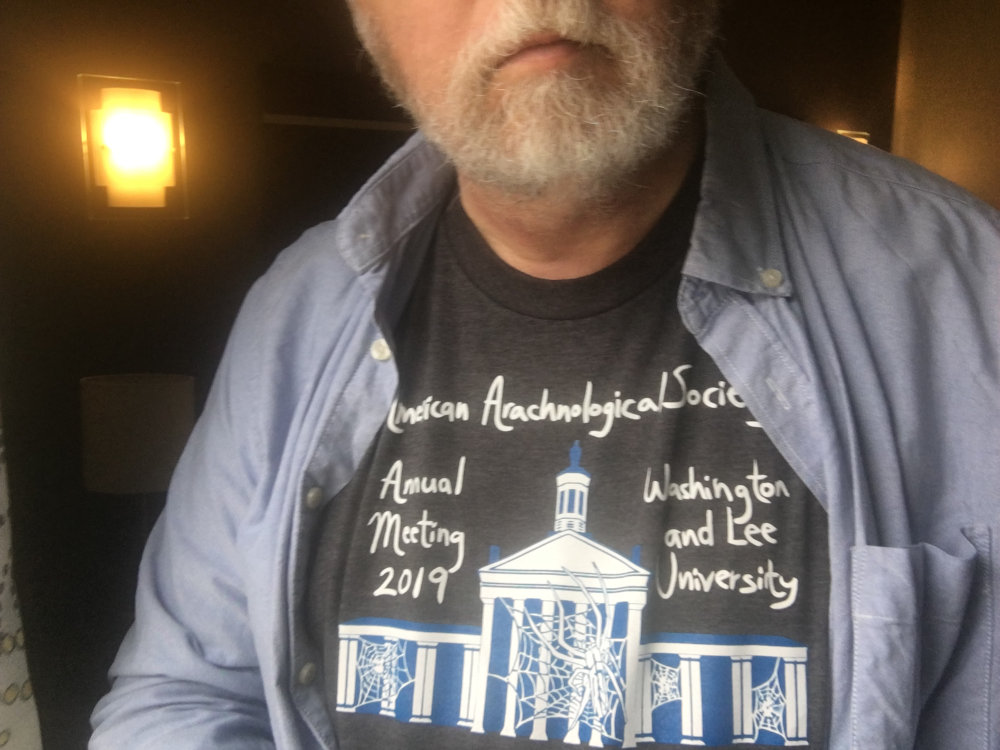
I’m out here at Washington and Lee University to attend the American Arachnological Society 2019 meeting, and the sessions start in a few hours. It’s going to be intense: the sessions today are on functional morphology, morphological evolution (the session I most look forward to), molecular phylogenetics and systematics, and circadian rhythms. Damn, I’m interested in them all. My brain is going to be running hot all day long, so it’s a good thing the program culminates in a trip to a brewery to cool it back down.

There are no zebrafish talks to give me a retreat to the familiar, so it’s going to be a challenging day.

Oh, also, I met another first-timer here at AAS, and learned she has a blog called Spidermentor — it’s very good. It’s full of stories about collecting and raising and observing spiders in Western Pennsylvania, and is first-rate science communication. Check it out while I’m getting a high-speed cerebral infusion today.