The magical world of epigenetics

epigenome

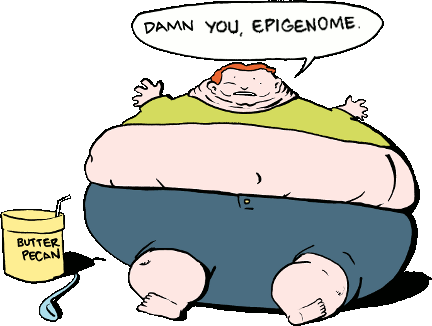
Let me tell you the hard part about writing about epigenetics: most of your audience has no idea what you’re talking about, but is pretty sure that they can use it, whatever it is, to justify every bit of folk wisdom/nonsensical assumption that they have. So while you’re explaining how it’s a very real and important biological process that is essential for development and learning and behavior, half your readers are using the biology to confirm their biases about evolution and inheritance, and the other half already know all the basic stuff and want to get to the Evisceration of the Wrong, which is always the fun part anyway.

So I’ve split this post in two: there’s a section on the basics of what epigenetics is, and there’s a section on what epigenetics is not, and why. Read whatever part floats your boat.

[Read more…]

Suddenly, I have a favorite fungus

It’s beautiful: the devil’s fingers, AKA the octopus fungus. Even just the name is like a barbed hook calculated to draw me in.

devilsfingers

It has other interesting features, besides the awesome appearance.

While unappealing to us humans,

Stop right there. Am I not human? Did I not coo in delight when I first saw this lovely organism? Do I not want to see my grassy yard replaced with thousands of erupting fungal eggs?

But do continue.

what you’re seeing is actually a rather ingenious method of reproduction. The tentacles are laced with a foul smelling tissue, specially formulated to attract flies and other insects. When bugs come-a-knockin’, they get to feed on the slimy substance, but not before their feet are coated with fungus’ spores.

See? What’s unappealing about all that?

Constructive pessimism

I approve of Kim Stanley Robinson’s message: interstellar travel, and interstellar colonization, are almost certainly impossible. He breaks the obstacles down into 5 categories, physical, biological, ecological, sociological, and psychological (wait, since when is ecology not biological?) and explains how unlikely we are to overcome them. We’re part of Planet Earth, and nowhere else.

This may sound like terrible news to people weaned on Star Trek and Star Wars, but I prefer to think that closing off the fantasy alternatives helps us focus on the realistic ones.

Oh no! For some people this is a disturbing and deeply pessimistic conclusion to come to. Then when you combine that new judgment with the recently discovered problems concerning the plan to terraform and inhabit Mars (presence of perchlorates and absence of nitrogen), and we come to an entirely new realization about our species: there is no Planet B.

Earth is our only home.

Oh no again!

This conclusion, startling to some, obvious to others, has ramifications that are worth pondering. If it comes to be a generally agreed on view, it might change how we act as individuals and a civilization. These changes in behavior might turn out to be crucial for our descendants. So although this entire discussion consists of speculations about hypothetical futures, which is to say, science fictions, still they are worth thinking about, as useful orientations in our sense of our own history as a species.

I like that. It’s not a bad thing to take a sober look at what we’ve got (which is a pretty danged sweet planet) and maintain and enrich it, rather than neglecting it for a dream of building a hermetically sealed dome on a hostile planet far, far away.

Something else I like: Robinson has just written a novel about…humans colonizing a planet around Tau Ceti, titled Aurora. He doesn’t condemn the genre, which is good, since I like reading space opera of various sorts, but is asking us to recognize that it’s no more realistic than fairy stories. Which are also fun.

I think I evolved and am hardwired to bang my head against the wall when I read this stuff

Did you know that women might have been driven by evolution to be “bitchy”, that is, aggressive, competitive, and insulting towards other women? An article in The Atlantic presents a couple of evo-psych studies — the usual stuff, Western college students given culturally specific choices, and then makes absurd universal conclusions about human nature and evolution. I hated it.

But at least, buried in the middle of the article, are a couple of paragraphs that state the rational response to the succession of maddening EP bullshit.

[Read more…]

Why did it have to be physics?

Tom Levenson has a new book, The Hunt for Vulcan:…And How Albert Einstein Destroyed a Planet, Discovered Relativity, and Deciphered the Universe, and it’s getting interesting and positive reviews. I’ve also got two flights coming up at the end of this week, so I need something tasty to read.

But it’s physics. There are a heck of a lot of good physics books coming out all the time — one of my colleagues here at UMM, Chrissy Kolaya, also has a new book, Charmed Particles: A Novel, also about physics, wouldn’t you know it. I’ll have to read both, I think.

But people! Don’t you know that developmental biology is the most interesting subject in the universe?