Friday Cephalopod: quite possibly non-Euclidean

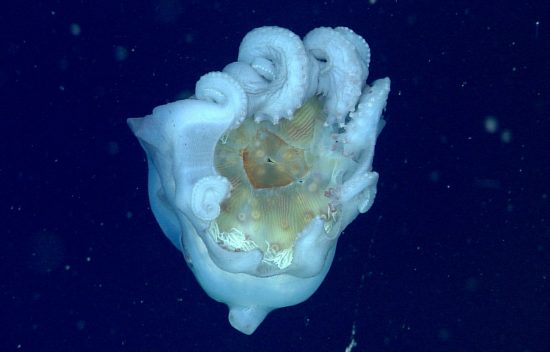
You might be tempted to stare deeply into this image, trying to puzzle out what it is you’re looking at, but that’s how they get you.

That’s Haliphron, the 7-armed octopus, holding a jellyfish it’s been nibbling on. Now that I’ve told you, I hope that has broken the spell, and you’ll be able to escape. If not, well, a cephalopod has got to eat, and it’s next victim will by baffled by the way those twisting arms surround your face.

Look who’s moving into our yard!

Cicada-killers!

Yes, please, make yourself right at home. Do you have more family you can invite over? August is coming soon, and it’ll be time for a feast. Please do. Kill all those wretched noisy shrill shrieking beasts and dismember their bodies and chew on their guts, thank you very much.

Spirals. It’s always spirals.

Whoa. This is a siphonophore colony, 15 meters in diameter, just floating in the ocean with tentacles dangling down to catch prey.

I read the whole thread and didn’t see an answer to the question that immediately popped into my head. This is a colonial aggregate of multiple siphonophore bodies linked together into a long string, but it has an overall form of a spiral. How? Is there local signaling going on to regulate the distance between the strands so that it spontaneously forms that structure, or is it an accident of currents? I’m going to guess the former, which would be most interesting, because it implies the existence of factors that lead to large scale form and is therefore the kind of process that would lead to more elaborate patterns of development.

Also, it’s so planar. Is this something the animal regulates, or is it just layers in the ocean maintaining it?