This story was making the rounds last week, about a study that had found that women who are creeped out by bugs are less likely to be attracted to men with beards.
According to a new study, if a woman runs screaming from hair-dwelling creatures such as lice, ticks, fleas and the like, she’s likely to find men with beards much less attractive.
It’s on an unconscious level, of course. But from the viewpoint of her inner animal brain, who wants to pucker up to a mouth fringed by a thicket of hair that might contain tiny, squirmy, maggot-like creatures?
I’m taking this personally, as a bearded man with a fondness for creepy crawlies. For the record, my beard is respectably groomed and does not contain any squirmy maggots, and I find the implication offensive and unfounded. Do we go around suggesting that women grow their hair longer than men (usually) in order to provide a nesting ground for ticks and lice, or do we consider tastefully coiffed hair to be an attractive feature? Why assume that beards or any other hair repulsive?
So I read the paper, A multivariate analysis of women’s mating strategies and sexual selection on men’s facial morphology, by Tessa R. Clarkson, Morgan J. Sidari, Rosanna Sains, Meredith Alexander, Melissa Harrison, Valeriya Mefodeva, Samuel Pearson, Anthony J. Lee and Barnaby J. W. Dixson. I was even less impressed. In particular, they are trying to associate a phenomenological study of women’s reports of their preferences of a set of photographs with an evolutionary effect of sexual selection, which is a rather long reach. We know that fashions in hair styles vary wildly with time and location with a rapidity that cannot be associated with reproduction — shall we look at big hair styles from the 1980s and draw inferences about paleolithic mating preferences? Beards go in and out of fashion all the time, so a sample taken in 2019 of Western women’s taste in North European male faces (yes, they explicitly used only faces of a small ethnic subset) is only a snapshot of a narrow cultural preference in a tiny slice of time that cannot be interpreted as a significant biological factor.
Here’s the abstract.
The strength and direction of sexual selection via female choice on masculine facial traits in men is a paradox in human mate choice research. While masculinity may communicate benefits to women and offspring directly (i.e. resources) or indirectly (i.e. health), masculine men may be costly as long-term partners owing to lower paternal investment. Mating strategy theory suggests women’s preferences for masculine traits are strongest when the costs associated with masculinity are reduced. This study takes a multivariate approach to testing whether women’s mate preferences are context-dependent. Women (n = 919) rated attractiveness when considering long-term and short-term relationships for male faces varying in beardedness (clean-shaven and full beards) and facial masculinity (30% and 60% feminized, unmanipulated, 30% and 60% masculinized). Participants then completed scales measuring pathogen, sexual and moral disgust, disgust towards ectoparasites, reproductive ambition, self-perceived mate value and the facial hair in partners and fathers. In contrast to past research, we found no associations between pathogen disgust, self-perceived mate value or reproductive ambition and facial masculinity preferences. However, we found a significant positive association between moral disgust and preferences for masculine faces and bearded faces. Preferences for beards were lower among women with higher ectoparasite disgust, providing evidence for ectoparasite avoidance hypothesis. However, women reporting higher pathogen disgust gave higher attractiveness ratings for bearded faces than women reporting lower pathogen disgust, providing support for parasite-stress theories of sexual selection and mate choice. Preferences for beards were also highest among single and married women with the strongest reproductive ambition. Overall, our results reflect mixed associations between individual differences in mating strategies and women’s mate preferences for masculine facial traits.
Among the flaws are the aforementioned narrow set of sample images — sorry, you’re not going to get to choose whether you’d like a one-night stand with Idris Elba vs. a long-term relationship with Hugh Grant — but also, the study was executed using Amazon’s Mechanical Turk, which is going create unanalyzed biases in the respondent population. It also apparently created a far more diverse respondent population than was represented in the target images, so who knows what effect that had.
And really, the game they played was a variation on “shag, marry, kill”: would you have a quickie relationship with this face? Would you like to live with this face for months and months? Is this face totally unattractive to you? It’s the most superficial analysis possible. How many of you chose your mate because of their appearance, and nothing else, and prioritized conventional attractiveness over all other attributes? This is a meaningless study. You can’t say anything about human evolution with a study that reduces a complicated process, courtship behavior and reproduction in humans, to such a trivial scope.
Yeah, sure, you can talk all you want about Tinder and swiping left or swiping right, but that’s about transient relationships and not long-term investment in offspring.
Anyway, you want the results? Here you go.

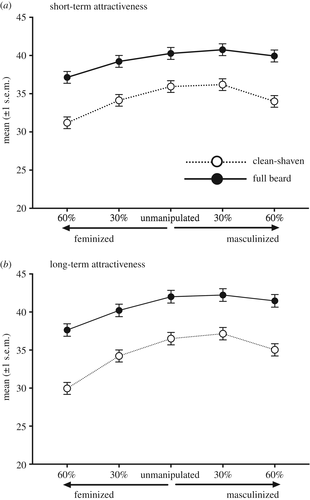
Mean ratings (±1 s.e.m.) for attractiveness when judging short-term (a) and long-term (b) relationships for bearded (black circles) and clean-shaven (white circles). The composites were manipulated to appear 60% and 30% feminized, unmanipulated, and 30% and 60% masculinized. Note that the full rating scale ranges from 0 to 100.
Oh, wait, maybe the study isn’t so bad, since it found that bearded men are generally preferable to clean-shaven men, both for long term and short term relationships, clearly the correct result. Also women prefer the unmodified or slightly masculinized photographs, so men — be yourself, or use just a little subtle makeup.
But no…you know this result is going to vary across time and cultures. Wait a decade, and those results could flip.
This leads into the next part of the paper, which is to look at how the results vary with women’s phobias about disease and parasites and sex and morality. They even suggest a hypothesis: “The ectoparasite avoidance hypothesis proposes that ancestral humans underwent additional loss of body hair as it lessened the potential for disease-carrying ectoparasites to proliferate.” But they can’t test this hypothesis! These data are so ephemeral that you can’t use them to describe human behavior during the long period of our evolution, and further, I’d argue that it doesn’t even hold up, given that a) we don’t know much about the timing of hair loss in the human lineage, and b) they’re examining a persistent phenomenon, male facial hair. If there was selection to get rid of beards full of squirmy maggots, how come we still have them? The beards, that is, not the squirmy maggots. I’d also ask what’s special about humans, since most mammals are covered with hair; are chimpanzees uninterested in selecting mates lacking in parasites?
The authors administered a test to measure respondents attitudes about 4 dimensions of disgust and then correlated that with their measures of attractiveness. The idea was that if a woman was particularly repulsed by the sight of arthropods (“ectoparasite disgust”), then they ought to rate men with beards as less attractive, because who knows what might be lurking in that thatch?
That was sort of the result they got, that excited the popular press the most.

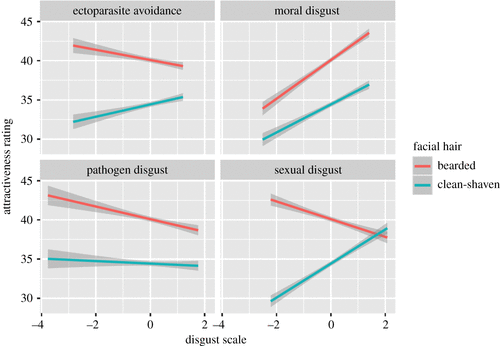
The associations between women’s ectoparasite, moral, pathogen and sexual disgust and their attractiveness ratings for male beardedness when judging bearded faces (red line) and clean-shaven faces (green line). Data show regression lines (±95% confidence interval). Note that the full rating scale ranges from 0 to 100.
Look at the ectoparasite avoidance and pathogen disgust graphs on the left. The attractiveness of bearded men did decline as the women subjects exhibited increasing queasiness about parasites…but I also notice that no matter how sensitive the women were, they still (on average) found bearded men more attractive than cleanshaven men. Which I interpret to mean that if I cultivated spiders in my beard, I might be slightly less attractive to more women, but I’d still be prettier than the beardless boys. I don’t see how it provides evidence that beardlessness has a selective advantage; I take it to mean that the forces behind the growth of male facial hair are more complex and diverse than can be accounted for by one simplistic hypothesis.
The moral disgust graph is complicated. Increasing moral disgust means the respondent attaches more importance to upright behavior, that they are repulsed by criminality, for instance. Those women find both bearded and clean-shaven men more attractive, and that may be a consequence of, for instance, avoiding homosexuality, to speculate a bit. Every man looks prettier when you’re afraid of falling for the wrong sex.
The sexual disgust scale is the only one that shows a preference for clean-shaven men over bearded ones at the extreme end. Sexual disgust is a measure of the importance of sexual propriety (no incest, for example) and also of the desirability of an individual for reproduction — again to speculate, maybe beards are a way of concealing biological defects, so they are less attractive.
Finally, though, these measures of attractiveness are so deeply subject to trends and fashions and wildly varying personal taste that they cannot be used to test hypotheses of human evolution. This would have been a better paper if they’d avoided making the unwarranted claims of deep biological meaningfulness…but then, it wouldn’t have been picked up by the tabloids and news agencies, now would it?