All you have to know about the Limbaugh affair

Just go read The Rude Pundit. He’s got Limbaugh pegged. He also has a somewhat realistic prediction for the aftermath.

And thus Limbaugh will go on, damaged, but unbowed. He’s now tainted, but you can bet that all of his listeners see him as the victim here and that, six months, a year from now, nearly all of those sponsors will be back. But maybe, just maybe, he will be poisonous enough to be nothing more than a deranged cult leader, a deaf and dumb and dying dinosaur in the tar pit of his fading career.

The Rude Pundit being optimistic? Wow. I don’t think the poison will daunt his fans — they wallow in that stuff.

I am so glad I’m a science professor

I assign a fair bit of writing in my courses, but because it’s all about biology, the papers I get back might be full of cryptic words like mek and src and neoplasia, but they tend to have a straightforward narrative and avoid ambiguity…and since I’m at a good liberal arts college, most of the students are competent writers. But then every once in a while I get a glimpse from my colleagues of the world outside my mechanistic and straightforward world, and I feel a small thrill of horror. You should read the whole student essay, but here’s the concluding paragraph.

Because knowing what it knows now, it will never know peace. It will only know humiliation. For there are no limits on the number of Grade Change forms I can request, or if there are, I plan to collect them like an ignorant naturalist on a well-trodden shore and submit them in perpetuity.

Yeesh. The tortured syntax, the ambiguous referents, the vague threat of drowning the poor victim in paperwork…I do not want to live in that universe.

But still, this one is still the all-time champion worst.

“IT BELONGS IN A MUSEUM!”

There isn’t that much difference between a trained archaeologist and a professional wrestler, is there? Look at the new depradations encouraged by reality TV:

There’s nothing more exciting than digging for treasure, and that’s just what SPIKE TV’s new unscripted original series, American Digger is going to do when it premiers on March 20 at 10/9c. Former professional wrestler Ric Savage and the American Savage team have the tools, knowhow, and instincts, and are ready to show everyone what could just be hidden beneath your backyard if you give them the chance.

American Digger will showcase Ric Savage and his crew trekking across the country each week, from Chicago, IL to Jamestown, VA and everywhere in between. Once the team identifies an area they think is ripe with high-value artifacts and relics, they’ll have to convince the current homeowner to give them permission to dig up their backyard. If American Savage is persuasive enough, they’ll get a chance to dig up the tenant’s backyard using their state-of-the-art equipment, and divide the cash they get from selling the artifacts they find there with the tenant.

Savage and his crew definitely have an eye for artifact-rich areas, and will seek out historic sites as a result. These areas are home to great finds, as the team uncovers old relics in the show such as a 5 million year old Megalodon shark’s tooth. American Savage is the top artifact recovery company in the United States and is made up of Ric Savage’s wife Rita, who manages the business, battlefield historian Bob Buttafuso, recovery expert Rue Shumate, and Giuseppe, his 25-year old son.

Shark’s teeth aren’t a big deal, but having a team of hacks charge into a historical site to dig up and sell everything they find sounds like a horror story.

Family matters and cheesy insinuations

What do you know? Richard Dawkins and I have something in common.

In a particularly slimy move, the Telegraph has posted an article that tries to tar Dawkins with the sin of slavery. Not that Richard Dawkins himself has slaves or endorses slavery, but that he had an 18th century ancestor who had a Jamaican estate with over a thousand slaves. The reporter also made the ludicrous suggestion that slave-holding was genetic.

I’d scarcely had time to re-open my lecture notes when he rang back: “Darwinian natural selection has a lot to do with genes, do you agree?” Of course I agreed. “Well, some people might suggest that you could have inherited a gene for supporting slavery from Henry Dawkins.”

So now there’s a slavery gene? That is quite possibly the dumbest assertion I’ve heard in a whole week…and I read creationist websites. As Dawkins points out, he had 512 direct ancestors in that same generation, and that he has a number of ministers in his lineage. Not only is it ridiculous to invent a slavery gene, but it’s a selective absurdity to cherry-pick members of a large population of remote relatives and claim that an individual is responsible for everything every ancestor did. That’s a rather biblical position to take, I think.

So what do we have in common? I poked around a bit in the genealogical records and found this: a piece of the 1820 US census.

It’s not easy to read, but that’s a bit of the records for St Stevens Parish, King William, Virginia. I’ve mentioned before that I’m Scandinavian on my mother’s side, but on my father’s side, I’m English/Irish/Scots and an undefined mingling of who-knows-what, including a bit of Dutch, and they’ve been skulking around North America since somewhere in the 17th or 18th century, and some of them were even Southerners. My great-great-great-great-grandfather, Garland Hurt (1764-1839) was a Virginian married to Martisha Thurston (1768-1818), who had 3 sons and 3 daughters…and also 1 female slave under 14, and 1 female slave between 14 and 25.

Oh no! Do I carry the slave-master gene?

I suppose if I were interested and extremely ambitious (sorry, I’m not), I could trace all of Garland Hurt’s descendants forward, and then we’d find not only that some of you readers might be related to me. I suspect that some of the people who utterly despise me (if they even know of me) are distant cousins. We’re different from each other and from our ancestors.

My family is a bit down-class compared to those fancy-pants Dawkinses, but as you can see, it’s easy to find slave-owners for any of us among the swarms of ancestors we all have, just by going back far enough. I also have at least one ancestor who fought on the Union side (an Iowan who fought with Grant in the Mississippi campaign) in the Civil War. I deplore the slave-owner, but I don’t own his guilt, nor do I get to take credit for the great-great-grandfather who was mustered out in New Orleans. We’re all a great gemisch of subsets of genes from a bounded population. It’s simply silly to start parsing out characteristics from individuals in a complex cloud from the ancestral gene pool and arbitrarily assigning them to single contemporaries. The writer of that article, Adam Lusher, is an idiot…and the Telegraph ought to be embarrassed at publishing such tripe.

Segregation lives!

The Dallas Independent School District spent $57,000 to send students on a field trip, which sounds like a lot, but given that 5700 kids went on it, it isn’t that bad, and is a fairly routine expenditure. So the story is OK so far.

They went to see a movie, Red Tails, as part of Black History Month. Now it’s getting a little sketchy: that’s a commercial, Hollywood piece of entertainment, and a new release. But OK, I’d let it slide as an opportunity to couple history with an entertaining story. (If it had been for English and a chance to learn about the language from George Lucas’s dialog, though, there would be hell to pay.)

Here’s where it goes really, really wrong: only boys were allowed to go on the trip, and girls had to stay behind under the supervision of substitute teachers.

Their excuse: “it was something the boys would be interested in because it was about African-American men” and:

“There is only so much available space at the movie theater, so the decision was made for boys to attend the movie. Girls stayed at school but principals were given the option to show them ‘Akeelah and the Bee.’”

The girls’ movie is an uplifting story about a girl going to a spelling bee. The boys’ movie is a big-budget sfx-fest with explosions and airplanes. The girls’ movie was an inexpensive afterthought shown in their classrooms. The boys’ movie involved an expensive field trip.

Oh, yeah, that sounds like an equal opportunity for both.

The Grammy Awards will be televised tonight

Do not watch them. Do something else. The Walking Dead season premieres tonight, and that stuff is going to be showing all day. You could read a good book. You could put on some good music and dance in your living room.

However, the Grammy Award organizers are apologizers for abuse. In fact, it sounds like the whole entertainment industry will look the other way when a thug like Chris Brown will batter a woman.

So I’m sure you could find something better to do.

Our illness is their profit

Have you ever walked around an 19th century (or earlier) graveyard? It gives you a depressing snapshot of the old reality: so many young women dead in childbirth, so many children reaped by diseases. We’ve been fortunate, we residents of the late 20th and early 21st centuries, that so many of those lethal conditions are treatable, and we’re mostly able to live without fear of our children dying in our arms. But here in the United States, we may have been living in a brief window of time in which treatments are both available and affordable, and are moving into an era where they’re available, but only the lucky top few percent are actually available to take advantage them.

I’m one of those lucky ones: I’ve got a good secure job with adequate health insurance. I had my own little health scare a year and a half ago, and I obediently marched into the hospital for a full battery of the most up-to-date treatments, and I walked back out with almost all of the expenses fully covered by my insurance. I could even urge everyone to get checked out at the slightest twinge. But this isn’t true for everyone.

Take, for example, Kevin Zelnio: a smart guy with an advanced degree, working as a writer and scientist-at-large, relatively young and healthy, with a young family — and he’s uninsured, like almost 50 million Americans. When they get a cough or a nagging ache, they can’t just go to the doctor to get it checked out, to prevent something more severe developing. Even the most basic and most essential of preventive medicine is prohibitively expensive.

When I started my family 6 years ago, I was on a path to a career in research and teaching. We had amazing health insurance through my institution and my wife and children-to-be were generously covered, no-questions-asked by the state of Pennsylvania during, and a year after, the pregnancies. We never saw a bill. After I got “real jobs” upon completing my Masters degree, I entered a grey zone of contract teaching and research employment at universities. With a decent, regular salary we were ineligible for state aid, yet didn’t make enough to afford extra costs. Furthermore, the quality of the insurance kept lowering until I wasn’t even sure what I was paying for – even as the premium costs were rising.

It reached rock bottom last Spring when we attempted to actually use our insurance that I bought for $1400 every six months while a contract lecturer and beginning PhD student at a North Carolinian university. My boy was starting Kindergarten and needed to be current on his vaccines. Of course, both kids needed to be current, so we took them in one-by-one, got their shots and check-ups, handed over the insurance information, paid our co-pay and went on our way. Never thinking about it, assuming that insurance would do the job we paid them to do.

Exactly 6 months later we received bills, after I no longer had insurance (I had to leave my phd for variety of reasons), and addressed to our kids’ names and not mine, the policy holder, for substantial amounts. Apparently, my daughter owed over $400 and my son owed over $1600 to the doctor office, which was the net left over after the insurance contributed about $200 for each visit.

The Zelnios are paying more for simple vaccinations and check-ups than I had to personally cough up for a week of cardiac care and surgery in a hospital. That is a deep injustice. That is wrong. That shouldn’t be happening in what we arrogantly call the richest country on earth, but it is. And you don’t get to claim that people in these situations “deserve” it.

Most of the uninsured in this country aren’t lazy, freeloading hobos who don’t wanna work. They span a wide variety of demographics. As a 30 something, white male with advanced college degree who works full time as a self-employed consultant and writer are you surprised that I cannot afford health insurance for my family? In fact, the majority of uninsured are in my age range and are full or part time workers earning incomes above 100% the federal poverty level. The fact of the matter for many of the uninsured is that employment-sponsored coverage has been in decline due to the escalating costs of health care. Employers can’t remain competitive and pay double the costs they were paying a decade ago for insuring their workers.

The uninsured are locked out of basic health maintenance: now imagine a crisis, a life-threatening illness striking one of your kids. The Zelnios don’t have to imagine, it happened; read the whole thing.

This is madness. All this country has is this paltry compromise called Obamacare, which doesn’t even touch the fundamental problems of our rapacious insurance industry and complacent medical system, and the Republicans want to revoke even that. The people who are the heart of this country are driven into bankruptcy while the people who are little more than parasitic tumors, the obscenely wealthy, flourish. That is not a formula for survival.

(Also on Sb)

What are colleges good for then?

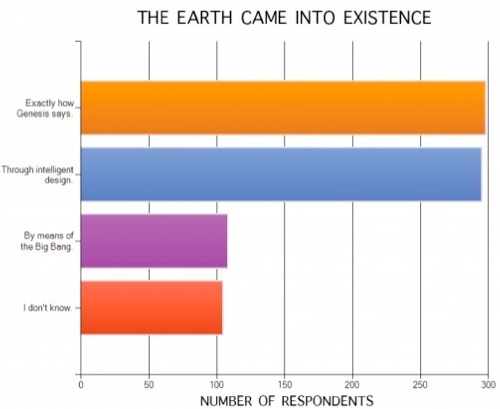
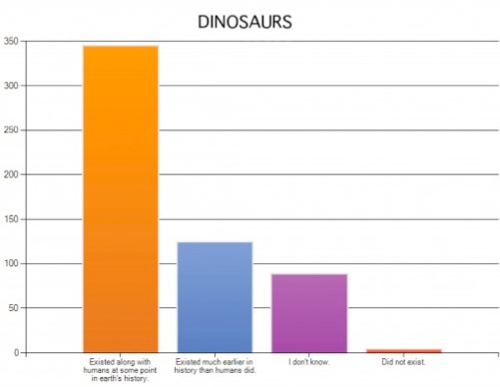
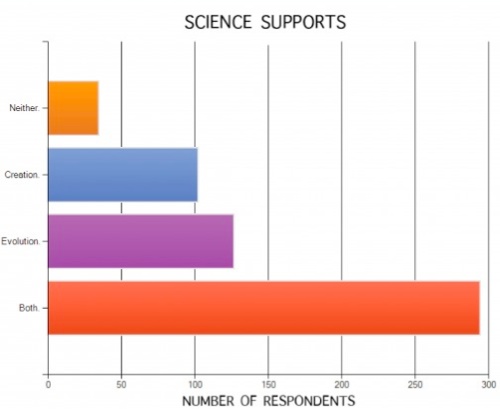
I wish I’d had these data yesterday. I gave a creationist-bashing talk, and my introductory slides were intended to show the generally deplorable state of science education in this country. I used some national data, but what would have been more dramatic would have been to use something local and even more extreme. Walla Walla University, a Seventh Day Adventist college, did a survey of student views on origins. There is lots and lots of data in chart form on that page, and all of it is depressing and disgraceful.

Perhaps you wonder how many students think a magic man in the sky did it:

Or how many students stopped learning about science when they stopped watching the Flintstones:

Or whether these devout kids find the clergy sufficient, or have deluded themselves into believing their wacky ideas are supported by science?

I thought about raging about how WWU wasn’t doing their job as a university (but clearly, they’re doing great as a church), but then I was stopped short — what would a similar survey at other American colleges look like? What does the student body at my university think? I dread finding out.

But I want to find out. Hey, student freethought groups out there, here’s a project suggestion for you all: do a similar survey. Put together a questionnaire, table at your student union and gather respondents, and post the results somewhere. The reward is that you’ll almost certainly make your science professors cry.

Making excuses

The editor of Life, Shu-Kun Lin, has published a rationalization for his shoddy journal.

Life (ISSN 2075-1729, http://www.mdpi.com/journal/life/) is a new journal that deals with new and sometime difficult interdisciplinary matters. Consequently, the journal will occasionally be presented with submitted articles that are controversial and/or outside conventional scientific views. Some papers recently accepted for publication in Life have attracted significant attention. Moreover, members of the Editorial Board have objected to these papers; some have resigned, and others have questioned the scientific validity of the contributions. In response I want to first state some basic facts regarding all publications in this journal. All papers are peer-reviewed, although it is often difficult to obtain expert reviewers for some of the interdisciplinary topics covered by this journal. I feel obliged to stress that although we will strive to guarantee the scientific standard of the papers published in this journal, all the responsibility for the ideas contained in the published articles rests entirely on their authors. Discussions on previously published articles are welcome and I hope that, by fostering discussion and by keeping an open-minded attitude towards new ideas, the journal will spur progress in this little explored, difficult and very exciting area of knowledge.

In particular, the paper “Andrulis, E.D. Theory of the Origin, Evolution, and Nature of Life. Life 2012, 2, 1-105” was published recently online and is due to appear in Issue 1, Volume 2, 2012 of Life, at the end of March this year [1]. So that our readership has as much information as I can divulge without violating the confidentiality of the review process, what follows is the background of these events. Professor Bassez had previously guest-edited a successful special issue titled “The Origin of Life” in another MDPI journal [2]. Although Professor Bassez [3] had also planned to be the Guest Editor of the special issue “Origin of Life – Feature Papers” for Life [4], she was, for personal reasons, unable to do so. I therefore volunteered to take this responsibility on her behalf and to guest edit this special issue and supervise the editorial procedure for the papers. I made the decision of acceptance based on the peer review reports we received and their recommendation in support of publication.
As stated earlier, finding reviewers able to cross discipline boundaries as is often needed for multidisciplinary “origin of life” topics [5] is particularly difficult. The publishing process that MDPI manuscripts go through by our in-house editorial staff members is that they choose reviewers from sources like Chemical Abstracts, PubMed, Web of Science or more recently, from Google Scholar. Very often we also ask the Editorial Board members to review papers or ask those of them who have relevant knowledge and expertise to supply possible reviewer names. We also use the reviewer names suggested by the authors, but we do this with great care, checking the background of each potential reviewer and their publication record, as well as ensuring they have no collaborations with the authors that may be construed as a conflict of interest. I should stress that although we try to encourage bold, innovative science, we reject many submissions. In the case of the Dr. Andrulis’s long paper, the two reviewers were both faculty members of reputable universities different than the author’s and both went to considerable trouble presenting lengthy review reports. Dr. Andrulis revised his manuscript as requested, and the paper was subsequently published.

Regardless of opinion on specific papers that have been published to date, I sincerely hope that all of our articles, most of which are outstanding, will continue to be read and discussed. Our editorial procedure is under scrutiny by the Editorial Board, who wishes to be more closely involved in the editorial process, and we are striving to further improve our editorial service. We welcome comments on the Dr. Andrulis’s paper or any other papers that have been published in Life.

The “interdisciplinary” excuse is bogus. I am not a specialist in the fields discussed, but I could see immediately that Andrulis’s paper, and Abel’s paper as well, were “off” — to any critical, skeptical thinker their flaws are obvious. Are there any scientists in any field — general physics, biology, chemistry, psychology, for instance — who would read either of those papers and think maybe there’s something to them? You’d have to be a fellow crackpot or somebody completely unqualified to evaluate any science papers to fail to see the problems in them.

Also, you don’t need someone with great interdisciplinary knowledge to be able to screen out this kind of nonsense. I’m reminded of the comment I read on the Velikovsky affair: someone (it might have been Sagan) noted that the astronomers could see that Velikovsky’s cosmic billiard game was bad physics, but gosh, his biblical scholarship sure was impressive; while the Bible scholars were all saying his mythology was all terrible literary scholarship, but golly, he sure seemed to know a lot of physics. Evaluating interdisciplinary work does not mean you cherry pick the most favorable interpretations from those most ignorant of a specific subfield, nor does it mean you split the difference and average the opinions of the subfields together. If one part of the mix is bullshit, you throw out the whole thing.

The fact that they’re having trouble finding qualified reviewers for the work they’re publishing is also ominous. Shouldn’t the editorial board consist of people who are competent in this interdisciplinary field who can screen out the wackier submissions? And shouldn’t it be setting off alarm bells when they accept suggestions of reviewers from authors, and those are the only people they can get reviews from? It’s a situation ripe for selection by crackpots of crackpot reviewers; you just know that the Abel paper was reviewed by fellow travelers in the Intelligent Design creationism movement, and got no critical evaluation at all.

Given the spectacularly poor quality of the Andrulis and Abel papers, though, I am most amused by the claim that the editors and reviewers of Life “reject many submissions”. I would love to see the papers that they judged worse than Andrulis’s and Abel’s.

(Also on Sb)


OwlMirror found the quote in Sagan’s Broca’s Brain.

Velikovsky has called attention to a wide range of stories and legends, held by diverse peoples, separated by great distances, which stories show remarkable similarities and concordances. I am not expert in the cultures or languages of any of these peoples, but I find the concatenation of legends Velikovsky has accumulated stunning. It is true that some experts in these cultures are less impressed. I can remember vividly discussing Worlds in Collision with a distinguished professor of Semitics at a leading university. He said something like “The Assyriology, Egyptology, Biblical scholarship and all of that Talmudic and Midrashic pilpul is, of course, nonsense; but I was impressed by the astronomy.” I had rather the opposite view.