No, no, no…not philosophers too!

You’d think if there was any area of human endeavor that was least likely to be full of absurd sexual drama and thoughtless harassment, it would be philosophy. Don’t those people sit around thinking ponderously about ethics and moral behavior and living the life of the mind all the time?* But no, it’s all booze and animal lusts for them, too, just like the rest of us.

The crux of this story is that Colin McGinn, a very well known philosopher, was sliming one of his own graduate students with salacious email (pdf), making remarks about masturbating while thinking about her, etc. McGinn’s own defense does him no favors; and now he’s claiming that women support him in email, because they’re so much more sensitive than men. Advances towards a student are simply unacceptable, no matter how much McGinn wants to pretend it was simply friendly banter. McGinn’s own defenders aren’t helping, either.

Professor Erwin goes on:

“There was some sexual talk, banter, puns, and jokes made between the two,”  Mr. Erwin said. “The written records, I believe, show that this was an entirely consensual relationship.” 

No, no. That is not how it works. It is remarkable how profoundly this misunderstands the student/professor relationship. A professor’s relationships with his or her students are not “entirely consensual” like that. Student/professor relationships inherently have a highly unequal balance of power. That includes students in one’s undergraduate and graduate classes, obviously, but it also includes teaching- and research assistants; academic advisees; people whose thesis or dissertation committees one sits on; exam proctors; everyone. Everyone. Anything a student says or writes to a professor has to be seen in that light. Suppose the professor engages in sexual banter and the student banters back. Maybe that’s because she consented and wanted to banter, but maybe it’s because the power differential inherent in the relationship placed her in a position of duress, in which she felt like she had to banter or face unpleasant consequences. If the return banter was performed unwillingly or under duress, there is no reason to think that the written records will reveal it.

But wait, that isn’t the worst of it. On blogs and on twitter, all over the place, bad philosophy is being done.

I take it as a mark of how deeply messed up the moral compass of professional philosophy is that there are commenters at some of the blogs linked above who seem willing to go to the mat to argue that there may be conditions in which it is acceptable to email your RA you that were thinking about her during your hand-job. Because personal interactions are hard, y’all! And power-gradients in graduate programs that are at once educational environments and workplaces are really very insignificant compared to what the flesh wants! Or something.

Read some of the dumbest things clueless people are uttering in McGinn’s defense.

OK, the communities of atheists, science-fiction writers, gamers, scholars of literature, skepticism, politics, and philosophers are rife with sexist scumbags. Is there any small part of the human community that is untainted? Do I need to start hanging out with polyamorous left-handed fly-tying hobbyists or something?


*The pdf linked above also cites something I did not know.

Complaints of sexist remarks and behavior have long plagued the field of philosophy, which has been dominated by men for years. More than 80 percent of full-time faculty members in philosophy are male, compared with just 60 percent for the professoriate as a whole, according to 2003 data compiled by the U.S. Education Department, the latest available.

Harvard’s shame

It seems Tauriq Moosa and I have a similar opinion of Oprah Winfrey — she’s a successful peddler of pseudoscientific nonsense. It’s too bad that Harvard doesn’t have the same ability to recognize a fraud when they see one, since they had Oprah disgrace their commencement ceremonies, and then gave her an honorary degree. In what, I don’t know; can you get a Ph.D. in dangerous foolishness at Harvard?

Carl Zimmer gets a lot of email

And a lot of it is students asking him to do their homework for them. I get this too, and I sympathize — but Zimmer goes straight to the teachers to ask them what they’re doing.

It’s great that you are looking for new ways for your students to do research and learn about science. But having them send emails to scientists and writers has failure stitched into its very concept. Writers are perpetually scrambling to meet deadlines and pitch new stories. Scientists have full plates as well, between their research, their eternal quest for the next grant, and their teaching. To answer a single email from a student–either in the form of a long list of questions or just an open-ended plea for help–takes a lot of time. We may respond to the first few emails we get, but as they keep pouring in, we tend to burn out. And the more popular this becomes as a pedagogical tool, the more emails students will be sending to scientists and writers. And that makes people burn out even faster. It doesn’t seem fair to the students for their grade to depend on whether they get a reply from their email. Even the most polite email may land in the inbox of someone who decided long ago never to respond to such requests.

And, frankly, we can’t help but wonder what good this exercise does. When we were young, it certainly was a thrill to get an email or a letter from someone we admired. A message like that can steer young people into a career and change their life. But the exchanges we get today are nothing of the sort. They are just requests for information. They’re sometimes courteous and they’re sometimes unintentionally rude. But it feels about as educational for the students as copying a Wikipedia page.

I sometimes get a ittle flood of emails all at once, and it’s clearly from a class that’s gotten an assignment like that. More often, though, it’s single students, acting on their own initiative, thinking they’ve got an angle to getting a difficult concept explained with little effort on their part.

But I also see it from the other side.

I see a lot of students who freak out when I give them an exam question that isn’t neatly summarized for them in a text book — who come to college not having the slightest clue how to synthesize information. They’re often really good at regurgitation and the kind of mechanical skills that get emphasized on standardized tests, but coming up with something new? That’s too hard.

I often get these complaints (and they also show up in my student evaluations):

“But the answer wasn’t in the textbook!”

“You didn’t tell us we’d have to know that!”

“I looked all over my lecture notes, and you didn’t talk about that!”

That’s right, I didn’t, and it wasn’t in there. Sometimes it was somewhere in the assigned readings, but I didn’t mention it; sometimes you have to integrate a couple of lines of evidence to come up with the answer; sometimes the answer isn’t known by anyone, and you have to come up with the best answer you can.

I second Zimmer’s concern. Teachers, your students don’t need to learn how to transcribe information, they need to master the skill of expressing new ideas. Encourage them to interpret science creatively and go out on a limb now and then — that’ll serve them better when they get deeper into science.

By the way, teachers, could you please also kill the 5-paragraph essay? I hate those things.

Uh-oh. Now Victor Stenger disagrees with me

I’m sticking by my guns, though. Stenger thinks that Eric Hedin, a professor at Ball State, should be fired have his classes cancelled for teaching Christian/creationist nonsense. I don’t.

While agreeing that the course is "bad science" and its material of "abysmal quality," in his April 25 Pharyngula popular blogger and biologist PZ Myers defended Hedin’s right to teach what he wants, citing academic freedom.

Laurence A. Moran, professor of biochemistry at the University of Toronto agreed with Myers in his blog Sandwalk appearing the same day. Moran said, "I defend the right of a tenured professor to teach whatever he/she believes to be true no matter how stupid it seems to the rest of us."

Well, Moran and Myers are wrong. Academic freedom does not imply that an instructor is free to teach material that is demonstrably false. Most campuses provide a "free-speech area" for that purpose.

I think treading on the content of a university-level course sets a dangerous precedent. If we’re going to start firing professors who teach things that are wrong, we’re all going to be vulnerable; there are things I taught 10 years ago that have since been found to be in error. Shall we encourage the right-wingers to start accumulating lecture notes and using every error and revised datum to instigate legal proceedings against professors they don’t like? Shall we inhibit discussion of material that’s controversial or on the very edge of science in our upper-level courses?

I should think we atheist professors should be on our guard against this. I don’t promote atheism in the classroom, but I do present a strictly natural/materialist understanding of biological processes; I advocate for a well-established scientific theory called evolution that a frighteningly large fraction of the general public have judged to be wrong. Do we seriously want our courses subject to review by some podunk Republican lawyer in our towns? Do we really want to open the door to having to think about our course material from the perspective of whether it’s considered actionable by the local priesthood?

Going after a course for its ideology is a terrible mistake. Bringing in outside lawyers to shape the curriculum of a discipline is a disaster.

Hedin ought to be dealt with internally, and not for being a Christian…but for being a bad teacher and colleague. He is not contributing to the education of the students in his class; if we had someone like that at my university, he’d be considered a massive problem who was disrupting the progression of our student’s education. And if the university refuses to deal with it, if the rot spreads, it should be publicized so that prospective students know they won’t get adequate instruction, and it should also be brought to the attention of accreditation agencies.

I want the evaluation of university faculty to be in the hands of our peers, not the local tea party chapter, the local council of churches, or for that matter, the local Democrats or atheist meetup. I’m really surprised that any professor would want their work opened up to criticism by a public that isn’t equipped to understand the topics, and welcomes circumventing peer review.


Scratch my opening comment: he doesn’t want him fired, just to have his class cancelled. That’s less disastrous, but again, that’s also still taking to legal measures to interfere with what should be an internal matter. I’m also not clear on what standing anyone other than a student in the class has to take legal action.

Let me repeat, too, that I’m not saying what Hedin is doing is OK: it’s godawful incompetent teaching and bad science. My concern is with how we take action against it.

Spare me this ‘deficit model’ nonsense

Maybe it’s something in the air: Spring brings out the sociological criticisms of science, or something. But for some reason, this week people have been talking at me about the “deficit model” repeatedly, and it is really beginning to annoy me. The latest source is Alice Bell in the Guardian, who says some sensible things (don’t treat scientists as a priesthood!) and then gets all mushy-mouthed over the myth of the deficit model. How nice of her, though, to define it for us.

It’s the critique of the so-called “deficit model” many of us have been dancing to for decades. The deficit model, if you’re lucky enough not to have come across the term, assumes science has the knowledge the public are deficient in, and that many of our social ills will be solved if we all listened to the experts. It’d be a nice idea maybe if science, the media, policy or people were that simple, but they’re not (I talked about similar issues in my Radio Four piece on scientific literacy last year).

Oh, no…it brings back cranky memories of those annoying rounds of argument with Mooney and Nisbet, who loved to slam us with sneering rebukes that we’re true believers in the Deficit Model, and don’t you know, everybody rejects that model nowadays.

And I’d just, what, say what, I what? I’m right here, why are you arguing with that caricature? Look, I’ve spent decades battling creationists, giving them the actual facts in the face of their distortions, and I know they heard me, and I know they’re not so stupid they couldn’t comprehend what I was saying, and yet they’ll be back the next week saying the same lies. I know that there’s more to getting people on the side of reason then calmly stating the evidence while equipped with a Ph.D. I don’t know anyone who subscribes to this “deficit model” of which you speak.

Here’s the model I actually accept; let’s call it the Obstacle Model. Everyone has a whole collection, to varying degrees, of obstacles that interfere with effective progress: for instance, there’s poverty, and racism, and sexism, and religion, and authoritarianism, and ignorance. Focusing on just one without paying any attention to the others means you won’t get very far. Every good educator knows that teaching is a multi-dimensional problem.

Correcting ignorance has a rather critical role to play in the solution. I think the other factors I listed are more important in giving people the will and capability to make decisions, but addressing an intellectual deficit is essential in giving them the power to decide how to decide; without it, you’ve got a blundering herd of enthusiastic incompetents.

But ignorance also has a special place because it’s the one thing teachers are commissioned to address, so if you’re interested in deprecating expertise, finding a straw man like the “deficit model” to set on fire is a handy tool to knock those scientists and educators down a peg. It’s also a useful bludgeon if you’re a sociologist and want to assert your authority over those puffed-up boffins (not that I think most sociologists have an inferiority complex, but some of the dumbest things ever said about science come out of the mouths of sociologists).

You want examples? Alice Bell continues by citing sociological analyses of the scientific establishment.

The deficit model sticks around partly because it feeds scientists’ social status, implicitly underlining their powerful position as people who get to define what counts as important, true, reliable knowledge. Stephen Hilgartner put it well back in 1990, saying such top down approaches implicitly provide the scientific establishment with the epistemological right to print money. Something we don’t appreciate enough though is that also serves the handmaidens of the deficit model – science communication professionals, less powerful scientists, many science “fans” – offering them some social status by association. Play into a game of hierarchies, and even if you don’t get to the top, you get to climb a bit. Pierre Bourdieu, in his classic sociology of the university campus, Homo Academicus, talks about the way students are happy to submit to the idea that they are inferior to senior academics because doing so earns them subsequent admittance to a distinguished club of graduates. I think we can see similar patterns at work in terms of the way academic ideas are shared outside of universities too.

O My Fellow Scientists, do you feel like you have the right to print money? Here we are in an occupation with relatively limited recompense — we tend to be solidly middle class, which is very nice, but not much more — and we had to spend much of our youth in training, which from a purely economic point of view, represented a tremendous loss in earning potential. Deferring getting an entry level job because you spent a decade in graduate school and post-doctoral positions isn’t sound financial sense. Are these critics even aware of how many scientists get thrown into the churn of the unending provisional appointments? Somehow, though, we always get this criticism from creationists and other outsiders that we’re in it for the big bucks, as if we’re investment bankers or oil company executives.

O My Fellow Scientists, do you feel like you have high social status? I certainly don’t. Scientists are not particularly well-regarded in the communities I live in, except among ourselves; I follow politics, and scientists certainly don’t play much of a role there. Except when they’re trying to fill knowledge deficits (which is constantly trivialized by these critics of the deficit model), scientists are treated as awkward nerds with no social skills at all — the archetype we see flaunted on shows like The Big Bang Theory. You’re very confused if you think Sheldon is regarded as having high social status. He’s a pretentious clown.

O My Fellow Scientists, do you scorn your students and think of them as your inferiors? Maybe some do; I certainly don’t. I’m in this teaching position because I respect and enjoy the company of students. I identify with my students.

And here’s the thing: that hierarchy? Definitely a mixed bag. I remember being a student, and my professors were pretty much just like me, except with added obligations. Graduate school was wonderful — they had to order me to wrap up and get the thesis done. I tried to keep my post-docs going as long as I could stretch them out, because every step up the academic ladder meant less playing in the lab, more uncertainty (where am I going to get a job?), and more teaching and administrative responsibilities. If I had my druthers, I’d still be a grad student.

Even now, I’m dragging my heels about getting promoted to full professor, despite the nudges from my unit head. Promotion would mean a little more money (but I’m not in this job for the money!) and additional responsibilities in campus-wide governance. Why should I do that? Because I’m a good citizen of my university, not because I have some illusion that it will let me lord my superiority over others.

But OK, Bell does salvage the article in the end.

Less cynically, top down models also stick around because scientists do, genuinely, have special ideas and information to share. We pool our resources to allow a few people to cut themselves off and become experts in particular subjects. We do this so that they might feed back their knowledge and we can, collectively, try to make a better world. We should listen to them. As David Dickson wrote in 2005, factual reporting of science can be socially empowering for audiences. It’s worth remembering this. Political systems of scientific advice in government are built partly for this reason too, to make best use of scientific expertise. I don’t want to throw the baby out with bathwater, and lazy critique of science is not just silly, it can be dangerous (if you’ve never read Merchants of Doubt, do).

Yes, that is the way it works. I’m glad to see a realistic perspective on the matter — now if only everyone would realize that most scientists share this same view, and that this deficit model crap is a sociological contrivance intended to take a back-handed slap at expertise.

Say it ain’t so, Genie!

Eugenie Scott is planning to retire from the NCSE. This is not possible. There is no one fit to replace her!

Although…perhaps I should apply for the job. I looked at the qualifications, and it was like looking in a mirror, man — especially that last bit about “the ability to work effectively and diplomatically with diverse communities and allies”. It sounds just like me, right, gang? I should go for it.

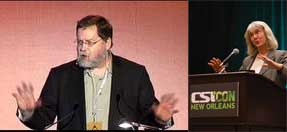
Look here, we’re like clones of each other! If I can so perfectly emulate her lecturing gestures, there’s no reason to assume I won’t be as great at the rest.

pz_genie

<quick cut to directors of the NCSE, all looking horrified…then scrambling to find more inducements to Genie to keep her on>

What I taught today: FINAL EXAM TIME!

I’m in Arizona, on my way to Orange County, but that doesn’t stop me: I’ve given my students a take home final exam. I wouldn’t want them to be bored over finals week, you know.

1. In the last lecture, I tried to give you a little context, and explained that a dynamic picture of biology would include evolution, ecology, and development, all subdisciplines that deal with change over time. You’re all upper level students; explain to me how developmental biology fits into the perspective on biology that your experience here at UMM has given you so far. Are there pieces you wish our curriculum emphasized more? Why?

2. We’ve spent most of the semester talking about animals — as it currently stands, evo-devo has an unfortunately limited emphasis on metazoans, with an occasional nod to higher plants. Explore a little deeper. What would an evo-devo of fungi, or bacteria, or protists talk about? Is the toolkit we’ve been talking about truly universal? Give me a brief precis of the developmental principles for any other kingdom.

3. Imagine that after you graduate, you find yourself in an unexpected job: you’re working in university press office or as a science journalist. You have to explain scientific research to the public every day. What general principles would guide you? These should be ideas about ethics, effective communication, psychology, etc. in addition to purely scientific concerns. Tell me what standards you’d have to become a great reporter of science.

There. That should make them think.

When science is criminalized, only criminals will do science

I hate the way chemistry has been infantilized to the point where you can’t even buy a decent home chemistry kit for kids anymore, but this story takes it a step further. A teenager in Florida did a simple experiment that made a small plastic bottle go boom and spew out some smoke (and no one was hurt, although apparently the student was surprised), and the school over-reacted: they expelled her.

It was a simple reaction: aluminum + sodium hydroxide releases hydrogen gas and the pressure ruptures the bottle. It was also a poor decision to do it unsupervised in a school yard, but good grief…kicking her out of school means that interest is now quelled. Channel that perfectly reasonable curiosity into constructive academic pursuits! This school seems to be more concerned with shutting down exploration and keeping everyone unchallenged and safe than in engaging in that dangerous business of education.

What I taught today: toroids!

Hox 11/13 expression in an echinoderm blastula

It was the last day of classes for us. I brought donuts.

Dammit, I just realized I missed a golden opportunity. I should have talked to them about Thrive and Pivar and Fleury and Andrulis. Crackpot fringe developmental biologists all seem to have a thing for donuts.

Rats. Well, I’ll just send all my students an email and tell them they have to come back. They don’t even realize the importance of our little snack together.