
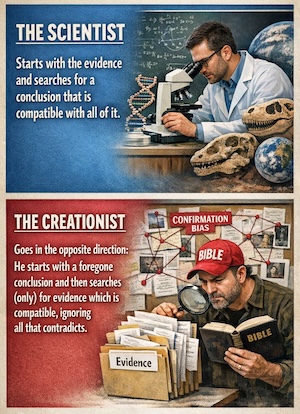
Georgia Purdom, the creationist “scientist” working for Answers in Genesis, has written an article titled “How Can I Become a Creation Scientist?” It’s bad. I’m tempted to reply to it with one simple recommendation, “Don’t.” But this article is full of bad advice I have to try to counter.
Purdom breaks the process down into the stages of education, so I’ll follow that too.
High School
Her advice is stuffed full of self-serving religious nonsense. She suggests, first of all, read your Bible and Christian apologetics, and then adds reading AiG’s list of creation scientists, and visiting the Creation “Museum” and the Ark Park. You will not get any foundation in science from any of that; it’s not necessarily bad for you to follow a religion, unless you get fooled by the anti-science sentiment in those sources, but it’s entirely irrelevant to pursuing a science career. You can be religious and be a good scientist, but being steeped in religion isn’t going to help.
She gives some good, but generic, advice: do well in school. OK, that’s fair. But then she also has some bad ideas, beyond just stuffing your brain with creationist apologetics. For example, she expresses an attitude that I really dislike: I struggle with math, so chemistry or physics would not have been a good field for me
. Don’t dismiss math, and don’t imply that biology is for people who don’t like math. All sciences are quantitative, and you must cultivate some understanding of math. You don’t like it? Then you’ll have to work harder to grasp the necessary quantitative skills. More importantly, learn the joy of mathematics by understanding what it is good for. That would be far more useful than reading Christian apologetics.
What’s missing from Purdom’s advice is anything to foster a love of science, replacing it with soaking in the Bible. The Bible isn’t going to help you in science! I would tell a high school student to indulge in fun, relevant hobbies, in addition to doing well in classes. Take up model rocketry or chemistry experiments, hike in the woods, go fishing, collect butterflies, collect rocks, raise pet insects, birdwatching…that’s all stuff I did in high school, but there’s much more. Geocaching, computer programming (even computer games), space camps, math olympics, etc., you can think of lots of entertaining activities that simultaneously build skills that will be useful in science.
Another thought I’ve had is that learning to cook is a fabulous support skill for science. It’s quantitative, it requires careful measurement, you learn to appreciate a variety of chemicals, even if people don’t like to call them that.
Purdom also recommends that you prepare to attend a college that stands with AiG on the truth of God’s Word beginning in Genesis
. Don’t do that. Avoid those places.
College
Purdom’s recommendation for college students is to read even more apologetics, join the creation research society, attend creation science conferences, and find a good church. None of that will inspire a deeper appreciation of science.
As someone who advises college students, I would say that finding a church, if that’s your thing, is a fine thing to help a student who is looking for social support. What I’m usually telling students is that they need to take more math to meet the prerequisites of their more advanced classes. I’m serious: the number one problem for students entering a science major is insufficient preparation in math, which is why I hate those people who downplay the significance of math and lead young people to neglect a core piece of their education.
But beyond that, the other thing I tell students is to get involved with a campus organization: we have a physics club, a chemistry club, a math club, a biology club. One of the jarring things about Purdom’s advice is that nowhere does she suggest doing science recreationally, because it’s fun. I also tell students to get involved in research, that you actually can just walk up to a professor and ask if there’s anything you can do in their lab, and often they’ll say yes and welcome volunteers. My last (sadly, my very last) research student got involved in studying spiders, joined the American Arachnology Society, presented her work at an arachnology conference, and is currently off in grad school, studying entomology. She’s on her way to a career in science in a way that joining a church cannot directly promote.
Purdom has another strange recommendation: hide your ideas.
Be careful what you share on social media and with others about your biblical creation beliefs. Much of higher education is antagonistic toward Christian students in general but especially those who are biblical creationists in science fields. Today, it’s easy to find out a lot about a person using a Google search and even AI.
How sad. The persecution complex is pervasive, to the point the creationists are telling their young students that they can’t be forthright in public. Have they considered the possibility that creationism is stupid and wrong, and simply telling young people you’ll look like an idiot if you espouse it? She says, It’s best to keep your mouth shut and get the education and training you need, and when the time is right, you can open it!
There it is: she openly advocates lying for Jesus until you’ve got your diploma.
Graduate School
You’ll never guess what advice she has for grad students. Read more apologetics and find a good church. Aww, did you guess it?
She also recommends picking an advisor who is a creation scientist. Good luck with that! There aren’t many around, except maybe in the AiG approved crap colleges she wants you to attend. Then, another revealing comment:
If you’re constantly being bombarded by ideas that are counter to God’s Word, it will be hard not to compromise. For example, I would not recommend getting a degree in evolutionary biology. There’s a very real chance that you would be an author on a paper that espouses evolutionary ideas as truth.
She wants to raise up more dedicated pseudoscientists to challenge evolutionary biology, but it’s important that they don’t get exposed to evolutionary ideas that refute the nonsense that creationists peddle, and above all, do not actually get a degree in evolutionary biology. That explains a lot, actually: creationists don’t understand the science they criticize.
Professional Career
I’m sorry, but if you follow Georgia Purdom’s advice, you won’t have a professional career. All she can suggest is that you get a job with a Christian church or Christian organization.
My secular path doesn’t guarantee you a job, it’s a hard path to follow. But there are far more options available to you: we have students working in industry, agriculture, and research, as well as in education. And you know what allows our students to succeed in a variety of occupations? Their quantitative skills. Knowing math and statistics is a powerful skill that can help you find a place in all kinds of jobs.
Knowing bizarre Christian apologetics and how to lie for Jesus gets you diddly-squat in the world outside the churchy hotbox.

“It doesn’t matter how beautiful your theory is, it doesn’t matter how smart you are. If it doesn’t agree with experiment, it’s wrong.”
― Richard P. Feynman
And here is the problem, all experimental science supports evolution. Creation has no experiment that demonstrates creationism, and there never will be.
Yes, the gist of it seems to be “Don’t learn too much, lest you be seduced by the dark side.”
It seems like good advice if your dream is being a “creation scientist” working at AiG. For any other job, probably not much use.
Creation science: Plain old Christian apologia fallacies dressed up in fancy modern wording.
cheerfulcharlie: 8-)
Another Feynman quote that I like, from The Pleasure of Finding Things Out, p. 103: “Before you begin, you must not know the answer.” I’d guess that that’s why apologists don’t ever actually “find things out.”
Instructions unclear: I read the Bible and it turned me into an atheist.
It may be illegal to claim a protected title but “scientist” is not protected.
These are the people that make documentaries that later get burned on skeptic podcasts all over Youtube.
.
They are disadvantaged by being more boring than flat-Earthers and breatharians. My favv Xian kooks are those who think extra-terrestrials are demons in disguise.
Question: If Zod created Earth 4,5 billion years ago, does that count as creationism?
All the more reason to completely reject creationism entirely.
I reject all of creationism. I reject it then. I reject it now. And I’ll reject it in the future. All because it’s downright stupid and incredibly wrong. And Perdumb proves it right here.
*Purdumb
Embarrassing. And sad. Very sad.
I would recommend any activity that cultivates curiosity and critical thinking. Of course, she would never recommend something like that because religion doesn’t stand up well to either.
@birgerjohannson #8:
Technically, yes: “Old Earth Creationism” is a thing, and it’s not as obviously wrong as “Young Earth Creationism” because it actually agrees with the evidence on most things. OEC is what you get if you take the Deism approach of basically “God created the world and then just left it running,” and my understanding is that the official Catholic stance is “Deistic Evolution”, which also qualifies.
When people talk about how stupid Creationism is, they’re obviously usually talking about YEC, because that’s where all the noise and politics are. And it’s because the people behind YEC have created this massive conspiracy theory to explain how their mid-1800s interpretation of the Bible (that they insist is the ‘plain reading’ and not an interpretation) is absolutely true and complete and any possible break in the wall will shatter their entire faith. So people brought up in that culture either see it for the fragile fraud that it is and leav, or they get really good at doubling, tripling, and quadrupling down.
And these people have spent generations actively making themselves the face of Christianity in America, to everybody’s detriment.
“How Can I Become a Creation Scientist?” translated: “How Can I Become a Fake Scientist?”
John @15: If one insists on pigeonholing, I suppose Kelvin and Maxwell could be classified as Old Earth Creationists. Were they fake scientists?
Rob, no. What Jenora wrote.
Whether someone was a “fake” scientists depends on when they lived and what the prevailing views were at the time — you can’t project current categories back on history. Modern OECs accept the basic story told by cosmology and geology, but insist that evolution can’t work; God must intervene to create a new species every now and then. So if the OEC in question is an astronomer or a geologist, then fine; if they’re a biologist, then….? And then there’s the Intelligent Designists, who are rather chary about just what God did and when. (Of course I’m sure there are YECs who do legitimate chemistry and physics — are they “fake”?).
The, um, evolution of scientific and religious views during the 19th century is fascinating. Simplistic YEC was already in trouble by 1800; it was apparent that there had been a succession of biomes over the course of earth history, but no one knew quite what to make of it. 100 years later, of course, pretty much everyone but Agassiz was an evolutionist.
stevewatson.
Not at what they do, if that is the case.
However:
The compound term is ‘Creation Scientist’, not chemist who is a creationist, not physicist who is a creationist, but someone who considers Creationism to be a science, and themselves a scientist.
Right? Not a scientist who happens to be a creationist, but a creationist who imagines that is scientific.
(Methodological naturalism, else it ain’t science)
Some, maybe. Others totally accept evolution, but claim God set it into motion and set it up.
cf. https://ncse.ngo/creationevolution-continuum