
Today I learned something that surprised me: plants that mimic other plants. The question is…how?
Seven years ago, Gianoli and Carrasco-Urra reported on their discovery of Boquila trifoliolata (Lardizabalaceae), a woody vine from temperate rainforests of southern Chile, capable of complex leaf mimicry, when leaves of up to three different host plants were mimicked by leaves of one B. trifoliolata plant. However, according to a side-by-side published commentary, the absence of any plausible hypothesis for such a phenomenon makes this report unexplainable and mysterious.
Gianoli and Carrasco-Urra preferred some chemical volatile signals released from the host plants, which would allow the B. trifoliolata to mimic leaves of host plants. As an alternative proposal, they also speculated that horizontal gene transfer between host plant and Boquila vine, mediated perhaps via airborne microbes, might allow this leaf mimicry. They proposed this scenario because B. trifoliolata leaves mimic the nearest foliage, irrespective if these leaves are from the host plants or some other neighboring plants.
Interesting ideas, and I find them very reasonable. Sure, horizontal gene transfer, of the diffusion of morphogenetic signals — that seems plausible, initially, when I didn’t know the degree of mimicry. These plants copy the shapes of leaves, and the degree and pattern of venation. That seems a bit much to attribute to the chance transfer of multiple genes, or picking up signals that change or modify the plant’s intrinsic signals. The authors of this paper propose a surprising alternative: the plants are watching other plants in their neighborhood, and copying them visually.
No way, I thought. Plants don’t have eyes. How do they see? Let’s skip right past that minor anatomical difficulty — maybe we can return to that issue another day — and instead block the possibility of genetic or developmental signaling. They came up with a delightfully simple experiment.
we have been given a rare opportunity to test plant vision in more detail. The simplest way to test the vision hypothesis with the B. trifoliolata would be to see if it would mimic a non-living leaf shape from an artificial plant. In this study, B. trifoliolata was exposed to the artificial plastic plant with a characteristic leaf shapes. The results of this study show that this is indeed the case as leaves of B. trifoliolata mimicked leaves of the artificial plant. Hopefully, this report will stimulate more experiments in future to improve our understanding of the plant sensory abilities.
Surprise! Organic Boquila leaves copied plastic leaves to varying degrees!
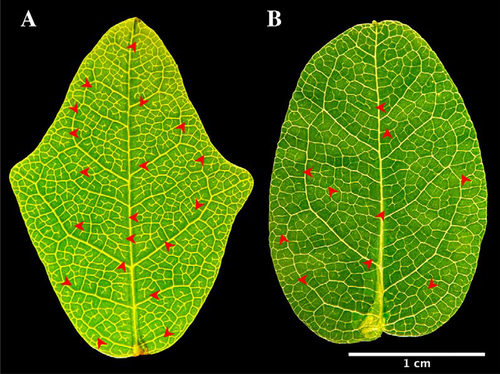
Leaf shapes in Boquila trifoliolata. (a) Non-mimic leaf, with three lobes, dense vascular network. (b) Mimic leaf, with a single lobe in the apex, less dense vascular network. Red asterisks shows examples of free-ending veinlets.
Now I’m confused…how do they do that? I haven’t thought of any alternatives, yet. I welcome your speculations.
Until I have a better explanation, though, I’m going to have to cover the houseplants.

I’m also wondering what advantage mimicry confers on these plants.
Maybe the vine likes shade and its leaves shape themselves to be in the shade of the host leaf directly about it?
I mean the host leaf directly above the vine leaf.
I’ve read about this too. Boquila being able to see other leaves seems like the only answer.
But it’s not that hard to imagine, is it? Plants are obviously sensitive to light, given the existence of phototropism. Maybe it’s evolved the genes for that ability into an eyespot-like structure to detect patterns of light and dark.
I recall a study – maybe 8 or 10 years old – demonstrating that certain plants (P. sativum and A. thaliana) can “hear” the sound of running water and direct the growth of their roots towards that stimuli. Phonotropism is the term and it appears plants use mechanoreceptors to detect vibrations. It seemed alien to me at the time…just as the idea that plants can “see.”
Life finds a way. Mother nature is full of surprises.
Plants are amazing. Venus Flytraps among others and the Sensitive Plant (Mimosa pudica ) have a sense of touch. They have such chemical senses that are rather hard for us to grasp, Then they have their fungal connections & “wood-wide web” and then there was that video Mano Singham shared once showing body language of them with two vines (?) racing each other and one instantly knowing somehow when the other one had reached the supprot they both heading for and getting dejected.
Amongst so much more.
The plants get no advantage at all. They do it because they’re insecure in their own identity. However, the plant is now at least getting a bit of a chuckle at our speculation, so there’s that.
I’m still having problems that they can “see”. Vision is complex, and requires processing and integration, more than just passive light detection. For instance, if they’re seeing adjacent leaves at the same level, they’re all going to be seen on edge, and look long and thin. Why aren’t the mimicked leaves long and thin? They have to have some ability to reconstruct their shape in 3 dimensions.
Plants are covered in photoreceptors, after all. All they need to detect a neighbor’s shape is its shadow—if the sunlight is bright enough and the receptors sensitive enough, that could give you venation as well.
As PZ says, though, a shadow is not a fixed shape, it changes every hour. And it looks like the plant is mimicking vein structure, not just shape.
If plants can see, that would also explain the adaptive advantage of mimicry, as it is needed to avoid detection by the host plant.
Seriously, this is begging for followup. For example, put it in diffuse lighting, to try ruling out a lot of shadow-based mechanisms.
This needs both fieldwork – particularly, what eats Boquila and its neighbors – and labwork – specifically, testing species, location, lighting, etc as to which factors increase/decrease mimickry, whether close relatives of Boquila show any equivalent tendencies.
Have plant geneticists figured out anything about which genes determine/affect leaf morphology, and what activates or inhibits same?
Speaking of vision…
Red asterisks on green leaves? Really??? Great. Thanks. Can’t see a single one. Didn’t even know there were asterisks present until I read the description. I’m a plant biologist (PhD). Was very excited to see this paper. Not anymore.
Reminds me of the time I was a visiting Prof and I explained to a student practicing for a senior thesis presentation that some members of the audience may be colorblind and not to rely too heavily on reds and greens to distinguish significant data. A tenured colleague (who I, in hindsight, suspect was jealous of my rapport with the students) immediately shot down my advice and told the student not to worry about it- that it wasn’t a big deal to accommodate a colorblind audience member.
Seriously, why red? Black (or even better, white asterisks with a thin black outline) would have been perfect, especially for people with atypical color vision.
This needs to be taught in data presentation / scientific communication classes and seminars. I’ve been griping about this ever since red/green became standard for microarrays. But I was most upset that a colleague would so flippantly dismiss a real concern- in front of a room of students, no less.
… B. trifoliolata leaves mimic the nearest foliage, irrespective if these leaves are from the host plants or some other neighboring plants.
Grow some in isolation, and see what their non-imitative leaves look like.
Grow some in proximity to basic geometric shapes, asymmetric shapes, Rorschach blot cut-outs, variegated leaves, Picasso prints…
Perhaps a bit more advanced trick than when Daniel Dennett was reflecting on the intentional stance per trees on the Philosophy Bites podcast:
“Recently, we’ve learned that many varieties of trees have a capacity that gives them quasi-colour vision. When the light on them is predominantly reflected from green things they change the proportion of their energy that goes into growing tall. We might say that they have sensed the competition and are taking a reasonable step to deal with the competition.”
From Philosophy Bites Again by David Edmonds & Nigel Warburton
There’s this:
https://www.scientificamerican.com/article/veggies-with-vision-do-plants-see-the-world-around-them/
Which mentions the climbing wood vine.
Apparently it may be protection from herbivorous insects and animals. Also the non-mimic leaf shapes are shown in the article PZ quoted from.
https://www.sciencedirect.com/science/article/pii/S0960982214002693
Fascinating research. I think they need to look at the root systems and whatever the mimicking plant uses to attach itself to its host. It’s clearly picking up clues to its hosts leaf form, but horizontal gene transfer seems like something you could check for? Perhaps it’s getting information via root grafting.
I suspect dense foliage the leaves need consistent shapes to get maximum sunlight. There might be some mechanism that makes leaves grow into the shapes of surrounding leaves, based on their shadows or light interference patterns.
Rather speculative and disputed, the vision thingy.
https://en.wikipedia.org/wiki/Boquila#Ocelli (basic ref)
&
https://www.asimov.press/p/plant-vision (detailed ref)
—
Kinda reminds me of Supernature, which excited me as a young lad, before I lost some of my naivete.
(https://en.wikipedia.org/wiki/Lyall_Watson#Supernature_(1973))
I can see a mixed plot of seedlings where one has an advantage (say bitter leaves) that the individuals of the other species closest in shape would be ar a selective advantage. I cannot see how grown plants could mimic shape of leaves. I am tempted to say this must be an error in the experiment.
I’m skeptical. I haven’t clicked any links for more detail, but what I see here doesn’t add up. I do have a little experience in botany. Last century I was a horticulture major with several required botany classes, so I’ve examined lots of plants. Iirc, that’s a fairly common vein pattern, and the description even says the density and number of end points is different. And the leaf shapes are completely different.
When they start issuing prescription glasses I might become a believer.
The Day of the Triffids is nigh.
More years ago than I care to remember the lecturer leading us on a Biological Field Work trip made the observation that Australian mistletoe causes the branches of the plant it infects to produce leaves identical to the mistletoe. It wouldn’t be light but some chemical signal transmitted through the host plants own tissues that is responsible.
Don’t look up!
@ 19 Tethys
You seem to have missed the bit where it mimics plastic leaves. So clearly nothing to do with roots or genes. It enough to just look like a leaf.
@silentbob
No, I read the linked paper. The leaves pictured in the OP aren’t evidence of anything except the variability of leaf shapes of Boquila trifoliolata. They don’t show the plastic plant it’s supposedly mimicking. Plenty of plants have variable leaf shapes depending on age/sun exposure/climate etc…
All of the variations shown in the paper are basically ovate. I might believe it’s evidence the plant can “see” it if it grew palmate leaves or round leaves. Leaves are photoreceptors so they can obviously detect light and shadows. The most interesting bit is where the leaves of the same vine do change as it grows into different host plants.
I recently had surgery to repair my retina. I’m starting to see more. The healing process is long.
I’m having an existential crisis.
I’m wondering if the distorted vision in my right eye is really the way the world looks and my left eye has been lying to me all this time.
fishy @29
That’s been a lingering low level fear for me over the course of this year as I went through posterior vitreous detachments in both eyes. In a small percentage of cases the retina gets involved. Yipes!
I hope your retina problem resolves.
The genes for root morphology are complex, but one day maybe GM may deliver more plants sharing the ability of legumes to live in symbiosis with nitrogen-fixating bacteria.
.
Also, on the matter of plant communication I recommend the wossname SF novel with a character called ‘Stevland’. Very original.
Another matter… there are some transparent sea organisms that eat algae but preserve the chloroplasts. Neat.
@31birgerjohansson, google tells me the science fiction with the sentient plant Stevland is Semiosis by Sue Burke. I’ll look for it. By the way, Stevland is Stevie Wonder’s given name.
“Who goes there?”
“No one. Just your friendly neighborhood Boquila trifoliolata.”
;-)
Since the topic has drifted into fantasy, i note https://en.wikipedia.org/wiki/Midworld is the obvious work that Avatar ripped off.
But then, there are progenitors: Ursula K. Le Guin’s The Word for World Is Forest (1972) and Harry Harrison’s Deathworld (1960).
That’s part of my problem; so much seems derivative these days.
But the thing is all are about the unsuspected powers of plants,
(Comic book version: Alan Moore’s Swamp Thing)
Since the topic has drifted into fantasy, i note https://en.wikipedia.org/wiki/Midworld is the obvious work that Avatar ripped off.
But then, there are progenitors: Ursula K. Le Guin’s The Word for World Is Forest (1972) and Harry Harrison’s Deathworld (1960).
That’s part of my problem; so much seems derivative these days.
But the thing is all are about the unsuspected powers of plants,
(Comic book version: Alan Moore’s Swamp Thing; insect version, Frank Herbert’s The Green Brain)