Pharyngula
Evolution, development, and random biological ejaculations from a godless liberal


We’ve only had our HHMI undergraduate research program in action for a year, and we’re already seeing success: one of our students has landed a prestigious summer research position.
Ellie Hofer ’15, Sioux Falls, South Dakota, is one of only a few students nationwide selected for the Howard Hughes Medical Institute (HHMI) Exceptional Research Opportunities Program (EXROP). EXROP provides outstanding summer research experiences to bright, motivated undergraduate students from groups traditionally underrepresented in the sciences.
We like getting rid of our students by kicking them upwards.

I am told I’m supposed to take The Dark Enlightenment seriously. I can’t. I just can’t. What it is is mostly a bunch of pretentious white dudebro computer programmers with a fascist ideology who write tortuous long-winded screeds off the top of their heads, with most of their ‘data’ coming from pop culture movies like The Matrix, and a few similarly clueless nerds who think it’s neat-o. I take it seriously only in the same way I take Libertarianism seriously: it’s a nucleus for idiots to coalesce around.
They also throw the term HBD around a lot. If you’re not in the know, HBD is short for Human BioDiversity, and it’s the hot new sciencey word for racism. The only people who use it are racists.
Human biodiversity is the rejection of the “blank state” of human nature. Creepily obsessed with statistics that demonstrate IQ differences between the races, the darkly enlightened see social hierarchies as determined not by culture or opportunity but by the cold, hard destiny embedded in DNA. One blogger calls it “The Voldemort View” (adding Harry Potter to the Star Wars/Matrix mix), claiming that, “mean differences in group IQs are the most likely explanation for the academic achievement gap in racial and SES [socioeconomic status] groups.”
Oh, please, fuck the whole “blank slate”, nature/nurture dichotomy. Biology affects everything human, and everything human is affected by the environment.

I very much like Kameron Hurley’s take on l’affaire @wossy, the obnoxious television presenter who was appointed to emcee the Hugo awards in London, provoking howls of outrage. I think she’s right, that what’s happening is the privileged assholes have finally pissed everyone off, and we’re mad as hell and not going to take it anymore.
We speak out because we are brave, not because we’re baying for blood. We speak out because we’re tired of being hit, and we need to know that if you’re coming into our house, you’re not going to act like an asshole. We went to school with that dude. We deal with that dude on the internet everyday.
We are fucking tired of that dude.
But what I really like is that she goes a step further and suggests how said privileged asshole could have short-circuited the whole mess.
So instead of snarking back at people on Twitter and calling them nutjubs and invoking Neil Gaiman’s name as a ward of protection, it would have behooved the privileged person to stand back and say, “Hey. Wow. I’m so sorry! I didn’t realize so many of you had that impression. Let me assure you that I love and support this community and I take this gig seriously. I respect and love every single one of you and please be assured I’ll be respectful and welcoming, just as I hope you will be respectful and welcoming to me as a host.”
I don’t see it happening very often, though: that approach requires a smidge of humility and honesty, and that dude usually lacks both.
If you want a real world example of that positive response, I think Anton Zuiker’s comes close. Zuiker was cofounder of Science Online with Bora Zivkovic, and annoyed everyone with a post a few months ago, titled ‘Roots and Bitters’, that tried to redeem Bora. Zuiker has retracted that post, and his latest is an expression of honesty and humility and a lot of regret. He’s basically withdrawing from the online world, which is unfortunate — but it is sincere.

My birthday is on Sunday, and Neil deGrasse Tyson went to all the trouble of remaking Cosmos just for me. It was just for me, right? And you’re all going to celebrate my 57th year by watching it.
I hope there is some biology in it.

The Christians are upset by ‘historical inaccuracies’ in this new Aronofsky movie, “Noah”. Wouldn’t you know it would inspire bickering among them?
At the request of the National Religious Broadcasters (NRB), Paramount added a disclaimer which reads, in part, that “[t]he film is inspired by the story of Noah. While artistic license has been taken, we believe that this film is true to the essence, values, and integrity of a story that is a cornerstone of faith for millions of people worldwide. The biblical story of Noah can be found in the book of Genesis.”
NRB board member Phil Cooke told The Wrap that the disclaimer was necessary because the film is “historically inaccurate.” It is, Cooke said, “more of an inspired movie than an exact retelling.”
How can a myth be historically inaccurate? None of it happened; there was no global flood, there was no rescue of all the animals on earth with a floating zoo, humans never went through a population bottleneck of 8 people, the whole thing never occurred. I just want to tell them to calm down and recognize that a major film studio has just spent $130 million making a propaganda film for your cult, so you’ve got nothing to complain about.
But OK, here’s a test. Which of these images is “historically inaccurate”, and have you also sent off letters of complaint to them?




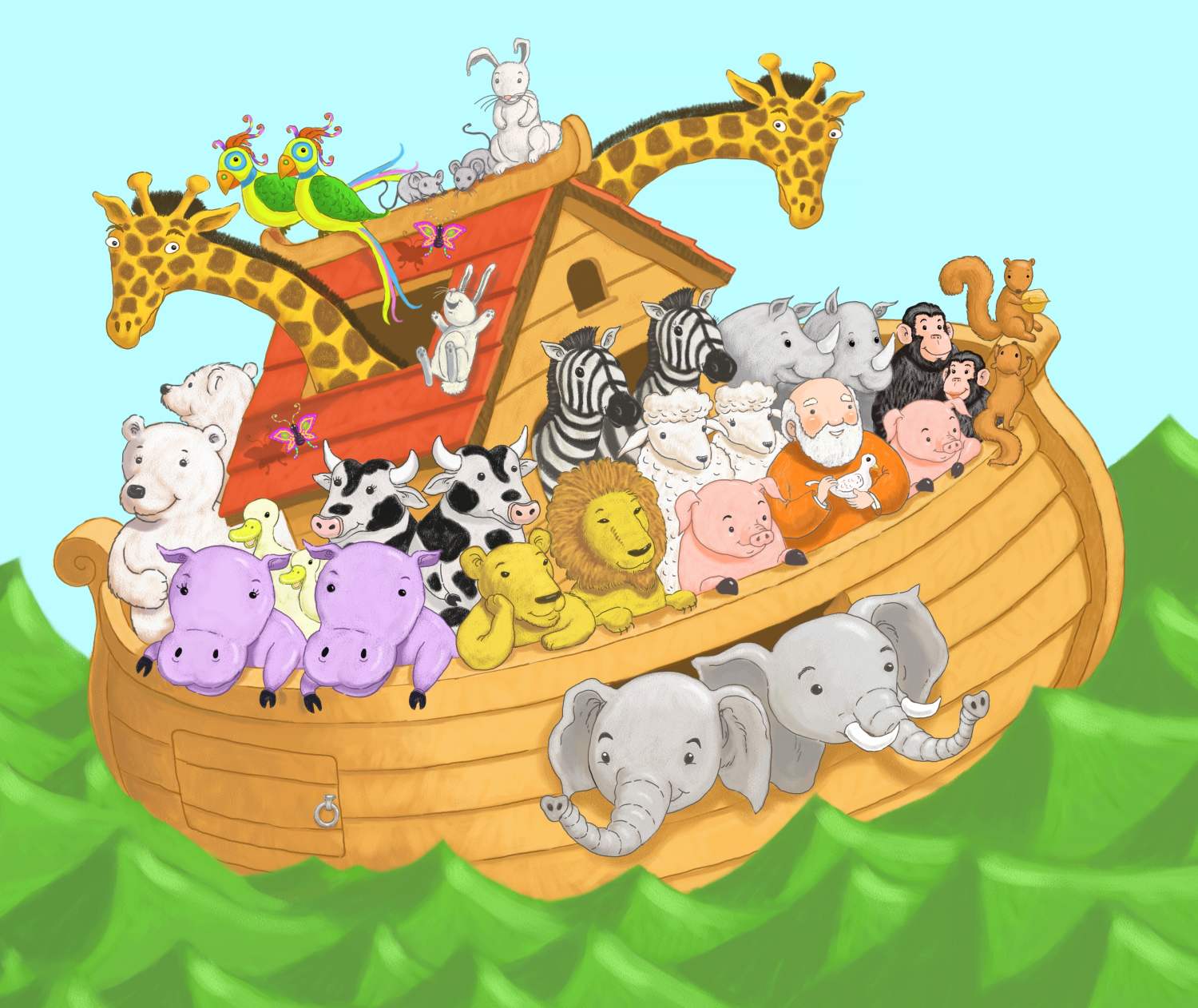

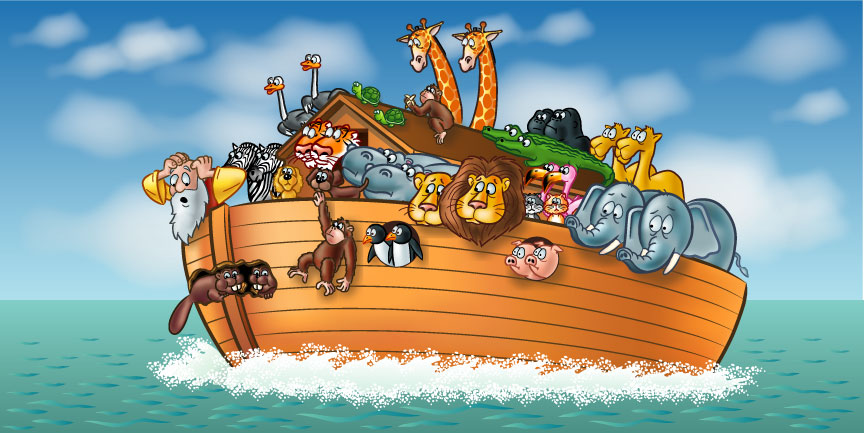
Whining about inaccuracies is just silly. Here’s another silly complaint:
Brian Godawa, a screenwriter whose Christian films have repeatedly failed to be profitable at the box office, wrote that Noah‘s script “is deeply anti-Biblical in its moral vision.”
Oooh, mean dig at the guy for making unprofitable garbage, but he does have me wondering what “moral vision” he’s talking about? Slaughtering every person on the planet for their purported moral failings?
Yes, actually, that’s the moral vision he wants promoted.
Another problem with Noah is that it fails to acknowledge that while, from a Christian perspective, “[k]illing all humans but eight in order to start over (as the Bible portrays) may seem harsh to our thoroughly Modern Millie minds…it reaffirms that Image of God in Man that gives man value despite the evil.”
It may seem harsh…right. This is the logic that says it is OK to kill people who do not properly affirm their idiosyncratic image of a god. I will say unabashedly that such a perspective is humanly evil, and the excuses of the faithful for their bloodthirsty demon-god do not reassure me that they have the slightest understanding of moral behavior.
Did I say it was a mean dig to point out Godawa’s failure as a screenwriter? It wasn’t. He also makes a point of the importance of money.
Godawa is also concerned that this “uninteresting and unBiblical waste of a $150 million” will make it difficult for Christian screenwriters like him to find employment. He fears that it “will ruin for decades the possibility of making a really great and entertaining movie of this Bible hero beloved by billions of religious believers, Jewish, Christian, and Muslim.”
Gosh, thank you for giving me the bright side of this movie. Hey, if the Christians all boycott it, and the Muslims (who are also unhappy with the movie) skip it, and the atheists, who aren’t at all interested in yet another bible movie don’t show up, then Noah will tank at the box office and no one will ever make another bible movie, and Godawa will live in penury, never able to make a movie promoting his murderous, callous vision, and we’ll all be better off.
Well, except Godawa. But screw that jerk.

American Atheists still has a presence at the gathering of the wackaloons called CPAC, despite having their booth expelled. This promises to produce some great stories from both of them, but I’m getting a little worried that Silverman is going to try and bring some of the assholes home to atheism with him. Could we try to grow the movement at a progressive conference instead, please?

Some columnist named James Knight has decided to strike back against New Atheist tyranny by rebutting their major claims, and he’s starting out by picking on Hitchens and Dawkins, who, he says, make terrible arguments.
As you’ll see, Dawkins and Hitchens have ready-made methods for twisting meanings and distorting logic in a way that the more pliant and impressionable individuals don’t seem to notice.
Prepare yourself; that’s from a guy who’s about to launch into a series of theological arguments. Self-aware, he’s not.
Knight has a whole series of excerpts from the Hitch he warbles about, and I’m just going to pick two of the more famous arguments he’s made, and I think that will be enough to see that Knight is all pompous puffery. I’m sure you’re all familiar with Hitchens’ theistic challenge.
Name me an ethical statement made or an action performed by a believer that could not have been made or performed by a non-believer.
Now read Knight’s pratfall:
To me that is the sort of pliable question that sounds intelligent but isn’t really. I think Hitchens’ question shows a lack of understanding of what religious belief entails, and also the overlooking of something that should be trivially obvious. The short answer is, the question is as meaningless as asking whether quenching thirst is better than feeding oneself. It is true in most cases that there is no ‘statement’ or ‘action’ that a theist can make or do that others cannot, but that tells us nothing meaningful about the God debate, because a proper analysis involves much more than just the statement or action – it involves analysing the beliefs, intentions, humility, motive, and other psychological factors that do not come out in a mere action. Naturally we could name good moral actions taken by both religious and non-religious people that have produced the same results, but that does not tell us anything about what is directing the action, or whether the person is living a Godly life, and it certainly has no bearing on whether there is a God.
That’s not a reply, it’s an evasion! We don’t understand what religious belief entails? Then tell us what it does. Throughout his replies, he does this constantly: you just don’t understand,
he whines, implying that there is some great deep thought behind his claims, while never illuminating exactly what it is.
But most importantly, it’s an abject concession. He can’t cite anything a believer does that could not be done by a non-believer — there is no special grace granted by faith. We have good moral actions taken by both religious and non-religious people that have produced the same results
, is one concession, but this is the bigger one: that does not tell us anything about what is directing the action
. Exactly! You cannot discern the presence of a guiding moral force outside of any individual person, and Knight agrees…so how can he talk about a Godly life
? How does he know?
It certainly does have bearing on the argument about the existence of gods. I have never debated anyone who doesn’t eventually get around to an argument from consequences: How can you be good without god? Aren’t you worried about Hell? Society will fall apart without god! Yet here is Knight, admitting that there are no moral consequences to disbelief, while also implying that goodness is a Godly life
. He wants to simultaneously argue that unbelievers can be morally good, while predicating the standard for moral goodness on a god.
Here’s another famous Hitchism that Knight dislikes:
What can be asserted without evidence can also be dismissed without evidence.
Watch out, here comes the egregious relativism, which sounds like something straight out of Answers in Genesis.
To express fully what is wrong with this statement would take a whole essay in itself. But briefly, it grossly caricatures religious faith to state that it is ‘asserted without evidence’, when, in reality, evidence is in the eye of the beholder, and different people accept and interpret different evidences differently. Maybe some people are too easily seduced by interpretations that shouldn’t ever be offered as reasons for belief in God, but equally there are going to be lots of people whose psychological agitations predispose them to a scepticism that demands too much evidence, or the wrong kind of evidence.
I suspect Christopher Hitchens’ main problem is that he’d never thought through properly what evidence for God actually means, and how it might be different from the more simplistic evidence found in empirical science. Never once did I ever hear Christopher Hitchens tell us what he thinks good evidence is, what makes good evidence good, how belief in God differs from knowledge of the empirical world, and what he thinks would be satisfactory evidence for God.
I really despise the vacuous Well, we just interpret the evidence differently
argument — it’s a lie. Over and over, I see it said in order to defend ignoring the bulk of the evidence.
I see a pad of post-it notes next to my keyboard on my desk. This is clearly evidence that tiny invisible elves from 3M climbed up the wall outside my window, translocated extradimensionally through the glass into my office, and left me a present. Or is it evidence that I picked up a pad at the central office and put it in a convenient spot near my phone? You don’t get to say that the existence of this pad is equal evidence for both claims; you have to ignore the consilience of phenomena that provide better explanations. There is a cabinet of these things just down the hall from me; it’s a mundane object with obvious utility; there are torn-off post-it notes with scribbled comments attached to my phonebook. At the same time, 3M elves have no evidence for their existence, have posited powers with no known mechanism, and are arbitrary, ad hoc, bizarre explanations for a perfectly ordinary object. It is not demanding too much evidence
to expect some independent corroboration of the mechanisms of the phenomenon that aren’t more simply explained by my ability to walk 50 feet to a collection of supplies.
In the same way, believers like to say they do have evidence for their supernatural phantasm…and then they point to their Bible. Sure, it’s evidence. Evidence backed up by documents and history that over the course of many centuries, human beings collected stories and legends and hectoring homilies and poetry, all written by people, and assembled them into a clumsy compilation, and stamped it all with the imprimatur of religious authority. Meanwhile, you’re trying to tell me this hunk of cellulose and ink was magically transported into the world of Catholicism by the equivalent of invisible elves.
Who actually has evidence for the origin of the object?
Knight’s second paragraph is a complaint that Hitchens’ didn’t tell them what evidence for their god would be acceptable, which is a fair complaint. Or it would be, if there weren’t another problem: define God. I can’t tell you what would be evidence for or against it if you’re not going to settle down and get specific about this god’s properties and nature. Is it an anthropomorphic being with a penis that can impregnate human women? Is it a vast eternal cosmic intelligence that encompasses the entire universe and manipulates matter and energy with its will? Is it benign fluff, a happy feeling of love that permeates us all? I suspect he’d tell us some meaningless noise about a “ground state of being”, which seems to be the universal bafflegab right now to avoid answering the question.
You know, this is the big difference. If you tell a scientist that their evidence doesn’t distinguish between two alternatives, it’s the scientist who thinks hard about the problem, comes up with what would be differing consequences of an experiment if his hypothesis was valid or invalid, and does the work. We actually love this part of theorizing, thinking through the implications of a hypothesis and then testing them. And that’s a process that involves getting specific about the details of our hypothesis.
Theologians, on the other hand, hate that part. We can ask them what the difference would be between a universe that had a god and one that didn’t, between a god that answers prayers and one that doesn’t, between a Christian god and a Muslim god, between a Catholic god and a Protestant god, and they love to tell us that the differences are profound
, but not anything specific. And then they yell at us that we haven’t given them the criteria that we could use to discriminate between the alternatives. And then, most aggravatingly, if we go ahead and make some predictions ourselves about what the universe ought to be like if there is or isn’t a god, they yell even more that their god isn’t like that, we used the wrong premises, we didn’t address their idiosyncratic view of a god…which is always conveniently tailored to circumvent whatever test we propose.
Do you theological wankers even realize that as the proponents of hypothesis about the nature of the universe, it is your job to generate testable hypotheses about how it all works? And that we, as agents in opposition to your nonsense, would be overjoyed to have you say something explicit about an implication of your ideas that we could test? Actually, I think you do know, because you so invariably avoid presenting any useful descriptions of what your philosophy entails. We keep waiting. And right now, your silence and the vacuity of what few feeble replies you make are just added to our stockpile of evidence that you’re all farting theology out of your asses.
James Knight ends with what he thinks is an insightful comment about the nature of god debates.
The God one accepts or denies is only likely to be as intellectually tenable as the intellectual tenability of the person holding those ideas.
I will therefore take the lack of intellectual competence of his arguments for gods as evidence of his own, personal intellectual emptiness.
Don’t worry, James. You’re in the company of a great many idiots, so you’ll just blend in.

They even come right out and say it. Here’s Larry Pratt, of Gun Owners of America, pleased that fear of getting shot will keep congress in line.
I was told of a conversation that one of our members had had with a member of Congress. And he was lobbying on a gun issue, but he was, I knew the guy well enough to know that almost certainly he was mild-mannered, he was just explaining our position. And apropos of nothing, the congressman – congresswoman, actually – said, ‘You want to shoot me, don’t you.’ Well, that’s probably a healthy fear for them to have, even though that’s not the guy’s – he wasn’t saying anything about that, it wasn’t in his demeanor. But you know, I’m kind of glad that’s in the back of their minds. Hopefully they’ll behave.
Perhaps Larry Pratt ought to be politely shooed out of the halls of power as a barbarian who does not belong in the company of civilized lawmakers?

You’ve all been replaced by a simplistic algorithmic protocol, which, as a side effect, has completely ruined van Eyck for me for all time.