
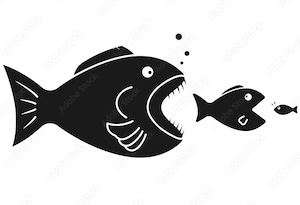
I’ve been a distracted mess lately, with all this PT stuff as well as a week of administrative malarkey, but I did notice a a provocative comment that I feel compelled to respond to.
Upon accepting the risk of dispensing an unpopular remark: One day, we shall have to set nature in order using genetical engineering.
No creature should devour any other.
Wow. That makes no sense. We humans are obligate heterotrophs — we must obtain certain vital molecules by consuming other organisms. For example, we cannot synthesize valine, isoleucine, leucine, methionine, phenylalanine, tryptophan, threonine, histidine, or lysine, so we have to consume other organisms that contain those substances, or we die. I guess we can define “creature” to escape the problem, which is the vegetarian solution. We don’t eat meat from animals by making the decision that plants don’t count. It’s very convenient to say that killing carrots or yeast or lettuce is ethically OK, but if you think about it all deeply, even a carrot is a product of processes that kill insects with pesticides. Do insects count? What about protists? The lines are all arbitrary and we each draw our own lines.
Is our solution to genetically modify humans so they can synthesize every molecule we need? Or are we going to build factories to create all these essential substances as supplements?
But deeper still, the planetary biome is built on dependencies contingent on death and consumption, in every food web that exists. For example, sea otters eat sea urchins; sea urchins eat kelp; when sea otters are eliminated, the kelp forests die. How do we genetically engineer “devouring” out of the system without necessarily deleting entire ecologies? The only way any of this can happen is by magic.
Nature is already in order, reordering it to your preferences is silly.

Yes, the entire food chain which has evolved over billions of years is not subject to shallow human ideas about morality. It’s silly to think that nothing should devour anything or humans are going to genetically engineer a better web of life.
Everything is food for something, and that’s a GOOD thing. Just imagine the rotting carcasses and organic debris that would pile up if the deritrivores and scavengers weren’t well fed. We all become worm food eventually.
While I can appreciate the sentiment, just the idea of “adjusting” the whole planet one way or the other shows a spectacular lack of comprehension regarding real, actual human abilities.
It’s not even SF, it’s fantasy. Maybe a good start for a novel but not anything we can do or even envision (did they bother to produce a blueprint for the job?)
Like someone or the other once said (ol’ Leonardo I think): Facciam nostra vita con altrui morte (we make our life with the death of others).
I like the Simic Conclave in Magic, but I think this would be beyond even them.
Hey! Maybe I can convince that hungry mountain lion over there who is stalking me that if I won’t eat it, it won’t eat me.
Carrot juice is murder.
There’s a guy — possibly the same one — who occasionally comments here about re-engineering all life so that it feels no pain. Of course, this entails wiping out all existing life, in order to replace it.
He’s nuts.
Among some vegan/animal rights activists, there seems to be a serious proposal to eliminate carnivory, by finding substitute vegan diets for all carnivores and somehow preventing them from getting at other animals. IOW: turn the entire planet into a giant zoo — which is something these people are otherwise against. And as impractical as it would be even w.r.t. to large terrestrial predators, it’s impractical-squared w.r.t. insects and aquatic organisms. Some people really don’t think through their ideas very well.
I’ve come back to wholeheartedly defend my position.
First of all, I’d like to clarify that by “creature” I did indeed mean beings that are sentient. And you’re quite right in quoting some problems that APPEAR to be insurmountable, such as having our crops not eaten by insects, or engineering biology so that we get healthy ecosystems without having to have carnivorism as a population control measure.
And yet, to call them entirely insurmountable would be folly, because looking far into the future it is well imaginable that we shall possess the kinds of technologies that would make this sort of thing possible. You even gave some possible solutions yourself (production of nutritions, genetical engineering)!
I’ll walk away from this without the feeling that my proposition has been thoroughly disproved.
And I’d like to add that even though I’m not the originator of the post that was being alluded to, in certain circumstances (if humankind has developed so far that feeling pain is no more use, because there aren’t any dangerous situations against which that has to guard) I wouldn’t mind having that turned off. But it may vanish anyway due to classical degeneracy of unneeded features, at least if we will continue to subject ourselves to evolution for prolonged amounts of time.
“subject ourselves to evolution”…what is your plan for exempting us from evolution?
Also, you know that there are some medical syndromes that lead to a loss of pain sensation, right? They do not lead to pleasant outcomes.
Now it’s been mentioned, I think that genetically engineering humans to produce our own Vitamin C would be a good idea.
So that all those carnivore/lion diet followers could stop lying about their not taking supplements.
@9: Really? I think I need my sense of pain to warn me that e.g. I’ve got my hand too near a heat source, I’m beginning to stab myself with something sharp (but I can limit the damage if I stop RIGHT NOW), that I’m sick or injured in some way and should seek medical attention. And I don’t think we’re ever going to “develop” past the point of encountering those dangers.
How would this be possible?
Let’s make everything breatharian aka inedia,
Regarding the two points made by the original author: There is a branch of science called “immortality research”, which I dare not to call entirely ridiculous and whose goal it is to make humans immortal. In such societies, there would in principle be no need for sexual reproduction, granted that humankind manages to rid itself of all other dangers to life. Who knows what we’ll be capable of in a thousand years from now?
Furthermore, the illnesses you cited would in today’s environment even be dangerous if the loss of pain sensation was the only effect (because pain is very useful in our present environment, to prevent hurt). If, however, our technology has involved so far as to render every physical accident impossible, we could probably do without any pain sensation.
I do not claim that some of these scenarios are not very hypothetical, but I’d go as far as suggesting that even IF THEY WERE IMPOSSIBLE TO ACHIEVE, they would still be GOOD to achieve.
@12 garnetstar,
On the surface that looks like a pretty easy fix. As far as I am aware we know the gene and we know the broken bit. So it should be fairly easy, right?
Well, I’m not a biologist, but we do know that genes can have more than a single function. What other function might this gene contribute too? It may be nothing, that may even be the most likely result. It may be moderately benign, like the next generation growing tails. It may even be detrimental, maybe we stop being able to digest other things we need from fruit. As far as I know, we don’t have that knowledge yet, and I can’t think of an ethical way to find out.
Obligatory SF reference, Hyperpilosity by L. Sprague De Camp, written in 1938.
“immortality research”, which I dare not to call entirely ridiculous
maybe you should
Accelerationism taken to its logical conclusion. Simply remove all lifeforms and allow our machines to use that space for harvesting energy for themselves. And, you don’t even have to actively kill any of them, just find technological methods (radiation to the gonads, chemical sterilization, or even nanobots that can intercept sperm or emulate sperms to inactivate ova) to keep all life from reproducing. The single-celled immortal creatures could be put in stasis near 0K and launched into space. See, no more suffering or misery…
.
… and plenty of room for the botome.
As pointed out to me on swing past the new-books shelf at the library by my then-twelve-year-old kid, “The Complete Vegetarian — it’s a cookbook!” (And it was/is.)
“Grand assertions of ethical imperatives” versus “pondering present scientific knowledge and consequences of implementing it when we know that knowledge is incomplete” always leads to an enlightening conversation. Most of the time, that enlightenment relates to the gauge of tinfoil millinery by one (or more!) of those arguing and not to the substance of the argument itself, which usually involves refusal to engage with the counterarguments and/or overgeneralization…
Stop everything eating live beings? First, maybe, convince mama spider not to lay 100 eggs at a time. And don’t forget the crabs, with their couple of million babies.
Tonight’s dinner will be some Jack In The Box eggrolls. I shall pretend to be a voracious spider eating delicious wax worms. Where do egg rolls fit into the food chain?
The Hitchhiker’s Guide to the Galaxy
Eat Randy
ObRef:
[well, fuck! https://hitchhikers.fandom.com/wiki/Ameglian_Major_Cow ]
What about all the organisms where once the adults have produced seeds or fertilized eggs, they naturally die, such as salmon?
I get the impression that with Bill Gates’ lab-grown meat we’re getting close to the Chicken Little from Kornbluth’s The Space Merchants
I want to know what “genetical engineering” is. Is it the same as genetic engineering?
Making all life ‘ethical’? Wait till this guy hears about traumatic insemination!
All things in nature (and maybe all things in existence) are driven by consumption. Is it possible to stop all consumption? And still exist?
stuffin, not consumption. Devouring.
That is, not inorganic matter. Either living or once-living things.
Vivo or necro phagia.
cf. https://www.boem.gov/newsroom/ocean-science-news/tube-worms
(chemoautotrophs, they)
I remembered this story
The Problem of Pain by Poul Anderson
googly sez
Why were so many of the highly advanced alien races from the 1960s such a bunch of wankers?
I am reminded of the longtermist father of the year who struck his toddler for misbehaving, because big cats do that, and big cats enforce order.
Perhaps drdrdrdrdralhazeneuler is proposing a moral claim that those with advanced enough technologies to do so should free themselves (and potentially others) from the cruel requirements of a naturally selected system.
Reframing it in a more obvious ethical dilemma, should anthropologists interrupt their study of an isolated people to provide life-saving medical care to children, even if that means exposing that culture to knowledge of modern medicine and the outside world? I think they should. It is by no means a settled argument, and plenty of people disagree with me.
There’s no way we could ever “reorder” all life on Earth so no “creature” (however one defines that word) would ever need to eat another. The closest we can hope for is to use more advanced technology to synthesize various meats and other animal products so we wouldn’t have to harm any animals to get them. Not sure how close we are to that, but that’s totally different from “setting nature in order using genetical engineering.”
And of course it wouldn’t stop other animals from eating whatever is available; it would only change human eating habits.
…which is why it was decided to cut through the whole tangled problem by breeding an animal that actually wanted to be eaten
Shmoos? From “Li’l Abner?”
Predators are necessary to keep the herds of prey animals healthy. They remove the weak, sick, and many of the young. Without the prey animals, the prey species would quickly overpopulate their biomes and wreak havoc on the plants they need to survive, which leads to them starving.
There is nothing amoral about nature. Thinking humans could somehow engineer away death and pain is incredibly shortsighted and hubristic. Death is part of life, and evolution cares nothing for human ideas about morality or suffering.
Please don’t tax me.
I remember Chicken Little from Kornbluth and Pohl’s Space Merchants.
Chicken Little is fed by algae in solar ponds that are harvested by skimmers.
Clifford Simak had steak plants in his 1961 novel, Time is the Simplest Thing.
These were brought back from the stars by Project Fishhook.
Reminds me of this incoherent video: https://www.youtube.com/watch?v=o1zhcj6SVYY
In it, the person argues that improving animal welfare should take the form of intervening in nature itself to literally PICK winners and losers with the goal of reducing overall suffering in certain global animal populations. In practise, this means that cute, fuzzy animals shouldn’t have to suffer and die by being consumed by other animals, while less endearing animals (he gives the example of the screw worm) are eradicated (since they cause so much suffering without being cute OR fuzzy). Because apparently, it’s just terrible to have an anthropocentric view of the world (wherein everything serves the purpose of benefitting PEOPLE), but having an anthropocentric MORALITY where we use our intuitions over the worth of various species, how much they can possibly suffer, and how disruptive any intervention would be to the overall ecosystem health, to just decide to screw around with nature itself in the name of preventing suffering. The hubris of these people…they will loudly decry any animal suffering that we cause for our own benefit, but will hand-wave away suffering we cause in the goal of actually PREVENTING animal suffering (usually claiming that we’re doing more good than harm, as if this is a simple balance sheet, and we can quantify “suffering” like we quantify funds). It’s like those PETA freaks, (allegedly) kidnapping dogs from people’s yards and euthanizing them, because they believe such a practice is preventing more suffering than it’s causing. Holy crap these people are morons.
Very interesting and important subject.
Nature may be in order, but the human element is certainly, completely out of order, out of balance and well on the way to destroying the planet.
I’m sure some that will deride our admission we are not fully informed on this topic. We would rather admit that and learn than bloviate with a sense of false knowledge.
In our spare time (yeah, right!) many in our organization have been trying to learn more about how diet impacts our health. Many of us are near or past the three-quarter Century mark, so we must be doing some dietary things right. (no raccoon penises or other roadkill) We abhor the dangers and poor quality coming out of the giant food factories and want to avoid store products whose ingredient lists seem to contain the entire contents of a chemistry set. There is so much dietary information on the internet. And, much of it is very incomplete and/or misleading, re.: the endless stupid food fads that so many seem to follow. Over the years, even the ‘experts’ contradict each other quite often: wine?, coffee? margarine vs butter? Our founder read an article years ago that said cooking rice, beans and corn together provides proteins comparable to eating red meat.
We are trying to find comprehensive, accurate information sources for an ‘almost vegetarian’ diet that we are comfortable with. Being vegan is just too extreme for my taste (pun intended).
As a vegetarian and biology professor, I would like to hear what PZ finds are good sources for dietary info.
[OT]
shermanj, don’t make a habit of consuming https://en.wikipedia.org/wiki/Ultra-processed_food I reckon is the single best guideline these days.
chigau @32: Probably because a lot of futurists from then still held a lot of shitty 19th and early 20th Century views on what was “natural” and “right.”
In response to @32 chigau and @42 microraptor, having ‘consumed mass quantities’ of science fiction, and having pondered those story types, I came to realize that ‘world building’ (creating an entire planet-wide ecosystem) is a virtually (pun intended) impossible task (and I don’t even want to think about how AI, having learned from human writings, would botch the job). Think of how badly/deadly the Biosphere project failed. As flawed and impractical as many of those ecological ideas were, I think many were attempts to envision a less predatory, less violent and more idealistic world. And, yes they probably were heavily encumbered with and limited by their 19th and early 20th Century mindset and limited biological/ecological knowledge.
And, as the founder of our organization reminds us: “There is no top to the food chain”
… but there is a lowest trophic level.
Dr. McCoy: Suffer the death of thy neighbour, eh, Spock? Now, you wouldn’t wish that on us, would you?
Mr. Spock: It might have rendered your history a bit less bloody.
— The Immunity Syndrome, ST:TOS S2E18
@ 36 Tethys
Presumably, you meant the opposite?
Except you’re invoking a “man vs nature” false dichotomy. Human ideas about morality and suffering are of course as much a part of evolution as opposable thumbs.
Quite so.
Nor is there anything moral about it, of course.
I get you intimate morality is something we create for ourselves, not a Platonic aspect of Nature.
(Some don’t; they reify the concept)
Recently, a number of companies have been creating various artificial meat substances and putting them in grocery stores for sale to the public. And then various far right politicians were like “Noooooooooooooo!” We can’t legally use the word “meat” with these products. Lordy, how these goobers like to squawl about such things.