Think like a Sponge: Global warming intensifying rainstorms in North America

One of the effects of a warming world that has long been predicted, and has caused some confusion, is the way in which higher temperatures will mean more droughts and  more floods. The basic mechanics of it are pretty straightforward, if you learn to think like a sponge.

Image shows a bright orange and yellow sponge growing on the sea floor in a coral reef. It is made of several thick vertical tubes with a rumpled texture on the outside. There's a blue-gray fan sponge or fan coral between a couple of the tubes, and the reef in the background is tinted blue from the light filtering through the water. The color of the sponge is probably so bright from a camera flash.

”                                                                                                                                                         ” -From Thoughts of a Sponge, Volume 7, by A Sponge

Wrong kind of sponge, sorry.

Basically, hot air is like a dry sponge that’s being expanded. It sucks up any water with which it comes in contact. When it cools, it’s like squeezing out that sponge. So in a hotter world water in soil, rivers, lakes, and oceans will be absorbed rapidly by the air, and dumped out in other parts of the world when that air cools down. Because of how air moves around, that can mean that one location will both get bigger rainstorms, and be in a near-permanent state of drought compared to what we’re used to. That means all the harmful effects of heavy rainstorms, but also the harmful effects of water shortages. As with so much else in this field, this is entirely predictable based on things we’ve known for a very long time, despite what the Doubt Industry might do to confuse things, so it’s no surprise that, with the planet warming fast, the likelihood of intense rainstorms is increasing:

“The longer you have the warming, the stronger the signal gets, and the more you can separate it from random natural variability,” said co-author Megan Kirchmeier-Young, a climate scientist with Environment Canada.
Previous research showed that global warming increases the frequency of extreme rainstorms across the Northern Hemisphere, and the new study was able to find that fingerprint for extreme rain in North America.

“We’re finding that extreme precipitation has increased over North America, and we’re finding that’s consistent with what the models are showing about the influence of human-caused warming,” she said. “We have very high confidence of extreme precipitation in the future.”
At the current level of warming caused by greenhouse gases—about 1.8 degrees Fahrenheit above the pre-industrial average—extreme rainstorms that in the past happened once every 20 years will occur every five years, according to the study. If the current rate of warming continues, Earth will heat up 5.4 degrees by 2100. Then, 20, 50 and 100-year extreme rainstorms could happen every 1.5 to 2.5 years, the researchers concluded.
“The changes in the return periods really stood out,” she said. “That is a key contributor to flash flooding events and it will mean that flash flooding is going to be an increasing concern as well.”
The image shows a graph of extreme one-day precipitation events in the contiguous 48 states from 1900 to 2015. The image shows individual years as vertical gray bars, with a nine-year weighted average as an orange line. The X axis of the graph is time in decades, starting in 1910 and ending in 2020 (the vertical bars don't go that far). The Y-axis is

More often than not, when there’s a so-called “natural disaster”, the actual disaster is the result of human malfeasance or error. An event, like a storm, or an earthquake, or a drought, may be natural in origin, but the scale of disaster it causes is often a matter of how well the affected human population is prepared to deal with an event of that nature. Areas accustomed to dry weather aren’t bothered by what amounts to a catastrophic drought in other parts of the world. One of the bigger threats we face from climate change is that we are, increasingly, going to be seeing “the wrong weather” for what we’re used to in any given part of the world. This is something for which we can prepare, because we have enough understanding of how the temperature change is going to affect things.

The droughts could be significantly mitigated by a coordinated effort to capture, clean, and safely store rain water during the big rainfall events. Likewise, infrastructure could be designed to be able to handle a more monsoon-like annual rainfall pattern, while capturing the water needed. Doing all of this is not likely to be profitable, but it would dramatically decrease the need for drought-stricken areas to import water to deal with fairly predictable problems.


Hey, did you know that in this capitalist hell-world I need something called “money” to get shelter and food? It’s true! It’s also true that because of the global pandemic, there are literally hundreds of people applying for every job to which I or my wife apply, and nobody seems particularly eager to hire immigrants here. If you want to help out, you can do so for as little as $1.00 USD per month (about three pennies per day) at patreon.com/oceanoxia

My patrons are a collection of wonderful people who want to support the work I’m doing, and are contributing a little bit of their earnings to help me keep providing free content here! You could join them in that endeavor, and earn my sincere gratitude, as well as some extra content every month.
In Which We Go on an Expedition

Raksha, alas, has arthritis. When I first got her, waaay back in 2007, she was very high-energy, and could run circles around most other dogs we would encounter. As she got older, she started straining muscles when she went all-out, and we had to start being careful how much we let her run. A couple years ago, it took a very rapid turn for the worse. She couldn’t make it up stairs without us lifting her by a cloth under her belly, she wouldn’t eat, she started losing muscle mass in her hind legs – it was all very depressing, and it seemed like she wouldn’t survive another year. We got arthritis meds for her from the vet, and it completely turned things around. Within a month or so she could go up the stairs again.

After we got to Scotland, she seemed to improve even more. We had been worried the move would be too much for her, but she’s been more active, more energetic, and generally happier since we’ve been here. We had to switch her to a different arthritis medication, because that’s what the vet here was able to provide, but it has worked well. It’s clear that her hips still bother her, and they are slowly getting worse, but the meds make an incredible difference.

As a side note – this is one reason why it’s so important to have universal healthcare. For Raksha, having access to this medication has extended her life by two or three years at least, and allowed her so much more happiness than I thought was left to her. For a human suffering from arthritis, or any other debilitating condition, that can mean decades of fulfilling life, simply by having reliable access to the right medication. It should go without saying, but apparently it doesn’t, so I’ll say it again – that should be worth more than profit.

Anyway, we’ve been getting her meds refilled by mail since the pandemic started, but when we went to get a refill this time, they told us we had to bring her in. We don’t have a car, a significant portion of Uber drivers refuse to let dogs in their cars, and cabs are expensive, so we walked.

This summer has been delightful for me, and a bit too chilly for Tegan. We’ve had, I believe, one or maybe two days where the temperature might have reached 80°F(26.7°C). Today was in the 60s or 70s, and partly cloudy. It was pleasantly sunny when we set out, with a nice breeze. The walk was something like five miles(8km) round trip, with a couple stops for business/banking, and a couple big hills.

There was a time when neither I nor Raksha would consider that a particularly long walk, but we’re both older than we used to be, and I’ve gained weight (though I’m working on changing that). More importantly, none of us have done much walking since the pandemic started, because there hasn’t really been anywhere to go. We make sure Raksha gets her exercise pretty close to home, but where tiring her out used to take a couple hours of running around, now it takes a quarter of the time. It’s sad to see, but she still seems to enjoy it. Such is life.

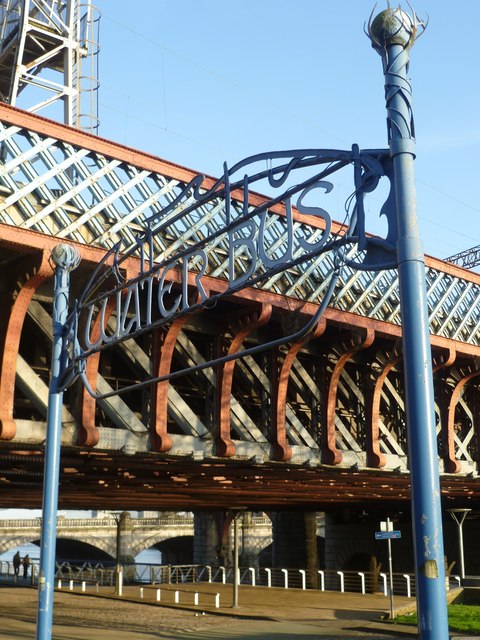
The image shows a wrought steel sign between two lamp posts, forming what used to be where one could approach the river to board the water bus. The metal is painted blue. There's a bridge in the background, making it a little hard to read the sign, with reddish and white-ish structural elements. The cement river walk path is visible running behind the Water Bus sign, and under the bridge.

Broomielaw Water Bus sign. The bus is no longer in service, and honestly the river doesn’t see much use these days, except by seagulls. The old sign’s still there, though.

So we walked. Very slowly. Gone are the days where I have to remind her not to pull on the leash.

I’m honestly very fond of Glasgow. It has an interesting mix architecture, a few tall hills that give a bit of a view, and the slightly melancholy feel of a city that used to be a major industrial hub, and isn’t quite as central to global commerce as it once was. There’s a lot of construction going on year-round, and the city seems to be fairly busy most times of day. While Scotland’s re-opening has been going pretty well, there are still fewer people out than there were last August, many stores and restaurants are closed, and where Tegan and I were in the distinct minority with our mask-wearing back in March, they’re now required in most businesses, and about half the people walking around outside are wearing masks of one sort or another. We’re still relying on bandannas, but most people seem to have bought either surgical masks or some of the various re-usable ones that are now so common. I feel like a lot of people’s ears must be a little sore from being used as mask anchors, but maybe not. At some point I plan on whittling myself a wooden mask frame with slots for quilted filters I can run through the wash, but I need to track down some good wood for that. It’s a longer-term project, as I expect that novel viruses and masks are going to be much more present in the second half of my life than they have been in the first.

Anyway, we got to the vet, after stopping to let the dog rest in a couple parks along the way, and experienced our first big change in procedure since the pandemic started. We had to go around the back, call them to let them know we were there, and then wait outside until they came to get Raksha. I think we ended up waiting somewhere over half an hour.

Which brings us back to the weather. No matter what city I’ve lived in, someone would, at some point, tell me that if I didn’t like the weather, I could just wait five minutes. This has always had a touch of hyperbole to it. Not so in Glasgow. I don’t know if this is normal in the rest of the UK, though I expect it’s not far off, but the only time there’s weather that’s constant, particularly from one day to the next, is when there’s rain.

The reason the UK is so warm, despite being farther north than much of Canada, is that the Gulf Stream is constantly bringing heat up from the tropical Atlantic, and blasting the island with warm, humid air. The change of conditions as it leaves the ocean and rises up over this island results in a great deal of water condensing out and falling down. Sometimes there will be rain that lasts a few days, and farther south there seems to be a lot of flooding.

But in Glasgow, the default seems to be that if you don’t like the weather, wait a few minutes and the odds are good that it’ll change. We sat in chairs kindly provided by the vet, in gentle sunlight, and a few minutes later, were the beneficiaries of a gentle, soaking rain. The veterinarian came out, realized it was raining, and gave us an umbrella. I had considered bringing one of our own, but decided against it. About five minutes after we got the umbrella, the rain stopped.

The image shows a stone arch, that appears to be the entrance to a grand, old building that no longer exists. The stone is mostly reddish-brown, with a more gray-colored decorative arch over the doorway, peaked with a cross. Through the door, and around the outside of the arch, other Glaswegian buildings can be seen, making it clear that the lonely doorway stands at the top of a steep hill. The Rottenrow Gardens are a tiered garden with benches and walkways climbing down the hill below, out of view of the camera.

Rottenrow Gardens. A few rows, not much in the way of rot. Naming conventions on this island continue to intrigue me. This is the former site of the Glasgow Royal Maternity Hospital.

Raksha got her checkup, and some vaccines. She’s got a lump on her throat that seems to be benign, but it’s also likely the reason she’s been making the occasional horrible hacking noise. Apparently when she lies a certain way, it probably puts a little weight on her windpipe, and irritates it.

We got her meds, and headed back. It was lovely to be out among humanity for a while, and I still enjoy seeing people’s reaction to Raksha. Generally, most people seem to find her charming, and children seem to find her both fascinating and a little scary. A surprising number of them seem to think she might be a wolf of some sort, and I suppose they have a bit of a point. We were dry by the time we got home, and really my only regret was that I didn’t have any money to give to the folks who asked for some. Hopefully I’ll be able to start doing that again soon.

I don’t know how much longer that trip will be doable for Raksha, but she seemed to enjoy most of it, even if it was a bit longer than she’d like. She’s currently sleeping the sleep of one who has done about all she can do for the day, and Tegan and I are feeling just a little bit more connected to humanity. Glasgow is, on balance, a beautiful city. It seems unlikely we’ll be able to stay here as long as I’d like, but it’s a good place to be while we can.


As mentioned earlier, I’m more than a little short on money these days. There are far fewer jobs than there are people looking for them, so the patrons of this blog are our only stable form of income. It’s wonderful to have people willing to pay me for work they can access for free, so I try to show my appreciation with periodic patrons-only articles, and science fiction. If you’d like to support the work I do here, access a little extra content, or just pay for my dog’s food and meds, you can sign up at patreon.com/oceanoxia. The beauty of crowdfunding is that no single person needs to spend very much for the cumulative effect to make a big difference. Either way, thank you for reading, and thank you for sharing my work with others, should you choose to do so.

Positive Leftist News Roundup from @mexieYT , plus a couple additions of my own.

We live in terrifying times, my friends. There’s a lot of bad going on right now, both in the world, and in many of our personal lives. There’s real reason to be worried about the future, but as ever, it’s not all bad. Mexie is here with her much-needed positive news roundup for those who want a better future for humans around the globe, and the rest of the life with which we share our planet (sources on Youtube):

Honestly a lot of this stuff is encouraging or downright inspiring. It’s especially nice to see the Dakota Access pipeline being ordered to shut down. The fight against that has been long, and bloody, with Democratic and Republican “leaders” united in their willingness to brutalize Native Americans and their allies in service of the oil industry. I often say that many of the advances humanity has made in the last couple centuries have come from fighting against capitalism, rather than because of capitalism (as many in the U.S. like to pretend), and it’s nice to see people who put their bodies on the line win a victory for all of humanity. We owe the Water Protectors a great deal.

I’d like to add a couple other positive news stories relating to climate change and energy in particular:

First up, offshore wind energy continues to get cheaper. While more needs to be done to limit the environmental damage done by wind farms and the manufacturing of wind turbines, they’re certainly an upgrade from fossil fuels, and it’s good to see wind power increasing, even in a world where capitalist profit is valued over the habitability of the planet.

One reason the price of offshore wind has fallen so rapidly is technology development, in particular the ability to build larger wind turbines further out at sea. Larger turbines can harness more wind energy and have access to more consistent wind speeds at higher altitudes.

The biggest wind turbines under construction have rotor diameters of 220 metres — twice the diameter of the London Eye. At the same time, wind farms are getting larger; the newest wind farm at Dogger Bank has the same installed capacity as Hinkley Point C and is expected to produce about two-thirds of its annual electricity.

The success of UK offshore windfarms, which are now primarily built in the Dogger Bank region of the North Sea, also means the UK has considerable skills and expertise than can be exported around the world.

The researchers also say this success means even more ambitious projects may now be attempted at offshore wind farms, such as producing hydrogen fuels using the wind power on site, out at sea. Hydrogen fuels could be another key technology in helping decarbonise the UK, by replacing petrol used in transportation and natural gas used for heating homes.

On my move out here last summer, it was a delight to see so many wind turbines in Germany, The Netherlands, England, and Scotland. I’m glad to hear that trend is continuing.

Next up, a new study indicates that as we continue researching and implementing photovoltaic solar panels, we’re able to make them last longer.

After correcting for variations in weather and curtailment, the group found, on average, the first-year performance of these systems was largely as expected, and that newer projects have degraded at a slower rate than older ones. This suggests photovoltaics technology has improved over time. Interestingly, they also confirmed that projects in hotter climates tend to degrade faster than those in cooler climates.

Longer-lasting solar panels, and a better understanding of what we can expect from each panel over its lifetime, both contribute to photovoltaics as a reliable source of power. A longer lifespan also reduces the amount of silicon extraction and processing needed for a given amount of energy over time.


I want to express my gratitude to my patrons, whose support continues to encourage me to write, and to help make ends meet in these turbulent times. None of us expected the current pandemic to upend everything like it has, and my patrons are the only reason I’ve been able to make ends meet in recent months. That said, I’m still not breaking even. If you would like to support my work, earn my undying gratitude, and feel able to contribute a dollar or two per month, you can do so at patreon.com/oceanoxia. Every bit helps!

Exploring the Wilds of Scotland

While our building’s courtyard is very nice, it’s a little boring sometimes. Other times, it’s a bit too exciting. The seagulls apparently object to Raksha hanging out there during their breeding season, and so a couple months ago, particularly at night, they started making a lot of noise and swooping at us whenever we went out. They never got close enough to be a threat, but Raksha now has a somewhat reasonable fear of flying dinosaurs, and gets nervous every time she hears them.

Ah, the joys of island living.

So we periodically go to a nearby park. Well, I say park. What I actually mean is one of those areas under and around a highway on-ramp where there’s a lot of grass and some trees. It’s surprisingly pretty there, with surprisingly little litter, and the seagulls apparently don’t object to our use of the place.

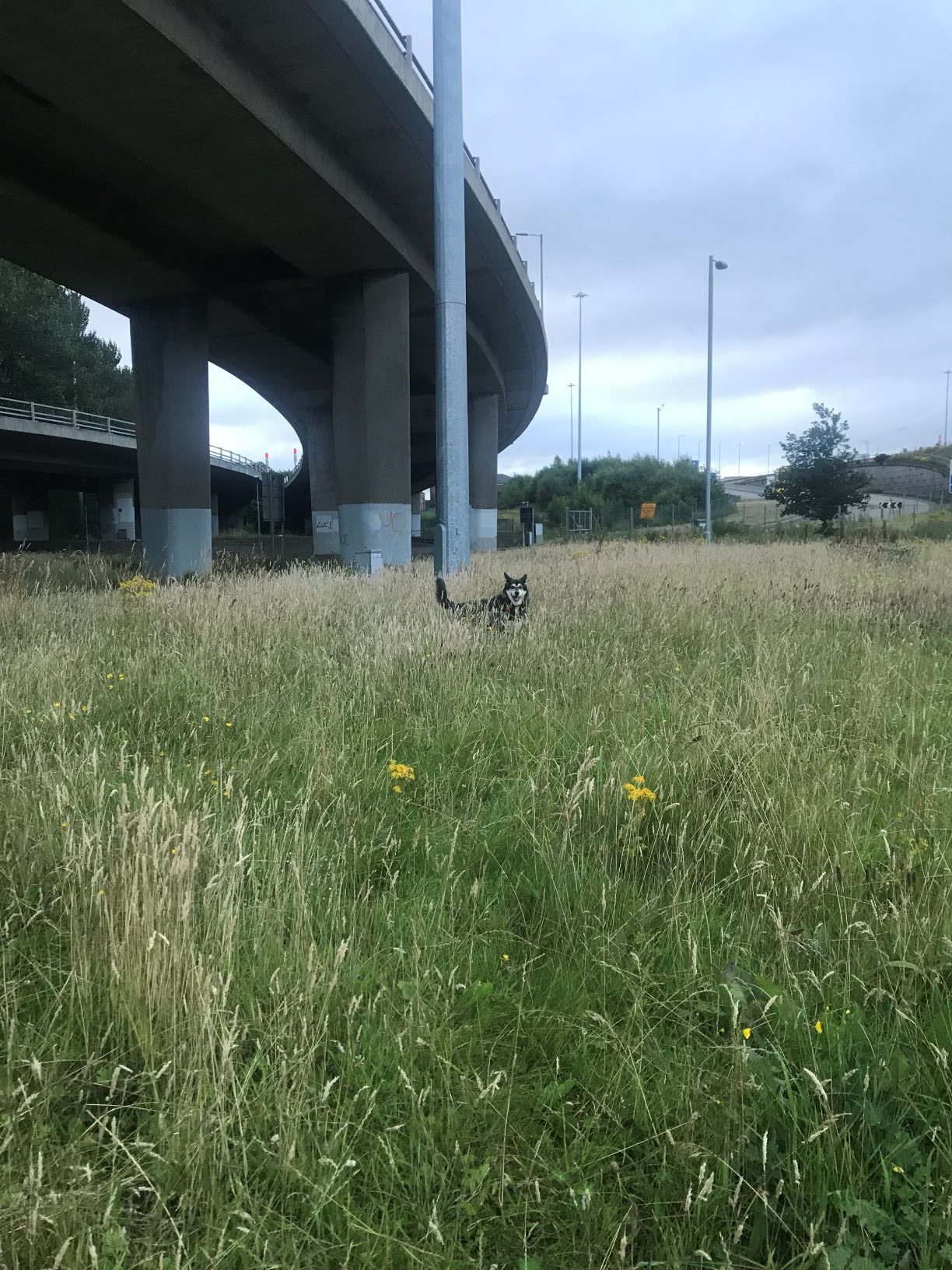
This image shows Raksha in a field near a highway overpass. The bottom half of the image is green and tan grass, with a few golden flowers, and Raksha. She is a mid-sized mix of German Shepard and Husky. You can see her black fur and tail, her pointy black ears, her white cheeks and eyebrows, and her black eyes and nose. She is waiting for me to throw a pebble for her to chase. Above and behind her is the highway overpass, with a few very tall street lights near it. Some trees are visible in the background.

The Beast lurks in the grass. She would like me to throw something for her.


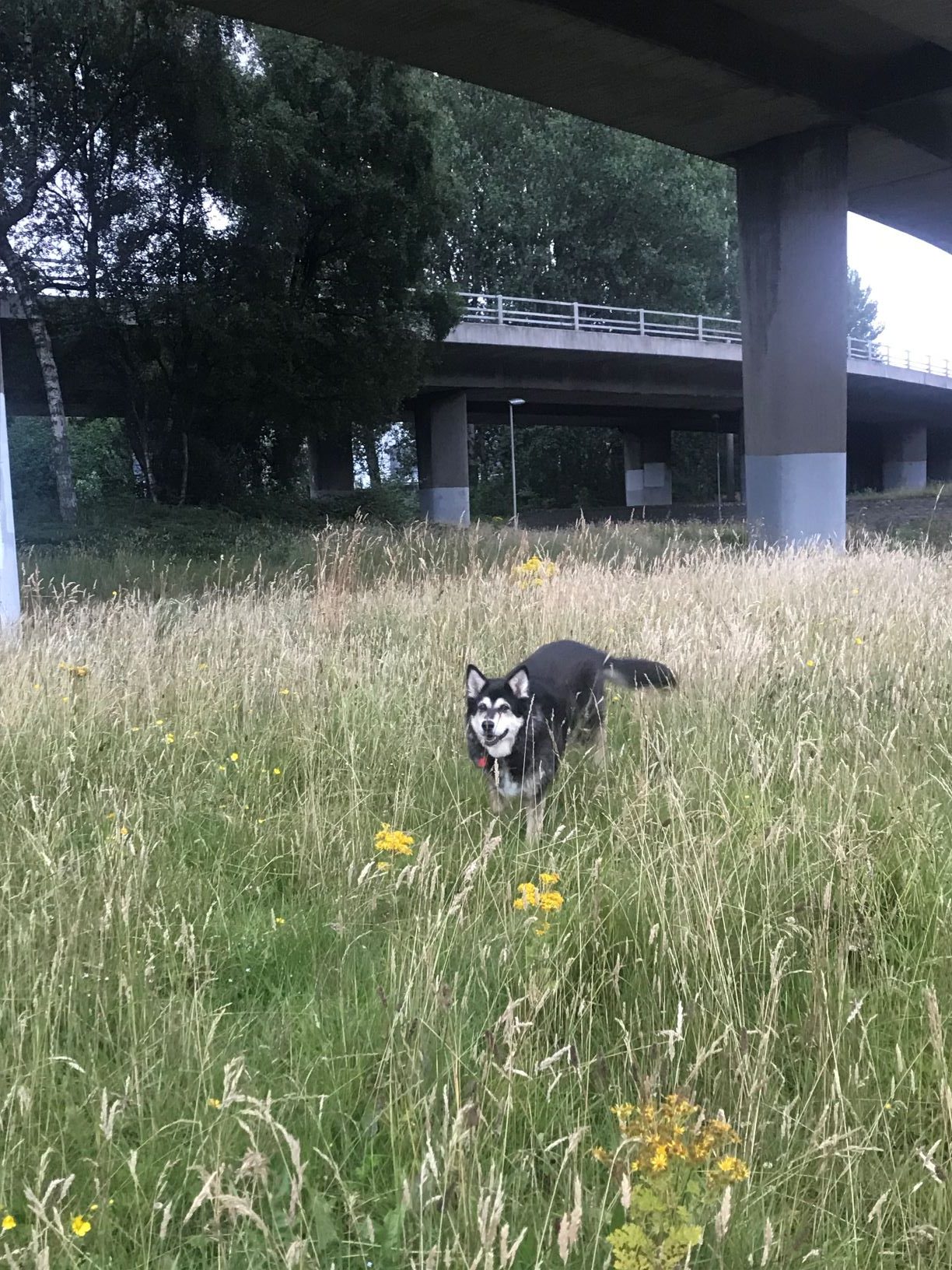
The image shows Raksha coming closer. She is a mid-sized mix of German Shepard and Husky, with black fur, white cheeks and eyebrows, and some white on her chest and legs. her ears are visible as white triangles with black outlines. She is in a field of green and tan grass with some golden flowers and two concrete highway overpasses and some trees in the background.

The Beast feels that I am not throwing the pebble in my hand fast enough. She approaches, jaws open, to scare me into doing her bidding.


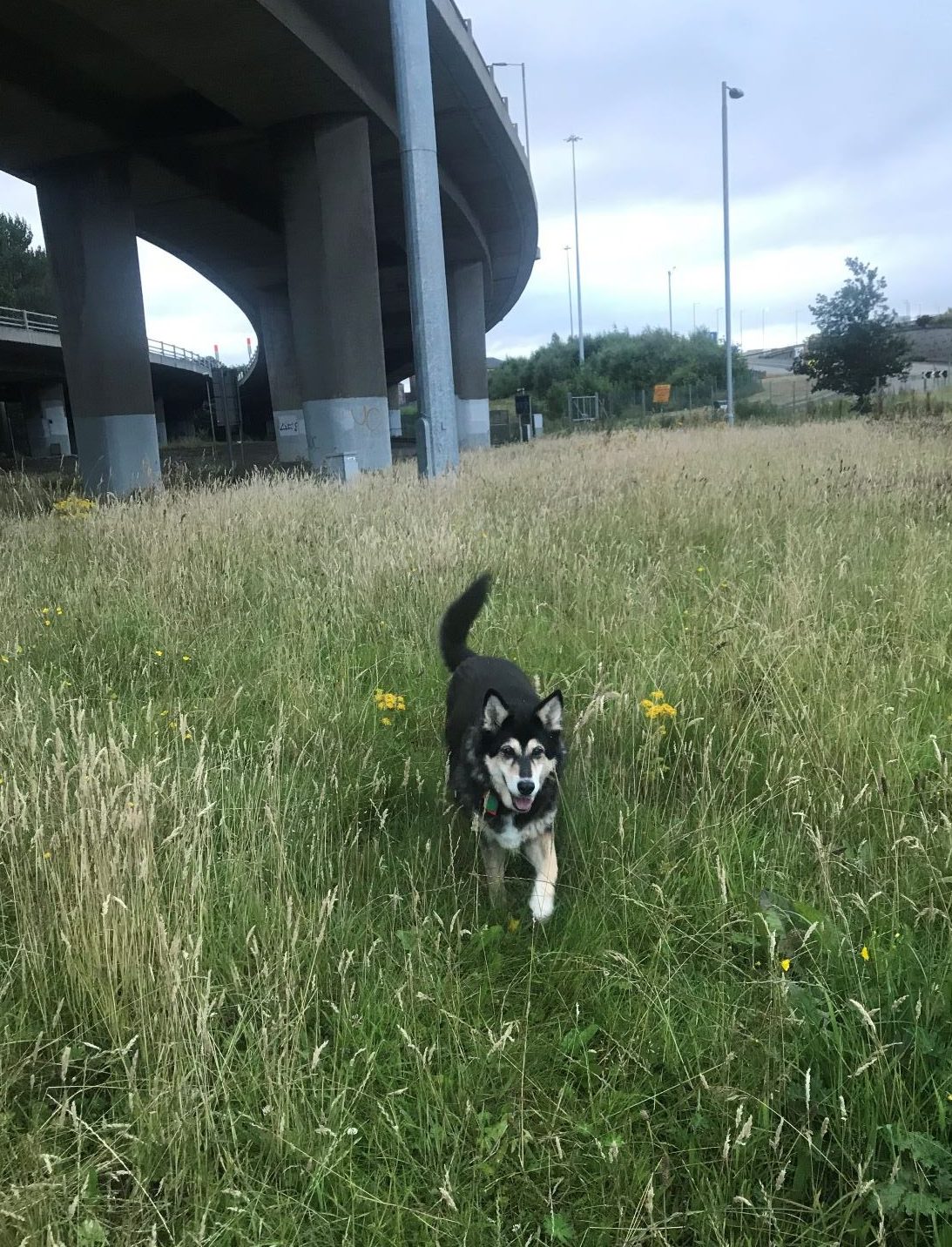
The image shows Raksha approaching. She appears to be having fun. She is panting a little, has one paw lifted up, mid-stride. Her cheeks and eyebrows are white, her eyes and most of the rest of her is black. Her ears are two white triangles with black outlines. The field is green and tan with golden flowers. An overpass and some trees loom in the background.

The Beast approaches. I must now throw something, or face certain doom.


The same scene - tan and green field with yellow flowers and looming overpass. The dog is now mid-leap, facing away from the camera as she bounces after a thrown pebble. Her fur is black, and her ears are two black triangles as she bounds through the tall grass.

The Beast Sproingeth. Now that I have, finally, thrown a pebble for her, she will bounce around in the field looking for it until she gives up, and comes back to demand I do it again. I use pebbles because she never brings back the things I throw.

In her youth, Raksha’s favorite pastime was chasing stones thrown into tall grass. She can’t dolphin around looking for them as much as she used to, but she still enjoys it, and it’s nice to live in a place where I can provide that for her again, now that she’s an old lady.

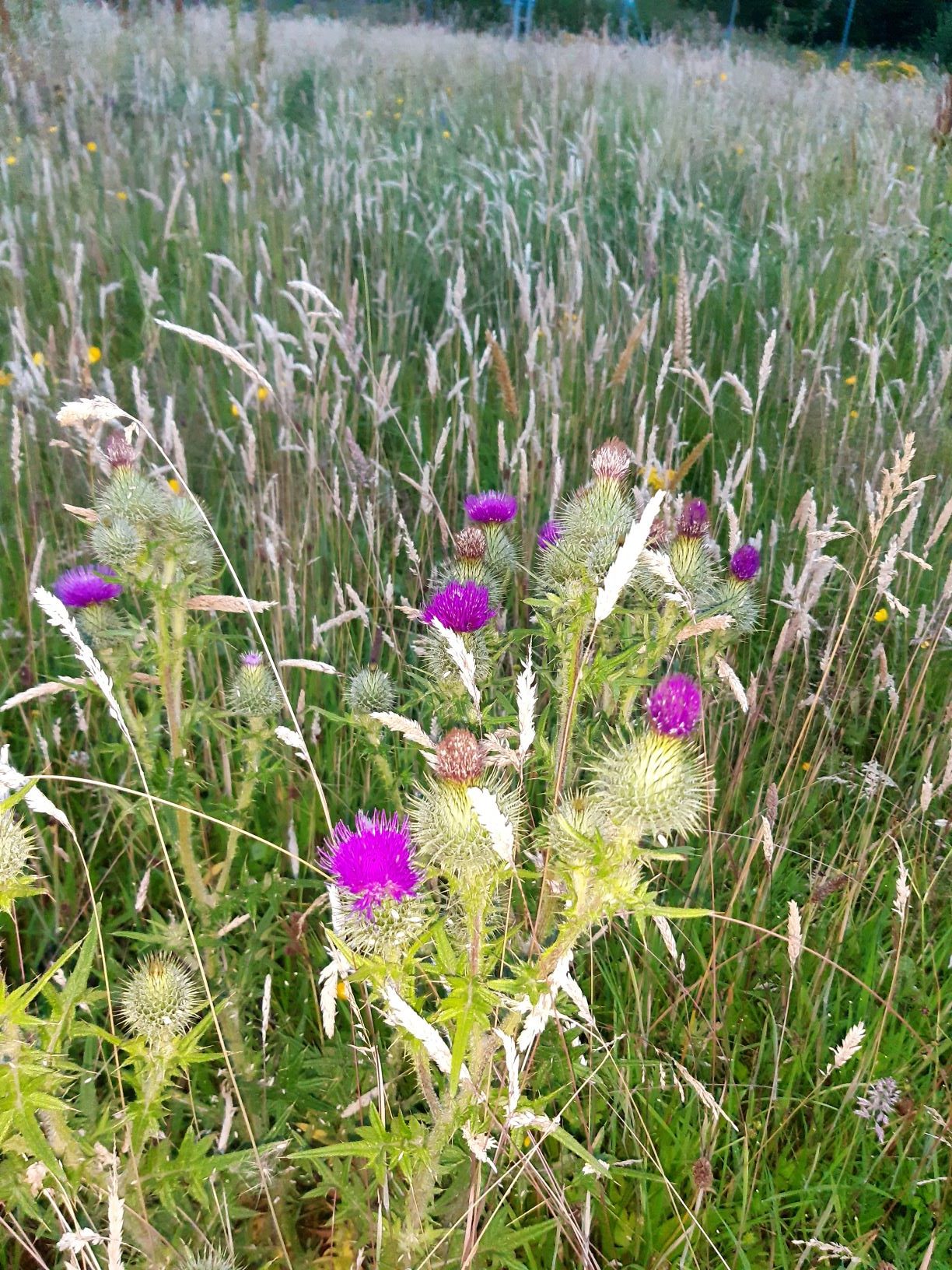
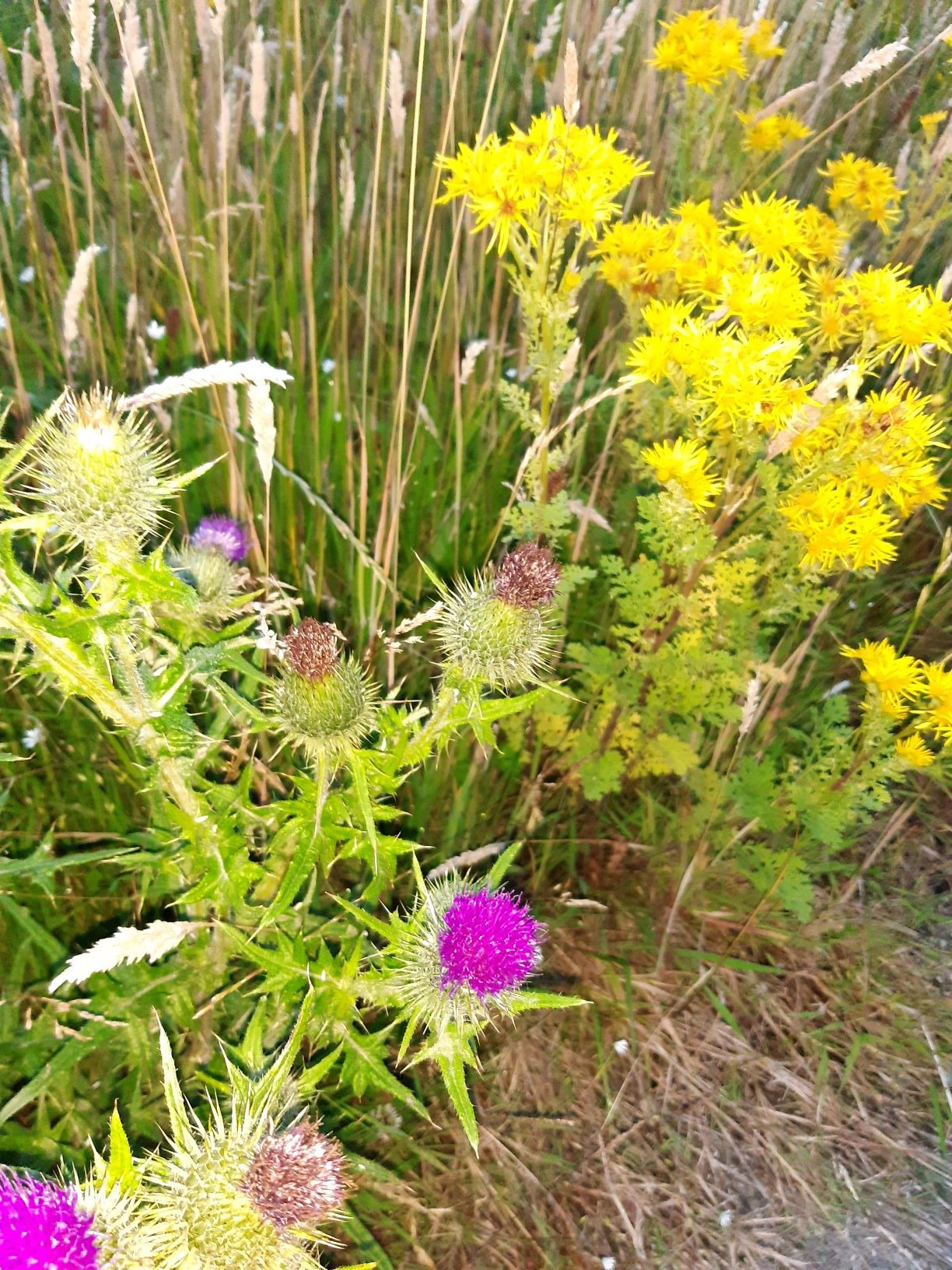
The image shows a Scottish thistle. The leaves are very spiky. The floweriug is a ball of spikes maybe an inch or two in diameter, with a bright purple tuft at the top. It is a more imposing flower than any of the thistles I encountered in the United States

Feuch an cluaran, suaicheantas nan Albannach


The image shows a thistle plant, with spiky leaves and flowers, topped by purple tufts. Behind it is another plant with light yellow flowers.

Dh ’fhaodadh tu seo a chleachdadh mar chluba.

Urban living really is more pleasant when one has access to even a little pocket of “wilderness”. I’ve even seen a fox in this spot!

If you enjoy these pictures, or find this blog to be a useful resource, please consider supporting me through patreon.com/oceanoxia. You can sign up for as little as one U.S. dollar per month, and every new patron really does help a great deal. Aside from helping me make ends meet, you also get access to some patrons-only articles and short stories that aren’t available anywhere else.

On avoiding war: Another must-watch video from @BeauTFC

The Republican party, led by the Trump administration, is pushing the United States ever closer to something like a civil war. In many ways, the protesters and those supporting them are involved in something very like an insurgency, and our goal should be to avoid that crossing the line into warfare. If riot gear is replaced with bullets, that’s bad news for everybody. As Beau has been saying, there are a few layers of bad. The first is the simple fact that there’s no guarantee of victory for those of us who want justice and equality. The second is that even in the event of victory, political change achieved through force of arms generally doesn’t result in a peaceful, just, equitable society. It’s not a path likely to get the results we want.

The third, and most important, is that this movement has the politics of race at its core. If it comes to bloodshed, the people most vulnerable are those who LOOK like they’re part of the insurgency. Right now, Trump’s “Brute Squad” are targeting people who’re wearing black, or carrying shields, or wearing helmets – protesters who stand out.

If we enter some form of warfare, the rules change. People involved in combat can and will work to not stand out, because going toe-to-toe with the armed forces of a nation – particularly the United States – is a great way to get killed, even without fascist terrorists looking to “help out”.

The difference between dark skin and clothing has always been at the core of this. Black people don’t have the option to blend in. They stand out by default, and that makes them the most obvious targets if things get out of control. They already have targets on them, and further escalation will make those targets glow. The same goes for other groups with darker skin, and for people like Muslims who dress in a particular way.

We want change, but we do not want war. We have little control over what Trump and the Republicans do, while they are in power, which means that, as always, the American people have to show more discipline and self-control than the authorities. We need to win the messaging battle. We need to be sure that at every turn it is as clear as possible that the “authorities” are the aggressors. That doesn’t mean people shouldn’t defend themselves. Shields, helmets, gas masks – all are good and appropriate things.

But we do need to be clear about what we do and don’t want. We need to be clear about what war would mean both for the country as a whole, and for the people in whose name this movement began.

As always, Beau of The Fifth Column has made a video that everyone should hear. He talks about the numbers of what war would actually mean for the United States.

Just as importantly, he talks about the steps people can be taking right now, both to avoid war, and to start creating the change we DO want without the need for bloodshed. Please watch the video. If you’re unable to, and the captions provided by Youtube don’t work for you, let me know and I’ll either find or make a transcript.

Obviously I still need financial support, and if you’re able to contribute at patreon.com/oceanoxia. That said, I think the work showcased in this video is more important than what I’m doing. If you can, please consider supporting it at patreon.com/beautfc. And take the advice in this video.

Musical interlude

Well, shockingly my involved post on insurgencies, American political unrest, and avoiding civil war is taking longer than planned. Doesn’t help that I spent several hours working from the wrong edition of the Army manual. Sigh.

Time for a break and some sleep.

In the meantime, here’s a lovely song about strike-breakers:


Please watch this video

I’m working on a long, involved blog post relating to this video and the playlist of which it is a part, but I think it’s important for people to watch this by itself. This is particularly aimed at people in the United States, or those interested in what’s happening there, but I think it’s worth paying attention to for everyone else as well, because it’s relevant to the dynamics of government and power in any society. Watch the video, and if you can, please support the work of this channel.


An important source of information from on the ground in Portland

As my readers may be aware, all is not well in the heart of the American Empire. There have been continuous protests across the United States for a number of months now. Some state and local governments have turned from repression to bargaining, and starting make concessions to the Black Lives Matter movement, and the protesters’ demand for a system that better serves the working class and racial minorities. The federal government, under the control of the Republican Party, has decided that justice and peace are less important than brutal domination. It has been pointed out, and I’ll write more on this tomorrow, that the Republican use of federal or other “law enforcement” personnel to detain, assault, and harass protesters goes against everything in the government’s manuals about how to handle situations like this. If we assume they are paying attention to the manuals, or to history, than more violence, chaos, and unrest are their goal. They want this to get worse.

That being the case, it’s important for folks to pay attention to what’s happening in Portland right now, because the GOP, under Trump’s leadership, has told us that they intend to replicate that “strategy” across the country.

Crip Dyke has been doing valuable reporting from the ground there, on her blog Pervert Justice, and I urge you all to check out her work there. It’s important to know what’s going on, to get reporting from sources other than corporate media, and to familiarize yourself with the tactics used against people exercising their right to protest, and the tactics being used by those protesters to defend their rights against state repression.

I was going to link to one or two of the posts there, but honestly, just go there and read all of them. Whether you’re an American citizen or not, whether you’re an American resident or not, it’s worth paying attention to this. The tactics used by the government mirror those that have been used by authoritarian regimes all over the world. One of the more graphic examples is the Law Enforcement tactic of aiming cause brain trauma or to destroy eyeballs – something they seem to be copying from the regime in Chile. At the same time, we’ve seen protesters adopting tactics used by those struggling for freedom in Hong Kong.

There’s a lot going on right now, and right-wing authoritarian governance seems to be on the rise. It’s up to all of us to keep an eye on that, and fight back as best we are able.

Check out Pervert Justice. Read Crip Dyke’s reporting, and be sure to follow her blog to keep up to date. I’ll have a post up some time tomorrow talking manuals, tactics, and rhetoric, but observations from on the ground are essential.

Michael Brooks -1983-2020

Today I’m mourning someone I never met, and never talked to. I’ve felt sad about the death of a number of famous people whose work was a part of my life, but this is the first time I’ve felt a sense of personal loss akin to losing a friend or a family member. I’m reasonably certain he had no idea that I existed, but I feel a need to write about the impact that his work and his attitude had on me.

He didn’t start my interest in international politics, but he broadened it, and he deepened it.

He didn’t start my interest in a better world than capitalism could offer, but he focused it, and gave it weight and guidance.

He didn’t give me empathy for people with experiences different from my own, but he gave me some of the tools to understand those differences, and feel a stronger commitment to the happiness of people I will never know.

He expanded my understanding of the world, and expanded my mind in a way that I never expected.

He didn’t give me the ability to speak my thoughts on controversial topics, but he helped give me the perspective and courage to do it in a way that might reach past the mental walls that people put up around those topics.

He wasn’t the first political journalist and commentator who was able to bring a combination of deep knowledge, empathy, and courage in the face of difficult or horrific subjects, while also acting as a comedian and entertainer. He was a great example of someone who worked hard, and lived well.

He did a lot of good work, himself, through writing, through The Majority Report, The Michael Brooks Show, and many other media. Beyond that, though, he had a remarkable ability to find people, perspectives, and information that was vital to what’s happening in the world, and to bring them to other people.

He taught me a lot, but more importantly he introduced me to a great many people from all over the planet who taught me even more. His life’s work was to elevate humanity, and he went about that in a very direct way. He lifted up other people so their voices would carry farther. He knew a staggering amount about the politics of the world, and worked hard to guide others to that same level of understanding.

I was never sure how I felt about him, as a person. It was always very clear that his guiding light was a commitment to the wellbeing of humanity, and to living a good life, while fighting a good fight. His personality grated on me sometimes. His humor, in particular, sometimes seemed a bit mean-spirited, and I often felt that I might not get along well with him, or him with me. Maybe he reminded me of someone I didn’t get along with in the past, I don’t know.  Hearing his friends memorialize him, I can well believe that the empathy and care for humanity that came through in his work also came through in his personal life as well.

But he provided an insight into the world that I’ve never seen anywhere else, and that I will always miss, and I doubt I’ll ever be able to replace.

And damn, he died too soon.

He was 36.

I learned of his death because Lula da Silva, one of the most important political leaders on the planet today, tweeted about it.

It’s been said many times now, but he had so much to give. He hit the turbulent waters of the 21st century hard enough to ripple across the world, and I think I’ll always feel the loss of the work he would have done with another 36 years.

If I do as much to lift up other people by the end of my life as he did by the end of his, I’ll feel good about myself, even if I live twice as long as him.

I’m not on the same path as he was, but his life and his work are one of the stars by which I hope to navigate as I find my own way forward.

I’ll continue using his material on my blog, but please look into him on your own, and if you want to learn about him from those who worked with him, check out the Majority Report memorial show. It’s a long video, and paints a moving picture of a loving friend whose passion for humanity shone out like a beacon.

Environmental rights, human rights, privatization, and climate change: A podcast conversation, and supplemental article.

Last Friday I went on the new podcast, Rights and Wrongs, to talk about environmental and resource rights with George Oakes and Scott Twigg. Check it out below. I do want to apologize for my own sound quality. The only mic I had available was a small one on a short cable, so I had to hunch over it to be audible, and didn’t think to put a piece of cloth over it. My breathing gets in the way about, so sorry about that.

It was an interesting conversation to be a part of, and hopefully, an interesting one to listen to, despite the audio problems. I recommend listening to it. There’s not currently a transcript for this, so if you can’t hear it for whatever reason, the best I can offer right now is the youtube version, with auto-generated captions. They’re not great, but they’re more than nothing if you really want them. Fair warning, the audio on that version is worse, includes more “ums” and the like, along with a barking dog at one point.

The rest of this post, which is a bit long, is to add in supplemental information and thoughts. It’s not a blow-by-blow of the conversation, but hopefully it’ll be a useful companion piece, as well as a stand-alone blog post.

First, on the issue of the Male’ Declaration on the Human Dimension of Global Climate Change (PDF), I think it’s worth noting a couple aspects of the discussion of economics vs human rights. The first is simply that the language of economics and capitalism has become far, far too embedded in our discussion of pretty much everything, in an inconsistent manner that always benefit those with wealth and power. This has been mentioned frequently in the discussion of universal healthcare in the United States – any time it’s brought up, someone will demand to know how it’s going to be paid for, in a way that is never asked of things like military activity. At the same time, economic calculations that show that a particular humanitarian action would actually save money in the long term are ignored. Part of this may be an ideological quirk – that anything that helps people and saves money is simply too good to be true. Another part is, I think, a very dangerous false dichotomy that has been drawn between The Economy, and the needs of people in general.

I don’t think I could pinpoint where in history this trend came about, but versions of it seem to go back quite a ways. The Economy has become a stand-in for “the greater good” in a lot of ways. It seems that our entire society has been structured – at a global level – around the notion that if The Economy is doing well, then the entire world is doing as well as it possibly could be. Along with that come the claims that anything that seems like it ought to benefit the population at large are actually bad, because they would hurt The Economy. Workplace safety, better wages, pollution, environmental degradation – all of these would help pretty much everyone in pretty much every way, but they have all been opposed as being dire threats to The Economy. What it really means, as far as I can tell, is that these measures which would so improve the lives of so many people threaten not our nation’s economy, but the people around whose interests The Economy is designed – the capitalist class, from which capitalism derives its name.

Workplace safety makes everyone’s lives better with one exception – it costs money, and therefor reduces the profits received by the owners of the company. The same is true for better pay for workers, and for environmental protections. The only time things that benefit humanity as whole become “worth it” in the eyes of The Economy, is when continuing to oppose them would cause enough of a mass uprising that it would harm the power and profit of the aristocracy even more than the beneficial measures in question.

The most successful project of the 20th century and the Cold War was creating a global capitalist system, with no real alternatives. In many ways, “developing nations” have taken on a role, in relation to the various imperial/colonial powers of a “free” working class. On paper they have rights, and sovereignty, but as the signatories of the Male’ declaration point out, those rights only really exist when respecting them does not interfere with The Economy. Historically, this has been most evident in the ways in which international activity has affected the politics and national economies of the countries in question. The end of colonialism came with various arrangements that left countries that had long been looted for the benefit of their colonizers with few options when it came to actually benefiting from the wealth that made them targets in the first place. Attempts to actually exert their sovereignty have resulted in everything from economic sanctions, to coups, to outright invasions. In reality, life, liberty, the pursuit of happiness, the sovereignty of nations – none of that matters unless it does not interfere with the endless hoarding of wealth by the capitalist class.

Small wonder, then, that climate change has followed a similar trajectory. The entire history of the efforts to deal with climate change has been plagued with this insidious, false dilemma. The only reason that the inaction might have surprised the “developing world”, who are long used to being treated as disposable, is that unlike other environmental issues, there’s no real way for the capitalist class to avoid the consequences of climate change.

But boy, are they trying. Unless we build solidarity as a global species, and work to value human life and happiness over the priorities of capitalism, the island nations will not only lose their homes, they will then be subjected to all the worst abuses we’ve seen inflicted on immigrants the world over.

Because helping them might hurt The Economy.

As Scott rightly points out here, we’re in a situation where this endless homage to The Economy now serves not to minimize and erase the suffering and death of portions of the population, but to minimize and erase the possible – and avoidable – demise of our entire species.

The second bit is on the phenomenon of enclosure, and how it applies to water. As I’ve said many times, I’m no expert on this, but here’s where my understanding is currently at:

The transition from feudalism to capitalism required a major shift in how the ownership of land was considered. Under feudal society, while the nobility had nominal control over the land, the lower classes also had rights to that land, and it was generally used for the maintenance of the society, rather than the creation of excess – what we now call “profit”. There were people who accumulated wealth, of course, but that wasn’t really the driving force of production at a systemic level. In order for capitalism to exist, all of that common land had to become someone’s “private property”, as did the resources needed to work the land. That allowed for production to be driven not by the needs of the local community, but by the creation of excess, which belonged by law to the landowner, in one form or another.

This process did result in the creation of excess material resources, at least in some ways, but it also changed the rules by which a person had to survive. You couldn’t make your living by hunting, gathering, or working common land for food and shelter, you had to work for wages, and use those to get those simple bear necessities of life. It was a long process, with some benefits, and some downsides, and it’s worth learning more about. I think this article from Socialist Appeal is useful in this regard, but there’s a lot more out there if you want to look into it.

One of the problems with this, as I see it, is that capitalism wasn’t just born with the enclosure and privatization of the commons, its existence has also always depended on endless new enclosure. That has been the engine of the “endless growth” economic model, and it has been largely hidden from most of the people benefiting from this process – the middle and upper classes of so-called “developed” nations. The colonial powers had limited space available for enclosure within their own territories, and so they began to conquer and enclose other territories around the world. On the continent of Africa, this resulted in the mass removal of some people through the slave trade to the American continents, the extermination of other people to make room for settlers, and the mass enslavement of others, most notoriously in territory that Belgium conquered in the Congo River region.

In North America, the process was primarily one of ethnic cleansing through forced relocation, a never-ending series of broken treaties, the destruction of food sources to create famine, biological warfare, and direct mass murder. South and Central America endured similar fates to Africa and North America.

Asia, Australia, and various island nations saw the same thing happen, to varying degrees.

In the United States, at least, all of this is treated as largely in the past. It’s History, and so part of some closed chapter that no longer affects us much today. If you ask the various Native Americans, I think they’d tell a different story, as would most minority groups in the country. The reality is that this process never stopped. The Dakota Access Pipeline is one recent, famous example of the effort to seize and enclose Native land for private profit. A couple other examples are the ongoing deforestation in Brazil and in Indonesia. As climate change alters the entire surface of the planet, the capitalists and their enablers are actively planning to expand this process into the Arctic as well, to continue the fantasy of endless growth, with no regard for the cost.

When it comes to water, the situation has always been a bit more fluid. By its very nature, water is generally difficult to enclose, and because it’s so essential to every aspect of life and society, there’s a degree to which enclosure was simply not practical. The claims of territorial waters, and the various international disputes over things like fishing rights are a good example of this. This has come up recently in the conversation surrounding the United Kingdom’s exit from the European Union – fish don’t respect lines that humans draw on maps, and their life cycles often take them from one country to another. If the UK were to over-fish “their” waters, that would hurt the fisheries of other countries that border on the North Atlantic, and that’s something that can get pretty heated. Look into the Cod Wars if you want an example.

So even as capitalism took over the world, water remained a commons, primarily restricted, protected, and exploited at a governmental level. Some corporations bought rights to bottle and sell water, but they often had to compete with municipal water supplies, or with the ability of people to simply draw water from nearby rivers, lakes, streams, or wells. That meant that while bottled water might often be a convenience, as long as a person had access to either clean tap water, or the means to boil or filter water for themselves, bottled water was mostly a luxury. It was a way to get clean, safe water quickly and conveniently. There are two problems with this situation. The first, from the point of view of corporations that profit from selling water and other drinks, is that they have to compete with water suppliers that aren’t trying to make a profit, and therefor can keep prices right around the cost of production.

The second is that as a commons, water sources are very vulnerable to things like pollution. The environmental movement was driven, in part, by the horrific consequences of water pollution – almost entirely by capitalist corporations – for those relying on those water sources. A lot of progress has been made, at least in some parts of the world, but even with much of the industry supplying the United States now operating in and polluting other countries, the problem has not gone away.

In January of 2014, a chemical storage tank owned by one “Freedom Industries” broke open and released thousands of gallons of  4-Methylcyclohexanemethanol – a chemical used in coal production – into the Elk River of West Virginia. The spill was upstream of an intake for the public water supply. Much of the groundwater in West Virginia is polluted, and has been for some time. when the Elk River spill happened, the river was the only “clean” water source available for that community, and the citizens were forced to rely on bottled water from outside their region. The spill not only highlighted negligence within the coal industry, but also the degree to which industrial pollution has put some parts of the United States right on the edge of being without a clean water supply.

In reality, millions of Americans have been without access to safe drinking water for some time, and the situation is as bad or worse around the world. In general, the closer an area is to industrial activity, the more likely it is that the water will be contaminated in some way, and that the people living there will be poor and politically powerless. Most decisions that result in poisoned water supplies are made by people who are not, themselves, exposed to the consequences of those decisions.

This is a problem all by itself, but unfortunately the situation is worse. It’s not just reservoirs and rivers that are being polluted, but aquifers are being put at risk by the natural gas industry, and are also being drained faster than their natural rate of replenishment.

History has show us that corporations are usually among the first to know about the harm that’s being done by their products or their byproducts. History has also shown us that with no exceptions I can think of, they respond to this information by doing their best to bury it, and silence anyone who tries to sound the alarm. While this is most likely done to serve the interests of short-term profit, in the case of water pollution, it has resulted in the gradual elimination of safe water sources that can be easily accessed by the working class. By accident or by design, the corporations that profit from selling water have seen their competition being eliminated.

Climate change has been rightly described as a “threat multiplier”. In the case of water, the implications of a hotter Earth are dire. Not only is water one of the most central ingredients for all known life, it is also the primary means of cooling available to a vast array of organisms, ourselves and our food included. Higher temperatures mean humans need to drink more, so our bodies can cool off through sweating. We also use water to cool ourselves through swimming, cold showers, and so on. Plants also require more water in higher temperatures, meaning the water demands for outdoor farming will be increasing. Without adequate planning, this will mean that the draining of reservoirs and aquifers will accelerate as the temperature rises, and much of the world will become increasingly reliant on water shipped in from elsewhere. This problem will be compounded again as refugees leave parts of the planet that are no longer habitable, further concentrating other populations.

As dire as all of this is, at this point I think it’s essential to emphasize that many of the problems of scarcity we’re facing, whether it be water, food, or housing, are artificial. Just as we have more than enough for everybody today, odds are we’ll have enough as the planet warms, as well.

But if we continue to use a system that prioritizes concentration and accumulation of wealth over human need and happiness, then that abundance will be as meaningless as it is today. Ever more people will become hungry, thirsty, and homeless, not because we can’t provide for them, but because we can’t provide for them, and also feed the endless greed of the capitalist class.

There are a few links to relevant resources in the “sources” document linked on Rights and Wrongs, including, but not limited to these two videos from The Michael Brooks Show:


As always, these issues are fare more complex than can be meaningfully addressed in a single blog post, but I hope this serves as a good introduction to the topics, and a useful angle on some of what’s happening in the world today.

If you found this post useful, please share it with others, and consider signing up to support my work at patreon.com/oceanoxia. You can give as little as $1.00 USD per month, though more is obviously welcome, and every little bit helps. This is currently my only source of income, and it’s not enough to actually pay the bills yet. Patrons get my undying gratitude, some extra blog posts, and a monthly science fiction story set in a version of New York City that survived the coming century, and continued existing for at least another couple thousand years, with much higher sea levels.