The Probability Broach, chapter 24
Win and Clarissa are on their honeymoon, but he’s still trying to figure out why the North American Confederacy is so different from his world. After much searching, he thinks he’s found the point where the two timelines split. In the NAC, the Declaration of Independence has one extra word:
The screen split, showing nearly identical documents side by side, the handwriting far too small to read, one tiny, illegible word blinking on and off. Clarissa punched ZOOM. The vital paragraphs leaped into visibility, the U.S.A.’s on the right, the Confederacy’s on the left:
…Life, Liberty, and the Pursuit of Happinefs—That to secure these rights, Governments are instituted among Men, deriving their just powers from the…
“There it is!” I paused. “But what the hell does it mean? Is this what I’ve been searching for, what made all the difference?”
She shrugged. “Well, the sentences do have rather different implications, don’t they?”
I thought about that. Yes, if each were followed to the letter. I read “my” version aloud: “…deriving their just powers from the—”
“—unanimous!—” Clarissa supplied from hers.
“—consent of the governed,” I finished.
Smith is fixated on this idea of absolute consent. He hates the notion of any law applying to him against his will. What he ignores is that, if you abolish government, you don’t abolish coercion; you abolish the only means by which people can protect themselves against coercion.
In the laissez-faire, dog-eat-dog world of anarcho-capitalism, if someone is richer or more powerful than you, they can treat you as ruthlessly as they like. If they own the land you live on, they can raise your rent to extortionate levels. Even if they don’t, they can make your life hell by surrounding your house with stinking factory farms or toxic petrochemical plants or deafeningly loud data centers. With no usury laws, lenders can entrap people in debt that compounds at inescapable rates.
Employers can coerce hungry, desperate people to sign their lives away into indentured servitude. They can treat their workers as expendable, sending them into grueling, dangerous conditions. They can make them live in company towns where they can only buy basic goods at extortionate prices and can lose their income and their home at a single stroke if they disobey the boss.
If all else fails, they can coerce you with sheer brute force, sending armed thugs to your door to push you around and make you submit to their demands, or to kill you if you won’t. Again, it bears repeating that all these things have actually happened.
The answer to these outrages is the many banding together against the few, using their collective power as a counterweight. That’s the point of those “Organize” posters.
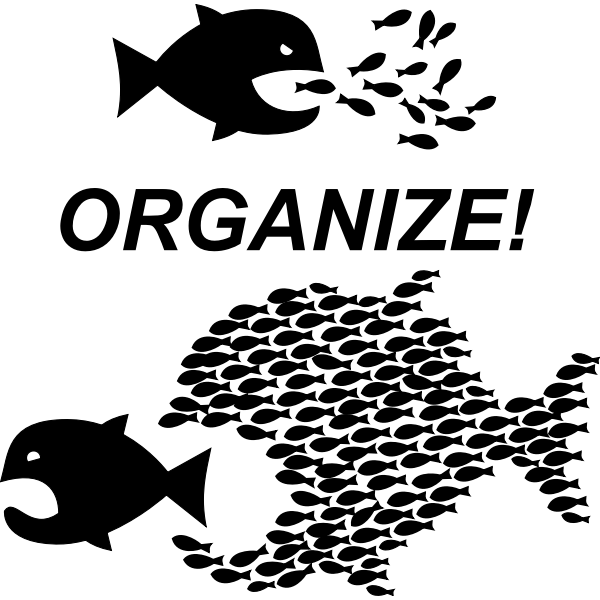
On a large scale, it’s also the idea of democracy. Rather than being ruled by monarchs, or plutocrats so rich and powerful they might as well be monarchs, we can come together to agree on laws that protect us all equally, so nobody can abuse or exploit anyone else regardless of the gap in wealth or power between them. (At least, that’s supposed to be how it works.)
“Win, why do you suppose Jefferson added that one extra word?”
“I don’t know. It would explain Gallatin’s supporting the Whiskey Rebellion. Unanimous consent? Ask those Pennsylvania farmers! Try getting any bunch of people,” I paraphrased Lucy, “to agree unanimously on anything! No wonder your government is so harmless and impotent!”
I was going to make this point, but Win makes it for me. People are unique, quirky, ornery and stubborn. They have wildly different opinions, beliefs, biases and upbringings. A large crowd will almost never agree completely about anything. Therefore, by requiring unanimity, you make government incapable of ever acting.
This means that, in the laissez-faire dystopia, the perpetrators of injustice can prevent action forever merely by voting in favor of themselves. (You may have heard the libertarian jibe that “democracy is two wolves and a sheep voting on what to have for dinner”. Well, my response to that is: Anarcho-capitalism is one wolf and one sheep, and the wolf proclaims that none of the other sheep are allowed to intrude by passing anti-freedom, nanny-state laws about who he can and can’t eat.)
Or a single reckless person can blackmail everyone else, demanding a bribe before he’ll give his consent to solve a problem that threatens everyone. It creates a massive incentive for Prisoner’s-Dilemma-style betrayal.
There’s a real-life example: the Polish-Lithuanian Commonwealth, a 17th-century European superpower. It was progressive for its era: one of the first constitutional monarchies, with legal guarantees of rights including religious freedom, and a nobles’ parliament called the Sejm which elected a king who was required to follow its decisions.
Unfortunately, the Commonwealth had a fatal flaw: the liberum veto, which allowed any member of the Sejm to block any legislation. Exactly as Smith wanted, it required unanimous consent to pass anything. The result was that the state was frequently paralyzed. After an initial period of expansion, its economy stagnated, its wealth became concentrated in fewer and fewer hands, and in times of crisis, it was unable to raise an army or defend its borders. As a result, it was slowly nibbled away by rival powers, until it was partitioned by its neighbors and dissolved.
In a very Ayn Rand-esque coda, Win narrates that he’s learned from NAC philosophers that “there’s only one act of free will… to think or not to think”. He says this is the ultimate explanation for the different wording in the two Declarations:
History isn’t determined by some mysterious impersonal machinery, but by people deciding whether to use their minds or slough it off. In this world, Jefferson decided to insert that one little word. Win Bear and Ed Bear don’t exist in twinned reality because they’re both Indians, but because they—their ancestors—decided they would, history be damned… The old alibis won’t wash any more: we’re responsible, and nothing’s ever written indelibly on that wall.
Apparently, Smith believes you can bootstrap yourself into existence, overcoming historical forces and genetics through sheer willpower. That’s his final explanation for why many people are the same in both worlds, despite their divergent histories.
As bizarre as this is, it fits his ideology. In a sense, this is something a libertarian anarchist would have to say. If people are the product of their heredity or their upbringing, they can’t be blamed for that. You can’t credit or fault someone for traits they didn’t choose to have. It also implies that you can make people better (or worse) by changing the society that created them.
But in Smith’s mind, none of that matters. People are who they are because they decide to be, and for no other reason—and they’ll be that way regardless of the world they exist in. Every outcome on both a personal and a societal level is brought about by people’s individual choice and nothing else.
In that worldview, you could justify not having laws or a safety net, since it won’t create any change in outcomes. But that worldview is based on pure magical thinking. It’s the supernatural belief that free will is a separate thing that not only floats free of both environment and genetics, but is more powerful than either. It holds that people choose to be good or evil, wise or ignorant, freedom-loving or power-hungry, and nothing that anyone else does can change that.
But this is patently not true. Whether or not you believe in anything called free will, humans are the product of their circumstances. Our brains are physical objects, subject to natural laws, and influenced by the environment they grow up in. Change that environment, and you change the people. To hold to a libertarian or religious worldview that denies this, you have to deny causality itself.
Next week: I’ll spend a little time discussing the appendix to The Probability Broach, which presents a timeline for Smith’s parallel universe.
Other posts in this series: