
New on OnlySky: Christians against empathy

I have a new column this week on OnlySky. It’s about the Christians and conservatives who are willing to say out loud that it’s bad to care about other people.

The Christian right has always disdained the idea of caring about the happiness and well-being of others – think of “bleeding heart liberals” or “social justice warriors” – but in recent years, they’re becoming more and more willing to discard the euphemistic language and to openly attack the principle of empathy itself, claiming that God wants us to hate and that empathy is a dangerous sin that leads societies away from God’s truth.

This is a logical development for a worldview that’s based entirely on tribalism, on drawing rigid boundary lines and declaring who’s accepted and who’s the scapegoat. By contrast, empathy is an inherently universal trait, encouraging us to identify with those we’re told to fear and hate. It’s no surprise that the Christian right scorns it, and that suggests a moral direction for nonbelievers to follow.

Read the excerpt below, then click through to see the full piece. This column is members-only, so consider signing up! Members of OnlySky also get special benefits, like a subscriber newsletter:

Christianity seems like it should be the least likely faith for an anti-empathy movement to take root. After all, this is the religion built on the principle of loving your neighbor, welcoming the alien and the stranger, and even loving your enemies. How is that not empathy in action?

Jesus teaches the principle of empathy in the most famous parable of the New Testament, the Good Samaritan. The softening effect of familiarity leads most modern readers to forget just how radical this teaching was in its cultural context. The Samaritans were a separate ethnoreligious group of the early Christian era, related to Judaism but firmly apart from it. Jews and Samaritans were bitterly antagonistic toward each other. Transposed into a modern setting, it would be like Jesus saying that an evangelical Christian pastor and a Republican congressman walked past a bleeding man, but a brown transgender immigrant stopped and helped him.

However, this assumes that a person’s theology drives their politics. In reality, it’s usually the opposite. White conservative evangelicals have always defined their worldview by whom they’re against.
Continue reading on OnlySky…

The Probability Broach: Evil Lincoln

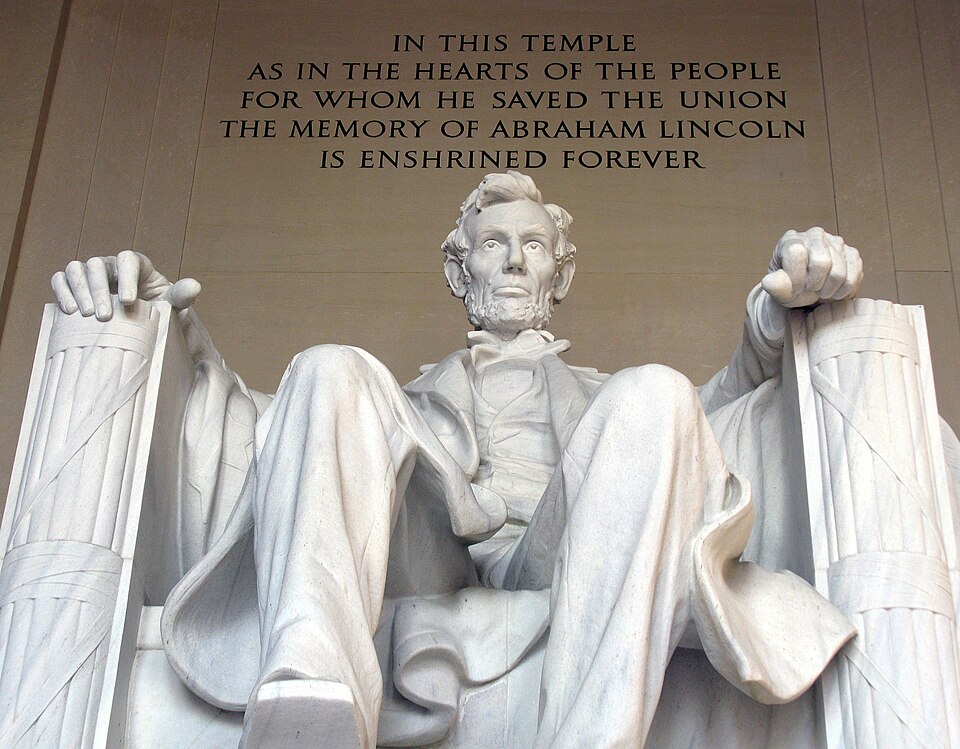
Looking up at the Lincoln Memorial in Washington, D.C.

The Probability Broach, Appendix

In sketching his anarcho-capitalist utopia, L. Neil Smith wanted to put his best foot forward. Among other things, that means he wanted his world to appeal to all kinds of people, and not just white men.

In contrast to Ayn Rand, who loudly endorsed the prejudices of her era (for example, she denounced Asian culture and food, called Native Americans “savages” who had no right to their own homeland, believed women should be subservient to men, and tried to pretend slavery never happened), Smith was at least somewhat concerned about equality. He’s eager to show that his fictional North American Confederacy has less racism and less sexism than the real world.

That is, until we come to this line of the appendix:

89 1865 Actor John Wilkes Booth murdered by obscure Illinois lawyer.

As I previously mentioned, in Smith’s history, Abraham Lincoln assassinated John Wilkes Booth, rather than vice versa. You might think that this is a meaningless historical inversion, silliness for its own sake. But no: Smith despised Abraham Lincoln.

He said that Lincoln should have been put on trial for war crimes like the Nazis at Nuremberg. He said that pennies should be melted down, five-dollar bills should be shredded, and the Lincoln Memorial should be destroyed by wrecking ball. He snarled, “Libertarians know Lincoln as the worst President America has ever had to suffer.”

Why so much venom? In an essay on his archived personal website, “The American Lenin“, he explains why:

Suppose a woman—with plenty of personal faults herself, let that be stipulated—desired to leave her husband: partly because he made a regular practice, in order to go out and get drunk, of stealing money she had earned herself by raising chickens or taking in laundry; and partly because he’d already demonstrated a proclivity for domestic violence the first time she’d complained about his stealing.

Now, when he stood in the doorway and beat her to a bloody pulp to keep her home, would we memorialize him as a hero? Or would we treat him like a dangerous lunatic who should be locked up, if for no other reason, then for trying to maintain the appearance of a relationship where there wasn’t a relationship any more? What value, we would ask, does he find in continuing to possess her in an involuntary association, when her heart and mind had left him long ago?

If it’s not completely clear, the Southern states are the battered wife in this analogy, and Lincoln is the brutal domestic abuser. He held the Union together by force, when some of the states would have preferred to secede. In Smith’s anarchist view, that’s the greatest crime imaginable.

But that’s not all; Smith offers more reasons for his ire. He also says that Lincoln was to blame for the South wanting to secede in the first place:

History tells us that Lincoln was a politically ambitious lawyer who eagerly prostituted himself to northern industrialists who were unwilling to pay world prices for their raw materials and who, rather than practice real capitalism, enlisted brute government force—”sell to us at our price or pay a fine that’ll put you out of business”—for dealing with uncooperative southern suppliers. That’s what a tariff’s all about. In support of this “noble principle”, when southerners demonstrated what amounted to no more than token resistance, Lincoln permitted an internal war to begin that butchered more Americans than all of this country’s foreign wars—before or afterward—rolled into one.

This is a reference to tariffs such as the Morrill Tariff, which was passed shortly before the Civil War. The tariff was a tax on imported goods such as metal tools, machinery and textiles—the idea being to weaken European competition and boost the growing Northern industrial base. But Southern states, whose plantation economy relied on cheap imported goods, hated the tariff. Smith, as a libertarian, takes the South’s side and argues that free trade is a sacred right, so any law that impedes it must be evil.

Now wait just a minute, you must be shouting. Maybe the Southern states had reason to dislike tariffs, but they practiced human slavery on an industrial scale. What’s more, it was enforced with extreme brutality and arbitrary terror. How can that not figure into Smith’s thinking? How can an anarchist libertarian, who claims to value liberty above all else, not cheer the downfall of this monstrous system? What’s really the lesser evil here?

Here’s his answer to that:

The fact is, Lincoln didn’t abolish slavery at all, he nationalized it, imposing income taxation and military conscription upon what had been a free country before he took over—income taxation and military conscription to which newly “freed” blacks soon found themselves subjected right alongside newly-enslaved whites. If the civil war was truly fought against slavery—a dubious, “politically correct” assertion with no historical evidence to back it up—then clearly, slavery won.

With this passage, all of Smith’s pretensions to anti-racism evaporate in a puff of smoke.

This paragraph lays bare the ugly, seething racism beneath the surface of right-wing libertarianism. Smith may have abolished slavery in his fictional world, but when push comes to shove, he still downplays and excuses slavery in the real world.

In the libertarian view, having to pay a percentage of your income in taxes, or being drafted into the army to protect your country in time of war, is exactly the same as living in brutal 24/7 servitude to a master who forces you to perform backbreaking labor for no pay; who tears families apart for profit; who forbids you from traveling or getting an education; and who can have you tortured or murdered for showing the slightest hint of resistance or resentment.

Smith’s extreme binary thinking sees no distinction between these scenarios. Needless to say, anyone who’s actually experienced racism or other kinds of prejudice knows the difference.

The obvious historical reality is that enslaved people wanted to escape and did so whenever they could. In later generations, Black people migrated to the North in huge numbers to escape Jim Crow and other kinds of institutionalized prejudice. In Smith’s view, there was no reason to do this. Since the North had taxes, it was just trading one kind of slavery for another—a monstrously ignorant and insulting dismissal of the lived reality of millions of people who survived unimaginable terrors.

Right-wingers like Smith engage in revisionist history because the Civil War causes them cognitive dissonance. They don’t want to admit that the side that wanted centralized government and more economic regulation was also the anti-slavery side, and the side that wanted small government and laissez-faire was pro-slavery. It casts an unflattering light on their pretenses to moral superiority.

In his fiction, Smith’s solution was to rewrite history to put everyone on the “right” side. In the real world, this move isn’t available, so instead he tries to obfuscate the record and reduce the Civil War to a solely economic dispute provoked by the tyrant Lincoln.

But this revisionist history founders on the fact that we have the Confederate states’ declarations of secession. We can read the reasons they wrote. And each and every one of them cites the preservation of slavery as their chief motive. It’s small wonder that libertarians want to whitewash the record and retreat into fantasy rather than address the evidence in front of them.

Other posts in this series:

The blue wave may give us the national popular vote

If you’re not glutted on good news already, here’s another implication of the Democratic midterm tsunami that deserves more attention: By the 2028 election, we may be choosing the president with a national popular vote.

The electoral college is a blight on American democracy. It gives outsize importance to voters in a handful of unrepresentative swing states, while diminishing the importance of everyone else. It means that conservative voters in reliably blue states, and liberal voters in reliably red states, have no voice at all when it comes to choosing the president. Worst of all, it allows a candidate to win the presidency with only a minority of all votes cast. That shouldn’t be possible in a democracy.

But getting rid of the electoral college would require a constitutional amendment. That isn’t likely to happen, since the states that benefit the most from it would have to vote away their own power.

Instead, reform advocates came up with a clever end-run around the electoral college: the National Popular Vote Compact. States that join the compact pledge to award their electoral votes, not to the candidate who wins that state, but to the candidate who wins the popular vote nationwide. This is allowed under the Constitution, which gives state legislatures the power to allocate their electoral votes any way they wish (Article II, Section 1).

The National Popular Vote Compact takes effect once it’s been enacted into law by jurisdictions which represent 270 electoral votes (an absolute majority of the total 538). As of November 2026, it’s been passed by 18 states plus the District of Columbia, representing 222 electoral votes.

To put it into effect, we need states which hold 48 more electoral votes. Currently, the holdouts include Nevada (6 EVs), Arizona (11 EVs), Michigan (10 EVs), Wisconsin (10 EVs), and Pennsylvania (19 EVs).

But as a result of the 2026 blue wave, Democrats will likely have a trifecta in all five of those states.

A Democratic lock on state government has already been confirmed in four of the five – in some cases, for the first time in decades. Votes are still being counted in Arizona, but a Democratic trifecta looks likely there as well.

This should be Democrats’ number-one priority when they take office. It’s hard to exaggerate how big this is. If we chose the president with a popular vote, George W. Bush would have lost in 2000, and Donald Trump would have lost in 2016.

It would reshape the landscape of American politics, making it impossible for presidential candidates to win solely by courting white conservatives in small rural states. It would boost the electoral importance of the large, diverse, progressive metropolises where most Americans actually live. That’s as it should be. Democrats have the power to do this now, if they choose. We the voters just need to force them to use it.

New on OnlySky: Blue Texas

I have a new column this week on OnlySky. It’s about the blue tsunami of Democratic wins in this week’s midterms, and what it means for the future of politics in America.

Last night, in a decisive verdict on Donald Trump’s chaos and cruelty, Democratic candidates romped to victory in red states all across the country. They won back both houses of Congress and claimed a majority of governorships. Possibly the biggest and most welcome surprise was in Texas, where Democrats swept the governor, senate, and many other statewide races besides, shattering Republican control and breaking a thirty-year electoral drought.

Is this a short-lived fluke brought about by voter anger, or the harbinger of a lasting American sea change? Only time will tell, but we have one relevant historical example to study. Namely, California used to be a solid red state just like Texas – but gratuitous Republican cruelty toward Latino immigrants galvanized a political realignment whose consequences continue to this day. It’s not inconceivable that Texas is headed down the same path.

Read the excerpt below, then click through to see the full piece. This column is free to read, but members of OnlySky also get special benefits, like a subscriber newsletter:

Nothing is new under the sun, and in the 1990s, as it is today, illegal immigration was a hot-button issue in American politics.

There were several high-profile scandals revolving around politicians who employed undocumented immigrants as household help. The passage of NAFTA decimated the agricultural industry in Mexico and forced thousands of Mexicans to emigrate to the U.S. in search of work, raising fears among prejudiced voters of Latino immigrants “stealing” jobs that rightfully belonged to Americans.

In 1994, pandering to these fears, California Republicans introduced Proposition 187. It would have made California the opposite of a sanctuary state, requiring local police to report to federal officials whenever they arrested anyone whom they suspected of being an illegal immigrant. It would have banned undocumented immigrants from receiving publicly funded health care, attending public school, or receiving any other public benefit.

Republicans thought this was a slam dunk, and at first, it seemed they were right…

Continue reading on OnlySky…