
In video gaming, there’s a meme that goes, “I want shorter games with worse graphics made by people who are paid more to work less and I’m not kidding.” To reassure you of the meme’s utter seriousness, the words are traditionally put into the mouth of Sonic the Hedgehog. The meme originates from a tweet in 2020, but continues to echo throughout games criticism.
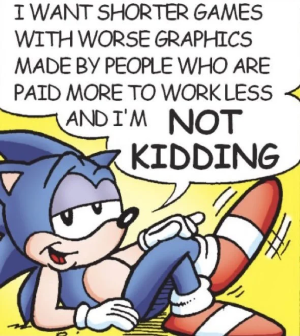
I think a major reason for the meme’s popularity, is that it represents an alliance of two interests. You have people who are upset about the poor work conditions of game devs. And then you have gamers who are tired of the monotony and conformity of big games, who think “worse” graphics make a game better.
Of course, gamers far outnumber game devs. So the tendency is to emphasize the concerns of gamers, and treat game devs as an afterthought. It is assumed, or openly argued, that the two concerns are aligned, which is certainly convenient for gamers.
To show this in action, I have a couple examples from the top search results. In 2025, game reviewer Roger Renfro breaks down the meme into components. When discussing “made by people paid more to work less”, he speaks against exploitation, but spends much more space arguing that this means cheaper games. In other words, even the part of the meme about game devs is made to be about gamers.
In my second example, an article by Luke Plunkett drops “made by people paid more to work less” entirely. Luke writes plenty about game dev work conditions, for example, so I intend no criticism of a writer who focuses on one topic at a time. But it goes to show that if the meme represents an alliance between two interests, it more strongly serves the interests of one of them.
I think it’s worth questioning the assumption of alignment between the interests of gamers and game devs. I don’t think the interests are opposed exactly, but maybe it doesn’t work out as nicely as gamers would like to believe. I think it’s a little perverse that the indie gamer segment uses the meme to convince themselves of the moral superiority of doing what they already wanted to do in the first place. I want shorter games with worse graphics too, but it’s mostly just because I like the games.
Why bad graphics?
From a selfish gamer perspective, there are broadly at least three reasons to prefer worse graphics. First, we’d rather more effort was allocated to refining the gameplay rather than the graphics. Second, bad graphics look good actually. Third, because low-budget games allow a broader range of possibilities.
One of my favored game subgenres are challenging puzzle games. Baba is You is a well-known example (but also just the tip of the iceberg). For what I’m looking for, good graphics can be a negative signal. When I look at a game like Viewfinder or Cocoon, I can immediately tell that they will not satisfy. (And almost anything with AAA graphics need not apply.)
Challenging puzzle games are often made by solo devs or small studios, and they really don’t have time to muck around with nice graphics, unless graphics are a major part of what they’re selling (instead of the puzzles). More detailed graphics can make puzzles worse, because it’s harder to distinguish critical puzzle elements from non-critical decoration. And finally, challenging puzzle games are a genre with niche appeal. A game with good graphics is a game with a larger budget, is a game that’s trying to appeal to more popular tastes.
But there are a lot of caveats. There isn’t a direct relationship between difficulty and audience size. For example, Baba is You is well known despite its difficulty. Some graphical styles are cheaper to make than they appear to the untrained eye. Some games just aren’t appropriately budgeted for their intended audience. And what if you actually like the easy puzzles? You’re allowed, we are not elitists here.
Tim Rogers once said that video game graphics are the suit you bring to the job interview. It’s a social signal, which may or may not be appropriate depending on the job. Knowing what graphics say about a game is one of the secret languages that gamers learn with enough experience.
What are bad graphics?

My mother once saw us playing Celeste, and asked why the graphics are so bad. I don’t know what she’s talking about, Celeste is pretty. Image credit: Gamespot
Back up, what does it even mean to say graphics are bad? The way people talk about it, it seems to mean that the graphics are not realistic, or not detailed. People are bored of every game looking the same. They want graphics with a clear style, that makes an artistic statement, that offers something new.
Is it just me, or does it feel like we’re twisting around the meaning of bad graphics, so that it actually means good graphics? What about the bad graphics that are actually undesirable, the graphics that people see as cheap and lacking effort?
Yeah, so there’s AI graphics now. And people hate it. It turns out that people do not like bad graphics.
My stance about AI in games is I only care about the quality of the final product. Even so, I have to acknowledge that AI art is a negative signal for quality. I frequent spaces that where a lot of solo devs promote beginning projects, some using AI art. And I’m a beginner dev too so I get where they’re coming from. But the ones with obvious AI art are often bad, and it’s hard not to see it.
And aside from AI, there is another kind of cheap bad graphics: premade asset packs. I think asset packs are often invisible to gamers, but to the extent they’re aware, they do not like. “Asset flip” is one of the worst insults you could say about a game.
So what can we say about this? When gamers say they want bad graphics, they don’t really mean it, and they know they don’t mean it. They want “bad graphics” as in an indie art style instead of a AAA art style. They still want a commercial product that looks pretty. They largely don’t understand games below the indie tier.
And fair enough. It’s generally believed that AI art has a corrosive effect on game dev jobs anyway. So that’s just the thing: Sonic is wrong. No you do not want bad graphics. And no, graphics that require less labor to create do not lead to people being paid more to work less.
What’s good for devs?
The larger context is that professional game dev is not a great job. Many studios are known to use “crunch” which means intense overtime for months leading up to deadlines. Job security is very poor, with 33% of devs experiencing layoffs in the last two years. There are big scandals about sexism and abuse in the workplace, which you know means there are even more problems that haven’t emerged into public view.
It’s probably naive to think you can address all these problems just by making the right purchasing positions. The real solution is to require overtime be paid extra (i.e. classify fewer workers as exempt), support labor rights, and create safety nets for people with transient jobs.
Okay, but what can you do with just your purchasing power? Hard to say.
Dump less money into games? How are game devs supposed to get paid more if there is less money to pay them?
Dump more money into games? (This doesn’t necessarily mean more expensive games, it could mean buying lots of individually cheap games.) This is the obvious route to paying devs more, but it seems to be the opposite of what many gamers have in mind. And fair enough, since many gamers could well need that money more than devs do.
Buy games that are less labor intensive to create? That it doesn’t mean devs work less, it may just mean devs work the same amount but with fewer people employed. Recently people have had this revelation that using cheaper AI graphics isn’t good for people’s jobs, but haven’t yet absorbed the implication that switching from ultrarealistic AAA graphics to indie graphics could have a similar effect.
Support the “correct” sector of gaming, i.e. indie games rather than AAA? This is based on the assumption that indie studios are better for game devs compared to AAA studios. But why would I believe this? I have not seen a justification. I have not heard it expressed by professional game devs. While I don’t know about the games industry, tech startups are generally associated with more passionate workers, but also worse job security and increased crunch.
But look, there are still plenty of reasons to want shorter, better games with worse graphics. It’s counterintuitive yet true, and so we can say it. But I think gamers are convincing themselves it’s a more pro-social move, and this is not in evidence.
There is also anger with the AAA companies. Over the past 2 decade there have been a bunch of big releases of major franchises that the players did not think worth the money. The new version turned out to just be some updates and a bunch of new microtransactions/DLC to spend money on. Because of this to a certain extent gamers have turned to buying more cheap games and waiting for the reviews on the big titles.
I suspect it is also gamers getting older. The same people who were happy to buy a $60 game and spend 100+ hours playing it don’t have that kind of time now and would rather get a $10 game they can finish in 20 hours.
@JM,
Absolutely. Monetization schemes for AAA games have gotten worse over time, where indie games (outside of the mobile space) continue to use the premium model. I think the premium model is more pro-consumer and pro-artistry.