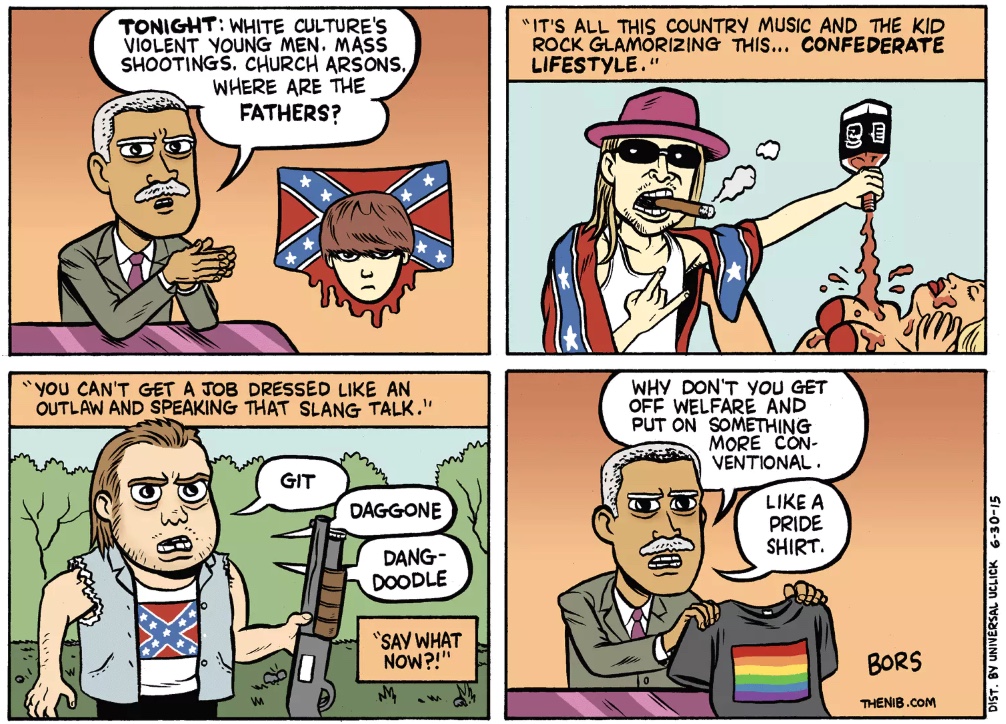
So many thugs here in Minnesota!
Pharyngula
Evolution, development, and random biological ejaculations from a godless liberal

I did not know that Devo was founded in the aftermath of the Kent State massacre.
With campus shut down until the fall and nowhere to go, Casale and friends would decamp to the Akron home of Mark Mothersbaugh, a part-time Kent State art student whose graffiti art had caught Casale’s attention. Parsing through the aftermath, the pair began collaborating, drawing on Dada and other Interwar art movements to create bizarro, disconcerting takes on agitprop posters, 50s ad graphics, and religious pamphlets. They also started playing music—Casale on bass, Mothersbaugh vocalizing over an early Moog synth—hoping to capture the sound of things falling apart.
Even before the shootings, Casale says he’d felt American society regressing. He even had a name for the phenomenon—“devolution,” or “devo” for short—an art and literature concept he’d conceived with classmate and poet Bob Lewis, who also played in the band for a brief stint. It was a response, Casale says, to the failed promise of utopian progress peddled by post-WWII politicians and consumer culture. But what began as an in-joke, fodder for late night discussions and Casale’s graduate work as an art student, took on a new gravity and urgency in the wake of the Kent State shootings.
I did not know anything about the band’s history, but I did figure out that they were all about subversion and highlighting the malignant influence of all-consuming capitalism on the country. It’s nice to see it spelled out. Although it’s not as if Devo was ever subtle.
No one talked about brands in the 1970s in the way the word is used today. Brands were limited to Cheerios or Levis or Marlboros. Other than The Who making a joke on their Who Sell Out LP, and Captain Beefheart on Safe as Milk, there wasn’t even a nod to the irony of “rebellious” rock acts being part of the mainstream, corporate, commercial grind. I was quite aware of that disparity from the beginning. We knew that rebellion and its various poses (leather, chains, long hair) was obsolete and cornpone. We played with that conflicted duality in all that we presented, musically and visually, because that was central to the whole concept. There was nothing we did that was not on purpose. Nothing that I could not articulate. We were a a self-proclaimed canary in a coal mine warning people about the emerging dangers of technology as a god to be worshipped, rather than as a tool to be exploited, and the centralized Corporate Feudal State that seemed to be barreling full speed ahead.
Our brand was real freedom, rather than freedom as an advertising campaign where the consumer was told how to be free. We were performance artists when there was not a label for that either. We were pioneers who got scalped. We were roundly criticized and called “sell-outs” by the rock press for creating self-designed merchandise. We were attacked by preeminent music critic, Robert Hilburn, for integrating film with our live show, where characters and objects were in sync with our musical, theatrical performance. He said, “If we wanted videos, we could go to an arcade. Rock ‘n’ roll or stay home Devo!” Maybe we should have stayed home. But then no one would agree that De-evolution is real as they readily do today.
They were prescient, but they could do nothing to stop the forces of de-evolution. And now we live in the Age of Trump.

Tesla has a drug testing policy, so one can only assume that Musk will be failing it soon.
Tesla stock plunged 9 percent on Friday after a bizarre podcast in which CEO Elon Musk smoked weed and sipped whiskey, and two high-profile executives abruptly announced they were leaving the company.
Due diligence argle bargle shareholders bla bla bla.

He’s been named as the president of American Atheists, succeeding David Silverman. He’s a good, safe choice, having been involved in AA’s affairs for years, and he’s always come across as one of the good guys in my conversations with him — keeping in mind that we’re both white men, and we have the remarkable ability to see each other in the best possible light. In terms of experience alone he was probably the best candidates, although I do wish the committee that appointed him had put a higher priority on diversity.
I thought this comment on the announcement was a good one, though.
I thought this was a perfect opportunity for American Atheists to appoint a woman and / or minority as president. I just can’t get excited about another white dude.
Yeah. I have nothing against Nick, but at a time when atheists need to find common cause with other social justice movements to remain relevant, he’s got an uphill climb in front of him. He will have to work twice as hard to overcome the stereotype that a white dude is going to be privileged and blind to the major conflicts in his movement. He doesn’t have to — it’s really easy for us to coast — but he’s not going to make a mark if he doesn’t work to correct the stigma of atheism.
I have a suggestion for him. Start with that announcement. Right after the comment I quoted above, there is a triggered dude sealioning away about racism against white people. He’s going on and on. Someone at American Atheists, not necessarily Nick Fish, ought to stomp on that crap hard. That’s the kind of idiocy that has to be nipped in the bud, or it’s going to get worse…has been getting worse.
Then there’s another kind of comment.
Well hopefully he won’t be a liberal cuck!
I hope he will be. But if AA is just going to allow that kind of toxic noise to pollute the discussion, he’s doomed no matter what. Shut it down.
Then there’s a bunch of comments that really surprised me.
They could have picked a good-looking one !
Why did they have to use the photo with a mean looking face? Is that really what we want to say about who we are?
Is it just me or he looks creepy
Wow. Criticisms of his appearance? Good luck dealing with those assholes, Nick.
And finally, these twits:
I didn’t know my atheism had a president?
“Named” as new President? I really don’t care. I’m sure the stocks won’t be sky-rocketing over this news. But, was he named president, or voted in as president? I don’t recall seeing a ballot. Didn’t Castro call himself President too?
American Atheists is a professional organization, emphasis on organization, with rules and responsibilities and officers, so god damn fucking of course they have members with specific roles. I am so fed up with these clueless atheists who are so stupidly against any and all authority that they refuse to acknowledge the importance of expertise and regulations and duties within a function unit above the level of the individual. Someone has to do the work, dudes, and clearly it ain’t gonna be you shit-shovelers. You don’t like it, you don’t have to be a member.
I know there is going to be disappointment that a woman or minority did not get this prominent position. But to overcome that setback in opinion, the next step is to crack down on the racist/misogynist element in organized atheism. Be an accomplice with the minority community that is poorly represented in the leadership to take steps in the right direction, and maybe we’ll all see you as an asset.
Also, don’t use your authority as a way to canoodle. Just generally good advice all around.

Bad news, everyone. Fred is dead. Betty ate him. I’m hoping he at least fulfilled his biological destiny before getting his guts sucked out.
More bad news: as I expected, baby spiders are murderous little cannibals, and there’s been a fair bit of fratricide going on, even though they had plenty of fruit flies strolling about. I’ve now separated them all and the survivors now have their own little chambers with their own little fruit fly to gnaw on.
I made a quick video update. Don’t watch it if you’ve got the arachnophobia.
Here’s a story about a lab that has a substantially greater investment in spider science than I do.


NOAA

Oh, good, now we have an argument. After my discussion with Eddie Marcus, others have joined battle: Neil Godfrey and Tim O’Neill in the comments.
I’m agnostic on the subject of the historicity of Jesus, in that I can be whipsawed back and forth depending on who I listened to last. What I was interested in was a much more general topic. What are the criteria a professional historian would use to assess the status of a named figure from the past, when lacking any direct documentation from that person’s life? How do you separate legend from human being? There’s no denying that there is a remarkable mass of unbelievable legend wrapped around this Jesus guy, but if you peel away the myths bit by bit, will there be any vestige of a person left? Or, alternatively, there is not enough solid information to make a distinction, but is the most parsimonious, reasonable explanation is that there was a man, around whom the myths accreted?
As I said at the beginning of the video, I DON’T KNOW. I’m coming at it from the perspective of a completely different discipline, one with its own approaches to dealing with historical events, so I keep trying to find correspondences between how a biologist would infer a species with no fossil imprint, and how a historian would infer a person with no contemporary documentation. I also don’t know if that’s an appropriate analogy to make. So far, I’ve heard a lot of arguments.
One common one that nobody sensible is making is that the miracles and powers were true supernatural events. There are lots of people who insist on that literalist interpretation, and I dismiss them out of hand — fortunately, most of the historians are also willing to ignore those claims. I don’t consider the argument that the supernatural phenomena described in the Bible mean a human Jesus couldn’t have existed to be particularly credible. I think George Washington probably did lie now and then, and that some claim he never told a lie, which is unlikely, does not imply that Washington didn’t exist.
Another common argument is the one from the absence of contemporary accounts. Absence of evidence is only evidence of absence if you’ve got so much other data that the hole becomes obvious, and the ancient historical records are almost as tatty and bare as the fossil record. We’re not going to find Jesus’ birth certificate, or even his gravestone…which is true for virtually everyone from the ancient world. We’re lucky that we even have third person accounts from decades after his death of this hypothetical individual.
Here’s one from the historical Jesus side that I also don’t find persuasive: that it is the consensus of historians that he existed. Unfortunately, there is a strong alternative explanation for that, in that most of these historians are imbedded in a culture that insists as a matter of dogma that Jesus was real. This is a deep bias. You can tell me that most historians agree, but then I have to ask, what percentage of those historians are Christian? It’s why I find atheist historians more convincing on this subject (and the atheist historians are split!), although even there I have to watch out for a negative bias.
Another one that induces a mild cringe is the parsimony argument — let’s apply Occam’s Razor! Then the simplest hypothesis is that there was one man who got the whole religion rolling. I can sort of agree, except we might differ on who that man was. Was it a Jesus? Or was it that wandering evangelist Paul? Or was it the mystery man who wrote the first of the gospels? I’m inclined to agree that these religions start with a singular vision, by comparison with the modern faiths of Mormonism and Scientology — that there is often a first prophet who crystallizes something that becomes canon.
To counter that, though, we have other other examples — the Second Great Awakening and the Burned-Over District, for instance. Joseph Smith was one man, but he was just one among many who were stirring up radical revisions of religious thought. Was the ancient Middle East just another fermentation chamber, with all kinds of weird ideas bubbling up, so that pinning the credit/blame for Christianity on one man is a misrepresentation of the emerging ideas? Wouldn’t it be reasonable to assume that early Christianity was made by weaving together strands from multiple sources? (also note: you can believe that but still credit one real person as the inspiration.)
This was one moment in the discussion with Eddie Marcus that caught me off-guard. I suggested that one way to infer if there was a singular ancestor to Christianity was to compare it to other other beliefs arising out of roughly the same area and time, and ask if there were unique elements to make it unlikely that it was part of a general pattern. I’m basically saying that we should look for apomorphies that set it apart. To my surprise, he said no, and I’ve read other writers who say there was this likely mass of oral tradition and this complex set of written literature at that time that made for a fertile medium for religious ideas to sprout. It seems to me that is an argument against a singular author of the Christian faith.
One final question I have for anyone who wants to argue about this: does it matter? We do have solid historical evidence from the mid- to late- first century CE that there was a community of people who identified as Christians with a diverse body of literature that they regarded as true stories of their prophet. That’s the anchor point. Then we have almost two millennia of history shaped by these beliefs. That’s what matters, and no one, atheist or Christian, is going to dispute that. Then there is the question of what happened in the earliest few decades after the putative death of the hypothetical prophet. That’s an interesting phenomenon from a historical and sociological and psychological perspective, but until the physicists get off their butts and invent a time machine, we don’t have a way to resolve anything in that window of time with the necessary level of detail.
What we’re left with is battling sides. Christians, who have a stake in professing the reality of the founder of their religion, are arguing that of course there is good evidence for his existence. I disagree. There is reasonable inference, which is not the same as direct evidence. Meanwhile, atheists have what they consider an easy way to undermine the supernatural claims of Christians: show that he never existed, and poof, Christianity collapses with its foundation gone. They can’t do that, either. They can question the hypothesis, which is a good thing, but they’re not going to be able to demonstrate the falsity of the idea, and the louder they insist that their evidence of absence is true, the more they undermine their credibility.
Barring the invention of that time machine, that is.

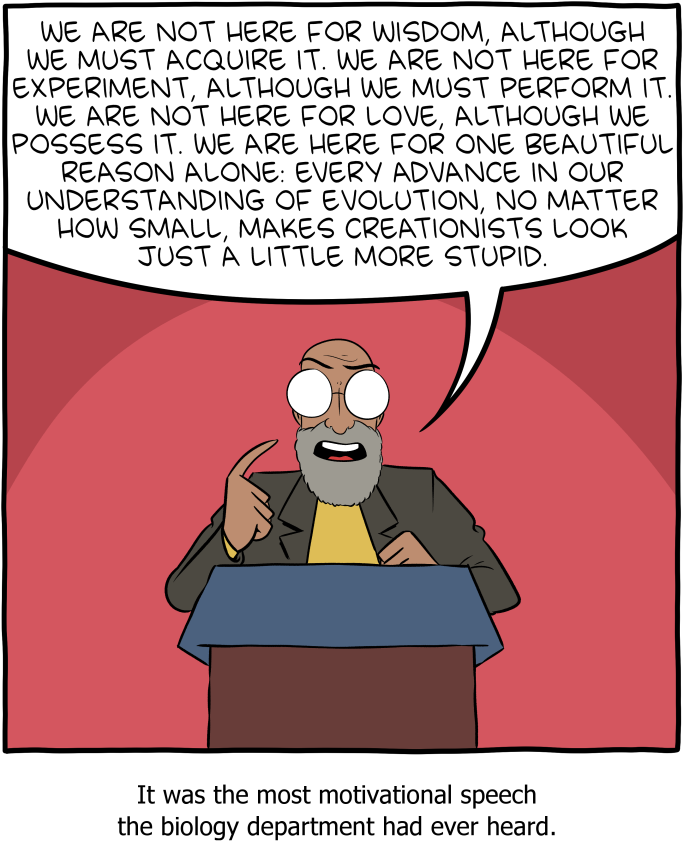
(Although, actually, it starts with a love of biology and then acquires a layer of anger at people who lie about the science, so this cartoon isn’t all that accurate.)

I was a bit disappointed with this video.
Some might not know just how diverse teratology is… How might your scientific research fit in? We're guessing, pretty well. Find out why in this video. #IamTeratology #science #research #professionaldevelopment pic.twitter.com/hrXRsw11jy
— Teratology Society (@TeratologySoc) September 6, 2018
Some of us see teratology as a tool to probe normal developmental processes — it’s been that way for centuries. Teratology is the science that studies the causes, mechanisms, and patterns of abnormal development. It’s much more than just figuring how to prevent or correct human developmental disorders…not to belittle that extremely important aspect of the discipline.

The Washington Post has a longish article on l’affaire Silverman. It’s a bit unsatisfying, because we still don’t know the specifics of what American Atheists considered a good reason to fire him, and he denies everything.
But where it gets interesting and more than a little dismaying is when it starts listing all the problems in the atheist movement. I remember the days when you’d go to a meeting and there all these enthusiastic, diverse people who were thrilled to just be there and meet like-minded peers…and now the ones who are most enthusiastic are dudebros who see it as an opportunity to bash feminazis with other dudebros. It’s taken a lot of joy out of the movement.
A couple of interesting points, though: 1) David Silverman is the first and only atheist to face any consequences at all for his behavior from an atheist organization. All the other sleazoids are still doing just fine, are still getting invited to speak at conferences, are still drawing a crowd. 2) All of the accused deny all wrong-doing, no matter how solid the evidence. The Bart Simpson approach seems to work: rape or harass someone, then just say, “I didn’t do it,” and among atheists, you’re golden.
Here’s the depressing section of the article.
Organized secularism has been struggling with charges of misogyny, sexism and sexual harassment for almost a decade. The problem went public in 2011 when a then-little-known atheist blogger, Rebecca Watson, described unwanted sexual advances from a man at an atheist conference who followed her into an elevator and to her hotel room.
Correction: Watson was a well-known atheist blogger, active on Skepchick and SGU, and frequently invited to speak at conference…like the international conference where this event occurred. Also, the man didn’t follow her to her hotel room. But the rest is deplorable truth.
She was flooded with both supportive and haranguing comments. World-renowned atheist Richard Dawkins told her to “stop whining” and “grow up.” Dawkins — whose appearances at secularist gatherings can make or break attendance — has been called out multiple times for sexist statements but remains much in demand as a speaker.
Richard Carrier, a science historian and popular secularist speaker, has both apologized for and denied accusations of unwanted sexual advances at secularist and atheist events. He has been banned from at least one conference.
Michael Shermer, organizer of the popular Las Vegas Skepticon event, has denied allegations of sexual harassment and assault from several women, and remains editor of Skeptic magazine and a top speaker at secularist events.
Most recently, cosmologist Lawrence Krauss, another star speaker and best-selling author, was suspended in the spring by Arizona State University for what it described as a decade of inappropriate behavior, some of it at secularist events.
Sikivu Hutchinson sums it all up.
The alleged misconduct of these leaders, “was tacitly co-signed by an atheist leadership that is largely hostile to social and gender justice and complicit in the marginalization of women’s issues,” said Sikivu Hitchinson [sic], an activist who is often critical of organized atheism on the subject of women and people of color. “The atheist movement is no different from other male-dominated bastions in which sexual harassment and predatory behavior toward women are part of the culture.”
Ah, those heady days when I was blind to the injustices implicit in the movement, and could just think happy thoughts and be optimistic about the future. Why did you people have to open my eyes and ruin it all for me?
Maybe because it wasn’t so great for many people who didn’t happen to be old white cis heterosexual men.