There are 7.98 billion people on planet Earth. This is one of their stories.
(I was interviewed for a podcast. I fear I might have rambled on about spiders a bit much, which is currently a terrible danger in any conversation with me. Sorry.)

There are 7.98 billion people on planet Earth. This is one of their stories.
(I was interviewed for a podcast. I fear I might have rambled on about spiders a bit much, which is currently a terrible danger in any conversation with me. Sorry.)

It was a busy morning, good thing I got in early today.
If I keep this up, I do believe I’ll be able to start doing some genetics in the spring, optimistically.
New baby picture at the Patreon.

It’s a listicle, of course, but it’s written by an archaeologist, which is good, but she was the recipient of a Templeton grant, which triggers my skepticism. But she makes 6 points about our history:
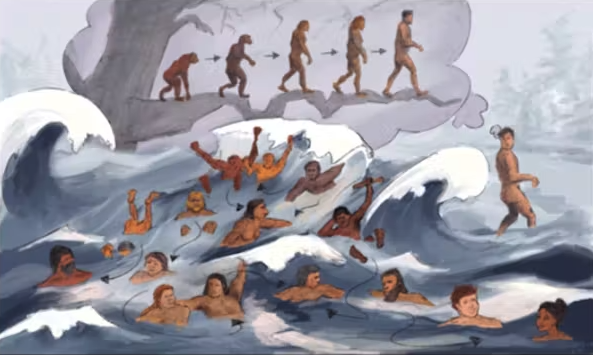
Species such as Homo Longi have only been identified as recently as 2018. There are now 21 known species of human.
And 20 of them went extinct. We’re part of a dying tree.
Hybrid species of human, once seen by experts as science fiction, may have played a key role in our evolution. Evidence of the importance of hybrids comes from genetics. The trail is not only in the DNA of our own species (which often includes important genes inherited from Neanderthals) but also skeletons of hybrids.
Our sexy ancestors were mating with everything that looked vaguely human. Keep that in mind when the dudebros are whining about how Western women aren’t meeting their high standards of beauty. They’d fuck a chimp if one offered the opportunity.
However, many of the changes in our human evolutionary lineage maybe the result of chance.
For example, where isolated populations have a characteristic, such as some aspect of their appearance, which doesn’t make much difference to their survival and this form continues to change in descendants. Features of Neanderthals’ faces (such as their pronounced brows) or body (including large rib cages) might have resulted simply from genetic drift.
Oh, dear, the evolutionary psychologist won’t like that. Too bad, it’s true.
The origins of our own species coincided with major shifts in climate as we became more distinct from other species at these points in time. All other species of human seem to have died out as a result of climate change.
…and we’re next, at the rate we’re going.
The trail of human compassion extends back one and a half million years ago. Scientist have traced medical knowledge to at least the time of the Neanderthals.
Altruism has many important survival benefits. It enabled older community members to pass on important knowledge. And medical care kept skilled hunters alive.
We should have listened more closely to Kropotkin, rather than the imperialist colonizers who shaped the early perspectives on evolutionary theory. He was on to something (he also considered climate to be a critical evolutionary force.)
Evolution made us more emotionally exposed than we like to imagine. Like domestic dogs, with whom we share many genetic adaptations, such as greater tolerance for outsiders, and sensitivity to social cues, human hypersociability has come with a price: emotional vulnerabilities.
Counterpoint: Republicans and Tories. Human psychopaths seem to have a decided advantage in the acquisition of power.

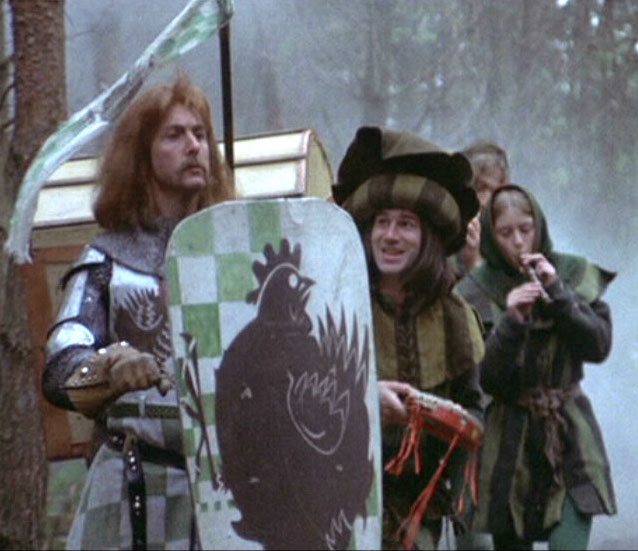
I am amused. Yet again, a tough-talking Texas pol disappears into the sunset in a cloud of dust, leaving a mess he doesn’t want to deal with behind him. The tale of the process server who tried to deliver a subpoena to Ken Paxton:
Herrera’s affidavit said that he arrived at Paxton’s house Monday at 8:28 a.m. and was greeted at the front door by a woman who identified herself as Angela. When he told her that he was trying to deliver the subpoenas to Ken Paxton, she told him that the AG was on the phone.
Herrera, who said he recognized Ken Paxton inside the house through glass on the door, offered to wait for him. Angela replied that Paxton “was in a hurry to leave,” according to Herrera, who observed a black Chevy truck in the driveway and then saw another car arrive there.
At about 9:40 a.m., Herrera said he saw Paxton exiting his garage. Herrera walked up the driveway toward Paxton and called out his name, at which point “he turned around and RAN back inside the house through the same door in the garage.”
Minutes later, Angela came out to the truck and opened both the driver-side door and the door behind it, Herrera wrote. A few minutes after she started the truck, “I saw Mr. Paxton RAN from the door inside the garage towards the rear door behind the driver side,” Herrera wrote.
“I approached the truck, and loudly called him by his name and stated that I had court documents for him. Mr. Paxton ignored me and kept heading for the truck. After determining that Mr. Paxton was not going to take the Subpoenas from my hand, I stated that I was serving him with legal documents and was leaving them on the ground where he could get them,” Herrera wrote.
“I then placed the documents on the ground beside the truck. Service was completed at 9:50 am. He got in the truck leaving the documents on the ground, and then both vehicles left,” he wrote.
Maybe he was in a hurry to catch his flight to Cancun.
Hey, Texians, did you know that John Wayne was a draft-dodging coward and that you lost the battle of the Alamo?

This doesn’t look like pleasant weather.
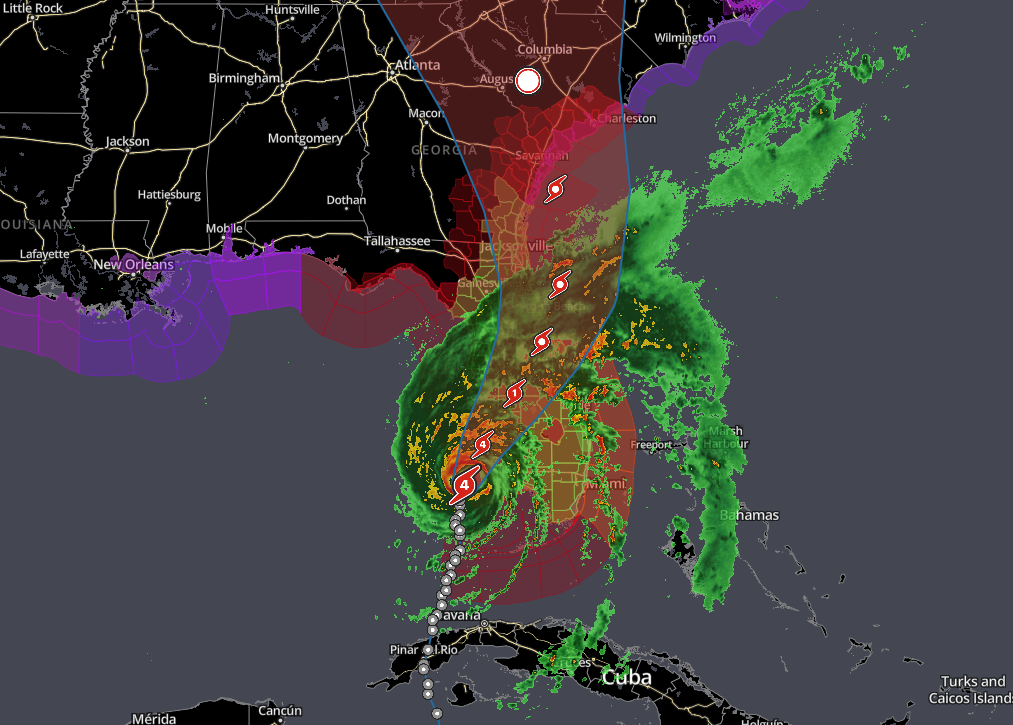
I think you need a sacrifice. I recommend staking out your governor somewhere in the middle of that storm track. Work fast, it sounds like it’s going to be ripping across the state quickly.
If that’s not enough, you’ve also got an ex-president there who is pretty much good for nothing other than propitiating the gods.


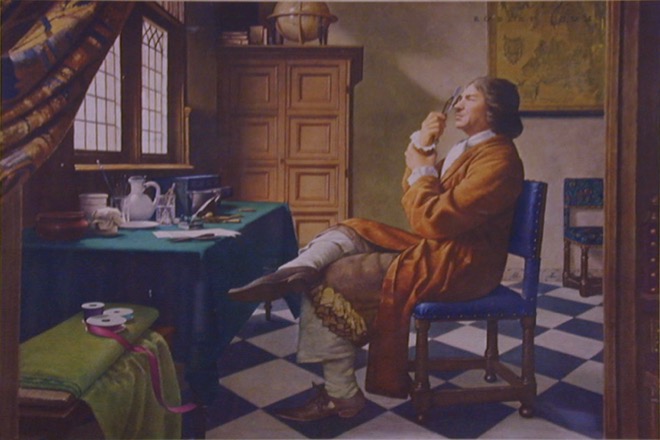
This is an impressive microscope. It doesn’t look like much, but this is the kind of instrument Leeuwenhoek used to make his observations, back in the 17th and early 18th century. I did not know until now that it was a mystery how he could magnify specimens 270 times with a simple lens — we didn’t know exactly how he constructed the lens, and he wouldn’t tell anyone. It was his secret, which is not a proper scientific attitude, but OK, it was his key to fame.
Until now, that is. The secret of Leeuwenhoek’s lenses has been cracked! It turns out he borrowed a technique of Robert Hooke’s and improved on it.
But on his most powerful lens, neutron tomography revealed that Van Leeuwenhoek used another technique entirely. It was almost perfectly spherical and completely smooth, without the sharp rim inevitably created by a traditional grinding cup. Even more tellingly, the lens retained the faint remnants of a snapped stem, concealed by the brass plates since the day Van Leeuwenhoek had placed it there.
The stem is a smoking gun. It’s the unavoidable result of forming a lens by melting a thread of glass until a bead forms on its end and then snapping it off. In other words, to make his greatest lens, Van Leeuwenhoek copied Hooke’s simple recipe from the book that likely inspired him. Cocquyt believes this may explain why he was so circumspect when Hooke asked about his methods; he wanted to avoid giving credit to Hooke himself.
Published in Science Advances last year, Cocquyt’s discovery that Van Leeuwenhoek used a well-known technique reveals a deeper truth about the state of microscopy in the 17th century. It suggests that for all the crafting genius required to make his tiny, super-powered lens, Van Leeuwenhoek’s greatest insight may have been that there was something new to see by making one.
I mean, everyone was copying Robert Hooke in the 17th century and then hiding the fact. Hooke was a real genius, and it makes me wonder why no one wanted to credit him for anything. Apparently, he was an unpleasant character, vain and jealous, and that has damaged his legacy. The lesson: be courteous and nice with your peers!

Prepping for my intro class today, we’re wrapping up the unit on basic Mendelian genetics and a little more. The students are now supposed to understand monohybrid and dihybrid crosses, chromosomes, and the principle of gene mapping. So today we’re going to talk about how genetics has been and can be abused, and how we have a long way to go before we fully understand inheritance. Yeah, we’re going to talk about eugenics and modern distortions of genetics. It’ll be depressing.
Then, to make it even more difficult, I’m sending them home with some reading and an assignment to watch this video of an old man with a funny accent just talking.
We’ll be talking about the subject of ethics in science on Thursday. I can’t let students walk away from instruction in elementary genetics thinking it’s simple and that they’ve been handed the keys to absolute certainty and comprehensive knowledge of the human condition. We’ve got enough of those people.

It’s just an innocent space rock, didn’t do anyone any harm, but NASA is getting ready to practice its marksmanship and shoot at it from a distance of 7 million miles. It’s getting hit tonight, so you can watch the livestream of the sniper shot right now.
IMPACT SUCCESS! Watch from #DARTMIssion’s DRACO Camera, as the vending machine-sized spacecraft successfully collides with asteroid Dimorphos, which is the size of a football stadium and poses no threat to Earth. pic.twitter.com/7bXipPkjWD
— NASA (@NASA) September 26, 2022
Not the view you want to see through your windshield.

The man is an embarrassment of failures. His latest? A right-leaning newspaper suggested it would be a good idea to have the candidates publicize their medical status, and Oz leapt into action!
News: Dr. Mehmet Oz has released medical records in response to a recent editorial from the Pittsburgh Post-Gazette.
A letter (dated yesterday) from a physician released by the Oz campaign deems Oz to be in "overall excellent health."
Here's the first page of the letter: pic.twitter.com/aVM27TWHXy
— Justin Sweitzer (@justin_sweitzer) September 23, 2022
I would not expect that he had medical concerns, and he certainly seems fit, and I don’t think anyone is questioning his health as a reason to disqualify him. Rather, Oz has tried to suggest that Fetterman is in poor health, so he clearly saw this as a way to get in another dig.
Unfortunately, there is one little glitch: that letterhead.

Cool. The primary care physician for this guy who claims to live in Pennsylvania has a Manhattan office overlooking Central Park, a two hour drive from his purported home. How nice for him.
Of course, Fetterman has a response.
Today Dr. Oz confirmed that he does not actually live in Pennsylvania, because no one who does would have a primary care doctor on 5th Avenue in Manhattan.
We didn’t need to know Dr. Oz’s bone density. We need to know whether he would vote to ban all abortions after 15 weeks. We need to know whether he would vote to raise the minimum wage. We need to know whether he even plans to stay in Pennsylvania after the election.
In June, I released a letter from my doctor where he clearly stated that I am fit to serve. Dr. Oz built his entire career by lying to people about health. I trust my actual doctors over the opinion of a charlatan who played on on TV.
This is the most entertaining political race in ages.


There are interesting questions in the population genetics and evolution of different human groups, and it would be nice if there weren’t wretched ideologues who will happily misinterpret every difference between two groups of people, or even two people, to turn a description of differences into a ranking of superiority. It’s the Jordan Peterson problem of turning everything into evidence of a hierarchy.
Jedidiah Carlson provides some specific examples of how the right wing mangles research. It’s easy to see when the current fad is for murderous mass shooters to provide manifestos with their interpretation of the science; they are happy to name the credentialed scientists who provide fodder for their delusions.
The Buffalo shooter’s scientific bibliography has clear echoes to a similar citation scandal that arose in the late 1970s and early 1980s. During this era, the National Front (NF), a neofascist political party in the UK that had been steadily growing throughout the 1970s, distributed a series of pamphlets with articles referencing mainstream academic research. Their goal was to justify the organization’s platform of ethnic nationalism, white supremacism, and eugenics using contemporary science. The first wave of NF propaganda proclaimed, “scientists say that races are born different in all sorts of ways, especially in intelligence. This is because we inherit our abilities genetically.” Here, the NF cited the work of Hans Eysenck and Arthur Jensen, two of the most vocal proponents of the hereditarian theory that genetics could explain IQ differences between racial groups. Steven Rose, a champion of radical science and coauthor of Not in Our Genes with Richard Lewontin and Leon Kamin, lambasted Eysenck and Jensen in a 1978 letter to the editor of Nature, calling upon them to “publicly and unequivocally dissociate themselves from the National Front and its use of their names in its propaganda.” Eysenck and Jensen both complied with Rose’s request, albeit without a hint of apology for the societal harm their research precipitated. Eysenck asserted that he was “absolutely opposed to any form of racism” and claimed that “No-one familiar with Professor Jensen’s or my own writings could possibly misinterpret our arguments about the mean differences between various racial and other groups with respect to intelligence as implying the kind of policies advocated by the National Front.” Jensen echoed this self-absolving and patently false sentiment but also took the opportunity to lash out against his leftist critics for being, as he believed, as guilty as the far right in their desire “to promote and to gain public acceptance of a particular dogmatic belief about the nature of racial differences.”
That’s fascinating. Jensen actually tried to argue that oh no, he’s not a racist!, while producing some of the most outrageously bad pseudoscience defending racist discrimination. This is an ongoing problem in recognition, because it is common for racists to deny they are racist, while promoting awful garbage that they will never deny. As the Southern Poverty Law Center points out, “Jensen worked hard to develop a reputation as an objective scientist who “just never thought along [racial] lines,” and to portray critics of his racist conclusions as politically motivated and unscientific.” Right. That’s why he has a long entry at the SPLC.
Jensen is way, way out there, and it’s patently obvious that he was a screaming bigot manipulating the data to support an evil conclusion. But there have also been other scientists, less aggressive about their racism, who have been quietly smuggling bad science into the literature. How about kindly old Grandpa EO Wilson, who, after his death, was found to have been supporting all kinds of openly racist ideas? On the one hand, we’re supposed to objectively evaluate scientific ideas, but on the other, we’re supposed to somehow ignore the biased presuppositions that have led to those ideas, which makes no sense. People regarded sociobiology with suspicion when it first came out, because we were supposed to consider only the limited set of facts presented within it, but somehow we should overlook the fact that it quickly acquired a following among the worst kinds of people, the ones who wanted a racist conclusion and could read between the lines and see that sociobiology was a tool to reach that conclusion? Only racists are allowed to see the obvious interpretations, critics are “politically motivated and unscientific”, which provides a useful ratchet to make sure only the racist perspective gets widely disseminated.
So what do we do about subjects like sociobiology or evolutionary psychology, which promote, with the authors’ open consent and approval, bad ideas like genetic reductionism or determinism? I don’t know. I don’t like the idea of censorship, so perhaps a better idea would be if the various channels of scientific communication, the journals and blogs and so forth, were more proactive in rejecting work that is so clearly constructed around fallacious premises? Good luck enforcing that. The gatekeepers seem to have mostly bought into the bad ideas, since they’re typically privileged beneficiaries of the biases.
And then even work in which the authors were not advocating racism (near as I can tell) will be chewed up and twisted by malicious actors to arrive at a malicious conclusion. There’s no avoiding that.
Much of the scientific community’s outrage in the aftermath of Buffalo centered around the shooter’s citation of a paper colloquially known as the “EA3” study (Lee et al., published in 2018 in Nature Genetics). This study, carried out in over 1.1 million individuals of European descent, identified hundreds of genetic variants associated with “educational attainment” (often abbreviated to EA)—i.e., the number of years of school completed, often taken to be an “easy-to-measure” proxy for intelligence. The shooter’s reference to the EA3 study came in the form of a screenshot of a plain-looking document (figure 1) proclaiming, “The latest findings on genetics and intelligence show that biological factors contribute to the gap in intelligence between European and African populations.” Beneath this image, the shooter weighed in with his own interpretation, punctuating his earlier claims that “whites and Blacks are separated by tens of thousands of years of evolution, and our genetic material is obviously very different.”
Many variations of this table can be found throughout the internet, but the earliest version can be traced back to a thread on 4chan (an anonymous and largely unmoderated online forum) timestamped to September 15, 2018, barely six weeks after Lee et al. was published online (on July 31, 2018). The original post that initiated this thread (figure 2) is a perfect example of what sociologist Aaron Panofsky calls “citizen scientific racism”: an individual, having come across the EA3 study, collected the top EA-associated variants from a supplementary table of the paper, annotated these variants with the allele frequencies in European and African populations using publicly available data from the 1000 Genomes Project, and curated a set of EA-associated variants with the greatest differences in population frequency to argue that Europeans are genetically predisposed to higher intelligence.
The responses to this thread rapidly crystallized into a simple propaganda strategy: turn these “findings” into a standalone unit of easily-digestible visual information—or a meme, for lack of a better term—and let it organically spread across other online spaces. Shortly thereafter, another user took these suggestions to task and independently reproduced the original post’s analysis, presenting the results in a table similar to that shown above. Within hours, this image began to circulate in other 4chan threads and mutate into alternate versions, often accompanied by zealous calls for diffusing these memes throughout the internet. “SPREAD THESE IMAGES LIKE WILDFIRE,” encouraged one user. “This is the new IOTBW” said another, referring to the racist slogan, “It’s OK to be white.” The meme was even passed on to a cabal of popular alt-right bloggers and Youtubers who “have several PhDs and can give you a hand…plus they’re fantastic propagandists.” This collective enthusiasm for propagandizing the EA3 study appears to have been wildly successful. Altogether, variations of this meme have been posted over 5,100 times on 4chan and regularly appear on more mainstream social media platforms like Reddit, Twitter, and Quora. Contrary to the scientific community’s prevailing narrative that the shooter was an isolated extremist who happened to stumble upon the study,20 these data demonstrate that the EA3 study has been a significant force in empowering far-right extremists for years, virtually since the day it was first published.
(Note that Carlson article includes many figures that illustrate the point he’s making, but he’s flagged all of them with a “do not replicate” watermark. They often come from places like 4chan, so I agree, let’s not promote these vile sources.)
One step forward that Carlson promotes is the revitalization of activist-scientists. We need to speak up on all fronts, rather than passively sitting by while nonsense gets published in multiple outlets.
Weaponized science continues to threaten far more than the public image of scientific authority. Today, it has morphed and evolved to find new victims and modes of victimization, and exploits whatever platforms and resources are at its disposal to promote its message. Synthesizing the lessons learned from past radical science movements provides us with a path forward: our collective response to weaponized science must be fiercely multimodal and operationally diverse, taking place in the pages of scientific journals, the digital streets of social media, and the physical spaces of our institutions and cities.
He also gives us three challenges.
First, we must further educate ourselves on the ecosystem of weaponized science. Second, we must actively resituate our appetite for scientific progress towards the service and liberation of our communities. Finally, we must channel this knowledge and desire for change towards the development and implementation of creative strategies to disarm weaponized science, inoculate against its normalization, build resilience and solidarity, and spread those ideas like wildfire.
All right, I think I’ve been doing the first. I’m depressingly familiar with the bad science that gets published in all kinds of outlets. I’ve been involved in the second already, too, as one of those people who strongly believes that science should be serving a larger social purpose. The third…I’m not sure about what creative strategies I could implement, beyond just telling all of you what sucks about some of our modern science.
