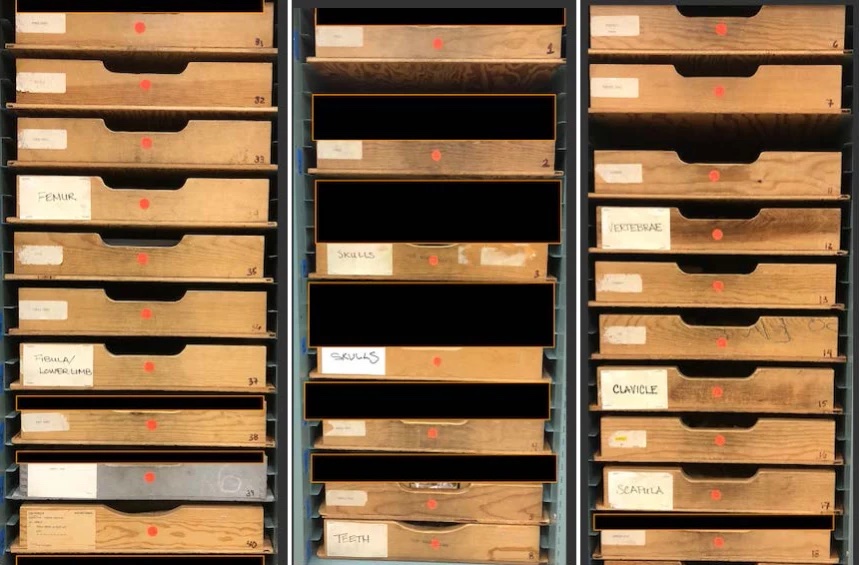
I organize spiders better than this
Berkeley has a bit of an unsavory reputation as the premiere grave-robbing institution in the US. They’ve got an impressive collection of looted remains.
More than three decades ago, Congress ordered museums, universities and government agencies that receive federal funding to publicly report any human remains in their collections that they believed to be Native American and then return them to tribal nations.
UC Berkeley has been slow to do so. The university estimates that it still holds the remains of 9,000 Indigenous people in the campus’ Phoebe A. Hearst Museum of Anthropology — more than any other U.S. institution bound by the Native American Graves Protection and Repatriation Act, or NAGPRA, according to a ProPublica analysis of federal data.
Tim White, the esteemed anthropologist, was in charge of repatriation decisions for many years, and basically stonewalled the process.
White said the collection did not need to be reported under NAGPRA because there is no way to determine the origin of the bones — and therefore the law does not apply.
The collection has exposed deep rifts at UC Berkeley, pitting a prominent professor who said he’s done nothing wrong against university administrators who have apologized to tribes for not sharing information about the remains sooner.
I’m looking at this as someone who is sympathetic to both educational and research needs, and I have to ask: why do you want these old bones anyway, Berkeley? They’re used to teach anthropology students, and I can understand why you want variations represented — one old mounted skeleton is not enough — but why do you need thousands of specimens for teaching the basics, and why do you need Native American skeletons shoveled out of their graves by the thousands? This makes no sense. It’s more like maintaining a dragon’s hoard then an actual, useful teaching collection. That’s especially clear when the collection is described.
By then, the teaching collection that anthropology professors used had grown to thousands of bones and teeth that White said in his report to university administrators had been commingled with others donated by amateur gravediggers, dentists, anatomists, physicians, law enforcement and biological supply companies.
The remains were unceremoniously sorted by body part so students could study them. A jumble of teeth. A drawer of clavicles. Separate bins for skulls. For decades, anthropologists added to the collection, used it in their classes and then passed it along to the professors who came after them, White said.
What use is an old bone if you know nothing of its provenance? What can you learn from a bucket of teeth?
For a moment I assumed that this would have been a massive, well-curated collection, where scientists can do research on comparative anatomy and variation. But no? This collection is just a pile of bones that professors have been letting students play with for decades. This is particularly appalling when various cultures have been begging to have the bones returned, and when the law is telling UC Berkeley to return them.
Recourse under the law was limited, leaving tribal nations to file formal challenges with the federal NAGPRA Review Committee, an advisory group whose members represent tribal, scientific and museum organizations. It can only offer recommendations in response to disputes.
In the first challenge following the passage of the law, in February 1993 the Hui Mālama I Nā Kūpuna O Hawai’i Nei, a Native Hawaiian organization, took a dispute over repatriation of two ancestral remains before the federal committee. The remains had been donated to UC Berkeley in 1935, at which time a museum curator classified them as Polynesian. White disagreed.
Addressing the committee, White introduced himself as “the individual who is responsible for the skeletal collections at Berkeley.” He argued the remains might not be Native Hawaiian and could belong to victims of shipwrecks, drownings or crimes. They should be preserved for study, he added, making an analogy to UC Berkeley’s library book collection, where historians access volumes for years as their understanding evolves.
White is admitting that they don’t know whose bones they have…then what use are they? His excuse for keeping them is that they might not be Polynesian, but could be from shipwreck victims. That is not a defense. That’s an admission that they have a hodge-podge, a confusing grab-bag of bones scooped up off of Pacific islands, and they don’t know what they’ve got…except that they’re going to keep them.
I’m trying hard to view this mess from the perspective of a college professor, but I’m not seeing it, and Tim White’s arguments for hanging on to these bones reads like a confession that Berkeley has been careless and sloppy. And White keeps stuffing his foot in his mouth!
In August 2020, White reported the contents of the collection he taught with to university administrators.
White told ProPublica and NBC News that given the lack of documentation, it would be impossible to determine if they were Native American, much less say which tribe they should be returned to.
“There’s nobody on this planet who can sit down and tell you what the cultural affiliation of this lower jaw is, or that lower jaw is. Nobody can do that,” he said.
It’s just the weirdest defense: our bookkeeping is so bad and ignorance is so great that we have no idea whose remains these are, therefore we ought to be allowed to keep them. To me, this is an argument that the whole collection ought to be shoveled out and given to people who would treat the bones with real respect. Berkeley seems to have a history of disgraceful disrespect and exploitation, and doesn’t deserve to be custodians of those dead people.