Why I am an atheist – Elizabeth

I’m an atheist because there is nothing else I can be.

My parents are both British scientists. I was born in Africa because my father was doing postdoc work on, I believe, giraffe respiratory physiology (we have pictures of him standing on a ladder holding a mask over a giraffe’s nose) but spent my first seven years living in England. While I was aware of religion and churches because, well, in Oxford it is difficult to go thirty feet without banging into a church of some description, it never really occurred to me that the people who attended those churches did so because they believed in a god. I didn’t even truly understand that both my grandmothers were believers. Church to me meant Nativity scenes, ringing bells, those little palm-leaf crosses, the smell of brass polish and damp and lilies, cross-stitched kneelers, worn carvings of various saints, and (most fascinating of all) graveyards with all sorts of interesting headstones and tombs in them.

We moved to America when I was seven, and have lived here ever since. I’m thirty-one and I still cannot wrap my head around the fact that people, many of whom are otherwise quite sane and sensible and have advanced degrees, actually believe that a god exists–let alone that that god a) requires people to live up to an impossible standard, b) damns them to hell for not living up to this impossible standard, and then c) creates and murders an avatar of himself to “redeem” everyone from the artificial damnation he himself invented. I can understand the idea of wanting to shift responsibility for oneself and one’s decisions to a greater authority, but the Big Three Abrahamic god is such an insecure, reactionary, vicious, cruel, irrational, demanding, and untrustworthy entity that I fail to see why anyone would give (H)im the time of day.

My parents never told me that there was no god; they just never suggested to me that there was one, and therefore I grew up without the need to believe in one. Without, in fact, the ability to believe in one. Sometimes I think it’d be easier, in a country as overwhelmingly christian as the US, to be able to believe in their god to the point where I was no longer cross with the vast majority of the population for subscribing to such a bloody stupid concept. Proselytizers I’ve come across have said “you just have to have faith” that a god exists, but how? I can say “I believe in the Great God Om and His holy horns” or “I believe in Ahura-Mazda” or “I believe that the Republican Party is not a conclave of viciously misogynistic homophobes who hate the idea of anyone anywhere having a good time,” but I can’t actually follow through on any of those statements.

Most of the time I don’t discuss my atheism with people other than my close friends (or the internet) because it always comes down to the fact that yes, I do think religion is not only stupid but actively poisonous, that continuing to give tacit approval to this limited and illogical worldview hinders humanity’s development as an intelligent species, and that people who are clever and educated and literate enough to understand the scientific method damn well ought to discard fairytales and embrace reality. This is not a popular viewpoint and rarely leads to constructive discussion so much as “so you’re calling my (father, mother, doctor, academic advisor, etc) stupid for being a Christian/Jew/Muslim?”

I’m calling your authority figure intellectually dishonest. Which may on some levels be worse.

Elizabeth
United States

Ken Ham’s wretched excursion into children’s books

Read and weep. Answers in Genesis has a voluminous line of crap books, and a significant chunk of it consists of propaganda for kids. Joe Csonka reviews Dinosaurs of Eden, by Ken Ham, with scans of the contents.

You knew that, according to AiG mythology, dinosaurs lived with Adam and Eve, and were vegetarians, right?

There’s more at the link. There’s threat of more to come. Let the groaning commence.

Abby Johnson doesn’t know what she’s talking about

Abby Johnson is one of those anti-abortion advocates. She has a different story, though: she was employed by Planned Parenthood for several years, and claims to have had an epiphany while participating in an abortion (a claim that doesn’t actually hold up), and become a forced-birth activist instead. She’s gone so far over to the Dark Side that she endorses Santorum for President, which means she’s a credulous dingleberry for god now.

But there’s one virtue to her: she’s such an awful liar for her cause that she inspires outrage in reasonable people who hear her, and they scurry out and do the research that shows she is making stuff up whenever she talks about abortion. In case you ever have to deal with Ms Johnson, she recently spoke at Colorado State University and motivated a couple of bloggers to do a very thorough takedown. Read why Abby Johnson is a liar about Planned Parenthood, and why Abby Johnson is a liar about biology. These are useful, concise resources in any argument about abortion.

Now I get it

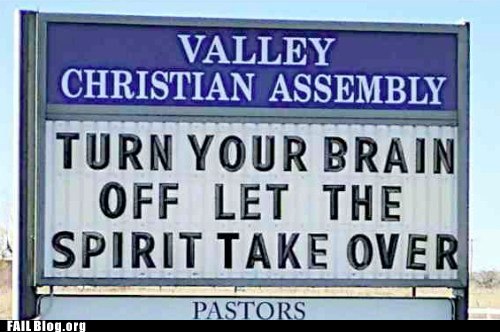
I think I understand now why some less-than-appropriate speakers are appearing at the Reason Rally: those are the siesta breaks.

I owe this revelation to a church sign. Just turn your brain off for five minutes turn to your neighbors and start a conversation, just cool off and ignore the bozo on the screen.

Also as I’ve been learning on twitter and elsewhere on the blogosphere, this event is not one where atheists stand up and let their values shine, it’s one where we’re supposed to bow and scrape and show that we can be accommodating to senators and other assholes.

But what if I don’t want to get along with them? What if I want us to change the world?

Why I am an atheist – Matthew Kiffmeyer

When I was 7 years old, my 2nd grade teacher was giving a lesson about dinosaurs. Another student asked a seemingly sensible question at the time, why hadn’t the Tyrannosaurus Rex eaten all of the people. The teacher replied that dinosaurs and people didn’t live at the same time. This answer didn’t sit well with me and in a rare case of assertiveness, I muttered defiantly, “Yes, they did.” The teacher’s eyes went wide and her gaze snapped onto me, burning the image into my memory, and stated, “No. They. Did. NOT!”

I can only imagine that my teacher must have thought she had a creationist in her class. But in my young, malleable mind, I was calling forth reference materials such as “The Flintstones” and “Captain Caveman”. While her harsh admonishment may have temporarily put me off from classic schooling, it started something else in me. If I was to be so publicly scolded for my ignorance, I wanted to know why I was wrong. More than that, I wanted to know how to find the real answers.

That philosophy of curiosity stuck with me. When I tried to apply this in my catechism classes however, not only was I not given a good reason for many of the strange traditions and beliefs in the Catholic religion, but people became angry with me for honestly trying to figure them out. Their anger told me they didn’t know either. “Faith,” I was told tersely, was essential to understand, but never once given a reason for that either. I got the distinct impression that discovery was not a valued virtue in religion. So, it ceased to be important to me.

I am an atheist because the things I want to believe are only the ideas that have a satisfactory answer to the question I should have asked my 2nd grade teacher and have since asked repeatedly of those seeking to share the “truth” of their religion with me, “How do you know that to be true?”

Matthew Kiffmeyer
United States