SXSW poll

The big music festival, SXSW (which I must attend someday) also has panel discussions, and apparently they accept public input on which panels to put on. Voting is going on right now, and one that’s getting some attention is “It’s Reddit’s Web. We Just Live In It.”. Here’s the description:

For many years, Reddit — a site that allows people to post, vote on, and comment on links from around the Web — was an also-ran news aggregator, a place stuck in Digg’s shadow. But suddenly Reddit has become the most exciting and influential community online. The site, which now gets billions of page views every month, was the epicenter of the Web’s protest against Congress’s SOPA copyright legislation, a gushing source of Occupy Wall Street memes (pepper-spray cop started on Reddit), and home to some of the most helpful, and the most misguided, Internet vigilantes. Redditors helped a bus monitor who was abused by her terrible kids raise hundreds of thousands of dollars; they also mistakenly attacked a cancer fundraiser, they’ve frequently posted child porn, and they’ve been accused of sexism. How is Reddit’s power altering Web culture — and should we celebrate it, or fear it?

Well, I’d question the premise that Reddit is powerful…it’s a tool for mobilizing a community of people to type faster (kinda like Pharyngula, only bigger…), which can sometimes be influential. It’s greatest weakness is it’s self-reinforcing nature, which allows really stupid, nasty people to sometimes send Reddit haring off towards really stupid schemes—like Reddit Island or their constant battles with a vocal and wretched misogynist minority, that can also wield the autocatalytic power of Reddit well.

So it sounds like an interesting panel, with provocative stuff to say on both sides of the opinion of Reddit. The description is certainly reasonable and fair.

But…the proposed panel has Rebecca Watson on it. And as we all know, that immediately fires up the hate brigade.

So of course Reddit has a thread denouncing the heretic and telling everyone to go vote it down, protesting the fact that a panel discussing the pros and cons of Reddit might actually include someone who is critical of Reddit’s slimy underbelly. They’re also upset that Shit Reddit Says, the mocking watchdog subreddit, is involved, somehow.

At the poll site, there’s another anti-Watsonista, BlueofHume1, who’s on a roll of stupid. He’s making the argument that in a community of 20 million readers, the fact that only 21,000 say “misogynistic/sexist/ablist/homophobic” stuff, by one count, means it is therefore not as bad as everyone says. He’s comparing all registered users to the vocal subset that are active commenters! I’d say it’s a bigger concern that 21,000 scumbags are allowed to thrive and promote scumbaggery on the forum. It’s an open question whether the nasty subset are a representative sample of some significant proportion of the 20 million readers, and his argument doesn’t touch it.

Anyway, if you hate faulty reasoning, if you’re just sick to death of people making excuses for women- and gay-hating fratboys and chill girls “because they are atheists”, if you’re fed up with the enemy constantly waving Rebecca Watson as the emblem of evil, go register at the SXSW site and leave a vote.

I’m still waiting for the PZome

“-ome” and “-omic” are overused, as Jonathan Eisen has been saying for years, and now the Wall Street Journal has taken notice. There are 404 “-omics” disciplines? It’s so silly that there is now a Badomics generator to invent new terms.

It’s still missing PZomics. I’m serious, it could be a real science, you know…I don’t know why researchers aren’t lining up to get cell samples from me. (There’s probably more money in Venteromics—I say “psshhht!” to their dedication to the principles of true knowledge over mere pecuniary gain.)

Why I am an atheist – Jim

I had been wondering for a while whether I should join the masses and add my own answer (and story) to the question “why are you an atheist?”. The new year brought with it a sense of “why the hell not?”.

Reading the answers of others, i’ve seen it often helps to give some basic background first. Don’t worry, most of it is relevent to the actual answer. I’m a person of the male persuasion in my early 20s, living in the pleasant (if you like mud) countryside of the east of England. I’m pretty much the stereotype of a geek/gamer (without the “fat, no sense of personal hygiene and glasses” parts). I grew up a basic countryside-dwelling family (as an only child), complete with the usual passive conservatism and Christianity – passive in the sense that it’s just “there”, everyone expects everyone else thinks the same as they do, so the subjects rarely come up. This is hardly perfect, but a lot better than being bombarded with it every day. But in other ways, it’s a lot more insidious.

[Read more…]

New signs, same criticisms

The new American Atheist billboard designs are now online, and I don’t want to disappoint Dave Silverman, so I’ll give my usual review: better than the last set, but still needs work.

Stuff I like: it’s a strong, assertive message, and that’s what I want from AA. The “Atheism: Simply Reasonable” slogan is clear, short, punchy. They’ve gotten away, mostly, from the blocky multi-colored Mondrian look of previous signs.

Stuff I don’t like: the text on the left is 5 lines long. That’s too much for a billboard. The central image is sort of arbitrary — it says religion is silly, but it doesn’t contribute much to the message on the left. The other billboard, on Mormonism, is worse in this regard; why is there a guy in his underwear there? Really, on a billboard, everything must be distilled down to deliver one clear, simple argument.

I know Dave is rolling his eyes right now and wondering why he’s even trying to lead those fractious, critical atheists at all…wouldn’t sheep be so much easier?

Live by statistics, die by statistics

There is a magic and arbitrary line in ordinary statistical testing: the p level of 0.05. What that basically means is that if the p level of a comparison between two distributions is less than 0.05, there is a less than 5% chance that your results can be accounted for by accident. We’ll often say that having p<0.05 means your result is statistically significant. Note that there’s nothing really special about 0.05; it’s just a commonly chosen dividing line.

Now a paper has come out that ought to make some psychologists, who use that p value criterion a lot in their work, feel a little concerned. The researchers analyzed the distribution of reported p values in 3 well-regarded journals in experimental psychology, and described the pattern.

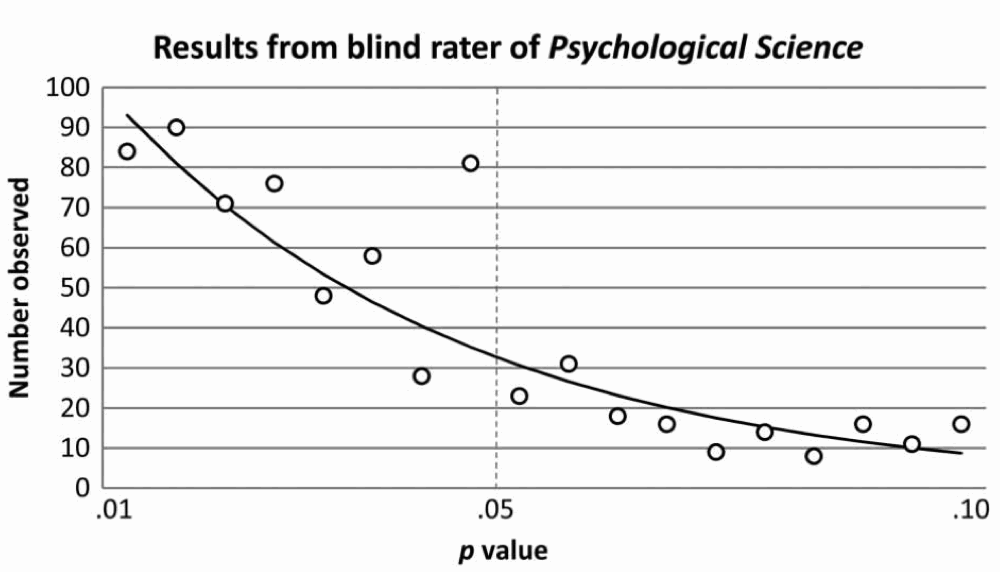
Here’s one figure from the paper.

The solid line represents the expected distribution of p values. This was calculated from some theoretical statistical work.

…some theoretical papers offer insight into a likely distribution. Sellke, Bayarri, and Berger (2001) simulated p value distributions for various hypothetical effects and found that smaller p values were more likely than larger ones. Cumming (2008) likewise simulated large numbers of experiments so as to observe the various expected distributions of p.

The circles represent the actual distribution of p values in the published papers. Remember, 0.05 is the arbitrarily determined standard for significance; you don’t get accepted for publication if your observations don’t rise to that level.

Notice that unusual and gigantic hump in the distribution just below 0.05? Uh-oh.

I repeat, uh-oh. That looks like about half the papers that report p values just under 0.05 may have benefited from a little ‘adjustment’.

What that implies is that investigators whose work reaches only marginal statistical significance are scrambling to nudge their numbers below the 0.05 level. It’s not necessarily likely that they’re actually making up data, but there could be a sneakier bias: oh, we almost meet the criterion, let’s add a few more subjects and see if we can get it there. Oh, those data points are weird outliers, let’s throw them out. Oh, our initial parameter of interest didn’t meet the criterion, but this other incidental observation did, so let’s report one and not bother with the other.

But what it really means is that you should not trust published studies that only have marginal statistical significance. They may have been tweaked just a little bit to make them publishable. And that means that publication standards may be biasing the data.


Masicampo EJ, and Lalande DR (2012). A peculiar prevalence of p values just below .05. Quarterly journal of experimental psychology PMID: 22853650