
Every once in a while, I hear these stirrings from scientists that there can be an objective morality, and that by following reason and evidence we can achieve great advances in ethics and reduce human suffering. I agree, in part. I think reason and science are the only ways we can implement our goals effectively, and that we should be empirically assessing our progress and making changes as necessary in a rational way. But — and this is a huge exception — science is not sufficient. Scientists are flawed, and while you can use science to optimally reach a particular goal, setting that goal in the first place is not determinable by scientific methods.
As a useful corrective to the scientific optimists, I suggest you read Francis Galton’s Memories of My Life, and try to do so with an open mind. That’ll be hard to do, because he says things that we now regard as repugnant, that we learned with hard lessons in the 20th century, lessons he did not experience. I think if Galton had lived through that period, he would have adjusted his opinions accordingly; charitably, I think I can safely assume from his writings that he had a sincere concern for improving the state of humanity, and that all that he proposed would have been for the betterment of individuals.
Man is gifted with pity and other kindly feelings; he has also the power of preventing many kinds of suffering. I conceive it to fall well within his province to replace Natural Selection by other processes that are more merciful and not less effective.
Try to keep that in mind when you read these quotes from his chapter on “Race Improvement”. He’s a scientist with only the highest aspirations for others. But he’s also a flawed scientist with imperfect knowledge, and a human being with a heavy freight of prejudices. He doesn’t realize that he’s paving the road to Hell with his intentions.
Here are the words of an upper middle class Victorian gentlemen who proposes to judge people and determine the value of other lives.
The most common misrepresentations now are that its methods must be altogether those of compulsory unions, as in breeding animals. It is not so. I think that stern compulsion ought to be exerted to prevent the free propagation of the stock of those who are seriously afflicted by lunacy, feeble- mindedness, habitual criminality, and pauperism, but that is quite different from compulsory marriage. How to restrain ill-omened marriages is a question by itself, whether it should be effected by seclusion, or in other ways yet to be devised that are consistent with a humane and well-informed public opinion. I cannot doubt that our democracy will ultimately refuse consent to that liberty of propagating children which is now allowed to the undesirable classes, but the populace has yet to be taught the true state of these things. A democracy cannot endure unless it be composed of able citizens; therefore it must in self-defence withstand the free introduction of degenerate stock.
Note what he considers both undesirable and heritable: Poverty. Crime. Intelligence. He can glibly divide humanity into classes, some of which are “undesirable”. He is looking for humane ways to prevent undesirables from propagating.
He has high moral aims! Keep that in mind; if it were actually true that poor people birthed children who were genetically determined to be poor, shouldn’t we do something about it? Of course, he’s not thinking it through: he can’t legitimately claim that poverty is biologically heritable (it sure is environmentally influenced, though!) and he certainly doesn’t seem to comprehend that poverty is a consequence of an unequal distribution of resources.
He’s also incredibly unaware of his own peculiar biases, biases that leap out to the more modern eye.
Most notabilities have been great eaters and excellent digesters, on literally the same principle that the furnace which can raise more steam than is usual for one of its size must burn more freely and well than is common. Most great men are vigorous animals with exuberant powers and an extreme devotion to a cause. There is no reason to suppose that in breeding for the highest order of intellect we should produce a sterile or a feeble race.
So “great men” are big-bellied men? Where is cause and effect here? Where is the evidence?
One of the dangers of science is that sometimes individuals get so captivated by that heady feeling of success and progress — and let’s not get carried away too far in the other direction, science definitely works and is a far better tool for understanding than any other process — that they forget the limitations, and assume that there every thought is pure and vindicated by scientific triumphalism. Francis Galton seems to have forgotten the meaning of the word humility. Your every opinion is not the same as scientifically-evaluated fact.
Speaking of arrogance and bias:
I may here speak of some attempts by myself, made hitherto in too desultory a way, to obtain materials for a “Beauty-Map” of the British Isles. Whenever I have occasion to classify the persons I meet into three classes, “good, medium, bad,” I use a needle mounted as a pricker, wherewith to prick holes, unseen, in a piece of paper, torn rudely into a cross With a long leg. I use its upper end for “good,” the cross-arm for “medium,” the lower end for “bad.” The prick-holes keep distinct, and are easily read off at leisure. The object, place, and date are written On the paper. I used this plan for my beauty data, classifying the girls I passed in streets or elsewhere as attractive, indifferent, or repellent. Of course this was a purely individual estimate, bat it was consistent, judging from the conformity of different attempts in the same population. I found London to rank highest for beauty; Aberdeen lowest.
I should like to see a complementary set of prick-holes made by the women he so judged, who were then given the opportunity to evaluate the beauty of Francis Galton. Further, I’d like to see a pair of assessments, the first made before the women were told what he’d been doing, and the second after. I think it would be apparent that far from being objective scientific measurement, this was an appalling exercise in subjectivity.
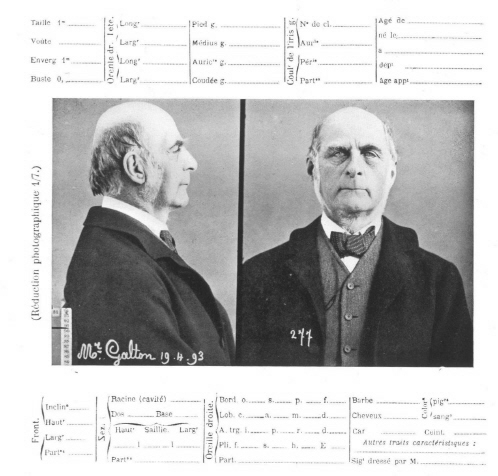
There’s also the bias of the chosen parameters: women were judged for beauty, their most salient characteristic, while Great Men were judged by the size of their guts.
And here’s the dangerous part: that a person can then claim that their views are blessed by Science and Darwin’s Law of Natural Selection. You can’t argue with me; I have the authority of Science, no matter how racist or sexist my views might be.
I venture to offer an explanation of this apparent anomaly which seems perfectly satisfactory from a scientific point of view. It is neither more nor less than that the development of our nature, under Darwin’s law of Natural Selection, has not yet overtaken the development of our religious civilisation. Man was barbarous but yesterday, and therefore it is not to be expected that the natural aptitudes of his race should already have become moulded into accordance with his very recent advance. We men of the present centuries are like animals suddenly transplanted among new conditions of climate and of food; our instincts fail us under the altered circumstances.
My theory is confirmed by the fact that the members of old civilisations are far less sensible than those newly converted from barbarism, of their nature being inadequate to their moral needs. The conscience of a Negro is aghast at his own wild impulsive nature, and is easily stirred by a preacher; but it is scarcely possible to ruffle the self-complacency of a steady-going Chinaman.
Now if you accept these prejudices as true, we cannot avoid Galton’s rational conclusion.
It is known that a considerable part of the huge stream of British charity furthers by indirect and unsuspected ways the production of the Unfit; it is most desirable that money and other attention bestowed on harmful forms of charity should be diverted to the production and well-being of the Fit. For clearness of explanation we may divide newly married couples into three classes, with respect to the probable civic worth of their offspring. There would be a small class of “desirables,” a large class of “passables,” of whom nothing more will be said here, and a small class of “undesirables.” It would clearly be advantageous to the country if social and moral support as well as timely material help were extended to the desirables, and not monopolised as it is now apt to be by the undesirables.
Pretend that there actually was a class of “undesirables,” people destined to be rotten wastrels who would increasingly drain society of its worth (further, suppose they are the poor rather than, say, investment bankers). You could legitimately argue that Galton’s solution is a good one. Wouldn’t that be a dilemma for all us godless liberals; we’d have a logical solution to a real problem, that would require a most illiberal course of action to reach an advantage for our country.
But of course, being a scientist doesn’t mean one is right. Declaring a course of action to be beneficial for society ought to be met with questions about “beneficial for who?” Premises for a claim that seem to do nothing but mirror common social prejudices ought to be questioned, and one good use for science is to test those claims…and perhaps finding that those foundations are rotten ought to be grounds to deny that the authority of science is backing up one’s actions.
And even if every claim was true, it doesn’t necessarily narrow our course as much as some would claim.
Anyway, whenever someone announces that science tells us that particular path is the one true path, or that their arguments are unassailable because they are Scientific, I always turn to high-minded scientist Francis Galton. Imagine a society that tried to actually implement his ideas…oh, wait. Imagine? Read a history book.


 , and he’s going to be
