
This is Thunderdome, the unmoderated open thread on Pharyngula. Say what you want, how you want.
Status: UNMODERATED; Previous thread

This is Thunderdome, the unmoderated open thread on Pharyngula. Say what you want, how you want.
Status: UNMODERATED; Previous thread


This is the lounge. You can discuss anything you want, but you will do it kindly. The baby hippo is wondering why it took me so long to put him on the page.
Status: Heavily Moderated; Previous thread

I mentioned a bit ago that some yahoos have been trapping bobcats in my neighborhood. That trapping has attracted the attention of reporter Louis Sahagun, who cracked the lid off the topic this weekend with an article in the Los Angeles Times. Sahagun interviewed some of my neighbors as well as a couple of trappers, one of whom — Mercer Lawing of Barstow, California — came up with this little bon mot:
“We love those animals more than the people who are complaining about us trapping them do.”
That link above is to Mercer Lawing’s bobcat trap business page, which contains potentially disturbing photos. He took down his Facebook page yesterday after my followup piece at KCET linked to it. I’m sure that was just a coincidence.
I’d been meaning to write something at KCET on the issue for a couple weeks, and since Sahagun had done all the hard work and beaten me to it, I followed his article with an analysis of the California Department of Fish and Wildlife’s epically crappy science on bobcats, and a call to ban bobcat trapping in California altogether.
My KCET piece is here. Short version:
The last time anyone came close to counting bobcat numbers in California was in the 1970s. Back then an estimated 72,000 cats lived in the state, and a scientific panel established by President Ford figured hunters and trappers could take one fifth of that population every year without damaging the species in California. The actual science was so tenuous that a judge stopped exports of California bobcat pelts in 1982, saying trade in pelts could resume only when the Fish and Wildlife Service came up with more authoritative numbers. That never happened, and the ban on bobcat pelt exports was lifted a few months later when changes in the federal Endangered Species Act made the case moot.

Also, an excuse to sneak a kitteh picture past PZ.
In the 30 years since, California bobcat trappers have had no limit on the number of cats they can kill. Five a day, ten, a thousand? It’s all the same to the California Department of Fish and Wildlife. Aside from the trapping season, which runs from November through January, the only limit on bobcat trapping is that DFW closes the season early if the haul reaches 14,400 cats — a fifth of the controversial population estimate in the 1970s, which has not been updated. As the price of spotted cat fur goes up, the haul of California bobcats does too, with DFW sitting on its hands as long as that magical “14,400 dead cats” number isn’t reached.
Check out the whole KCET piece for more detail on that, plus a natural history story about how bobcats might be Joshua trees’ best ally in a warming world.
As someone who likes to eat venison, I’m no anti-hunt person per se. But essentially unregulated trapping of top-level carnivores is altogether different. And doing so with no scientific justification is even worse.
The Center for Biological Diversity, which has also been tracking the issue, has set up an action alert page where Californians can send a preformatted but editable letter to the appropriate California legislator urging them to ban bobcat trapping in the state. I hope you’ll consider signing it and sharing it around your circles, should you have friends in California.
And a few bobcat enthusiasts in my neighborhood have set up a site called Project Bobcat, where they’ll be posting updates and background information. Check it out.

I just got home a short while ago, and of course I had to spend an hour shoveling snow. So I need this right now.

(via Florida Photo Magazine)

Melba Ketchum issued a press release announcing that she had sequenced Sasquatch DNA. That was back in November.
It stalled out at that point. It turns out the paper couldn’t get past peer review, and no one was going to publish it. We’re all heartbroken, I know.
But now she has overcome all the obstacles, and it’s finally in print! You can read the abstract.
One hundred eleven samples of blood, tissue, hair, and other types of specimens were studied, characterized and hypothesized to be obtained from elusive hominins in North America commonly referred to as Sasquatch. DNA was extracted and purified from a subset of these samples that survived rigorous screening for wildlife species identification. Mitochondrial DNA (mtDNA) sequencing, specific genetic loci sequencing, forensic short tandem repeat (STR) testing, whole genome single nucleotide polymorphism (SNP) bead array analysis, and next generation whole genome sequencing were conducted on purported Sasquatch DNA samples gathered from various locations in North America. Additionally, histopathologic and electron microscopic examination were performed on a large tissue sample. vel non-human DNA.
Umm, yeah, I know, it kind of falls apart in the last sentence, but that’s what it says.
How did she get it published?
Well, she says she bought an existing journal and renamed it (the Journal of Cosmology was on the market, and I hoped most fervently that that was it…but no, JoC is still online). So she owns the journal. It’s now called De Novo.
Then she came out with a special edition. It’s Volume 1, Issue 1. It contains precisely one paper, hers.
You should be laughing by this point.
The online journal is a mess. The layout is funky-ugly, it’s difficult to figure out how to actually get to the paper, and when you navigate to it, it’s got a wretched little “Buy Now” button imbedded in a couple of intersecting blocks of color in a hideous table-like layout. It reminds be of the esthetics of JoC.
Anyway, it’s $30 to buy a paper so bad they had to build a custom journal around it to get it published. Not interested.

Oh, horrors. One of those wicked people at Mad Art Lab has made himself a costume: a gender-bent version of Slave Leia. It makes my planned Rancor costume look pathetic. (In my case, it just involved stripping.)

This is a horrible little spot for the anti-gay marriage people in the UK. The first part is whining about FREE SPEECH and how it’s terrible that people can be discriminated against just for believing in “man-woman marriage” (hint: no one has a problem with “man-woman marriage”. The issue is that these people want to restrict the rights of people to practice other kinds of marriage.)
But it’s the last half that has me worried. They want to point to a failed state that is afflicted with the horror of allowing man-man and woman-woman marriage; a place where chaos has erupted, civil liberties are trampled, and the people live in terror of oppression by The Gays. And that place is…
Canada?
Have there been riots up North? Are the heterosexuals now enslaved? They’re just not telling us about it, right, because as everyone knows, The Gays dominate the media and they’ve clamped down on the word getting out. Canadians, you can tell me — just post your stories about the lesbians with whips and the gay men with cattle prods stalking your streets. I want to know.
You’re so close. It wouldn’t take much for jack-booted homosexuals to spill over the border and take over Minnesota, you know.
(via Joe. My. God.)

I wish that could be true for me. Robin Ince lives in a rather more secular culture. I live a few blocks from a cemetery with an odious electronic chime that plays hymns every goddamned 15 minutes; I live in a town with approximately 15 churches; I’ve been condemned by the county council of churches; I share a state with Michele Bachmann, a state where every couple of years we get to have another battle to keep creationism out of the public school science standards. I’m in a country where a politician denying evolution because the Bible says the earth is less than ten thousand years old, or denying climate change because their god promised to never screw up the weather again, are perfectly practical positions that will endear them to their benighted segment of the electorate. I wish these people would just take their faith into the churches and leave the rest of us be.
But at least Robin is generally correct in this part.
For a while I have worried there is a rise in the superior atheist, though I hope that is not true of most I know. I believe there can be a lack of imagination and experience amongst some atheists. We can gloriously bathe in the reprehensible examples of faith inspired misogynists, homophobes, terrorists and other thugs, and ignore the religious people who amble around us, filled with doubt, questions, compassions and a non-dogmatic view of the world. There are cultures and countries, where the repugnant, muscular hand of organised religion manipulates the populace. There are people who embrace dogmas, religious or political, and will refuse to view them with a critical eye, whatever the evidence might seem to be; old Maoists or Catholic die-hards who, while eagerly criticising other persuasions, will remain energetically blind to “their own sides” shortfalls. I am sure I have and will fail to notice my own shortcomings, while criticising those I see as opponents for exactly the actions I have been guilty of. It seems that is part of the human survival mechanism, though I hope I am becoming more vivacious in my eye for personal hypocrisy.
These are concerns that sometimes leave me in despair. Yeah, I’m surrounded by the absurdly devout, but as we’ve all been discovering in the last few years, my chosen atheist community is pretty well cluttered with arrogant, petty assholes. Some days I feel even more isolated than before.
So, this Odin guy…are his followers enlightened and tolerant?

Barton is such a lying tool. Chris Rodda catches him in an outright lie: Barton claims that gun accidents didn’t occur in 18th century America, and that he could only find two accounts of such problems. I guess he must be a very bad historian, then, in addition to lacking any sense, because Chris just went browsing and found lots of accounts of accidental shooting deaths and injuries (as you’d expect — guns are dangerous tools, of course you’re going to get accidents!)
One other thing you might do, though, is that a link to the story is on Reddit…and some people have even downvoted it. Why? I don’t know. Rodda’s story is full of hard evidence that Barton was completely wrong. Those of you with Reddit accounts might head over there and give your honest opinion.

The latest issue of Priscum, the newsletter of the Paleontological Society (pdf), has an interesting focus: where are the women in paleontology? They have a problem, in that only 23% of their membership are women, and I hate to say it, but the stereotype of a paleontologist is Roy Chapman Andrews — most people don’t imagine a woman when they hear the word paleontologist (unjustly, I know!)
On the other hand, 37% of the paleontology presentations at the GSA were by women. They’re there, but they aren’t getting far up the ladder of success. They’re not achieving high status positions within the society at the same rate as men, and then there’s this skewed distribution:

So women are over-represented in the student category, but under-represented in the professional category. The optimistic way to look at that is that there is an opportunity for change, and maybe that wave of current students will move on up and change the distribution ten years from now. More pessimistically, it suggests that there could be barriers that preferentially block the advancement of women in the field; if the distribution doesn’t change in the next decade, that says that there were more frustrated women who left the discipline than men.
So why would women experience greater barriers to advancement? It isn’t about evil men keeping the women down, and I wish we could clear away the resentment some men express when they hear that there are greater obstacles to women’s progress — too often I hear angry responses to accusations of academic sexism taken personally, as if it were a statement of personal criminality. It’s a product of the system, and men and women mostly contribute to it by neglect and an unwillingness to change the status quo.
What I most often see is statements of fact that I don’t disagree with, such as that women on average have lower publication rates than men, but the problem is that these advocates of blaming the inherent properties of women for their failure don’t think it through. Why do women have lower publication rates? Are there structural/cultural/professional properties that conflict and cause problems that men don’t see? And most importantly, if there are, what can we do to correct those institutional biases? Just saying that “women publish less” begs the question.
This article had a very helpful diagram illustrating the contributing factors, taken from a paper discussing a similar problems among evolutionary biologists.
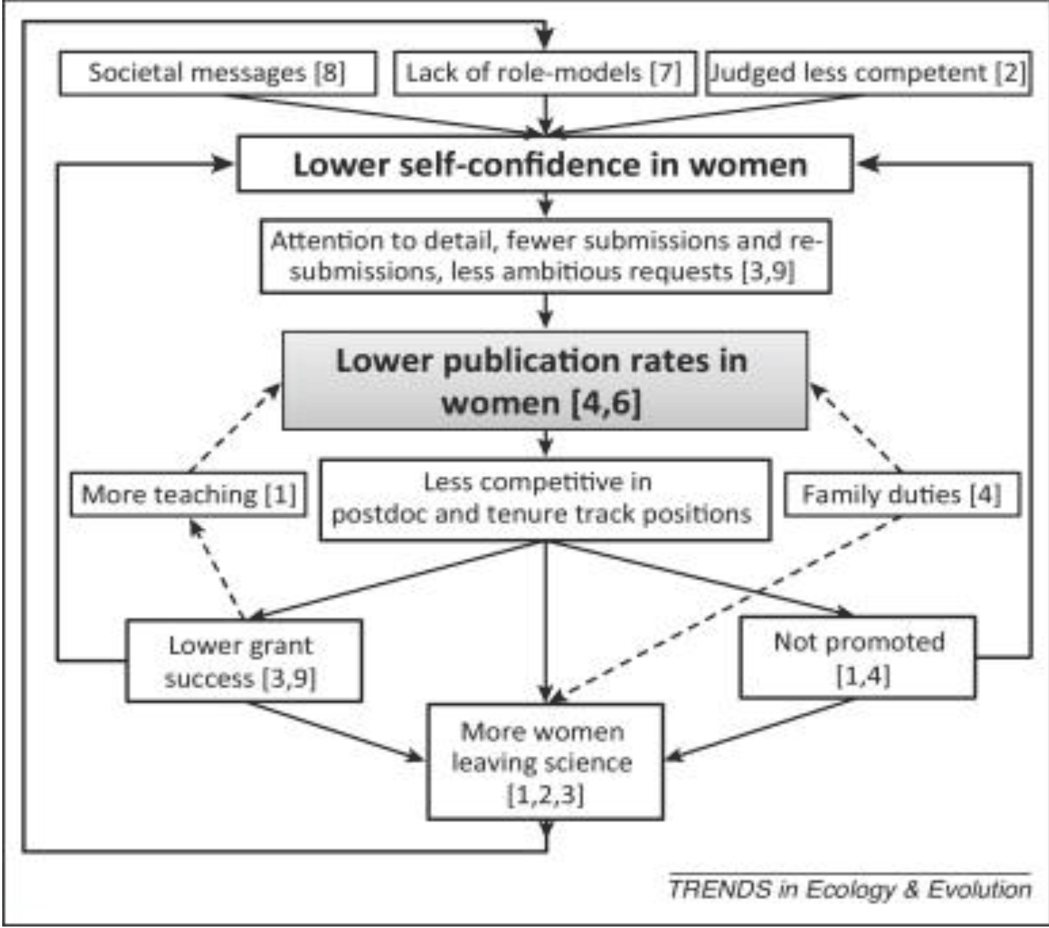
Right there in the center is issue of lower publication rates in women, but it looks deeper at consequences and causes. Follow the arrows. I’ve seen similar charts before — it looks a heck of a lot like an extinction vortex, a self-perpetuating cycle of defeat.
Another article in the same newsletter describes the distribution of the leadership of the Paleontological Society. It shows steady improvement in the proportion of women in the society leadership, but still, most of the executive positions have been held by women less than 10% of the time. The more recently the position was created, the higher the proportion of women. I also noticed one outlier: 67% of the Education and Outreach Coordinators (a very new position) have been women. That’s another stereotype, too, that women are better suited to teaching. Look at the diagram above: going into teaching is also one of the factors that hurts research productivity, and as long as research is more highly valued than teaching, and teaching is considered ‘women’s work’, it’s going to skew representation of the sexes.
They have a proposal to correct the imbalance. Notice that it doesn’t involve simply declaring that they have equality of opportunity (which they don’t!) and doing nothing. Correcting these kinds of biases requires active intervention.
Societies are strengthened by incorporating diversity (of gender, of ethnicity, of abilities, of ideas, and of disciplines). As a society, we need to be aware of equity issues and take intentional steps to counteract imbalances. The recommendations below relate to increasing ALL types of diversity. So far, we have data on gender equity, but there are many other types of diversity we should work to improve. This set of recommendations applies to all of them.
Intentional nominations. Think about the excellent female colleagues you have. Now nominate at least one of them for a leadership position (we have several open this year!) or a society award. All Society positions are open nominations, so please share your ideas!
Mentoring. Establish professional relationships with young women in paleontology (students and early career professionals). Spend some extra time at poster sessions meeting some of our student members. Encourage women to submit abstracts for oral presentations. Established women, share your career stories and experiences.
New initiatives. PS Council is dedicated to increasing equity for all types of diversity in our membership. Please share any ideas you may have for initiatives with [the author] or other council members—now and in the future.

