
How else is Google Maps going to get coverage of the 70% of the planet underwater?
(via Cephalove)

How else is Google Maps going to get coverage of the 70% of the planet underwater?
(via Cephalove)

I read this and thought, “but you’re alone either way!”

It tells you all you need to know about the people who endorse that kind of message, anyway.
(Sharing because I disagree!)

Ray Comfort is a very nice person in person, but there’s a price to pay: Heina warns us all of the deceptive uses of politeness. I agree, but then I’m from Minnesota, where assassination by niceness is endemic (we transplants are fully aware that “nice” is a wicked backhanded compliment when used properly, which native Minnesotans seem to be able do unconsciously and effortlessly).
Don’t worry, I’m not likely to forget that while he’s smiling at you to your face, Comfort is also disgorging toxic waste and ignorance out of his ass.

America, you are all screwed up.
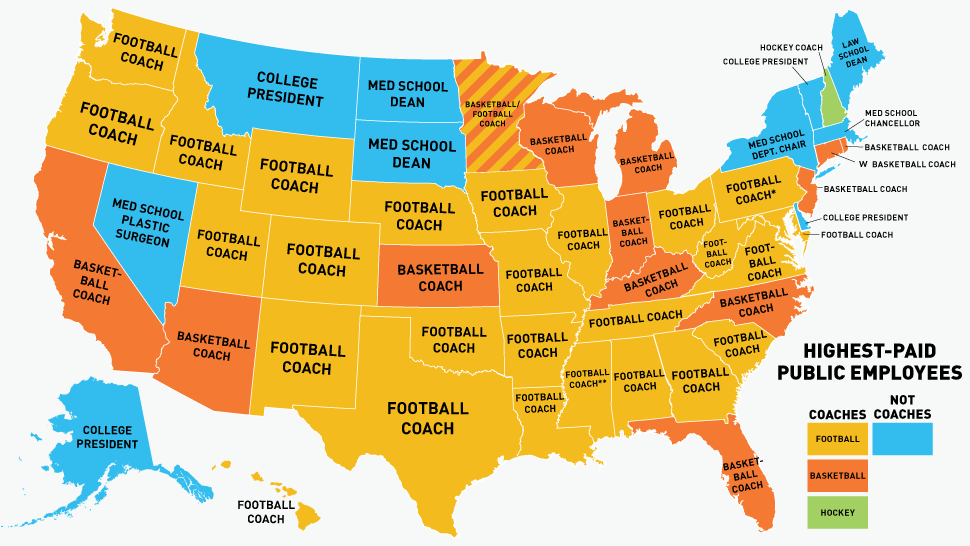
The article also makes the point that the athletic programs these universities sponsor are major loss leaders, draining money away from education to pay off overpaid coaches.

I’m all bleary-eyed this morning because late last night, Wilkins linked to this article on Pink Floyd and incidentally sent me off on a late night music jag. He is truly a horrible person.
Pink Floyd was the soundtrack of my youth, from adolescence through grad school and starting a family. I have all their albums, and have listened to every one multiple times — I know (or at least, used to know) the lyrics to “The Gnome”, even, that’s how bad it was. So it was very triggering of Wilkins to remind me, and I had to play a bunch of them very loudly on the home stereo and wallow in the sound.
Don’t worry, Mary was away, so it was just me, alone in a big empty house with most of the lights out, listening to “Careful With That Axe, Eugene” after midnight. I felt like a lonely anomie-laden teenager again. It was great! I’m just paying the price this morning…this morning when I have to bunker down in my office and grade papers.
So now I have to inflict some of it on you. Here’s one of my favorites, “One of These Days”, from Meddle.
Oh, man, there were good memories in there. When my kids were little, we had a tradition of sleeping in on Sunday and then making pancakes (if they’d been very good, chocolate chip pancakes), and sometimes I’d put on Atom Heart Mother while I was puttering in the kitchen, just because “Alan’s Psychedelic Breakfast” was the perfect accompaniment. Now I can’t hear it without an overlay of maudlin sentimentality and memories of happy kids.
Anyone else remember when bands would put out music that was more than three minutes long?
OK, now must go grade.

Hey, I thought Europe was more secular…so why is this poll going the wrong way? Oh, because it’s in Catholic Austria.
In German:
Sollen Kruzifixe aus den Klassenzimmern verbannt werden?
17,68% – Ja, denn Religion soll Privatsache bleiben.
77,04% – Nein, denn das Christentum hat in Österreich jahrhundertelange Tradition.
5,28% – Egal, es liegt sowieso an den Eltern, ihren Kindern Religion nahezubringen.
Auf Englisch:
Should crucifixes should be banned from classrooms?
17.68% – Yes, because religion should remain a private matter.
77.04% – No, because Christianity has centuries-long tradition in Austria.
5.28% – Doesn’t matter, it is up to the parents to bring their children up in a religion.
Can a bunch of Americans reverse this trend? That would be weird.


This is Thunderdome, the unmoderated open thread on Pharyngula. Say what you want, how you want.
Status: UNMODERATED; Previous thread

I’d apply, except that 1) I already have a job, 2) I don’t meet most of the qualifications, and 3) my ferocity might frighten David Silverman.
Public Policy Director
American Atheists, Inc., a non-profit and nonpartisan educational and advocacy organization dedicated to the separation of religion and government and the equality of atheists, is seeking a qualified individual to take a leadership role in the development and implementation of its public policy activities. Responsibilities may include:
• Arranging and taking meetings with Congressional and Administration officials.
• Drafting action alerts for mass emails to American Atheists members.
• Collaborating with coalitions of national nontheistic and secular organizations to create better outcomes for the nontheistic community in everyday life.
• Monitoring federal legislative and administrative policies.
• Monitoring state actions for bills and laws that violate the separation of religion and government.
• Developing policy proposals related to secularizing the tax code
• Preparing comments and other position statements.
• Other tasks as assigned.Candidates should have at least 3 years of professional experience in public policy and legislative affairs and have a degree in law or related to public policy as well as knowledge of the Constitution, federal government, and the tax code; excellent analytic and problem solving skills; creativity and leadership; knowledge of the legislative process; ability to work independently; and excellent written and verbal skills.
Well-qualified candidates will have Capitol Hill experience and a demonstrated commitment to the nontheistic community or separation of religion and government issues.
American Atheists’ headquarters is in New Jersey; this position will be based at a satellite office in Washington, D.C.
Salary will be commensurate with experience. Additional benefits include paid sick, holiday, and vacation days; health insurance and dental insurance.
Please send a cover letter, resume, and a writing sample related to public policy or a public policy issue to careers@atheists.org. Applications will be considered on a rolling basis until June 3, 2013.
Ooh, “Developing policy proposals related to secularizing the tax code”? Hint, hint. More of that please.

So Daniel Loxton comments on his tent. I found it exceptionally revealing, just not in the way he probably intended.
(From another commenter) Again, it would result in much less heat to declare that atheism/religion in not wiyhin your focus or interest, rather than insisting on a controversial position that plenty of scientists apparently don’t agree with.
(Loxton) I’m not about to accept the controversial positions of handful of atheist activists as representative of the wider view of scientists. (These are, you realize, positions novel enough to them that they felt they were good hooks for controversial books?) But regardless, many skeptics have argued just as you ask: that for reasons of division of labour, skeptics will stick to the testable paranormal claims that we do best. Paul Kurtz, for example, argued in 1999 that,
As I have said, I do not believe, however, that CSICOP or the Skeptical Inquirer should in any way, except tangentially, deal with religious issues. But my reasons are pragmatic, not theoretical. It is simply a question of the division of labor. We lack the resources and expertise to focus on the entire range of scientific questions about religion: biblical archaeological, biblical and koranic criticism, linguistics, psychology, anthropology, sociology, the genetic or environmental roots of religion, etc. It would take us too far afield. We have focused on fringe science and specialized in the paranormal, and we have made important contributions here. Skeptical inquiry in principle should apply equally to economics, politics, ethics, and indeed to all fields of human interest. Surely we cannot possibly evaluate each and every claim to truth that arises. My reasons are thus practical.
Atheist hardliners are no more willing to accept that pragmatic argument than any other. The only answer that will satisfy atheist activists, apparently, is that skeptics must accept that atheist activism is the most important cause in town.
That’s an impasse that skeptics resolve by getting back to our own work.
I think he’s feeling a little exasperation — it’s a cheap and ineffective shot to complain that some scientists write “controversial” books, therefore…what? The only worthwhile books are bland and uncontroversial? And if he’s thinking of, for instance, Dawkins’ book, wrong — atheism wasn’t controversial among scientists at all. It was just a bold move to slap the facts down in front of the public.
But it’s the Kurtz quote that is most remarkable. What jumps out when you read it?
I. I. We. Us. We. We. Who, kemosabe?
Who has specialized in those particular subsets of skepticism? Why, Kurtz, and Loxton, and Swiss, and Shermer, and Dunning, and Radford, and many others. And that’s fine; they should do what they know and what they’re good at. Yet somehow they’ve got this amazing close-minded privilege that what they are doing, their local “we”, is what their entire constituency, the more global “we” of all skeptics, should be doing.
Are these people even aware that their movement should be more than the desires of a few so-called leaders? That their group is made up of individuals, each with unique talents and interests, and that what determines the focus of the skeptical movement ought to be the ever-changing concerns of the people in the movement, and that as the movement grows (as we hope it would), the wider pool of talent would broaden the range of interests?
If an atheist joins the skeptical movement, and says she wants to work on the harm religion does to society, what are you going to tell her? “No, you have to study the wily chupacabra”? If an atheist joins the skeptical movement, does that mean some High Poo-Bah goes up to Daniel Loxton, and orders him, “Put down that keyboard, Loxton, we’re sending you off to rural America to blow up a church, because we’re all atheist hardliners now”?
No. And it’s idiotic to fret over it. I’ve been listening to the gay marriage debate in the Minnesota House this afternoon, and the skeptics sound so much like the conservatives — somehow, opening the door to different views means that their personal interests are compromised. No, they’re not. Keep on chasing Bigfoot, guys! Keep on doing “your own work”! No one is telling you to stop!
But, you know, if skepticism really is an analytical tool set for examining the world, stop being so damned possessive of it, and let people apply it in ways that reflect their expertise, not yours. Skeptical inquiry should, in principle, apply to all fields of human interest, as Kurtz said. What is impractical is policing skeptical inquiry and straining to keep it from being applied by people who aren’t members of the skeptical elect, who have goals different from the usual white male magicians and libertarian dilettantes. You don’t get to do that.
It’s not your damn tent. It belongs to everyone.
I should have mentioned, and will do so now since it was brought up in the comments, that Kurtz’s “we” was focused on just the organization he was running, and in that it is perfectly appropriate for a specific organization to limit it’s brief to what the personpower within the organization can manage. It requires a deliberate administrative commitment to focus on a topic. An example would be NCSE’s recent expansion from a group that addresses evolution education to one that addresses evolution and climate change. This is very different from what a larger movement can do; there, expertise can bubble up from the base.


