
Cloning brains with Science

While we’ve been waiting and waiting for the physicists to get their act together and deliver on Mr Fusion home energy sources and flying cars, the biologists have been making great progress on the kinds of things that turn biologists on. The latest development: growing tiny little human brains in a bucket. Only let’s not call them brains…they are cerebral organoids. Hugo Gernsback would be so proud.

Here’s the latest development. Start with embryonic human stem cells, or induced pluripotent stem cells (cells which you’ve reset to a kind of embryonic state by using a virus to transfect them with the genes OCT4, SOX2, KLF4 and MYC, which trigger a change to a pluripotent state). Culture them in a cocktail of chemicals like basic fibroblastic growth factor and retinoic acid, which induces the cells to become neurectoderm, a precursor tissue of the nervous system. Imbed these cells in a gelatinous capsule that gives them a framework on which to grow, and also prevents them from just sprawling out into an amorphous neurectodermal sheet. Let them grow in a spinning bioreactor which circulates nutrients around them, and watch. They begin to form structures resembling those of the embryonic human brain, all by themselves.
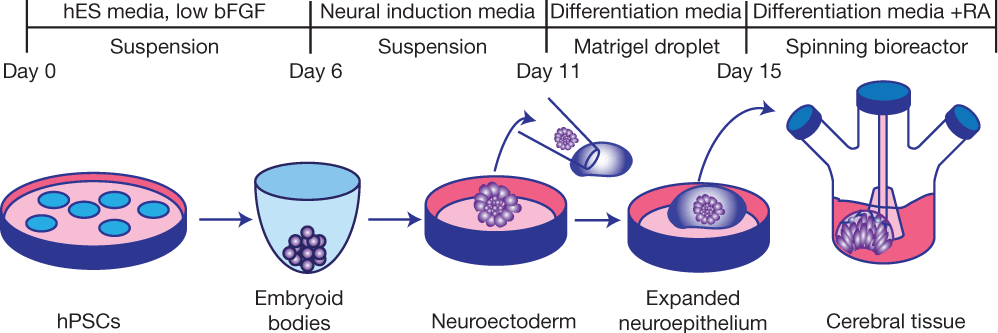
organoid_method

They show many of the properties of normal embryonic brains. Brains develop from the inside out; new neurons arise deep inside, and then migrate outwards along radial glia to the surface. These mini-brains show similar behavior, forming the beginnings of a laminar structure with roughly the same pattern of growth. They exhibit regional specification. We have a forebrain, midbrain, and hindbrain, for instance, and there are molecular markers for these areas; those molecular markers are selectively expressed in areas of the mini-brains, too. During development, our neurons exhibit fleeting electrical activity, especially the production of calcium action potentials (we gradually switch to sodium action potentials as the nervous system matures). These brains have bursts of calcium activity which can be diminished with tetrodotoxin, a nerve poison that affects signal transmission in neurons.

organoid

Awesome. Before you start imagining growing complete adult human brains in a vat to the point where they start doing philosophy, though, there are realistic limitations.

While there are regions expressing markers for typical human brain regions, they aren’t well organized — I looked at the sections of cerebral organoids, and while bits and pieces looked familiar, they weren’t in their canonical relationships to one another. It’s a kind of scrambled brain.

The laminar structure of the brain doesn’t fully form — it’s just the rough beginnings. It really is like a very early embryonic brain, and is not going to function to generate thoughts and perceptions.

It’s only brain tissue. They aren’t growing elements of the circulatory system, for instance, so there are no blood vessels delivering nutrients. That limits growth, and the largest cerebral organoids are only about 4mm in diameter. That might only be enough to generate an assistant professor of philosophy. (I joke! Don’t come after me, philosophy fans.)

Now this is pretty darned cool, and would be a shoo-in to win first prize at the Mad Science Fair, but you might be wondering what you can use it for. These are not functional brains, so no, you militarists, you can’t use them to control cruise missiles. What they are good for is studying developmental processes that build human brains (pure science!) and for figuring out the mechanistic causes of serious brain disorders (medical science!).

And the authors turned around and started doing just that. There are known defects that affect the proliferation of cells building structures in the brain, genetic diseases like microcephaly. You cannot do experiments on microcephalic human beings, and it’s been very difficult to generate good animal models of microcephaly — we have such unusual brains to begin with that it’s hard to find a brain analogous in sufficient detail in mice. But here’s what they can do.

They had a patient with microcephaly, with a known genetic cause (a mutation in a gene called CDK5RAP2). They can’t experiment on his brain, obviously, but what they could do is take a few of his skin cells, transfect them with the four inducing genes, and produce a clone which could be cultured in a dish and put through the organoid production procedure and make little tiny copies of his embryonic brain state. Now you can do experiments.

What they observed was that some brain areas in the organoids were smaller (complicated by the fact that overall growth was reduced), and that there more more neurons and fewer glia in affected regions. The hypothesis is that CDK5RAP2 maintains cells in a dividing state, and it’s absence causes premature maturation of neurons, which leads to reduced total numbers of neurons in the adult. They also tried inducing greater CDK5RAP2 in the organoids to rescue the phenotype — the experiment was confused by the fact that CDK5RAP2 overproduction seems to trigger cell death, and they do not have precise control over dosages, but they do find suggestions that glial production is rescued. They also did the complementary experiment of RNAi knockouts of CDK5RAP2 in non-patient organoids, and they did see a surge of neuron production. So it looks like they’re getting a good handle on the cellular processes behind this form of microcephaly.

So what they’ve built is a useful model for studying early brain development in humans that doesn’t involve experimenting on any actual humans. This is going to be useful for all sorts of developmental disorders.

Also, Mad Science Fair contests.


Lancaster MA, Renner M, Martin C-A, Wenzel D, Bicknell LS, Hurles ME, Homfray T, Penninger JM, Jackson AP, Knoblich JA (2013) Cerebral organoids model human brain development and microcephaly. Nature doi:10.1038/nature12517.

What do you get when a creationist visits the Galapagos?

I think it’s an anti-Darwin: instead of observations, you get pretty pictures; instead of insights, you get a cloud of murk and lies. Georgia Purdom of Answers in Genesis visited the Galapagos, and now she’s coming out with a book of religious apologetics.

After my return, I started thinking about writing a book on the Galápagos Islands. I wanted people to see that what we think about how and when the Galápagos Islands formed and how the wildlife changed over time has to do with a person’s starting point or worldview. The Galápagos Islands both past and present are a display of God’s majesty in His creation and His mercy in preserving life in a fallen world instead of an “icon of evolution.” I also wanted people to appreciate the diversity and beauty of the wildlife and landscape that is unique to the Galápagos through the 2000-plus photos I had taken.

If you should ever see this book, think about Purdom going to the Galapagos on a sight-seeing trip and learning absolutely nothing, and compare it to Rosemary and Peter Grant who spent decades there, documenting patterns of change in the bird populations of Daphne Minor. I learn something from the Grant’s work, while Purdom’s delusions will just make the world a stupider place.

Give the Purdom book a pass. Get the Grants’ How and Why Species Multiply: The Radiation of Darwin’s Finches instead.

Those dang comments

Scalzi is discussing comment management. There are…ideas…floating around there; some suck, some are interesting. Here are My Opinions™ on comments.

  • Comments are absolutely essential and are not going away. What do you think I read the site for? Besides, we’ve long had an interesting community here.

  • I’m not going to require real names. Consistent pseudonyms are good enough. I really, really hate sockpuppets; they undermine the credibility of all pseudonyms. I will burn all puppets to the ground on discovery.

  • My smartest recent move was appointing monitors who write in to report troublemakers. I don’t have to read everything constantly to track comments, which relieves a lot of strain.

  • The banhammer: too much or too little? I’ve been a little bit more heavy-handed lately, because of all the sexist jerkwads who’ve been popping in. I’m leaning in favor of more.

  • With the loss of the dungeon, I’ve thrown away most of my tracking of bannings, which doesn’t bother me much…but one thing I’ve long been missing is some way to achieve redemption. Once you’re banned, you’re dropped into a bottomless pit of blackness, never to be seen again, and there isn’t any way to gain forgiveness. How could we arrange to have a ban removed?

  • One capability I wish WordPress had was a way to require a certain minimum of words in a comment. I’d rather see fewer one-liners and more thoughtful discussion.

  • Should I implement a comment limit? I don’t think it’s currently a problem, except for that one guy who would dump German opera librettos or whatever into comments.

  • I do have keyword filtering, and I use it to block a lot of the language misogynists use, which is remarkably effective (there sure is a lot of rapey hatey talk stuck in the spam filter now). Other suggestions for words that magically disappear the bad guys would be useful. Also maybe words that block some of the knee-jerk responses from the good guys. What words/phrases do you hate to see popping up?

  • Never gonna implement comment threading or comment rating, so don’t mention ’em.

  • Scalzi shuts off some comments while he’s sleeping. I’m not going to do that: it discriminates against Australians and Europeans, and we have too many of that furrin ilk here.

  • Any wordpress experts know of any useful plugins for comments? I can pass suggestions along to the tech guy…who’s supposed to fix the main page first, of course.

  • I know the crappy preview function is a sore point for lots of you. Anything else that bugs you?

  • Styles. While we’re wating for the tech guy to get everything else done, one thing I can do all by myself is tweak the stylesheet. Any comment layout stuff you desperately want?

Skepticon wants more money

They need more donations. And they remind me that some of the people participating are providing incentives to coax cash out of your pocket.

Dogma Debate is trying to get Aron Ra to dress as a Jedi!

Shelly is going to write an amazing song that we choose!

Deep Fried Freethinkers is making dinosaur shaped chocolates!

Registrants who donate $100 or more receive a totally sweet gift!

Hmmm. Maybe you can make some suggestions in the comments for what I should possibly do to encourage more donations. What could I do to entice moolah out of you?

Christ-centered and cross-focused

Sorry about the earlier confusion, but it turns out the interview on Lutheran talk radio this morning was recorded and broadcast in the afternoon. But you can listen to the archive now.

They seemed nice. I hope they didn’t pull a Ray Comfort on me; let me know if the recording has me praising Jesus and professing my love of the Lutheran church.


Also, I’m done with classes for the day. Time to stagger home and vegetate.

OMG, it’s sinking in

Calendars are abstractions I ignore until I actually slam into the events listed in them. My teaching schedule has back-to-back lectures on Monday, Wednesday, Friday. Today with that radio interview, I have been talking non-stop for three hours. And on Wednesdays, I have lab immediately after my last class. This isn’t hump day, it’s splat-face-first-into-a-brick-wall day.

One of my students kindly gave me a gift of tea on the first day. I’m going to slump down into an exhausted heap after this is all over, and try to soothe my poor overworked vocal cords with something wet.

Quote war! We win!

A new billboard has gone up in South Dakota in reply to Coalition of Reason’s recent sign.

"When I saw the sign I thought of it as a direct attack on my God. I thought that it would be good for people to know that God is alive and that He has something to say," Kreider said to The Christian Post.

So, Mr Kreider, what does your god have to say?

The fool hath said in his heart, there is no god.

The fool hath said in his heart, there is no god.

Oh. The same damned quote you kooks always drag out. You know the authority of your bible is about the same as the authority of a Pokemon manual to me, so flinging quotes at me does you no good.

I can give you quotes, too — quotes from people who actually existed.

So much blood has been shed by the Church because of an omission from the Gospel: “Ye shall be indifferent as to what your neighbor’s religion is.” Not merely tolerant of it, but indifferent to it. Divinity is claimed for many religions; but no religion is great enough or divine enough to add that new law to its code.

Mark Twain

We despise all reverences and all the objects of reverence which are outside the pale of our own list of sacred things. And yet, with strange inconsistency, we are shocked when other people despise and defile the things which are holy to us.

Mark Twain

The World is my country, all mankind are my brethren, and to do good is my religion.

Thomas Paine

Religion has convinced people that there’s an invisible man … living in the sky. Who watches everything you do every minute of every day. And the invisible man has a list of ten specific things he doesn’t want you to do. And if you do any of these things, he will send you to a special place, of burning and fire and smoke and torture and anguish for you to live forever, and suffer, and suffer, and burn, and scream, until the end of time. But he loves you. He loves you. He loves you and he needs money.

George Carlin

Ask yourself this: if there is a god, why are the atheists so much more creative and witty?

Not surprising, but nice confirmation

Why present this as a mystery solved? I’ve been hearing about this hypothesis for years.

Many deep-sea squid actively grab their prey, sporting two muscular tentacles used to drag unsuspecting prey into their mouths.

But one squid species that lives down deep—the "wimp" of the proverbial playground—has limp noodles for arms. Scientists have wondered for years how it managed to catch and eat anything.

Let’s not exaggerate the mystery too much. Lots of deep sea squid have been known not to be active hunters: Vampyroteuthis, for instance, despite the fearsome name is actually a flabby-bodied blob that lives in near-anoxic waters and has a very slow metabolism. The hypothesis that they catch small prey by ambush with dangling tentacles has been the default for a good long while.

But that doesn’t change the fact that it is beautiful to see. Here are recently captured video images of Grimalditeutis bonplandi flitting it’s slender tentacles about as lures for prey.

MBARI always gets the most gorgeous footage.