Today is the 10th Annual Paul Nelson Day!

I think the appropriate way to celebrate is to do nothing at all, but just to pretend to have a big party.

Paul Nelson Day commemorates the fabulous concept of Ontogenetic Depth, a metric that Paul Nelson invented and presented at the 2004 Society for Developmental Biology meetings — he claimed that it was a measure of the complexity of a developmental process, and that it was a serious problem for evolution. Look, he said, all of a sudden in the Cambrian these creatures appeared with high Ontogenetic Depth values! Only he couldn’t tell us what those values were, or how he measured them. But they sure were a big problem for evolution!

Well, at least he couldn’t tell me right then and there at the meetings how to calculate Ontogenetic Depth. But he’d get right back to me with the details. Tomorrow. Right away. Some day.

Despite having actually had the gall to present this stuff at a legitimate scientific meeting, those details have receded farther and farther away, to the point where he finally admitted in 2011 that ontogenetic depth is impossible to measure. But we can still keep on rubbing his nose in his phony pseudoscience.

As for me, I have a cadre of strippers and a marching band here in my office, have dismantled all of the local churches to get the raw materials for a gigantic bonfire in the parking lot outside, and plan to have a picnic on the moon this afternoon to celebrate. I promise. I’ll post pictures to prove it…tomorrow. Pinky swear!

A good mission for MRAs

Have you heard of the Prison Rape Elimination Act? It was passed a long time ago.

The Prison Rape Elimination Act (PREA) was passed in 2003 with unanimous support from both parties in Congress. The purpose of the act was to “provide for the analysis of the incidence and effects of prison rape in Federal, State, and local institutions and to provide information, resources, recommendations and funding to protect individuals from prison rape.” (Prison Rape Elimination Act, 2003). In addition to creating a mandate for significant research from the Bureau of Justice Statistics and through the National Institute of Justice, funding through the Bureau of Justice Assistance and the National Institute of Corrections supported major efforts in many state correctional, juvenile detention, community corrections, and jail systems.

This law sounds like a good idea, and since the most common (but not the only!) victims of prison rape are men, you’d think this would be a major cause for men’s rights advocacy. I’m sure they’re poised to leap into action.

If you want an immediate focus for action, try this: Rick Perry, governor of Texas, has refused to comply, over a decade after the act was passed. His arguments aren’t very good: he claims that Texas standards have been sufficient, that it would cost too much to comply, and that they have far too many prisons and prisoners to be able to cover with the available auditing tools.

If Texas has adequate safeguards against prison rape, why is Texas one of the worst states in the country for sexual abuses in prison?

Years of government research, as well as thousands of letters to JDI from Texas inmates, show that rape is rampant in Texas prisons. In a 2013 report, the Bureau of Justice Statistics (BJS) singled out more detention facilities in Texas than in any other state for having high levels of inmate-on-inmate sexual abuse. That report, which was based on a nationwide survey of tens of thousands of inmates, was no aberration; two prior BJS inmate surveys, released in 2010 and 2007, also ranked Texas prisons as having some of the highest rates of sexual victimization in the country.

And maybe they could save some money and protect society humanely if they didn’t lock up so many men that they need hundreds of prisons. We have obscene incarceration rates, not just in Texas, but all across America.

It just seems to me that this prison problem ought to be a major focus of a men’s human rights movement, rather than abusing women and blaming them for all of their ills. Let me know when it happens.

A good weekend at Skep-Tech

I’m home from Skep-Tech, and I just have to say that that was one of the better conferences I’ve attended — which is remarkable considering that it was student-run and -organized, and completely free.

It was a good mix, too. There were several people I hadn’t heard from before, Kate Greene and Jessica Kirsner, who brought in fresh blood and interesting ideas. There were surprises: Ian Cromwell is a really good science communicator, and I learned a lot about the technical details of managing a health care system from his talk. You mean black people can talk about things other than race? Spread that news to other conference organizers.

Other standouts were Debbie Goddard, who gave a heartfelt talk about bringing meaning to atheism/skepticism, and Rebecca Watson, who gave an evidence-based and humorous talk about using social media — it’s not all selfies and photos of your dinner plate. Jesse Galef also accomplished a great synthesis of pop culture and a game theoretic approach to morality that explained how it evolved. They were all good talks, not a flop among them (well, I had to miss the last few because I had a long drive ahead of me…but I have complete confidence that Heina Dadabhoy was good, because she always is).

It also had an interesting audience. It was down a bit from last year, as Stefanie explains, but it was a healthy mix of familiar faces from the atheist community in Minneapolis/St Paul, and new strangers who wandered in. I didn’t bother to try and count heads — it was held in a gigantic auditorium, with a lot of flux as people drifted in and out (long breaks between talks encouraged a lot of discussion) — so I only took a quick count on Sunday morning, which is usually the worst time as people are recovering from all the late Saturday partying and increasing conference fatigue, and I saw about 60 people there. Total attendance was either significantly higher than that, or the talks were so engrossing that no one wanted to miss even the one held while they were hung over.

It was well worth the time, and it was held right there in my back yard, which was sweet. You should go next time it’s offered. Or if it’s too far for you to travel, organize your own — this was excellent outreach.

The smartest thing written about #CancelColbert

When the Colbert Report twitter account posted that ‘joke’, “I am willing to show #Asian community I care by introducing the Ching-Chong Ding-Dong Foundation for Sensitivity to Orientals or Whatever”, I understood exactly what he was talking about: that kind of remark was exactly what you’d hear said by the likes of Rush Limbaugh, in complete seriousness, and since Colbert is in the business of lampooning that kind of crap, I saw it as satire against casual racism.

But at the same time, it really bugged me. It was a lazy ass joke — it relied on a racist stereotype for laughs. And don’t talk to me about context; if you’ve got a joke that thoroughly depends on context, don’t put it on twitter, the worst possible medium for a lengthy build up. It also greatly put me off that Colbert doubled down afterwards. He’s a comedian. Are you going to tell me that comedians don’t understand that sometimes jokes fall flat? Is it a common response for comedians who tell a dud joke to then blame the audience for not appreciating it enough?

Maybe we should ask a comedian. Keith Lowell Jensen has some thoughts on Suey Park and the Colbert Report.

While many people of color defended Colbert, there were enough condemning the joke, even after the context was clear, that I had the choice to either consider the complaint further or assume that THAT large a number of people of color either didn’t understand satire and/or were hysterical and knee jerk and completely irrational. This seemed a poor assumption to make.

And while I considered Colbert’s joke, I don’t mean that I considered whether or not he should be cancelled (never Park’s real goal) or whether he was intentionally being racist (I have no doubt his intent was the opposite) but rather it was a good joke or not, whether this particular joke might have been a miss.

This discussion went on in my brain. I may have talked with a few friends about it, but I did so privately. What I didn’t do, was to immediately publicly condemn Suey Park and everyone else supporting #CancelColbert.

It seems to me that if an Asian woman finds a joke about racism against Asians (and about racism against Native Americans once context is added) offensive, the white guy should probably listen to her carefully and give her argument a lot of thought. The white guy should maybe not be SO quick to assume he knows more about racism than she does and should not be so quick to assume that she doesn’t comprehend or that she is hysterical and irrational. When many other people of color feel the same, this is magnified. I feel like a white guy navigating discussion of racism might want to be slower to respond, more eager to listen, less cocky.

That says it perfectly.

Pickles Poll

A minister with the silly sounding name of Eric Pickles is insisting that Britain is a Christian nation, the Telegraph is blithely reporting on it as news, and they have a poll which is running neck and neck with the contrasting views. Those of us in the United States can contribute our perspective on the matter: compared to our political apparatus, England is practically satanically godless. Maybe we should all let them know what we think of these wanking faithheads constantly trying to demand that entire diverse nations are ‘owned’ by single religious traditions.

Do you agree with Eric Pickles’ comments?

Yes, Britain is a Christian nation  50.08%

No, Britain is a secular country and religious beliefs should be kept private  49.92%

The abortion problem…solved!

Dana publishes the simple, brilliant solution to abortion. I can’t see any downside to it. We already live in a culture where pointless surgical alterations to boy’s genitals are common, and this just adds one more.

I’m thinking we could also make it a ritual of passage into manhood. You aren’t really a man until you’ve had The Procedure.

Islam and science are compatible, as long as you cut out the bits of science you don’t like

I visited Brighton, once. I took a pleasant stroll down along the beach, dipped my toe in the water, and I liked it! Therefore, my current physiological state is entirely compatible with swimming the English Channel, and how dare anyone criticize my lack of swimming practice and stamina and strength as somehow incompatible with being a successful English channel swimmer. Didn’t you see in my first sentence that I liked it?

That’s how I read Sana Saeed’s article in which she declares that Richard Dawkins is completely wrong about the incompatibility of science and religion. Her reasons are remarkably superficial and trivial, and she manages to kill her own case midway through. Here’s why she thinks they’re compatible:

I spent my childhood with my nose firmly placed between the pages of books on reptiles, dinosaurs, marine life and mammals. When I wasn’t busy wondering if I wanted to be more like Barbara Walters or Nancy Drew, I was busy digging holes in my parents’ backyard hoping to find lost bones of some great prehistoric mystery. I spent hours sifting through rocks that could possibly connect me to the past or, maybe, a hidden crystalline adventure inside. Potatoes were both  apart of a delicious dinner and batteries for those ‘I got this’ moments; magnets repelling one another were a sorcery I needed to, somehow, defeat. The greatest teachers I ever had were Miss Frizzle and Bill Nye the Science Guy.

I also spent my childhood reciting verses from the Qur’an and a long prayer for everyone — in my family and the world — every night before going to bed. I spoke to my late grandfather, asking him to save me a spot in heaven. I went to the mosque and stepped on the shoes resting outside a prayer hall filled with worshippers. I tried fasting so I could be cool like my parents; played with prayer beads and always begged my mother to tell me more stories from the lives of the Abrahamic prophets.

That’s all very good — it’s a great start to have a childhood in which she was enthusiastic about science, and perhaps she could have even gone on to be a practicing scientist when she grew up (she didn’t) — and she could have even continued to be a practicing Muslim. There is nothing in her story that rebuts any claim of the incompatibility of science and religion.

But here’s where there is an incompatibility: she could do experiments with magnets and potatoes, but did she ever ask herself if those long prayers really worked? Did she ask her grandfather how he knew heaven existed, and would she have been content if he’d simply said it was a tenet of their religion? Did she ever examine those stories of the Abrahamic prophets and ask if they were really true?

No, she did not. She comes right out and says it: magnets and potatoes, sure, but there are some things you are not allowed to question.

In other words: There’s plenty of wiggle room and then some. On anything that is not established as theological Truth (e.g. God’s existence, the finality of Prophethood, pillars and articles of faith), there is ample room for examination, debate and disagreement, because it does not undercut the fabric of faith itself.

She’s so blinkered by her faith that she doesn’t even realize that setting boundaries on what you may question is completely antithetical to science, and that her religion compels her to accept counterfactual nonsense. The only way she can say religion is compatible with science is by imprisoning a broken science within the limited boundaries of what the patriarchs of her faith will allow.

You may not question god, angels, the Qu’ran, Mohammed, the existence of the afterlife, or God’s will, but hey, as long as you unquestioningly accept everything the antique holy book says about the nature of the universe, it’s totally compatible with science.

She gives an example of how Islam and science are compatible, but it’s enough to make one cry in despair.

Muslims, generally, accept evolution as a fundamental part of the natural process; they differ, however, on human evolution – specifically the idea that humans and apes share an ancestor in common.  

Well, then, that means you don’t accept evolution. There is no good reason to single out humans as exceptional — the science says one thing, religion defies the evidence, and Saeed accepts the religion.

In the 13th century, Shi’i Persian polymath Nasir al-din al-Tusi discussed biological evolution in his book “Akhlaq-i-Nasri” (Nasirean Ethics). While al-Tusi’s theory of evolution differs from the one put forward by Charles Darwin 600 years later and the theory of evolution that we have today, he argued that the elemental source of all living things was one. From this single elemental source came four attributes of nature: water, air, soil and fire – all of which would evolve into different living species through hereditary variability. Hierarchy would emerge through differences in learning how to adapt and survive.

This is a “theory” that is not founded on evidence and experiment, propagates archaic ideas about the structure of the universe (water, air, soil, and fire are not the fundamental attributes of nature), contains erroneous statements about biology (al-Tusi endorsed a hierarchical ladder of life, and also set humans apart as a special case), and completely lacks the population thinking that was the core of Darwin’s insight. He was a smart fellow who did some brilliant things, but he was also a person of his times and his biological explanations were most definitely not comparable to what Darwin came up with 600 years later.

That Saeed thinks they are is just another sign of her ignorance.

Al-Tusi’s discussion on biological evolution and the relationship of synchronicity between animate and inanimate (how they emerge from the same source and work in tandem with one another) objects is stunning in its observational precision as well as its fusion with theistic considerations. Yet it is, at best, unacknowledged today in the Euro-centric conversation on religion and science. Why?

Because it was wrong? Because it did not lead to greater understanding of how biology works? Because it was all tangled up in ridiculous religious beliefs that you were not allowed to question?

I think Saeed understands her religion very well. But despite some early promise in childhood, it’s clear that she doesn’t understand science at all.

What’s causing the boom in atheism?

It is only appropriate that now, while I’m at Skep-Tech 2, we should get an article about the influence of technology on religion. It seems to be primarily corrosive.

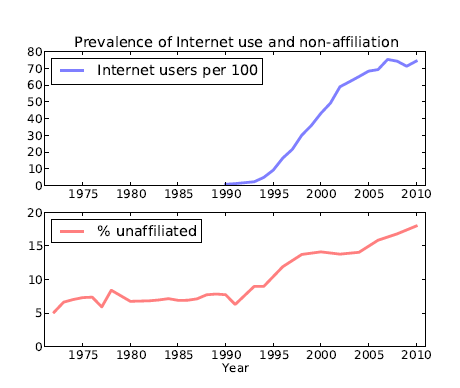
Back in 1990, about 8 percent of the U.S. population had no religious preference. By 2010, this percentage had more than doubled to 18 percent. That’s a difference of about 25 million people, all of whom have somehow lost their religion.

LosingReligion

(By the way, I’m not a fan of graphs that mislead by having different scales: the percent change in the adoption of the internet is far, far greater than the percent change in the adoption of atheism — this chart illustrates a similarity in timing, only.)

A computer scientist, Allen Downey, has dissected these trends to identify the major components affecting religiosity, and has narrowed it down to three big ones: upbringing, education, and access to the internet.

He finds that the biggest influence on religious affiliation is religious upbringing—people who are brought up in a religion are more likely to be affiliated to that religion later.

However, the number of people with a religious upbringing has dropped since 1990. It’s easy to imagine how this inevitably leads to a fall in the number who are religious later in life. In fact, Downey’s analysis shows that this is an important factor. However, it cannot account for all of the fall or anywhere near it. In fact, that data indicates that it only explains about 25 percent of the drop.

He goes on to show that college-level education also correlates with the drop. Once it again, it’s easy to imagine how contact with a wider group of people at college might contribute to a loss of religion.

Since the 1980s, the fraction of people receiving college level education has increased from 17.4 percent to 27.2 percent in the 2000s. So it’s not surprising that this is reflected in the drop in numbers claiming religious affiliation today. But although the correlation is statistically significant, it can only account for about 5 percent of the drop, so some other factor must also be involved.

That’s where the Internet comes in.  In the 1980s, Internet use was essentially zero, but in 2010, 53 percent of the population spent two hours per week online and 25 percent surfed for more than 7 hours.

This increase closely matches the decrease in religious affiliation. In fact, Downey calculates that it can account for about 25 percent of the drop.

That’s a fascinating result. It implies that since 1990, the increase in Internet use has had as powerful an influence on religious affiliation as the drop in religious upbringing.

I think there’s more to the story than this, though. The internet is too big and messy to be simplistically causal: there are also a great many sites dedicated to reinforcing the lies of religion, obviously, and there are Chrisians and Moslems who use the internet as a tool for evangelism and tribe-building. A more interesting question would be about how people use the internet. I don’t think a person’s faith would be challenged by the internet alone, but only if they use the internet to explore and compare conflicting views.