Why did no one tell me Neil Patrick Harris has a whole series of surreal puppet videos?
Pharyngula
Evolution, development, and random biological ejaculations from a godless liberal

Why did no one tell me Neil Patrick Harris has a whole series of surreal puppet videos?

A while back, I responded to Behe/Luskin’s claim that his model proving the impossibility of evolution of chloroquinone resistance was vindicated. I pointed out (as did Ken Miller) that showing that a particular trait required multiple point mutations did not affect the probability in the naive way that Behe and Luskin calculated — in particular, it did not require that the mutations be simultaneous. We’re familiar with a great many known mutations that involve multiple sequential hits to have their effect. I mentioned the work on steroid receptor evolution, and how cancer is an amazing example of the power of the accumulation of sequential variants.
Behe fired back, issuing a challenge to ‘show my numbers’. If he could have said anything to confirm that he was obliviously ignoring my point, that was it, and so I blew him a raspberry and ignored his challenge. I wasn’t arguing with his numbers, and we could even use his very own set of numbers — my point was in the operation he was doing with those numbers. His assumption is that you must have two mutations occur simultaneously, in the same individual, so that you simplistically multiply the probabilities together to get an improbably low frequency. I’m saying that’s invalid: these mutations can happen independently, they can accumulate to some frequency in the population, and then a second mutation can occur.
Now Larry Moran has carried through on the calculations. Using the known data on mutation rates, and throwing away Behe’s bogus demand that everything occur in the very same instant, he shows that the evolution of chloroquinone resistance ought to be rare, but not at all impossible, and with frequencies that are in the ballpark of what is observed.
Furthermore, Moran describes a paper that quantifies the presence of malaria strains in the population that contain pieces of the resistant combinations and that further describe the sequential series of mutational events that led to the most resistant strains.
All of the strains (except D17) are found in naturally occurring Plasmodium populations and the probable pathways to each of the major chloroquine resistant strains are shown. It takes at least four sequential steps with one mutation becoming established in the population before another one occurs.
None of the mutations occurred simultaneously as Behe claimed in his book.
The intelligent design creationists are somehow still crowing victory. I don’t quite understand how — their premises have been demolished, they’ve been cut off at the knees, but I guess their followers are easily bamboozled if they shout “math!” loud enough. Even if the math is wrong.

Minnesota senator Amy Klobuchar seems to be doing all the right things in congress — I’ll definitely be voting for her again, and also for Al Franken. All of you from states with less progressive representation can’t imagine how good it feels to actually have politicians in office who do good, rather than providing embarrassing soundbites. One of her latest efforts is a bill to close loopholes in background checks for gun sales.
For women, domestic violence is the greatest risk factor associated with guns. According to Everytown, “The presence of a gun in a domestic violence situation makes it five times more likely that a woman will be murdered,” and some Center for Disease Control statistics suggest more than 50 percent of female homicides are attributable to intimate partner violence.
Klobuchar’s bill, the Protecting Domestic Violence and Stalking Victims Act, would close gaping holes in background check laws that don’t bar gun ownership by abusive dating partners rather than spouses, and don’t incorporate many stalking crimes.
This is a popular bill — polls show that the electorate, even the responsible gun owning electorate, thinks it’s a good idea to keep guns out of the hands of your local angry bully. But as you might guess, the NRA opposes it, and they’ve got a few politicians in their pocket who’ve also been told to kill the bill, or similar bills in their home states.
And that’s where it gets interesting and uncomfortable. Democrats are fighting back. Not Klobuchar directly, but three states are running an ad right now to highlight the use of guns in domestic abuse — three states with three states with Republican shills for the NRA.
The thing is that the ad they’re running portrays a fairly common domestic abuse scenario, and it is terrifying. It was a punch in the gut for me, and I’m a guy who’s never been in this kind of situation, ever, so I’m warning you: if you’ve ever had a stalker or abuser, this is an extremely potent video.
Maybe this is what we need to do more of — slap people in the face with the horror of what our irresponsible gun policies do to people. My one concern is that there may actually be people who sympathize with the man in this ad, rather than the woman.

Take a look at the kind of profit you can make from various businesses. This is pretty good money.
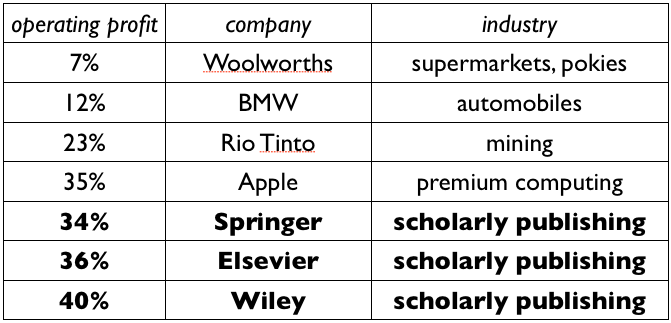
We all know Apple’s business model is to build cool gadgets with high end stuff inside that it then sells at a high markup for premium design and ease of use — they’re at least creating something novel. But what makes Wiley and Elsevier so profitable?
That’s the genius of it all. Their customers create everything, they charge the customers for the privilege of selling it to the publisher, and then they sell it back to their customers. Imagine if Apple did that: all of you homebrew computer people who buy components and assemble them into functioning wholes and trick them out with spiffy bells & whistles are contacted by Apple, who offers to take them off your hands if you pay them a few hundred dollars, and they then take your creation, polish up the case a bit, stick an Apple logo on it, and sell it in their catalog for a few thousand dollars.
Oh, also, when you buy an “Apple”, they require that you get shipped a broken Sinclair and an old Commodore PET. It’s part of the deal.
That’s how the scientific publishing houses operate. It’s a broken system that profits the middlemen.

Kate Clancy comments on a ‘satire’ published in a serious journal.
Genome Biology published a satirical piece by Neil Hall today, and since I’m American and he’s British I don’t find it funny. No wait, it’s that I’m female and he’s male. Or maybe that I’m junior and he’s senior. I’ve got it, it’s because he has a ton of publications (many times the number I have), and I have a ton of Twitter followers (many times the number he has). Meaning, my K-index knocks his out of the park.
Let me back up. You see, Hall created a joke metric he calls the Kardashian Index, which is one’s Twitter followers divided by one’s scientific citations. He writes:
“Hence a high K-index is a warning to the community that researcher X may have built their public profile on shaky foundations, while a very low K-index suggests that a scientist is being undervalued.”
Ha ha. Hilarious. You know how you could optimize your k-index? Never talk to the public at all. What this guy has done is published a joke that reflects the attitude of many senior people in the scientific community, that not only is communicating science to the world valueless, it reduces the value of the science. If he really wants to piss on his colleagues, he should have added something about how teaching is a debit on your academic credit, too.
I remember when Sagan was denied tenure at Harvard (which isn’t too surprising, Harvard is extraordinarily full of itself) and also refused admission to the National Academy of Sciences — the perception was that he was just too danged good as a popularizer, so he couldn’t possibly be a serious scientist. At the time, I was reassured that all the tightly puckered sphincters who were offended by popularizing science were old, and would be dying off, and it would be getting better. And now I’m getting old and gray myself, and they’re still hanging in there, immortal, apparently. I think they must live forever by sucking the joy of science out of children’s brains.
Maybe we need a different index, one that penalizes scientists who clutter up the scientific literature with fluffy stupid opinion pieces padded with pseudoscientific and contrived formulas marked as humor. It was the kind of thing that, instead of being elevated by Genome Biology, might have been better presented as a tweet. Except that distilling it down to 140 characters would have made its inanity even more obvious, and it would have hurt his k-index.


We’re doomed. The Pacific striped octopus is exhibiting complex social behaviors.
Panamanian biologist Aradio Rodaniche first reported the Pacific striped octopus in 1991 off the coast of Nicaragua, noting its strange behavior—living in groups of possibly up to 40, laying multiple egg clutches, and mating face-to-face and sucker-to-sucker. Most other octopus species, for instance, come together only to mate.
Next thing you know, they’re making spears, forming hunting parties, warring with one another. And then they develop city-states, philosophy, diplomacy, and politics, and all the horrible appurtenances thereof: assassins, lobbyists, and televangelists. Then they take over.
It’s all because of that face-to-face mating. Hey, that’s our thing! They’re copying our specialty! Only they’re making it scarier.
"Regular octopus mating, where the male is behind and on top of the [female]—or far away—that’s scary enough to watch," said Ross. Females of many species, for instance, will sometimes kill and eat their mate, even if they are mating from a distance.
But "watching these guys come and interact with their beaks—wrapped up in a ball of limbs—are they fighting or mating?" he recalled wondering.
OK. They win.

Freethoughtblogs is three years old today, and still growing (we’re adding three new blogs this weekend). To celebrate we’ve put on a fresh coat of paint, with a few changes under the hood. I think we’ve also added a few new glitches, and your party game is to find them all and tell us how to fix them.
Poke around and tell us what you think!

The Creation “Museum” is advertising on Nickelodeon with commercials aimed straight at your children.
Notice that nowhere in their ads do they mention biblical literalism, young earth, god’s extermination of most of mankind, or that their audience are all damned sinners. Instead, we get dinosaurs and animals and a lot of false implications that the museum is a fun place for kids.
It isn’t. It’s a pretty dry series of exhibits, full of earnest sincerity, and a good bit of it in the middle is an attempt to scare everyone away from hellbound evolution.
Oh, well, I hope they’re spending a lot of money on advertising, and that it all contributes to this year’s red ink.


This is the lounge. You can discuss anything you want, but you will do it kindly.
Status: Heavily Moderated; Previous thread

I saw this video this morning, and it really bugged me.
What I saw was a bunch of farmers pulling the leg of an easily fooled and somewhat patronizing Dutch reporter. They’re cocoa farmers, but they had no idea what cocoa was used for? I didn’t buy it.
Good thing I didn’t: someone named ChuraChura posted a dismissal.
I find this video pretty distasteful (and that’s aside from the link between cacao plantations in Cote d’Ivoire and child slavery).
I work in southwestern Cote d’Ivoire, just on the border of Cote d’Ivoire and Liberia. The men I employ are largely cocoa farmers, when they’re not in the forest taking complex observational data on primate behavior and ecology.
Most of the people in this region are farmers with 5-10 acres in cacao or rubber production, and a much smaller subsistence plot with manioc, cassava, rice, pineapple, avocado, and oranges. Cacao is a labor-intensive crop. Once a year, the pods get harvested from the trees. They’re then cut open and the cacao bean is pulled out of the membrane and left on tarps in the sun to dry (everything smells like vinegar as the beans ferment), before being bagged up in 50L sacks, and then brought to central cacao-grower organizations. If you’re in a slightly more developed part of the country or part of a wealthy organization, you can get your cacao loaded onto trucks to bring them to a central location. Otherwise, we see men with these big sacks on bicycles pushing them from the village to their closest big town. Where I work, guys are generally walking 15-20 km. Once you get your cocoa beans to the organization, you’re at the mercy of the buyers. They generally set a price per kilo, and sometimes will set a quota for the amount they’re buying from particular regions depending on supply and demand.
Cacao is an attractive crop because demand is fairly steady, and the farms have been productive for a really long time. The problem is that you only harvest once a year, and then you have to rely on that lump sum of cash to get you through a whole year. This is particularly hard because mobile banking hasn’t really penetrated the market, and what (few) banks there are in rural southwestern Cote d’Ivoire aren’t really set up to cater to small-scale cash crop farmers. Some people are relying on the long-term prospects of rubber, which is currently getting better prices/kilo and can be harvested year-round – this makes it a lot easier to pay for things like school fees, uniforms, books, and supplies that need to paid for year-round. The problem is that rubber plantations take a while to come into production (5-7 years), so first of all you’re cutting down your producing cacao trees, and then you’re twiddling your fingers for 6 years while you’re not earning any money, hoping that the price of rubber won’t crash when all the new trees start producing, and that there’s still a market in the future.
The region is still politically unstable, and conflicts over land rights are a major part of that. A lot of the men I work with either fled themselves, or sent their families, to refugee camps in Liberia during the recent crisis. During that time, people from northern Cote d’Ivoire moved south and took residence in these abandoned farms – so even now, two years after La Crise officially ended, people still in refugee camps in Liberia are sneaking across the border and killing people they suspect took over their land. In addition, the effects of climate change are making the rains less predictable. The rainy season normally goes August-October (more or less); we didn’t get rain in 2013 until almost the end of November, which had serious consequences both for people’s cash crops and people’s subsistence crops. Food prices are rising, commodity prices are falling, and the situation is looking grim. The forested buffer zone around the national park I work in has now been entirely converted to fallow fields, cacao, coffee, and rubber plantations.
And, the men I work with know what chocolate is. When they can afford to buy it, their kids eat a knock-off version of nutella called Chocomax (it is pretty gross). These are smart, sophisticated adult men (and women, though fewer women own their own land… they mostly just do a lot of the labor on their husbands’ and fathers’ farms). Even if they didn’t know what chocolate was, they’re plugged into their local economies, they have a sense of larger global economic forces, and they know what’s going on (we listen to BBC world service: francais every night in the forest on Ferdinand’s satellite radio. They’d ask me cutting and incisive questions about stupid American politics, like who the hell is that Sarah Palin person anyway?).
But look, this is the way an extractive (exploitative) cash-crop economy works. It’s not cute or endearing that these men who are working incredibly hard have never, or rarely, had the opportunity to sample the end-product of their labor. It’s not touching that you have to go to the big city to find chocolate, and that only a little of it is locally produced (Milka is very popular in Abidjan; Ivorian brands less so), It wouldn’t be touching if you showed a cell-phone to a coltan miner in DRC and said "Look at this amazing machine your backbreaking labor in dangerous conditions enabled!" or a diamond miner in Sierra Leone with your sparkly pretty engagement ring and said, totally amazed, "But why don’t you have one?" Consumers in the developed world should be smarter than that. The producers in the developing world – the folks enabling our lifestyles – certainly are.
Now that’s actually interesting. It doesn’t fit into the racist narrative of the poor black subsistence farmers, though.
I also found this complementary video, in which the reporters went back home and showed the cocoa nut to European citizens. This ignorance I can believe, because I would have been baffled, too.
Who’s smarter? Who thinks they’re smarter?
