A small step forward for patients’ rights

Dan Markingson was a schizophrenia patient who was enlisted in a University of Minnesota trial of an experimental drug — and he killed himself horrifically while in the experiment. The university has just now made a policy change that excludes people from research trials who are restrained under a 72-hour emergency hold.

That’s nice.

Markingson killed himself in 2004, and it’s taken 11 years to get this minor, and honestly, rather obvious change in policy. Why has it taken so long? Perhaps this attitude by Brian Herman, vice president for research, explains some of the problem.

[Read more…]

Delusional

idvenn

The Discovery Institute thinks Following Kitzmiller v. Dover, an Excellent Decade for Intelligent Design. What planet are they living on? Intelligent Design is basically dead: Kitzmiller v. Dover killed it as a legal strategy, and none of the expectations of the Wedge document have been met. But Casey Luskin provides a list of their great accomplishments post-Kitzmiller. It’s very sad.

The very first item on the list is Lots of pro-ID peer-reviewed scientific papers published. No, not really. They’ve been publishing in tamed pro-ID journals like Rivista di Biologia and their own in-house journal, Bio-Complexity, with occasional forays into marginal pay-to-publish hack journals. Their most prolific contributor is a retired veterinarian who has labeled his house the Department of ProtoBioCybernetics and ProtoBioSemiotics, Origin of Life Science Foundation.

One of their “triumphs” is that Stephen Meyer’s book, Darwin’s Doubt, was reviewed in Science. Have you read the review?

As Meyer points out, he is not a biologist; so perhaps he could be excused for basing his scientific arguments on an outdated understanding of morphogenesis. But my disappointment runs deeper than that. It stems from Meyer’s systematic failure of scholarship. For instance, while I was flattered to find him quote one of my own review papers—although the quote is actually a chimera drawn from two very different parts of my review—he fails to even mention the review’s (and many other papers’) central point: that new genes did not drive the Cambrian explosion. His scholarship, where it matters most, is highly selective.

Yay. Winning.

Also, via Nick Matzke, while they’re busy claiming that Kitzmiller was irrelevant and that they’re gaining on science, here’s what Google Trends has to say about Intelligent Design.

idsfuture

So that’s what victory looks like, huh?

Finding insight in the funny pages

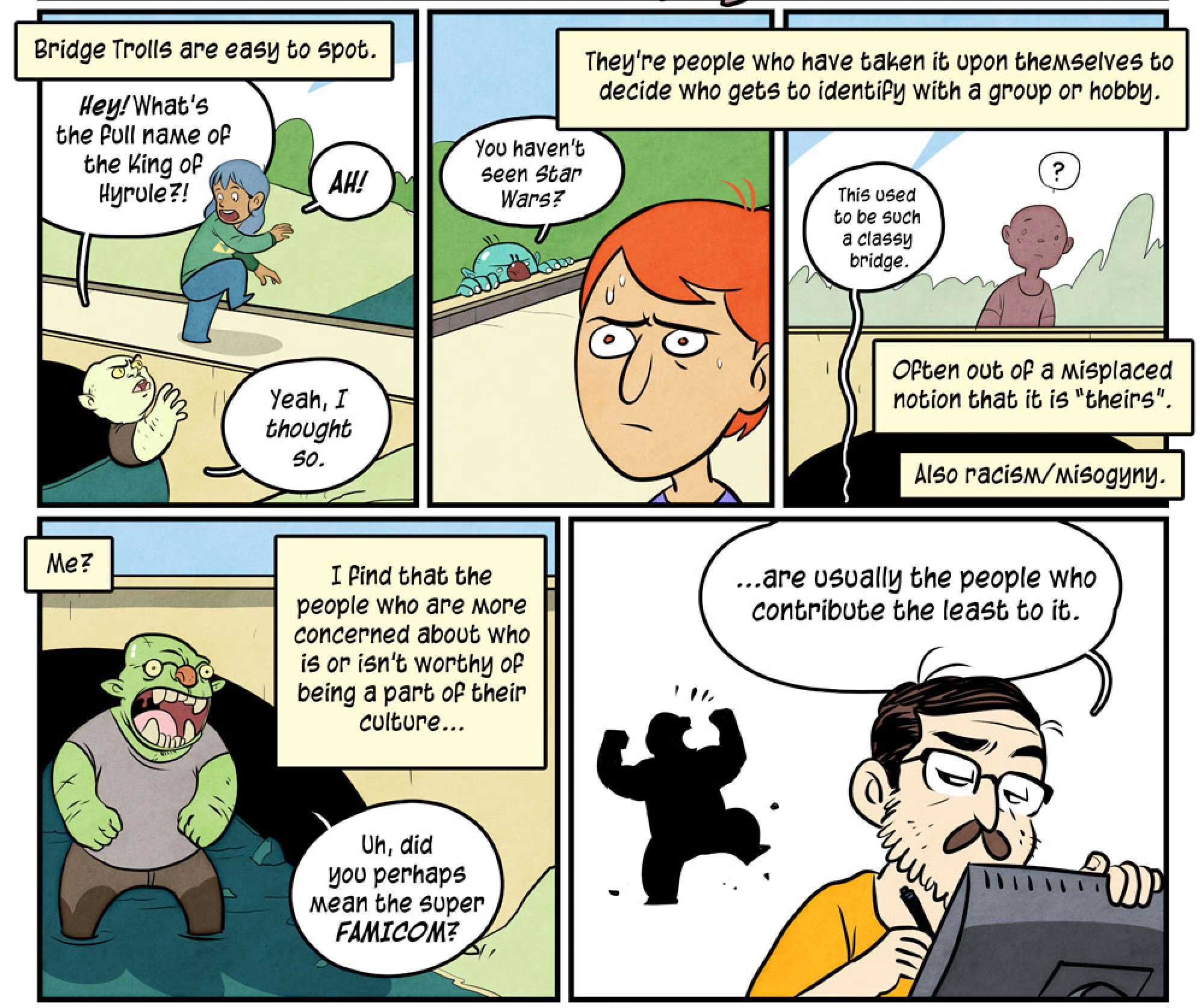
Maki illustrated two great truths about trolls:

  • They’re all about making sure only people like them get to be part of a community.

  • They’re so busy policing purity, they don’t bother to contribute productively.

trolls

His commentary is also spot on.

In a field where people work day and night to make sure every kid has a chance to become excited about science, the thought that there are old white dudes publicly sneering at a teenager because he wasn’t ingenious enough is sickening. Seeing people who identify as skeptics entertain wild conspiracy theories about a sinister muslim boy and his plot to get arrested for attention would be hilarious if it weren’t so toxic.

It’s a good thing to keep in mind: trolls aren’t necessarily simply frivolous haters who are out to destroy everyone’s fun for laughs. Sometimes they’re so very committed to the goals of a group that they dedicate themselves to non-stop hatred of the perceived enemies of that group, internal and external.

Perspective

While I appreciate the perspective on the relative investment in science, SciAm, this is a terrible graphic.

howbigisscience

It’s interesting that the total American investment in science is slightly larger than what the military throws away on just the F-35 program, but otherwise, this image has very low information density.

Humans are lousy at comparing surface areas, and here the money spent on each project is represented by…the area of a circle. That’s poor data representation. I’m sorry, but the creator of this graphic is going to be lined up against the wall with the person who invented pie charts.

Each data point is shown as a circle drawn arbitrarily somewhere on the page. There is no information in relative location — I guess the circles were just splotched down in an arrangement that looked good to a graphic designer somewhere. Are there any relationships between any of these data?

Colors are also arbitrary. Nations are in blue, genomes are orange, brains are purple, and telescopes are red. Just because.

There is so little information in this wall of circles that it needs to be helped along with paragraphs of text dumped onto the page in teeny-tiny print, and most of that text doesn’t tell us anything about the relationships between the circles. They are just circles of varying size on a bland blue background.

A tidy table would have been more than adequate for expressing numbers.

Oh, and there is content. Let’s shut down the F-35, give all that money to the NSF, and double the amount of grant money.

I guess we’ve been doing the advertising wrong

Heather Armstrong, better known as Dooce, is a mommy-blogger — she writes stories about her family and personal life — and she’s giving up the game for a surprising reason. Not because of the trolls (although there’s some of that) but because keeping her advertisers has been a pain in the butt.

The problem, Armstrong says, was that because she felt so beholden to them, she was agreeing to do just about anything to keep the advertisers happy.

“What happened over the last couple of years is the brands have been given a lot more say and a lot more control than they did when I was starting out,” Armstrong said.

“At the beginning, it was, ‘We’re just gonna put the logo at the end of the post. Write something around this.’ … And then it was, ‘Well, actually, we need you to show pictures of the product”. And then it was, ‘We need you to show the product.’ And then it was, ‘We need your kids involved in the post.’”

Wait, what? I’ve never been asked to personally endorse or build an article around the annoying items that we get as advertisements. No wonder we’re not rolling in the big bucks here!

Good for Armstrong for refusing to put up with it, but I’m wondering now how we’d handle it if FtB decided to sell out. Can you imagine the makers of homeopathic medicines, or shills for Bible colleges, asking me to show the product in an article or bring in a heartworming (not a typo) story featuring my godless, snarky kids? Not gonna happen. First try in which I mention some of our advertisers, they’d be frantically phoning me up to never mention their company name again…hey. HEY. I just had an IDEA.

Got something you want to bring to the public attention? I’ll start talking on the blog about your fantastically godless, liberal, feminist hair gel…wait a minute. What’s that poking out of the side of my laptop?

I didn’t know companies could transmit $100 bills through HDMI ports. That’s kind of cool. And a very fast response, Nameless Company That I Shall Never Ever Mention on the Blog Ever Again.

Wish I could be in Philly in December

The pope will be gone by then, right? They’re having a party:

The Freethought Society (FS) is pleased to be co-sponsoring a very special event with Ethical Humanist Society of Philadelphia (EHSP) and the Delaware Valley Chapter of Americans United for Separation of Church and State (DVAU) to mark the 10th anniversary of the “Intelligent Design” court case of Tammy Kitzmiller, et al. v. Dover Area School District, et al. (400 F. Supp. 2d 707, Docket No. 4cv2688).

The Sunday, December 6, 2015 event starts with a free and open-to-the-public 11:00 AM, EHSP morning platform featuring Hugh Taft-Morales (EHSP Leader).

That was the best Kitzmas ever.

Capering about with a dead pig latched on to an embarrassing location

snout

Who knew that being an Oxford professor was such a lousy proxy for being intelligent? Christians do seem to adore John Lennox, the Oxford apologist for Jesus, yet every time I’ve read anything by him, it’s been embarrassingly silly and stupid. You want an example? Here’s ten. Lennox was asked to give rebuttals to ten common atheist arguments, and he blew it each time with a series of inane responses.

[Read more…]