We’ve known about these amazing fossils from the lower Carboniferous for a while — it’s Arthropleura, a gigantic 2.5 meter long millipede. Imagine cleaning up your kitchen when a beast 2 or 3 times your length fluidly, sinuously crawls out from your baseboards. Wouldn’t that be neat?

One of the only problems with imagining that is that none of the fossils to date have had a head. Sure, it’s imposingly large, but what kind of face does it have? It’s a millipede, and millipedes are harmless detritivores who aren’t going to be a threat at all, unless you’re a pile of moldering leaves or a fungus. It’s centipedes that are primarily carnivores, with pointy sharp venomous forcipules that can deliver a nasty bite. That Arthropleura is in the millipede clade tends to blunt their potential menace.
Good news, time-traveling super-villains looking for a pet! The head of Arthropleura has at last been discovered, and it’s centipede-like, with strong bitey jaws, and also has stalked eyes. It’s a bit squished.
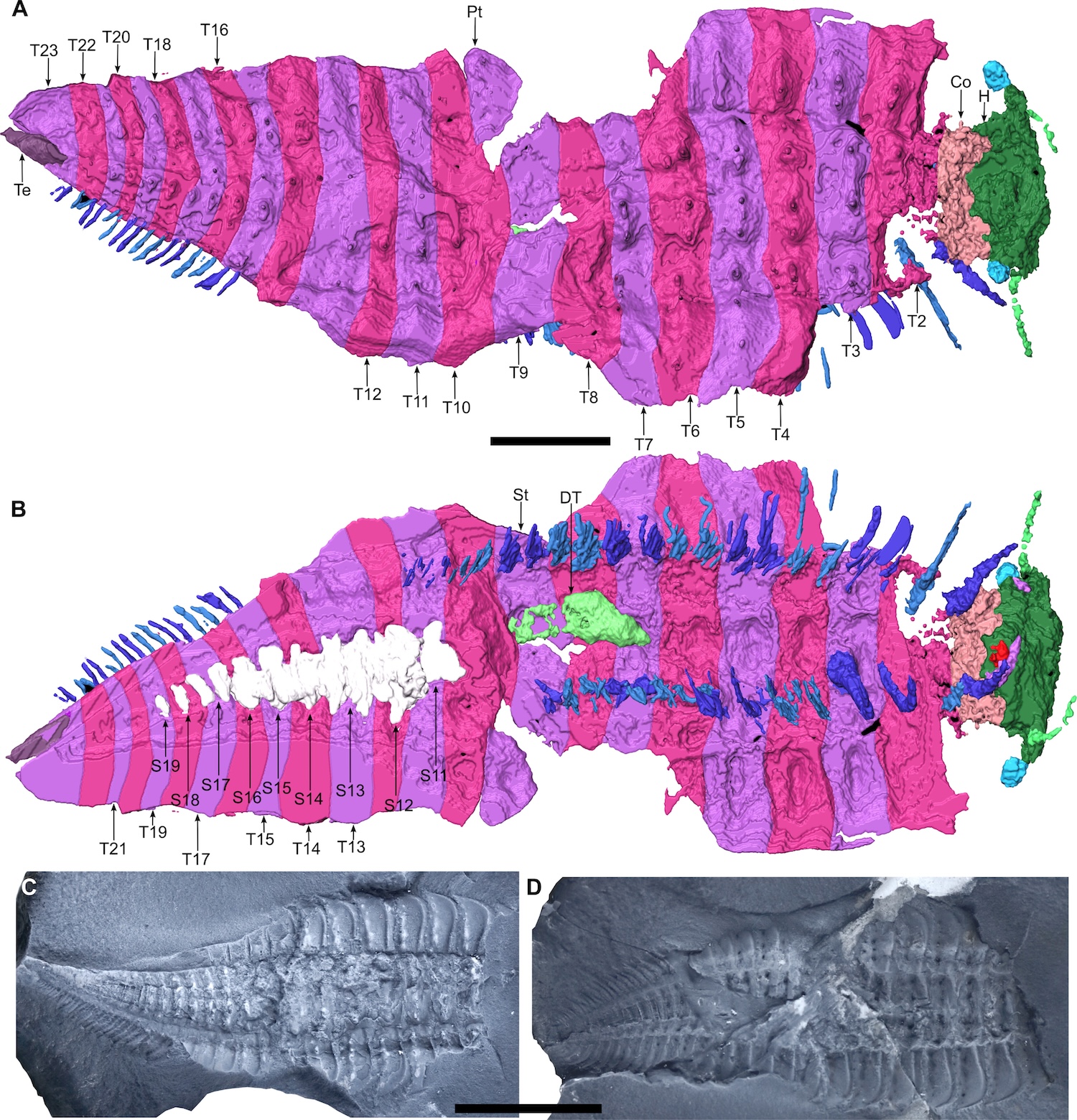
(A and B) Three-dimensional reconstruction. (A) Dorsal view. (B) Ventral view. (C and D) specimen inside the nodule. (C) Part. (D) Counterpart. Co, collum; DT, digestive tube; H, head; Pt, paratergite; S#, sternite number; St, syntergite; T#, tergite number; Te, telson. Reconstructions are made from Phoenix X-ray Phoenix V|tome|x CT scan. Scale bars, 1 cm (C and D) and 5 mm (A and B).

(A) Dorsal view. (B) Ventral view. (C) Back view. (D) Frontal view. Left maxillae were removed on (B) to better illustrate the mandible below. The red circle on (C) indicates the position of the digestive tract.
However, it’s still thought likely that it was a detritivorous. This has advantages for those of us who really want one as a pet: it’s still an intimidating creature, but in its free time it can roam the lair, cleaning up any untidiness.
Yes, I might fantasize a bit about keeping a few Arthropleura about the house. Better than a dog, anyhow.