What? Grandma & grandpa were…impure?

I’m reading this recent article on Population genomics of the Viking world, the one with a bazillion authors, and it’s nice and well done, but the popular press seems to find it surprising, when it’s pretty much what I would have expected.

The maritime expansion of Scandinavian populations during the Viking Age (about AD 750-1050) was a far-flung transformation in world history1,2. Here we sequenced the genomes of 442 humans from archaeological sites across Europe and Greenland (to a median depth of about 1×) to understand the global influence of this expansion. We find the Viking period involved gene flow into Scandinavia from the south and east. We observe genetic structure within Scandinavia, with diversity hotspots in the south and restricted gene flow within Scandinavia. We find evidence for a major influx of Danish ancestry into England; a Swedish influx into the Baltic; and Norwegian influx into Ireland, Iceland and Greenland. Additionally, we see substantial ancestry from elsewhere in Europe entering Scandinavia during the Viking Age. Our ancient DNA analysis also revealed that a Viking expedition included close family members. By comparing with modern populations, we find that pigmentation-associated loci have undergone strong population differentiation during the past millennium, and trace positively selected loci-including the lactase-persistence allele of LCT and alleles of ANKA that are associated with the immune response-in detail. We conclude that the Viking diaspora was characterized by substantial transregional engagement: distinct populations influenced the genomic makeup of different regions of Europe, and Scandinavia experienced increased contact with the rest of the continent.

Well, yes. If my Scandinavian ancestors were all tall, blue-eyed, blonde- and red-haired giants out of a Frazetta painting, how did I end up with this [sweeps hand dramatically over frumpy body] particular genetic complement? Why are my relatives so…variegated? I’ve been to Norway, and the people there are wonderfully diverse. This result should be what we all expected — and the scientists who did it were certainly unsurprised, just appreciative of the data — but somehow, the stories in the popular press all about how this upsets stereotypes. Like this one, “Vikings may not be who we thought they were, DNA study finds”.

History books typically depict Vikings as blue-eyed, blonde-haired, burly men sailing the North Atlantic coast to pillage wherever they set foot on land. While some of that may be true, a new genetic study of Viking DNA is flipping much of this history on its head.

In the largest genetic study of Viking DNA ever, scientists have found that Vikings — and their diaspora — are actually much more genetically diverse than we may have thought and were not necessarily all part of a homogenous background.

Notice what the title and the opening paragraph do: they center the story on public misconceptions about a group of humans. I guess “Humans had children with other humans” isn’t quite as exciting as “Cartoon version of ancient people isn’t quite accurate”. The real interesting question, other than the science of the study, is about how pervasive racist myths are.

It’s all about gene flow, which is important and interesting and pretty much universal, and not at all scary, all you white supremacists out there with your phony Asatru tattoos.

Finally, our findings show that Vikings were not simply a direct continuation of Scandinavian Iron Age groups. Instead, we observe gene flow from the south and east into Scandinavia, starting in the Iron Age and continuing throughout the duration of the Viking Age, from an increasing number of sources. Many Viking Age individuals—both within and outside Scandinavia—have high levels of non-Scandinavian ancestry, which suggests ongoing gene flow across Europe.

I wish I could hang around for a thousand years to see the results of anthropological studies of American graveyards. “History books typically depict Americans as obese, orange-skinned, and profoundly stupid, lying and cheating their way to exploit other people’s wealth. While some of that may be true, a new genetic study is revealing that they were much more diverse and complex than that.”

I brought another spider home, I couldn’t resist

We took a walk last night, and found a place in some cinder block where, suspended in a framework of silk, there were these little collections of grass and twigs glued together. I pulled out this one, which is nicely boat-shaped, and inside were two egg sacs and a shy momma spider. I carried it home in my hand, which was a little tricky — as momma became somewhat alarmed that her house was moving, she would peek out and sometimes scurry around on my hand. Fortunately, I think she was also concerned about her eggs, so she didn’t go far.

This is probably a mistake — I’ve got way too many spiders as it is — but I’ll take her into the lab today and feed her and care for her and raise her little babies as if they were my own.

Hey, here’s a game! I picked this photo because the spider isn’t at all obvious in her nest. Can you find the spider?

As usual, you can find closeups on Instagram and Patreon.

Venus must be the science topic du jour

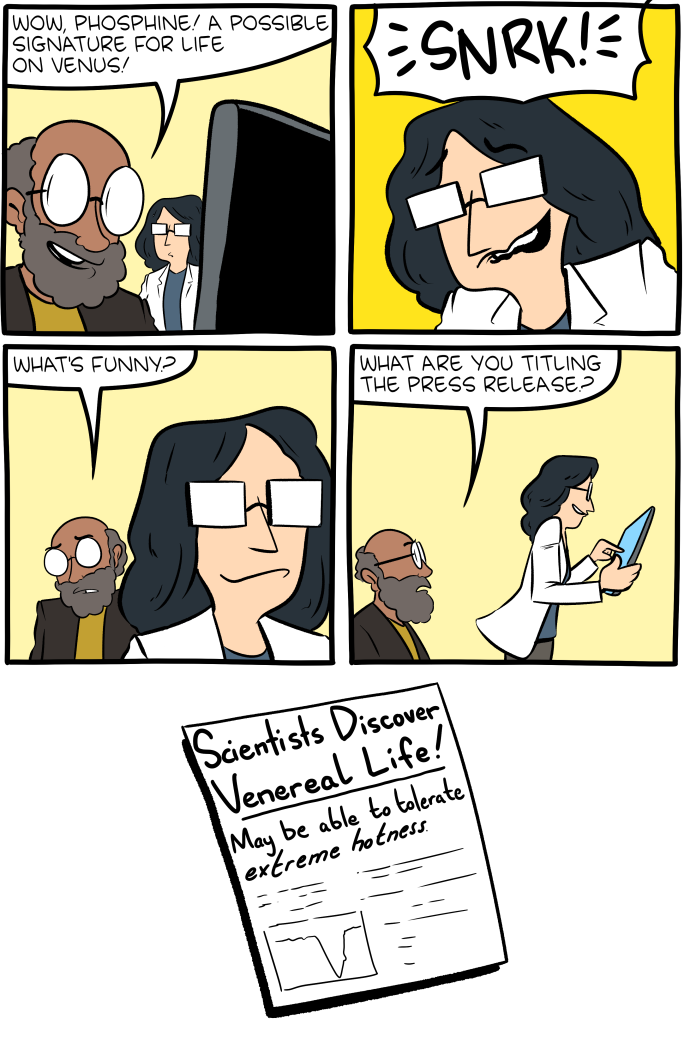
It’s in all the best webcomics!

I’ll take Paul Lynde for the center square, please. (oops, dated myself.)

Finding phosphine in the atmosphere of Venus is interesting, and it sure sounds like the scientists who found it were all cautious and conservative and thorough, so I believe them that it’s there. I have a couple of caveats about how it’s interpreted, though. Phosphine can be produced abiotically — it’s found in the atmosphere of Jupiter, for instance — but it takes a lot of energy in reactions that weren’t thought to occur on Venus, but that could be the “weird high-heat chemistry” the comic mentions. It’s also produced biotically, on Earth by the decay of organic matter, but here it’s only a small component, and it’s also fairly rapidly broken down by sunlight. So we’re postulating huge quantities of organic matter decaying on Venus to produce phosphines, or an unusual organic process that produces persistent phosphines from a small quantity of biomass? I don’t know. Sounds unlikely and strange, but I love to see unlikely and strange.

No matter what, though, don’t expect Venusian cloud-cities and communicative aliens. Phosphine is a flammable, toxic gas, and at best we’re seeing the excretions of bacteria-like organisms, and even that is not likely.

Surprising spider industry

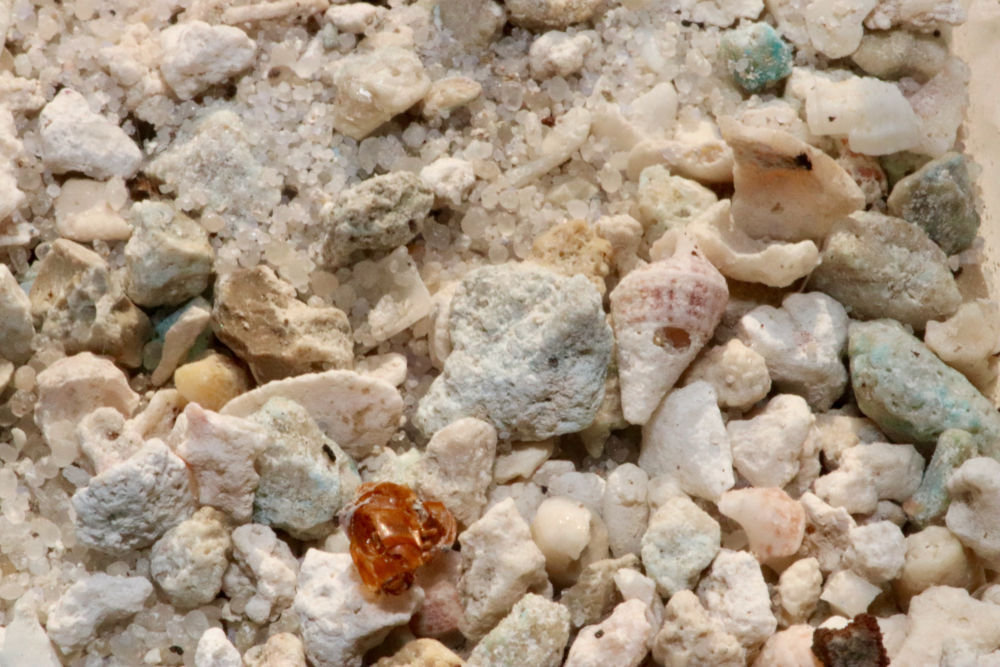
I have an office spider, Diana, who lives in a display case with a wooden climbing frame and a floor made of left over calcareous sand and shells from my aquarist days. Today I found that she’d seized stuff from the ground, like this:

…lifted them up to her web up high, and build a hemispherical nest, which she was snuggled down inside of. Clever girl.

If you want to see the nest, I put a photo on Patreon (reminder: I have a patreon account I use to try to pay off our legal debt) and also on Instagram.

A mysterious case of data blindness, maybe?

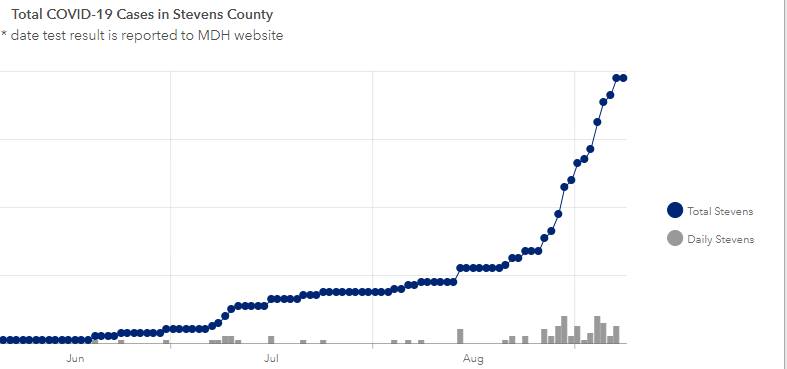
We’re teaching students how to plot data and analyze trends and do statistics in lab this week. Here’s an exercise for you. Does this curve look like it’s flattening? Or declining?

That’s us, the Stevens county frequency of COVID-19 cases. Classes are still ongoing. No changes in our plans. I guess that means the incidence must be stable or getting better?

Muh vaccine!

I really want to see a vaccine appear soon, since it’s our only hope for ending this pandemic in the long run. I’m also realistic and know that it would be really unusual to develop one this quickly. AstraZeneca is testing one, and already the trial is on hold, after bad but unspecified adverse effects appeared in the test population.

This is not surprising, and it’s to be expected that the development will not be smooth and linear. It’s still disappointing.

Next, of course, we don’t even know how effective the vaccine will be. You shouldn’t have been partying yet anyhow.

MORE! MORE SPIDERS! YOU ARE ALL DOOOOMED!

I went off to feed the spiders this morning, and as I was going out the door, Mary asked if I needed any more egg sacs. “I hope not,” I replied, because I’ve got so many baby spiders to tend that I’m not sure what I would do if I had another round of hatchlings. So she cursed me. I found 7 nice new Parasteatoda egg sacs, and 2 new Steatoda triangulosa sacs. I tell you, I’m getting so good at breeding spiders I am currently oscillating between two states.

The only thing that will save me is that I expect, from past experience, that about half the egg sacs will contain only infertile eggs. It’s not my fault, the females are picky, and some of them constantly friendzone* all their suitors. Three of them are definitely from non-virginal, proven breeders, though, so I’m anticipating dealing with about 300 more babies soon.

By the way, I like to regularly remind you all that I have a Patreon, and if you want to see a photo of a hungry baby at the table, sign up!

*“friendzone”, in the native Spider, is synonymous with “murder and eat”. I suspect MRAs/Incels of being native Spider speakers, which has led to all kinds of confusion and erroneous ideas about the human version of the word.

I know I rag on physicists sometimes, but you’ve got to stop making it so easy

God damn it.

This is true, mostly. It’s the University of Illinois, and it was a physicist and a bioengineering professor (who had also done some ecological modeling) who came up with the model.

Physicist Nigel Goldenfeld and bioengineering Professor Sergei Maslov, who developed models of the disease for the state and campus, said they think cases can be kept to a level that can be traced and won’t overwhelm the hospital system.

They also used a grossly simplified model of human interactions, which they claim was a “worst-case scenario”. It wasn’t.

“We did not model the friendship social networks of the students when they go outside and socialize in bars and restaurants,” he said. “So our calculation is, in fact, a worst-case scenario, because we assume more mixing outside of the university.”

Here’s an absolutely classic physicist comment from back in March.

For them, transitioning to epidemiology was easy. “The equations that describe epidemics are simplified versions of ones that describe ecology,” says Goldenfeld. For the COVID-19 model, they chose equations that echoed models of predator and prey.

So…epidemiology is easy, they just had to strip out a lot of complicating factors, and then adapt a general ecology model that isn’t actually appropriate here. In other words, they imagined a spherical frictionless undergraduate, made a model that they liked, and then — JESUS FUCKING CHRIST — got the ear of the governor of Illinois and set the policy for whole state.

And now

Parties, gatherings and “irresponsible and dangerous” behavior has led to a spike of nearly 800 coronavirus cases on the University of Illinois at Urbana-Champaign campus, school officials said, and the university is cracking down.

On Wednesday, the university announced 780 new coronavirus cases on the campus, the Chicago Tribune reported. The campus is now implementing mandatory testing twice a week for all students.

You know, you could have listened to epidemiologists, who actually have some specific expertise in this sort of thing.