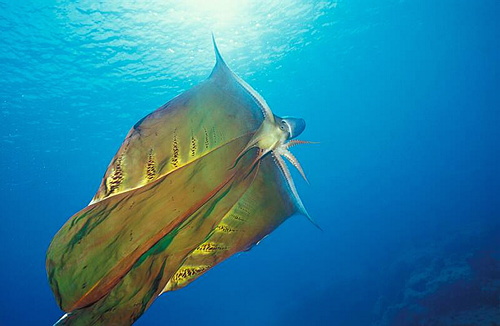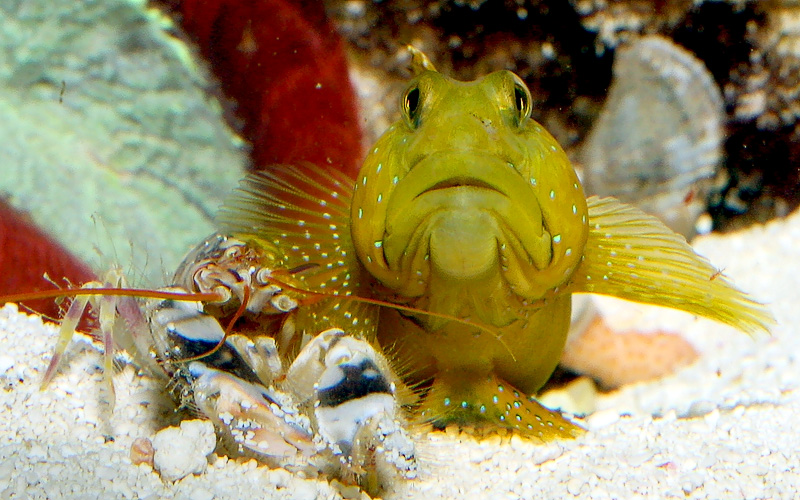
(via Advanced Aquarist)

In my post bashing that silly article claiming to have figured out how endoskeletons evolved from exoskeletons, there was a good question buried in the comments, and I thought I’d answer it.
Are there any models pulled out of arses which explain the turtle’s unique skeleton?
Yes! I mean, no, not pulled out of arses, but there is a lot of really good and persuasive research that uses evidence to show how the turtle skeleton evolved.


It doesn’t look like much, but it’s got a cute trick.


Because my copy of Evolution: Making Sense of Life
Actually, I lied. My happy face is oscillating back and forth with my frowny face. My frowny face is saying that I’ve got too much work to do to enjoy a new evolution textbook, no matter how well written it is.
You may also have a frowny face when you follow the link to Amazon, because this is an academic textbook and it is priced accordingly. Sorry.

The word for the day is PINK. Pink is a soft, non-threatening color associated with girls…and is therefore harmless and pleasant. Cats are not pink. But other, more interesting, animals are.

Very girly. By the way, that one secretes cyanide in defense, so much as you might be tempted, don’t play with it.

The mirror test is a well known indicator for some degree of self-awareness: surreptitiously mark an animal’s face, show it a mirror, and see if it recognizes that the reflected image is of itself by whether it reaches up to touch or remove the mark. We see that behavior and infer that the animal has some knowledge of itself and can recognize that the mirror image is not another animal.
But now robots are being specifically programmed to pass the mirror test.
Ow. It makes my brain hurt.
So this is a computer that has no other indicators of consciousness or awareness or autonomous “thought” (whatever that means…my brain is hurting again), and is being coded to respond to a specific kind of visual input with a specific response…to literally pass the mirror test by rote. Does that really count as passing?
I think that all it actually accomplishes is to subvert the mirror test. It’s always been a proxy for a more sophisticated cognitive ability, the maintenance of a sophisticated mental map of the world around us that includes an entity we call “self”, and I don’t think that training a visual processing task to identify a specific shape unique to the robot design counts.
I’d also like to see what happens if two identical robots are made and put in the same room. To recognize “self” you also have to have a concept of “other”.

Take one squid. Pin it down in a dish. Dissect out one of the peripheral nerves innervating the fin. Plug it into your iPod, and stimulate the nerve with the speaker output while playing Insane in the Membrane. Record the behavior of the chromatophores.
You have my permission, once I’m dead, to run any kind of patterned electrical signal through my nerves to see what my corpse will do. I don’t have the nice chromatophores, but maybe you could get some interesting twitches.