As anyone who has ever raised aquarium fish knows, they’re all different. Maybe you think a fish is just a fish, not very different from one another and all rather stupid, but I spent years sitting next to tanks of zebrafish, and I can tell you you’re wrong. I’d watch them gamboling about, and you’d quickly realize that oh, that one is aggressive, that one likes to hid, that one gets the zoomies and darts about the tank. You can learn to recognize individual fish by their behavior.
I always wondered about that. These were highly inbred animals, with only slight genetic differences between them, but could those little genetic variations account for strong differences in behavior? Then I acquired a new line of zebrafish, one that was the product of hybridization between our inbred lines and wild-caught native stocks, and oh boy, their behavior was radically different, instantly distinguishable. Maybe it is genetic. Maybe? I never did a formal, rigorous behavioral experiment, so I don’t know for sure.
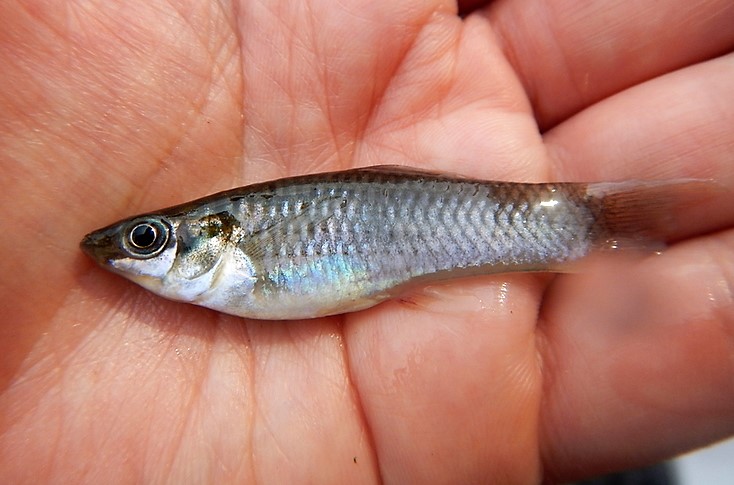
But now a new study comes along that does what I would have been excited to know about 20 years ago (and I still am!). This is an analysis of The emergence and development of behavioral individuality in clonal fish, and it’s a bit surprising. Laskowski and others are working with the Amazon Molly, a small tropical fish that reproduces clonally, producing clutches of babies that are all genetically identical to each other — so even better than my old zebrafish — that can then be separated and raised apart from their mothers and siblings. This rules out the possibility of genetic differences causing individual differences, and leaves us to consider alternative sources of variation.
To determine the causes and mechanisms that can generate behavioral individuality in the absence of genetic and environmental differences, it is essential to first pinpoint when behavioral individuality emerges and how it continues to unfold after emergence. Birth marks a critical time point: if individuality is present at birth, this points to pre-birth influences––such as epigenetics, maternal effects, and/or pre-birth developmental stochasticity––as being key drivers of individuality. Alternatively, it could be that individuality primarily emerges after birth. This emergence could happen both gradually throughout early life, which would suggest that individuality is driven by positive feedbacks between behavior and the internal and/or external environment, or abruptly at particular points early in life, if it is linked to critical sensitive windows.
So if cloned fish are behaviorally identical to one another at Day One, but become different later on, that suggests the differences are generated by varying experiences over time. If, on the other hand, the genetically identical fish are different on Day One, that suggests that pre-birth factors (I’d lean towards favoring developmental stochasticity, just random variations at the cell and molecular level) generated the variation.
To cut to the conclusion, Amazon mollies differ on Day One, with all that implies.
I think their chosen behavior is a bit simple, they’re just looking at mean swimming speed — does a fish have the zoomies, or is it a calm quiet little guy? — which is fine, since they do get an early difference. They also used motion analysis software, so I presume they could go back and reanalyze the data for more subtle differences, but they got their answer with just one parameter. They also looked for other possible correlations.
Individuality is present at day one after birth and is not explained by differences in maternal identity or body size.
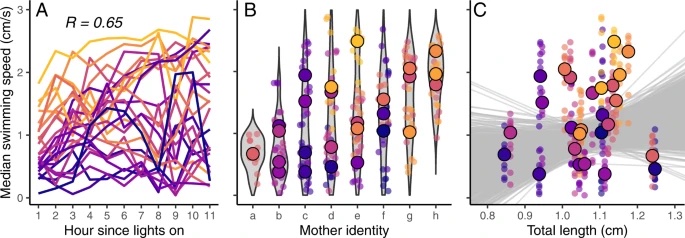
Repeatability of median swimming speed at hourly intervals on the first day after birth (A); each line represents one individual (N = 26). Maternal identity (B) did not explain variation in swimming speeds among individuals. Small and large points indicate the hourly (i.e. 11 data points per individual) and daily median swimming speeds, respectively, of individuals from each mother on day one after birth; see also Table 1. Behavior on day one after birth (C) was not related to an individual’s total length on their first day of life; see also Supplementary Table 3. Small and large points indicate hourly and daily median swimming speeds for each individual respectively; gray lines indicate posterior estimates for the effects of body size on behavior. Throughout, lines and points are colored according to the individual’s behavior in hour one on day one (yellow represents higher swimming speeds; purple indicates lower swimming speeds).
In panel A you can see that there was a huge amount of individual variation in swimming speed. In B, different mothers all produce progeny with a wide range of behaviors. That one has me wondering, though: Mama a’s babies were all a bit on the sluggish side. If they raise a second clutch from Mama a, does the second set exhibit a range of behaviors similar to that of the first set? Is there any genetic bias at all in this behavior?
Panel C shows that there was also variation in body length on Day One, which doesn’t surprise me at all — developmental stochasticity again. Body length is not a predictor of swimming speed, though, these seem to be unlinked variables.
Another feature of the study is that they observed the fish longitudinally, over 10 weeks of development. Variation increased, which would surprise no one, and it was correlated with Day One behavior. Zoomy fish stayed zoomy and became even more zoomy, while slow fish generally stayed slow for their life.
Individuality increases gradually throughout the first 70 days of development.
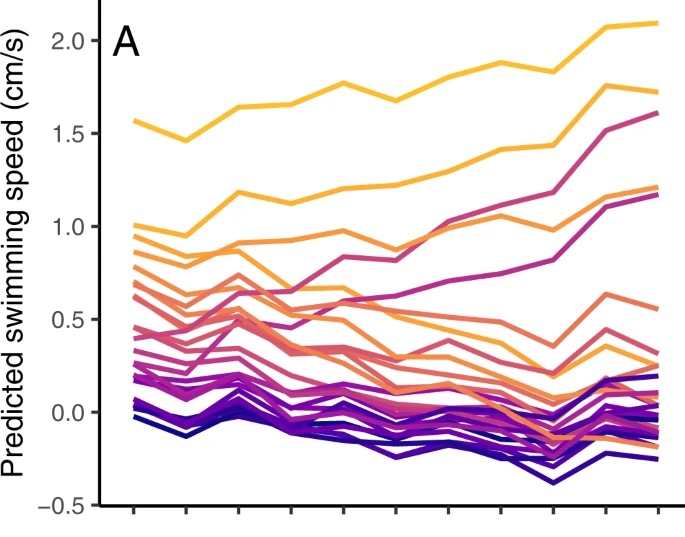
The predicted values of median individual swimming speed diverge over time (A) leading to gradual increases in the among-individual variance and hence repeatability (B, not shown here) of behavior. These models included only the 26 individuals on which we had complete data for the first 10 weeks of life to ensure that absolute levels of variation would remain comparable over time. Individual lines in (A) are colored according to their predicted behavior in week 1 with yellow indicating greater swimming speeds and purple indicating lower swimming speeds.
What have we learned?
Evidence is accumulating that even genetically identical animals reared under near identical conditions develop behavioral individuality, yet little is known about when exactly these differences emerge during ontogeny and how they continue to change during early life development. We show that genetically identical individuals already exhibit substantial behavioral individuality on their first day of life, highlighting pre-birth influences as being of critical importance to initializing durable behavioral differences among individuals. Epigenetic and maternal effects mediated through mechanisms such as changes to DNA methylation patterns or differential resource or hormone allocation, could influence the phenotype of offspring.
I’m still intrigued by the role of chance in development and evolution.
Another non-mutually exclusive hypothesis is that the behavioral variation we observed is the result of developmental stochasticity, that is, stochastic variation in any molecular, neurological or physiological markers that occur over ontogeny. An intriguing possibility is that the phenotypic variation we observed here––whether arising from epigenetic, maternal, and/or developmental stochasticity effects––might itself be adaptive, for example, as a potential bet-hedging strategy. Generating phenotypic variation among one’s offspring by such non-genetic means might be especially relevant in clonal organisms such as the Amazon molly. There is, for example, evidence in clonal fish, and poecilid fish specifically, that DNA methylation mechanisms and developmental plasticity more generally might be especially sensitive to environmental influences, offering a mechanism through which mothers can generate variation among their otherwise genetically identical offspring.
Developmental stochasticity as part of an evolutionary bet-hedging strategy sounds like an interesting model, and probably important in species like fish (and spiders!) that pump out huge numbers of offspring with concommitant high likelihood of death.
This kind of behavioral analysis of organisms with limited genetic variation is one motivation for what I’m doing in the lab — taking the offspring of one spider parent and then inbreeding them over multiple generations to reduce genetic variability in one lab population. A couple more generations, and then it’ll be time to work out some behavioral assays to identify differences that we can select for. Swimming speed won’t be one of our parameters, though. Not even speed in general, they tend to all be quiet lurkers. Web configuration, aggression, pigment patterns, though, those are all candidates for analysis down the line.