Script below the fold:
Pharyngula
Evolution, development, and random biological ejaculations from a godless liberal

The last time I mentioned my spider work, I had sad news: the eggs were dreadfully dessicated, and I hypothesized that the declining humidity was not good for their health. I have no new egg sacs, but I did increase the humidity in the incubator, and have other good signs to report. There has been zero mortality among the juveniles this week, and the adults were extraordinarily lively — so lively that I had to deal with 3 escapes while I was trying to feed them.
I had spiders crawling all over me, which was a delightful feeling, but also made me a little panicky — I had to get them back into their nice safe vials before they got injured. All were rescued, no harm done, and they also immediately chowed down on the juicy flies I’d given them.
I felt all paternal and warm inside, as one does when dealing with affectionate pets.

All my life, I’ve had this dichotomy staring me in the face: my mother’s side of the family tends to live to a ripe old age, I knew my maternal great-grandparents, my grandmother lived on to old age despite a rough life, and my mother is still around (she may outlive me). On my father’s side, though, it’s like the grim reaper marks everyone for death as soon as they hit their fifties. My paternal grandfather died when my dad was a kid, my paternal grandmother died when I was 12, and my father died when he was younger than I am now. So I’ve always wondered which side of the family I was going to take after.
It turns out it doesn’t matter! There’s a new analysis of the genetics of human longevity with a gigantic data set.
Starting from 54 million subscriber-generated public family trees representing six billion ancestors, Ancestry removed redundant entries and those from people who were still living, stitching the remaining pedigrees together. Before sharing the data with the Calico research team, Ancestry stripped away all identifiable information from the pedigrees, leaving only the year of birth, year of death, place of birth (to the resolution of state within the US and country outside the US), and familial connections that make up the tree structure itself.
The SAP included almost 500 million individuals (with a single pedigree accounting for over 400 million people), largely Americans of European descent, each connected to another by either a parent-child or a spouse-spouse relationship. The scale of the data allowed the researchers to get accurate heritability estimates across different contexts; they could stratify the data by birth cohort or by sex or by other variables without losing the power needed for their analyses. They employed structural equation modeling—a technique that hasn’t often been applied to this problem due to the amount of data required for it to be productive—to calculate life span correlations and heritability across the giant pedigree.
Yadda yadda yadda. OK. I’m impressed with the methods. Now I want the answer: tell me my fortune, how long will I live? And the answer is…
By correcting for these effects of assortative mating, the new analysis found life span heritability is likely no more than seven percent, perhaps even lower.
The upshot? How long you live has less to do with your genes than you might think.
You can’t really tell from the genes. Environment and experience matter more.
This is good news: my paternal genetics aren’t a death sentence. But it’s also bad news: my maternal genetics don’t mean I can coast into my 90s. I have to try and replicate the life history of my maternal relatives.
Let’s see…
Note: This result does not mean that genetics doesn’t matter. It means longevity is a complex, multifactorial trait, that many genes work in concert to allow for a long life, and that we inherit a mix of genes, some deleterious, some beneficial, such that you can’t easily estimate the role of the combinations you get from looking at your relatives. Also, as we all know, there is a huge environmental component: I could have the best suite of longevity genes, but if I start smoking cigars and drinking a quart of whisky every day while practicing a high wire act without a net, I may not last for long. There’s also a component of just simple chance.
So forget about genetic determinism. Just live the best life you can.

You can’t do anything about global warming, he says. Might as well burn more coal, otherwise you’ll have to start burning trees. There’s nothing anyone can do to mitigate climate change.
Jordan Peterson regurgitates Koch brother BS when asked about climate change. He is basically that Republican idiot who stood in Congress with a snowball in his hand as proof global warming doesn't exist, except he's considered a brain-genius by his lobster boy fanbase pic.twitter.com/QoF2qCB54Y
— ☀️👀 (@zei_nabq) November 4, 2018
There are more trees in the Northern Hemisphere* than there were 200 years ago, which says to me that we do have the power to enable changes in the environment. Where he goes off the rails is in implying that it would be worse to burn trees than to burn coal. Trees are a renewable resource. There is no net gain in atmospheric CO2 if you plant trees at a rate equal to or faster than the rate you burn them, while burning coal releases CO2 that has been sequestered for hundreds of millions of years.
No, you don’t have to turn off your heat (Minnesota, in the winter? No, thanks). But you can get your heat from renewable sources that don’t contribute to greenhouse gases. About a third of US electricity generation is from coal, another third from natural gas, and the other third is from renewables and nuclear power. We can shift that — in Germany, about half their power is generated from renewables and nuclear, so you can clearly work in that direction without compromising industry. One thing we could do is phase out new coal power plant construction and encourage more solar and wind power (and nuclear, maybe — although that’s guaranteed to start arguments among environmentalists). It’s going to take time, but it doesn’t help to have apologists for the fossil fuel industry advocating for giving up.
It also helps to set personal limits and long-term goals. That was the whole point of the Paris climate agreement, to set goals and provide practical guidance in meeting them. You know, the agreement our President* reneged on to keep his coal and oil friends happy.
And that Peterson guy has a packed house listening to him babble garbage.
*You should ask yourself, what about the Southern Hemisphere? Why doesn’t he say anything about that? Aren’t most of the planet’s trees in the tropics? Asking us to pay attention to a success story on the fringe while ignoring a net loss of 10 billion trees per year in the core is a classic right-wing distraction tactic.

There’s a federal court case, Juliana v. United States, in the works in which the plaintiffs argue that the pursuit of life, liberty, and happiness obligates the government to maintain a sustainable, livable atmosphere — or, at least, support legislation in good faith that limits how much we can poison it. That sounds like a good idea to me.
The plaintiffs, who include 21 people ranging in age from 11 to 22, allege that the government has violated their constitutional rights to life, liberty and property by failing to prevent dangerous climate change. They are asking the district court to order the federal government to prepare a plan that will ensure the level of carbon dioxide in the atmosphere falls below 350 parts per million by 2100, down from an average of 405 parts per million in 2017.
How can you argue against that? The Trump administration has a simple defense.
By contrast, the US Department of Justice argues that
there is no right to ‘a climate system capable of sustaining human life’— as the Juliana plaintiffs assert.
That is not the answer I expected. Hemming and hawing about the practicality of limiting greenhouse gasses, sure; endless lying about whether climate change is a temporary phase, or about the desirability of warming up the planet by a few degrees, or claiming that we might be getting a little warmer, but there is no threat to our existence…I could imagine all that coming out of Republicans in the pocket of the fossil fuel industry.
But to announce that they feel no compulsion to provide an environment compatible with life? That’s a new one.

I had such high hopes this morning — necessary reagent had arrived, I had a nice egg sac, I was going to open it up and spend my afternoon exploring embryos. It was not to be. I teased apart the egg sac, and what do I find? Heartbreak. Disappointment. Failure.
The eggs were all dead. I’m not sure what happened here, but I have a hypothesis: this summer and early fall, I had all these fish tanks in the lab, gurgling away, and the place was pretty humid. Now those are shut down, and it’s winter in Minnesota, when the air dries out. Spiders like some degree of humidity, and I’ve been maintaining that by regularly misting their vials with an atomizer, but maybe that’s not enough for the embryos.
So I’m cranking up the moisture levels in the incubator. Now I’ve got to worry about balancing everything — too much and I’ll have to worry about mold and fungus.
Babies are such fussy little creatures.

My halocarbon oil arrived today! Finally, I can do some arthropod embryo culture.

Squeee!
Would you believe that 100mL bottle cost me $166? Since I’m going to use a 20µl drop for each embryo, that means I only have enough for 5000 experiments. I’m already feeling a little panicky about my supplies running low. Maybe I should order another bottle.
In case you were wondering what this precious stuff is, it’s an inert, high molecular weight polymer of chlorotrifluoroethylene. It’s used a lot in insect culture because you can put an embryo into a drop of it, and it prevents it from drying out, improves optical clarity, and also allows for free gas exchange. I’m eager to try it.
P.S. Oh, right, I’m also voting first thing in the morning, and then hiding from all the media about the election all day long.


It’s a great job when you get to do stuff just for fun. For the last few days, I’ve been at the Science Museum of Minnesota, consulting on their new exhibit? Theatrical performance? Interactive game? called Infestation: The Evolution Begins. It’s a 3-part project funded by NSF to help teach key concepts of evolution to kids, and it’s looking pretty amazing.The first part is done, and it’s a theatrical event where the concepts are explained entertainingly, and the audience are introduced to little imaginary creatures called VISTAs. If you go to SMM today, you can watch the whole show yourself, get certified as an official VISTA handler, and get a sticker. A sticker! I got one! Oh, boy!
It stands alone, and is a fun demo. But there’s more! Not available to the public yet, but I was part of a team of consultants brought in to comment on/criticize/maybe improve some preliminary versions of interactive games that follow from Part I. Eventually, kids will be scurrying all over the museum to solve puzzles and address challenges that will require them to learn about biology and evolution. For now, it was just a troop of aging game designers, cognitive psychologists, theater people, museum curators, educators, and biologists running around trying out rough versions (some of the game rooms weren’t quite as polished as they will be). They’ve made great progress on Part II of the project, and I think, maybe, they’re hoping to have it available to the public this summer? Next fall? I’m getting an inside look at what it takes to build a professional and quite elaborate interactive exhibit in a museum, and I’m exhausted just thinking of all the labor and thinking that is done.
I had a lovely couple of days hanging out with the fantastic people who work behind the scenes at SMM — did you know real museums have large staffs of people who are doing, you know, science? — and my fellow consultants, like Scott Nicholson and Jonathan Tweet, who some of you may have already heard of. If you think combining “education” and “games” is going to flop at both, think again. This is serious stuff in the service of fun and learning.
We get to go back at some later date, once Part II is fully operational, and when Part III is in a preliminary state — we had some suggestions, but that bit is still up in the air, as it’s supposed to be a capstone that brings everything the kids learn together. I’m looking forward to seeing what they come up with. You should all be looking forward to a trip to SMM next year when the magic is all ready for prime time.

Here they come, the legions of cephalopods. Massive aggregations of brooding octopuses were found near Monterey Bay.
That’s not all. The University of Georgia had a single octopus in their aquarium, Octavius, presumed male, until they discovered a surprise one morning.
“I noticed this cloud of moving dots and I realised, ‘Oh my God, she had babies. There are babies. There are babies everywhere.’ And a sort of panic ensued,” aquarium curator Devin Dumont told Mary Landers at Savannah Now.
“I immediately started scooping them out and putting them in buckets and there were just buckets and buckets and buckets full of tiny octopi.”
Finding a tank full of baby octopuses (or octopodes for language pedants) would certainly be enough to shock anybody into mixing up their Greek and Latin word roots.
I, for one, welcome our breeding swarms of transgender octopuses, and will greet them as saviors when they emerge to release humanity from its misery.

I tallied up your responses from that post about arachnophobia, and took a quick look at the distribution. Several of you complained that you had no idea what the range should be — that was intentional. You’re not supposed to be trying to fit yourself into a particular bin, you should be just answering for yourself. There’s no judgment here!
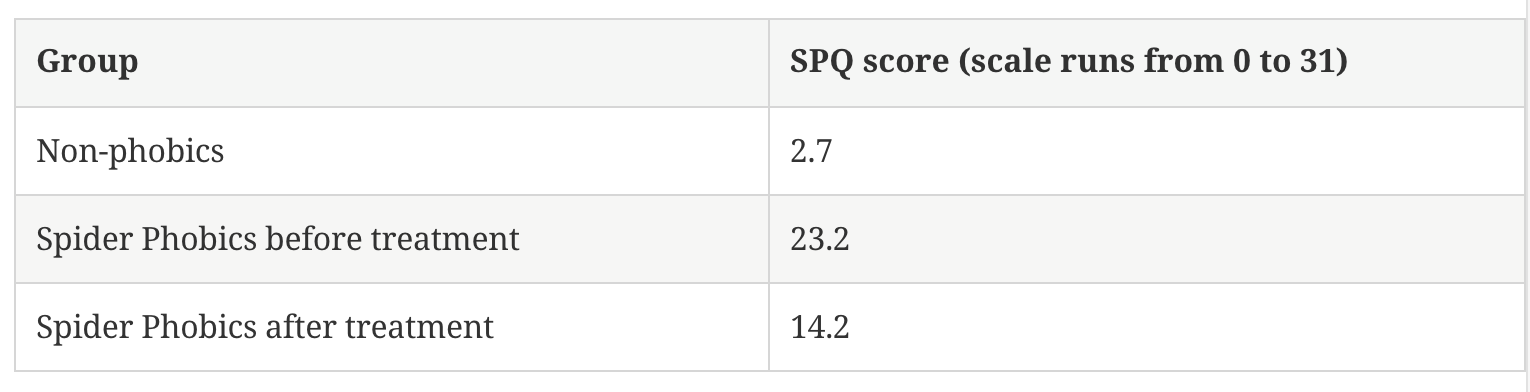
But if you’re curious, here’s the source with some general numbers. Serious arachnophobia — where the fear is actually debilitating and impairs a person’s life — is relatively rare, less than 5% of the population. There isn’t a magic number in the score that says whether you’re an arachnophobe or not. As many of you also noted, the questions are fuzzy and subjective, and as you might expect, produce a range of results. It’s a continuum — some people want to hug & kiss & love widdle spiders forever, others are horribly repulsed by them, and others are in the range from take ’em or leave ’em to “oooh, icky”. Here’s what I saw in this group of 113 participants (not a scientific poll, obviously, with a self-selected group and arbitrary participation, etc.)
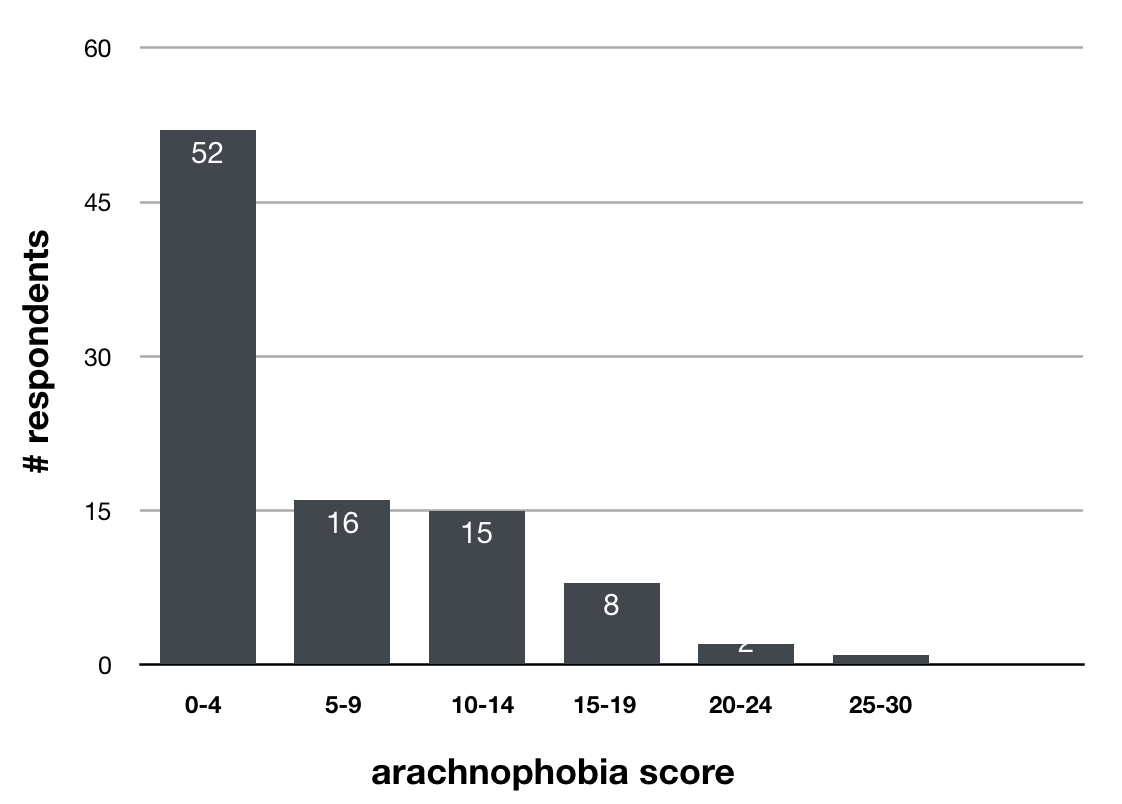
Most of you are way down on the scale! It’s probably a biased sample here — I’ve chased away all the deeply arachnophobic types. I got a few responses on Facebook, and they tended to be somewhat higher than blog commenters, but the numbers are too small to come to any strong conclusions.

