Michael Behe declares victory after being stomped flat

Behe is crowing over the Science review of his new book. The man is deeply delusional.

…the overwhelmingly important point to notice right up front is that the reviewers (Lenski plus Josh Swamidass over at Peaceful Science and John Jay College biologist Nathan Lents) have absolutely no response to the very central argument of the book. The argument that I summarized as an epigraph on the first page of the book so no one could miss it. The one that I included in the title of a 2010 Quarterly Review of Biology article upon which the book is based. The one for which I chose the most in-your-face moniker that I could think of (consistent with the professional literature) to goad a response: The First Rule of Adaptive Evolution: Break or blunt any gene whose loss would increase the number of offspring. The rule summarizes the fact that the overwhelming tendency of random mutation is to degrade genes, and that very often is helpful. Thus natural selection itself acts as a powerful de-volutionary force, increasing helpful broken and degraded genes in the population.
And they had no response! That’s because there is in fact nothing that can alleviate that fatal flaw in Darwinism.

So the central claim of his book is that sometimes, gene loss can be adaptive, something that no competent evolutionary biologist would consider a remarkable claim. Of course, they would disagree with his implication that that is the only process allowed or that no mutation could increase complexity or that novel functions can not increase the fitness of an individual. Contrary to Behe’s laughable claim that Lents, Swamidass, and Lenski had no response to his central tenet, they did: they pointed out that he ignores the various ways evolution proceeds (it’s not just by “breaking” genes), and that he runs away from the evidence of clear examples of mutations that increase complexity.

Behe is skeptical that gene duplication followed by random mutation and selection can contribute to evolutionary innovation. Yet there is overwhelming evidence that this underlies trichromatic vision in primates, olfaction in mammals, and developmental innovations in all metazoans through the diversification of HOX genes. And in 2012, Andersson et al. showed that new functions can rapidly evolve in a suitable environment. Behe acknowledges none of these studies, declaring an absence of evidence for the role of duplications in innovation.

Because they politely pointed out instances where his First Rule of Adaptive Evolution falls flat on its face without explicitly saying it’s wrong by name, Behe thinks they didn’t respond to it — I guess he needs it said literally. So here, I’ll help, I’m not very polite. Behe’s First Rule of Adaptive Evolution is stupid and wrong, isn’t a real rule, and we have multiple examples that refute it, which Behe doesn’t comprehend, because he’s an ignoramus about evolution.

Behe…yeah, he’s over and done with

When Michael Behe published Darwin’s Black Box, there was a loud “Huzzah!” from the creationists — they had new buzzwords, like “irreducible complexity”, for the first time in 50 years, and they had a scientist with a legitimate Ph.D. to cite as an authority claiming evolution couldn’t happen. The “science” was crap, but it was a strong rhetorical play, and we had to respond vigorously to it. It was garbage, but all the back-and-forth enhanced Behe’s reputation. I read it thoroughly and contributed to online discussions about the fallacies in it.

Then he came out with a second book, The Edge of Creation, and the creationists all went “huzzah?”, because there was nothing new in it, no spark of rhetorical flourish they could use in debates, but there was an implication that caused them worries. Behe was claiming you could see the hand of the Designer in ongoing processes, and that It was actively engineering diseases and parasites to kill us right now. Whoops. It was still garbage, but it didn’t trigger a surge of creationist activity that needed refutation. I skimmed it, threw it aside, ignored it.

Now he has a third book, Darwin Devolves, where he returns to the same old stagnant, tainted well and says the same old things, and it’s only going to inspire the die-hard Behe fanchildren, and isn’t going to challenge any scientists at all. I’m not going to pick up a copy. Not going to read it. Not going to critique it. Everything has already been said, he has nothing new that we need to refute, and he’s nothing but yet another crackpot…just one who has a tenured position at a legitimate university, even if he is something of a pariah to his colleagues.

But because he got creationists excited 20 years ago, someone had to suffer through his book for Science magazine, and the sacrificial victims are Nathan Lents, Joshua Swamidass, and Richard Lenski, who write that a biochemist’s crusade to overturn evolution misrepresents theory and ignores evidence.

Behe is skeptical that gene duplication followed by random mutation and selection can contribute to evolutionary innovation. Yet there is overwhelming evidence that this underlies trichromatic vision in primates, olfaction in mammals, and developmental innovations in all metazoans through the diversification of HOX genes. And in 2012, Andersson et al. showed that new functions can rapidly evolve in a suitable environment. Behe acknowledges none of these studies, declaring an absence of evidence for the role of duplications in innovation.

Behe asserts that new functions only arise through “purposeful design” of new genetic information, a claim that cannot be tested. By contrast, modern evolutionary theory provides a coherent set of processes—mutation, recombination, drift, and selection—that can be observed in the laboratory and modeled mathematically and are consistent with the fossil record and comparative genomics.

Deja vu, man. These are exactly the complaints everyone made about Darwin’s Black Box: he didn’t seem to understand modern evolutionary theory, he ignored the multiple mechanisms of evolutionary change, he blithely pretended the evidence against his thesis didn’t exist, and he just sailed on, smug in his ignorance. Nothing has changed. His formula is the same. The same counter-arguments still apply.

Let’s all just ignore this rehash, OK?

The rifts were widening everywhere

How interesting — Arun reports that the history of atheism in India was pretty much like it was here. A surge of interest sparked by The God Delusion (say what you want about Dawkins, that was an influential book), with an emergent split as one group saw social justice as an essential component of the movement, while another group “expressed abhorrence to the word feminism and propagated the myth that women are inherently irrational”, leading to a current divided movement.

I suspect it’s a reflection of a fault line that was there all along, and not at all unique to atheism. All you have to do is look at the American electorate and see a division that is somewhat independent of religious ideas.

The New Atheism gets another bashing

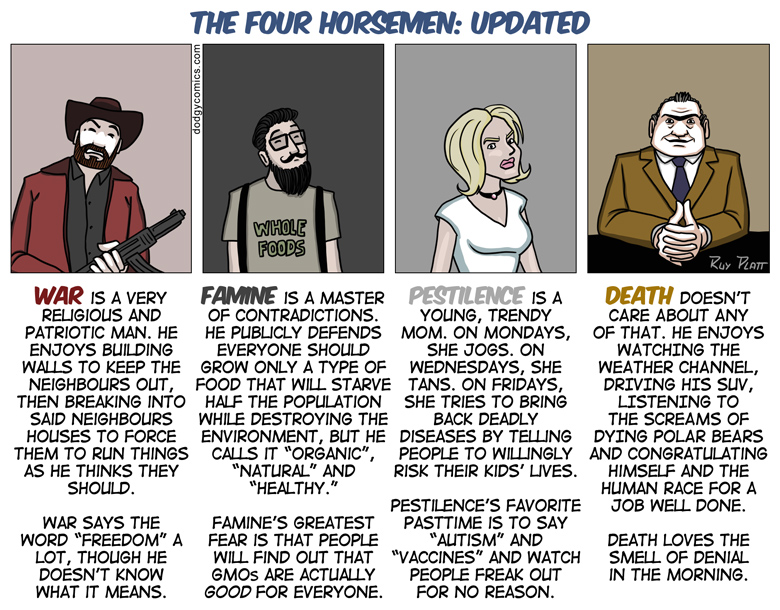
Last week, I posted about my deep regrets at ever being involved with New Atheism, and oh boy, have I been getting the hate mail. The most amusing thing was seeing an atheist facebook group filling up with complaints about how awful I am, and simultaneously whining that they never heard of this New Atheism thing, what four horsemen, and hey, wasn’t that just some nasty slur the theists threw at us? Memories are so short, and so easily diverted into safe and easy denial.

But I am not alone in my rejection of the Old Guard. The Guardian is asking “Whatever happened to New Atheism?” as if we didn’t know. I’ll tell you what happened: it foundered on the egos of its leaders, and their desire to steer it onto the shoals of misogyny, racism, and war. Hmm…maybe the “Four Horsemen” were appropriately named after all.

The article tears into the Four Horsemen, but especially into Harris (Hitchens was spared the worst of it by dying, I would guess).

The intellectual path followed by Harris is most balefully illustrative of the poisonous seeds that were always present in New Atheism. At one point here, the men admire themselves for their willingness to consider truths that might be politically dangerous. For instance, Hitchens says, if the notorious hypothesis of the 1994 book by Richard J Herrnstein and Charles Murray, The Bell Curve – that black people are genetically inferior in intelligence to white people – were true, it shouldn’t be ignored. Luckily, Hitchens hastens to add, that example is not viable. Later on, however, Harris brings up the argument again. “If there were reliable differences in intelligence between races or genders,” he begins, before Hitchens cuts him off dismissively. “But I don’t think any of us here do think that that’s the case.”

Hitchens might have been too generous. In 2018, Harris caused a storm by inviting Murray on to his podcast for a weirdly uncritical two-hour conversation. Murray, Harris claimed, had been the victim of a terrible “academic injustice” for the way in which his notions about the inherent cognitive inferiority of some “races” had been rejected by the scientific establishment. (Lest you worry about Murray, be reassured that he is still a fellow at the American Enterprise Institute, which is funded by the ultra-conservative billionaire Koch brothers.)

This is where the preeningly fearless insistence on entertaining uncomfortable questions can so easily lead. Harris ended up in the company of the “alt-right” and the so-called “intellectual dark web”, populated by people who portray themselves as valiant enough to say what you’re not allowed to say any more, and are constantly invited on rightwing talk shows to say it. For some, New Atheism was never about God at all, but just a topical subgenre of the rightwing backlash against the supposedly suffocating atmosphere of “political correctness”. In its messianic conviction that it alone serves the cause of truth, this too is a faith as noxious as any other.

This was the gigantic strategic error of the New Atheism. The time was right to make a strong appeal to humanist values and grow a movement around basic decency and fairness, and instead, the most influential voices decided to draw on the nascent alt-right and get rich quick off regressive values — they aimed the ship of atheism straight into the Trumpkin swamp, a mob of people who are explicitly anti-anti-religious, and now all they can do to maintain some popularity is to double-down on the ignorance and racism and sexism that that group likes. Reason and rationality have been turned into empty buzzwords. It’s a real shame.

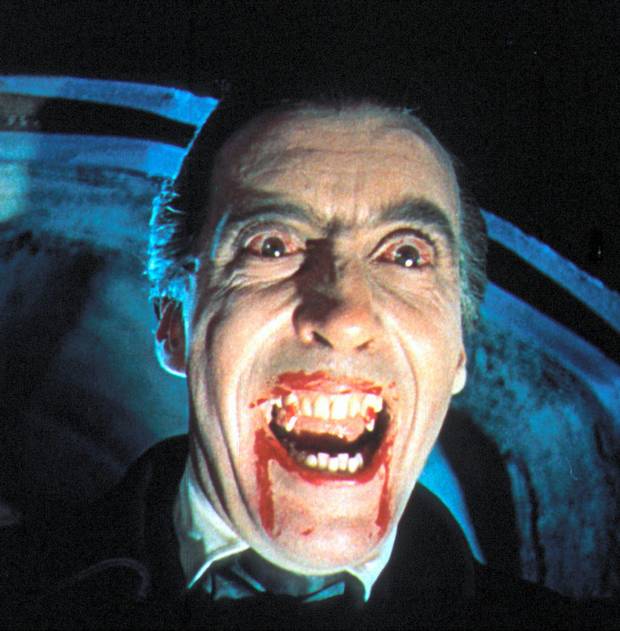
Inference: Dracula is a creationist and climate change denialist

When this new online “science” journal, Inference, came out, no one was fooled. The first issue featured an article by the notorious crank creationist, Michael Denton, so it wasn’t as if it wasn’t obvious. Jeffrey Shallit wrote the first expose, I think, noticing that the grubby fingerprints of David Berlinski were all over it. Ho hum, yet another attempt by creationists to create a pet journal, to feed the illusion that they’re actually doing credible, peer-reviewed work. But then another mystery has arisen: where is all their money coming from?

When Inference first approached me, the offer was appealing: up to $4,000 for a 4,000- to 6,000-word essay. According to their website, the Nobel-Prize-winning physicist Sheldon Glashow was on the editorial staff, which—as a physicist myself and a fan of Glashow’s work—was almost enough for me to accept on the spot. But a declaration in italics on their masthead gave me pause: “We have no ideological, political, or religious agendas whatsoever.” This struck me as unusual over-emphasis, so I did a little digging and came across a 2014 blog post by the computer scientist Jeffrey Shallit, where he muses on the first issue of this new “science” publication, adding: “the weirdness is strong—very strong—with this one.”

When someone claims they have “no ideological, political, or religious agendas whatsoever”, they’re lying. What they’re really claiming is that their biases aren’t biases at all, which is a real danger, because it means they aren’t thinking and challenging their own assumptions.

But wow. That’s some nice pocket change for an article — I am so used to just writing stuff for free. That adds up over multiple issues with multiple articles, and it isn’t funded by ads, so there has to be a pipeline somewhere that’s pouring cash into the enterprise. This article did some digging and found out who: it’s Peter Thiel.

Those tax returns reveal that Inference’s entire operating budget came from $1.7 million in donations during its first three years (through August 2017, the latest reports available). These donations came from a single donor: Auzen LLC. Looking at corporate tax reports and other registration documents, it’s unclear whether Auzen LLC and another entity, Auzen Corporation, are involved in activities other than funding Inference. But those documents make it clear that Auzen LLC and Auzen Corporation are run by the same people — and they also state that the sole director of Auzen Corporation is Peter Thiel.

Ah, another billionaire poisoning the world. “No ideological, political, or religious agendas whatsoever”…bullshit. He’s a libertarian wanna-be vampire and climate change denier who loves Donald Trump and thinks letting women vote was a bad idea. His agenda is devious but transparent.

Not all of Inference‘s articles are junk science. About 90 percent of the articles in the publication appear to be accurate, written by genuine scientists and science writers—at least several of whom weren’t aware of the publication’s record on evolution or climate change, or the source of its funding.

But whatever Inference’s actual intentions, one thing is clear: The inclusion of demonstrably pseudoscientific writing alongside the work of highly regarded researchers puts the two on equal footing—a false equivalence that gives creationism and climate denial an air of legitimacy that is not only unwarranted, but misleading to readers. Add in the fact that the enterprise is apparently funded by a billionaire with close ties to President Donald J. Trump—whose administration has a clear history of attacking and undermining science—and there seems ample reason to question just what it is that Inference and its backer are hoping to accomplish.

Note to self: When the revolution comes, make sure some of the people storming the citadel of malignant capitalism are carrying wooden stakes. Also, do it during the day so Thiel can’t flap away.

I keep turning down these honors

Gosh, you’d think I’d welcome the attention. I just got a call from an apologetics group asking if I’d consider debating Frank Turek next fall. My answer:

“Debates are a tool to give bad ideas, like those of Frank Turek, an undeserved platform. No.”

He was a nice guy on the phone, but I’m done with being nice to creationists. Oh, wait, I was done with that 30 years ago.

The train wreck that was the New Atheism

The title of the article is What Was New Atheism?. The use of the past tense is noted. The label was coined in 2006 by Gary Wolf in Wired, and we spent the next decade sort of agreeing that there is a kind of unified movement here (while trying to explain it wasn’t “new”), while what unity we had splintered beneath us. I guess it’s over now. The “New Atheism” had a 12 year shelf life. We should have used more preservatives, I suppose.

Yes, I was a New Atheist (past tense again). I promoted it, I happily wore the label, I was initially optimistic that we were going to change the culture, I was naive and stupid. I swallowed some of my early reservations — is this just a reaction against Bush fueled by xenophobia inspired by the September 11th bombings? — but figured that would pass, that people would step in the door and then find enduring meaning in science and evidence-based reasoning.

Boy, was I wrong.

Mainly what happened is that the credibility of science was stolen to bolster rationalizing prior bigotries. People were drawn into the Church of the New Atheism by Islamophobia, but rather than being enlightened about the unity of humanity, they instead learned that bastardized evolutionary theories could be weaponized to justify all kinds of abuses, because that’s what the self-appointed “leaders” were doing.

And that’s another thing — who put Dennett, Harris, Dawkins, and Hitchens in charge? They got profiled in Wired with ominously shadowy portraits (omens of the “Intellectual Dark Web” to come), and they made a video in which they appointed themselves “The Four Horsemen”. Whatever the New Atheism was, it was structureless, so it was easy for a couple of early popularizers to fill the vacuum. Watching a PR move rapidly turn into a de facto powerbase that would quickly dominate conferences and writings left me uneasy — but as long as we weren’t building idols and golden thrones for the Tetrarchs I figured this, too, would pass. Unfortunately, while it didn’t get to the golden thrones stage, for too many people the four turned into oracles whose dicta should not be questioned, and dissent would lead to being ostracized. It only took a year to build a cult of personality.

This particular article views the whole brief episode through the lens of politics, and just politics, which is rather interesting. To me, politics was a side effect, but I agree that it was clear that to some it was primary.

The genesis of New Atheism can be traced back to a series of foreign-policy debates in the immediate aftermath of 9/11. Christopher Hitchens’s writings in this period had little to do with atheism, as they were mainly directed against fellow unbelievers on the intellectual left. The controversies that led Hitchens to break with that left nonetheless helped lay the foundation for the New Atheist phenomenon. Like so many other apostates from the American left—from Whittaker Chambers to Irving Kristol and the early neoconservatives—Hitchens held onto his disdain for the liberal mainstream for the rest of his writing career.

Yeah, Hitchens…what a mess. He was a brilliant polemicist and one of the most artfully eloquent people I’ve ever met, but he was also politically vicious, and was adept at denying humanity to the people he wanted bombed. The most dangerously intelligent person I’ve known, he was quick to seize on the intellectual foundation of atheism as a useful tool to persuade others that his causes were legitimate. I suspect part of the reason was also that with God out of the picture, that left him the smartest man in the room.

Unfortunately, it also introduced a political rift, because now a group of people who may initially have rejected the pious stupidity of the Republicans found themselves being told that we ought to support Republican militarism. And at least two of the other three horsemen were agreeing with him.

An aspiring neuroscientist with an undergraduate degree in philosophy, Sam Harris had founded the New Atheist genre in 2004 with his anti-religious manifesto The End of Faith. Harris’s critique of religion was simple, hinging on the idea that “beliefs are principles of action.” In other words, everything we hold to be true has the potential to inform what we do, and at bottom our behavior rests on a more or less coherent set of propositions. The major world religions are illegitimate not only because they make claims that science can show to be false—though for Harris this was obvious—but because a system of belief founded on “bad ideas” will tend to lead people to bad actions. Two years later, in The God Delusion, the Oxford biologist and “Professor for Public Understanding of Science” Richard Dawkins emphasized the other side of the equation. The most commercially successful of the New Atheist best sellers as well as the most evangelical, Dawkins’s book actively aimed to convert readers to scientific rationalism. Unbelief was not only a social good which prevented irrational acts of violence, Dawkins argued, it was also a good in itself for the individual.

That’s an anodyne summary of Harris’s position. It needs to be mentioned that one of his themes is that Islam is particularly evil and that we’re in a great clash of civilizations and must overcome the Muslim hordes. I’d fully agree with that summary of Dawkins’ book, though. But again, the article looks at everything from a political perspective, which, while I agree that it’s valid, it doesn’t align well with my personal reasons for committing to the New Atheism, which were more humanist and scientific. But yes, these emerging political differences were definitely part of schism that was tearing the movement apart.

In this regard, the New Atheist critique of religion reflected liberal America’s defining worry about George W. Bush and his Christian voter base’s hostility to science and technical expertise. Under the Democratic consensus of the time, it was unnecessary to agree on whether the wars were just so long as everyone under the liberal tent could agree that the people in charge of these wars were irrational and incompetent—or simply stupid. American liberalism has a technocratic streak that long predates the 21st century, but both at home and abroad, the tenure of George W. Bush provided it with a counterpart that appeared uniquely ignorant of “facts, logic and reason.” Many liberals wanted no part in Bush’s personal crusade against the enemies of Christendom; others believed that they were more competent to win America’s wars than their boneheaded conservative opponents. New Atheism affirmed both of these impulses simultaneously.

From my perspective, though, the deepest of the rifts was the emerging anti-feminist wing and the active neglect of social justice issues. It wasn’t just that the New Atheism had a specific, narrow focus (on, apparently, oppressing Muslims), but that it loudly denied that anyone else within the movement could have other priorities. Feminism was wrong and bad and you should shut up about it, and there was the lie that atheism could only be about denying the existence of gods while not-at-all-subtly promoting other philosophical positions.

In the early 2010s, New Atheism was less in the headlines than it had been during its heyday. But at the conferences where the surviving New Atheists spoke and on the online forums where their books were debated, shouting matches regularly broke out over accusations that they were Islamophobic apologists for American empire. In addition, the 2010s also saw an increasing number of polemics concerning sexism within the atheist community, starting with a 2011 episode known as “Elevatorgate,” in which the feminist vlogger Rebecca Watson complained of being propositioned in an elevator late at night during an atheist convention, only to be scolded online by Dawkins that women have it far worse under Sharia law.

These kinds of incidents produced a schism among prominent atheists. On one side were proponents of an atheism explicitly tied to progressive values, such as the biologist PZ Myers, the “atheism plus” movement, and media figures like The Young Turks’ Cenk Uygur and Kyle Kulinski. On the other were most of the prominent New Atheist celebrities—including Harris, Dawkins, Michael Shermer and Dave Rubin, a former employee of The Young Turks—who felt that the emphasis on feminism, diversity and anti-imperialism distracted from the fight against religious extremism.

The rest of the article is describing an ongoing tragedy. The New Atheism has been successfully co-opted by the Alt-Right, and now is all about policing political correctness, whining about how white people are oppressed, and how women are ruining everything. The “celebrities” are all about sneering at social justice and promoting old conservatives, like Charles Murray, while denying that they’re actively working for conservative causes.

It’s interesting where the old guard have ended up.

Hitchens has died, but his fans continue the process of apotheosis. I don’t even want to talk about him anymore, because it usually prompts a deluge of people trying to patch over the ugly bits of his reputation. He was a saint, don’t you know.

Dennett has basically retired from the fray. Maybe he was the smartest of the four. Although I would argue with him fiercely on his misunderstandings of evolution, at least he kept his discussions on a philosophical plane.

Harris, the worst of the bunch, is also the most successful. He has successfully pandered to the most regressive members of his audience, and continues as an alt-right, “Intellectual Dark Web” figurehead, and is continuing to profit. If anyone is a symbol of the moral and intellectual corruption of the New Atheism, though, he’s it.

Dawkins had the most well-earned prestige, and has ended up squandering his reputation with repeated foot-shootings.

And me. I was never on a par with those big names, but I was a madly typing proponent of the New Atheism. Now, though…that period is the deepest regret of my life (not that that means much, I’ve been lucky to live a life with few regrets). I’m still a strong atheist, and will be on my deathbed, and I do not regret promoting godlessness and a reason-based life, but I was unfortunate to be part of that traveling shit-show before I realized it’s destination was where it is now: a shambles of alt-right memes and dishonest hucksters mangling science to promote racism, sexism, and bloody regressive politics.