
The Probability Broach, chapter 17
Win Bear and his friends are en route to the Continental Congress via cross-country airship. Win is still incredulous, as he might well be, that people in this world are allowed to bring guns on airplanes:
“Look, friends,” I said, once we’d cleared security, “I know you’re enthusiastic about weapons, but haven’t you heard about hijacking?” I had to explain.
“Silly way to commit suicide.” Ed laughed. “And if you lived, you’d be paying restitution for the rest of your life!”
… “What about capturing the crew?” I insisted.
“Like to see ’em try that on my ship!” Lucy, our former combat pilot, said. “One of these big balloons, they’d just switch over to auxiliary control, while the regular crew mopped your brains off the dashboard.”
“Security’s pretty good, these days,” Ed added. “Crew-country bulkheads are titanium. No one gets in unless invited. Besides, the minute you ban handguns, criminals will take up less detectable and less discriminating weapons. Bombs, for instance.”
Once again, Smith doubles down on his bizarre belief that terrorists only resort to bombs because airports ban guns.
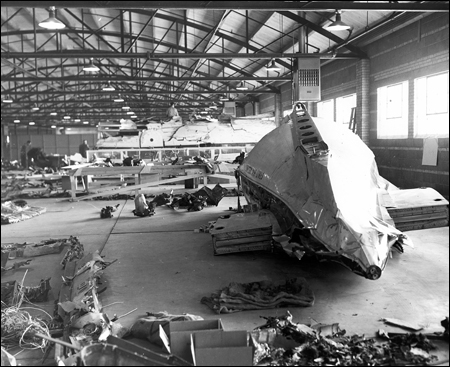
This book was written before 9/11, but that doesn’t mean that airplane bombings were unknown to him. One example is the 1949 crash of Canadian Pacific Air Lines Flight 108, in which a disgruntled man named Albert Guay sent his wife on a plane with a time bomb hidden in her luggage. His goal was to blow up the plane and kill her so he could marry his mistress. The bomb did go off, the plane crashed, and Guay’s wife died along with everyone else on board, but he didn’t get away with it. His guilt was quickly discovered, and he was convicted and executed.
There are many other examples as well. In all of these cases, the perpetrators didn’t resort to bombs because they first tried to hijack the plane with a gun and failed. The bombing was the plan from the start, whether to assassinate a specific person, or just to spread terror and destruction as a way of getting revenge on a country they had a grudge against.
Smith has no answer at all to these kinds of crimes. All the armed passengers and crew in the world won’t help when a bomb goes off at 30,000 feet and ruptures your airship’s helium envelope like a popped balloon.
Given the extremely light security he envisions, it would be very easy to smuggle explosives on board one of the North American Confederacy’s airships. As we’ll see later in this chapter, you can depart by shuttle while it’s between stops, so it wouldn’t even be a suicide mission. Just set a timer and leave the bomb on board when you go.
Indeed, you have to ask why the bad guys don’t do this more often. Given that the Hamiltonians want to force this world to adopt centralized government, why don’t they commit some spectacular terrorist attacks, to make more people afraid for their lives and persuade them that they need a government for protection?
Win is supposed to be the skeptical outsider, probing for flaws in this system so that the other characters can easily dispatch his objections with their common-sense political philosophy. But he never asks about this, most likely because Smith doesn’t let him pose questions that his belief system doesn’t have an answer for.
I persisted. “But what happens if I point a gun at the passenger sitting next to me, and threaten to blow his head off if they don’t take me, say, to Algeria?”
“Algeria?” Lucy asked. “Isn’t that somewhere at the bottom of the Sahara Sea?”
“Come on, you’re stalling! What happens if I take a hostage?”
“The hostage kills you,” Clarissa said, and that seemed to be that.
It’s not a spoiler to say that this exact scenario plays out in this chapter, just a few pages from now, and it doesn’t go the way Smith’s characters claim it would. In fact, hostage-taking is a highly effective strategy in this anarcho-capitalist society.
This is just what we should expect. It’s unrealistic to imagine that giving a gun to an ordinary civilian would transform them into a badass action hero who can competently defend themselves in a sudden life-or-death situation. (That’s why it’s so stupid for gun-loving conservatives to suggest that teachers should be armed to deal with school shooters.)
A more realistic expectation is that most civilians would freeze, panic, fire blindly, or make other terrible decisions in a crisis. A hardened criminal—let alone a gang of criminals—would easily overpower them. That’s the glaring flaw in Smith’s world, which asserts that you have to rescue yourself from muggers, hostage-takers and murderers because no one else will.
Image via Wikimedia Commons
New reviews of The Probability Broach will go up every Friday on my Patreon page. Sign up to see new posts early and other bonus stuff!
Other posts in this series:






.jpg)