
The Probability Broach, chapter 12
Over lunch, Ed and Win Bear are debating the merits of their respective governmental systems. Win protests half-heartedly that his world isn’t all that bad:
“We must be doing something right, the U.S. is the most prosperous—”
“Slum in your world.”
“The poorest American’s rich, compared to other countries!”
“And the poorest Confederate’s rich, compared to most Americans. All your taxes and regulations freeze old wealth, and make new fortunes impossible—except for those with political pull. The rich fend off the law, while those below get picked clean by your IRA.”
“IRS, though I’ll concede there isn’t much practical difference.”
First of all, how does Ed Bear know anything about Win’s United States? He’s never been there or even seen it. He might argue on behalf of his own society about why it’s better, but how can he feel qualified to criticize someone else’s?
On top of that, this feels like a Gish Gallop, where one party in a debate throws out dubious assertions too rapidly for the other side to counter them all.
Taxes freeze old wealth? Including progressive tax systems, which tax the rich at higher rates and use the revenue to fund safety net programs for the poor? How does that preserve old wealth?
This is a bald-faced assertion that programs whose goal is to decrease inequality actually increase inequality. I’d argue the point, but there’s nothing to argue. Smith doesn’t even try to justify it; he just makes the assertion and leaves it hanging. It’s like Ayn Rand asserting that regulation makes coal mining more dangerous (somehow).
Now, I’ll grant it’s true that there’s such a thing as a regulatory moat: big companies that lobby for government licensing and burdensome regulations in order to suppress competition. The big players can afford the costs of compliance, while smaller competitors can’t. But the solution isn’t to have no regulations at all!
In fact, Smith’s own argument proves the point: large corporations will do anything they can to shut out competitors. In our world, laws restrain them from doing that, however much they might want to. In an anarcho-capitalist world, nothing prevents them from using dirty tricks or outright violence. They could hire an army of Pinkertons, or whatever the NAC equivalent is, to threaten competitors with a gun duel if they don’t leave town. Under the anything-goes customs of this society, that’s perfectly allowable.
This goes back to the common libertarian misunderstanding that a free market is a self-sustaining state of nature. Actually, markets require laws and regulators to protect their existence and keep anyone from tipping the playing field too far in their own favor. Just as a sports game needs rules and referees to keep from degenerating into a brawl – and it doesn’t invalidate this point that referees are occasionally corrupt or unfair – markets can only exist when authorities uphold the preconditions for free and fair commerce.
“Tell me, how long does an American work to buy a car?”
“He can’t, any more. We used to spread it over a couple of years, why?”
“Win, a Confederate hoverbuggy represents about three weeks’ earnings—don’t look at me that way! How about a home?”
“Nowadays, forget it. Ten years ago, maybe five years’ wages. Actually, you’re talking a forty-year mortgage, even with—”
“I paid my house off in six months. And Win, this meal you’ve kindly provided is an expensive one. Meep’s got decorators to pay, after all. We could’ve eaten under the corner for the same price in copper!”
It’s also cheap because the NAC has no food safety inspections or labs analyzing ingredients or safety, of course. Getting rid of those undoubtedly saves money. But who do you call if you get sick from that cheap lunch?
It’d be one thing to argue that we have too much regulation, which creates inefficiencies that make goods more expensive without adding adequate value in return.
Smith isn’t arguing anything so modest. He’s saying that if we scrapped all government, the payoff period of a mortgage would fall from thirty years to six months, and the cost of a car would fall from several years’ earnings to several weeks.
In other words, he expects us to believe that state-imposed overhead makes up something like 98% of the cost of a house or a car. And he generalizes this to all goods, claiming that taxes and the cost of regulations accounts for a huge majority of the prices we pay for everything.
There’s an easy, back-of-the-envelope way to check this. If it were true, government spending would have to account for a massive majority of GDP. (Because all that money the state steals from hardworking citizens presumably goes somewhere, and isn’t just put in a pile and burned.)
The real value, as of 2023, is around 36% for the United States. That’s broadly in line with most industrialized countries. Even if you assume that all this taxing and spending creates no value (a dubious point we’ll discuss next week), it’s clearly not the case that it overwhelms the economy to the point of crowding out all else.
“How come everything’s so fucking cheap? Don’t your workers have to eat? Or is everything automated?”
“Automation doesn’t help: it always takes more people to create and maintain the machinery, and a healthy economy’s real problem is chronic labor shortages. Things aren’t unnaturally cheap. Win, we simply don’t tolerate a parasite that takes half your income and then builds more taxes into everything you buy!”
Wait, what?
It’s hard to understand Smith’s argument, but he seems to be saying that automation doesn’t make the economy more productive, because it takes the same amount of labor to maintain the machines that make stuff as it would have to make that stuff by hand.
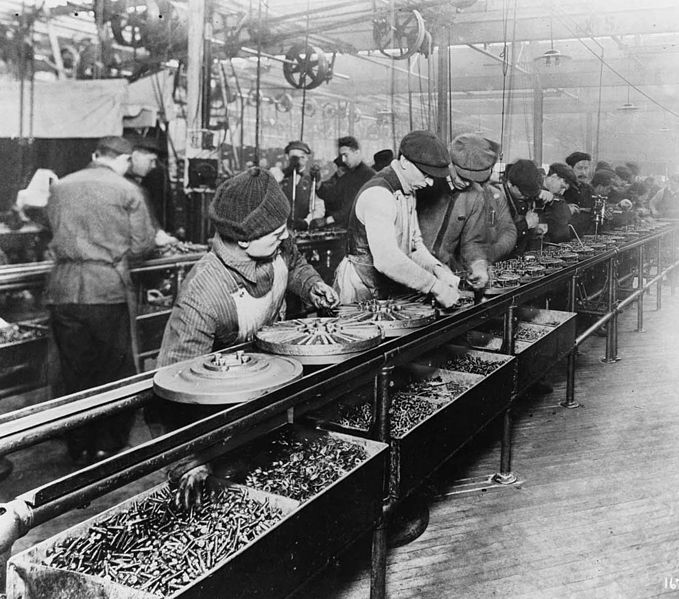
This is screamingly, unbelievably wrong. An assembly line with industrial robots can’t make cars faster than if each employee was a blacksmith hammering out the parts?
Of course automation makes us more productive. Why else would anyone bother with it? Why have we been inventing labor-saving technologies since at least the Roman era? This is an elementary failure, not just of political understanding, but of basic reasoning.
My best guess is that this bizarre assertion is the fruit of Smith’s ideologically driven one-reason worldview. He doesn’t want readers to conclude, incorrectly in his opinion, that the North American Confederacy is superior only because it has more advanced technology. (Because then a different society with the same technology would be just as good to live in.)
He wants readers to conclude that government and taxes are the only source of evil, and that every other good or bad thing about a society traces back to whether it has them. But to flatten a society down to the point where that’s the only thing that matters, he has to do violence to elementary logic.
New reviews of The Probability Broach will go up every Friday on my Patreon page. Sign up to see new posts early and other bonus stuff!
Other posts in this series:
Even for a libertarian that is an absurd position. Usually they argue that in a libertarian economy increased production would always mean price drops/better products because competition, so the wealth would always spread. This doesn’t work as a universal rule either but it does happen sometimes so it’s easier to argue.
Notice that Win has forgotten all his hatred towards his world’s tyrannical president and his goons? I totally forgot that Win’s world is a dictatorship, rather than the same as our world, till he mentioned that cars are banned. So what was the point of his world being a dictatorship in the first place?
As for cars and houses being paid off in six months, I think Smith could be saying that everyone is so rich that they can afford to pay off their stuff so quickly, which of course, makes as little sense as your theory, especially since these capitalists could gouge prices.
“First of all, how does Ed Bear know anything about Win’s United States? He’s never been there or even seen it. He might argue on behalf of his own society about why it’s better, but how can he feel qualified to criticize someone else’s?”
If criticizing based on no information is wrong, Ed doesn’t want to be right.
Do we ever learn what salaries are like in Ed’s world? Just curious about how cheap products are made (in the real world, mechanization and specialization made certain things cheap, but Ed’s world is one of small artisanal firms supposedly).
” So what was the point of his world being a dictatorship in the first place?”
It’s got to be a dictatorship, because Neil is standing on a slope that he thinks is steep and slippery with a dictatorship at the bottom, but Neil is also a real person in the real United States, so he forgets that he’s really oppressed severely most of the time, unless it’s ideologically necessary to remember.
If you can buy a hoverbuggy with three weeks of wages, then it would only require 120 hours of labor to make it. Including mining and processing all the raw materials. Actually less after profits, utilities, equipment etc. Sorry, but no not everyone can be rich.
I like the idea of a society where everyone, even the ditch-diggers and the wait staffs and the janitors are well-paid. However government isn’t the reason they’re paid little — hell, without minimum wage laws it would be even worse. So this is, as usual, gibberish.
Ed’s sudden knowledge of our Earth struck me as odd too.
… he has to do violence to elementary logic.
Why didn’t elementary logic hire adequate security?
It’s true that, on a consumer product level, a lot of labor-saving and time-saving products actually save very little labor or time, or do so for one narrow aspect of a task while adding a layer of complication which make the overall benefits questionable. Even in when the benefit is clear, a lot of the time you’re gaining convenience in exchange for additional cost and waste, making it a dubious prospect for poor, frugal, or environmentally-conscious people. (Not that being in any of those categories necessarily means that one is particularly wise about recognizing dubious prospects.)
But when it comes to industrial-use products? That sort of thing doesn’t happen as often and doesn’t last when it does. If it doesn’t provide real, measurable improvements to cost, scale, and/or efficiency within its particular niche, then it will be found out quickly and the news shared throughout the relevant industries. Soon the only buyers will be badly-managed companies with gullible leadership in the purchasing departments. There are only so many of those, and they tend to go bankrupt eventually, which in turn tends to lead to the collapse of whoever’s making the dubious product.
I’m wondering if maybe Smith had some bad experiences with questionable consumer products and ended up severely over-extrapolating.
There is also an effect with corporate labor saving things, like PowerPoint and Excel, where they don’t actually save any time, the people using them just create more work.
Before tool like PowerPoint creating a big presentation took a couple of people and several days, with PowerPoint a manager can create their own in hours. The result is not saving time for other work but more presentations. A few artists lost work but overall it didn’t save much time.
Same thing with spreadsheets. Before computer spreadsheets creating a company finance projection for the next year took several accountants. One projection was done per quarter. Now projections are done monthly or weekly with multiple different assumptions. No real time saved, instead a lot more work is created to fill time, work with increasingly marginal value.
House work, same thing. We no longer have to drag carpets outside and beat them to clean them but we vacuum a lot more, to give one example.
A business culture that looks down on busywork would be a great idea but that would imply the Confederacy’s superiority isn’t based on lack of government
“Automation doesn’t help: it always takes more people to create and maintain the machinery, and a healthy economy’s real problem is chronic labor shortages…”
This is pretty close to what businesses tell their workers when they want to automate some part of their business and get rid of workers. It’s another version of “don’t worry, we’re creating more jobs than we destroy, all those laid-off workers will find jobs somewhere else, we can’t say where exactly, just trust us!”
It reminds me of those dumbass Republican politicians insisting that business owners “want to create jobs,” when it’s perfectly obvious they want to maximize their own profits by minimizing expenses.
It’s all horsemuffins, and Smith was too ignorant and clueless to even rehash it right. Couldn’t he have at least got himself an editor from the Cato Institute?