
The Probability Broach, chapter 20
The Continental Congress has ended. Win Bear and his friends spent enormous amounts of effort convincing the delegates to meet, so they could warn everyone about the imminent Hamiltonian invasion. Then, after all that work, they belatedly realized they forgot to come up with a plan for what to do about it.
John Jay Madison is gloating that they know all the details of his world-conquest plot, and there’s still nothing they can do to stop him. They have no borders to fortify; they can’t forbid anyone from entering the North American Confederacy, regardless of hostile intent; they can’t outlaw weapons. This anarcho-capitalist society is helpless to defend itself.
But, of course, there’s one thing they haven’t tried. The North American Confederacy has no laws, so it’s not illegal to just kill someone if you’re mad at them.
To that end, Win shoves through the crowd, intending to catch Madison and challenge him to a duel. But he screws it up:
I fixed my gaze on Madison and half a dozen others converging on him. Leaping the row of consoles, I strode along the table, not caring whose fingers I stomped… I braced myself, and raised a hand. Suddenly Madison was pushed aside. I struck the upraised arm of Oscar Burgess, who grinned. “Say your piece, so we can get it on, Bear!”
I ignored him. “Madison, my quarrel’s with you!”
Madison looked innocent. “Then why did you challenge Mr. Burgess?”
“What?”
“There are a thousand witnesses around us who saw it.”
Win accidentally challenged Oscar Burgess, the secret-police goon from his world who was also Win’s firearms instructor at the academy. As we saw in an earlier chapter, he found out about the Probability Broach and traveled through it to this world, where he made an alliance with Madison.
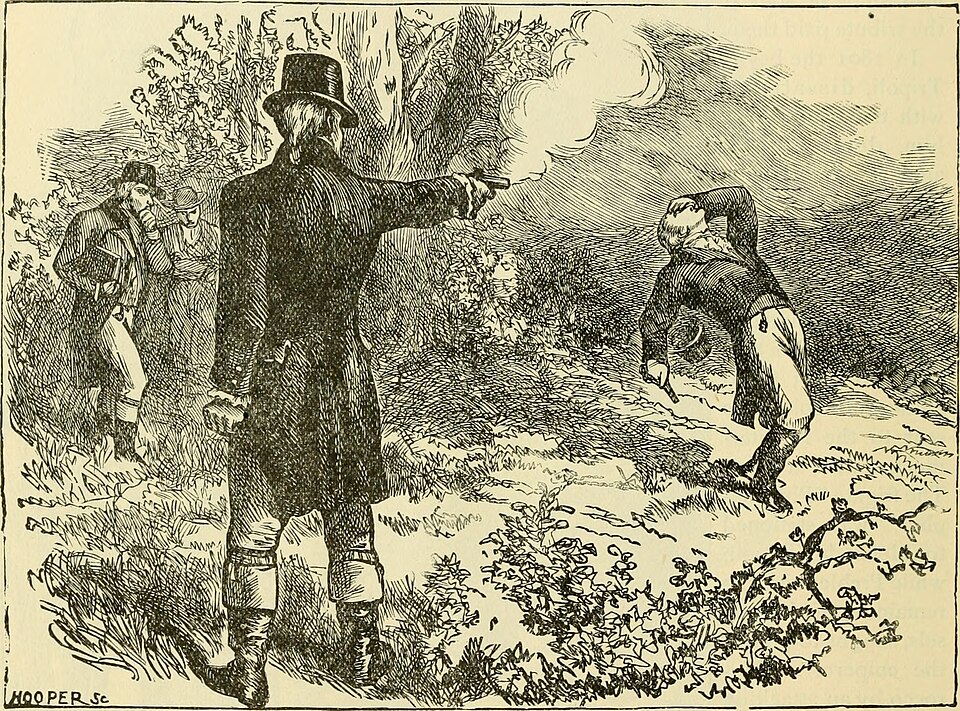
You can’t take a challenge back, and Burgess is gleefully eager for the chance, so Win reluctantly agrees to follow through. The two face off at a distance of twenty yards, and at a signal, they draw and fire:
I brought my gun to bear, too late. Over my front sight, Burgess’s muzzle blossomed brightly. A sharp bite in my right forearm, and I knew I was hit. He’d corrected faster than I’d counted on. I pulled the trigger once, twice, hoping to connect before he fired a second shot. I pulled the trigger once again.
The Smith & Wesson bucked and roared, spewing fire at Burgess. Two fist-size crimson gouts splashed his shirt-front, and his head exploded in a hazy red mist. His feet left the floor, he slammed against a desk and sank, blood obscenely pumping from his wounds, head smoking hideously where the upper half had vanished, mocked by the smoking Luger in his hand.
Win expects to see his arm blown off, but he only has a flesh wound. In a million-to-one coincidence (the kind that crops up nine times out of ten), Burgess’ bullet ricocheted off a brass button on his shirt cuff.
For plot purposes, I have no problem with that. What is problematic is that this supposedly civilized society still thinks a duel is the appropriate way to settle a dispute.
In our world, most countries outlawed dueling centuries ago, recognizing what a senseless waste of life it was. It makes perverse sense that an anarcho-capitalist world would revive this barbaric custom. (This casts a different light on the claim that the North American Confederacy has only a dozen murders per decade. Want to bet they don’t count deaths in duels as “murder”?)
In general, people want a legal system that’s oriented toward, you know, justice—examining the evidence, finding the truth, and delivering a fair result. This system offers none of that. Instead, the person with more combat prowess will almost always win, regardless of whether they’re in the right. People who enjoy violence and are good at inflicting it will dominate over those who value justice, truth and fairness.
This is regression to a medieval worldview, literally. Medieval societies practiced trial by combat because they believed that God would ensure the innocent always triumphed. It was obviously erroneous superstition in service of a might-makes-right philosophy.
In the moment of victory, Win suddenly hears gunshots behind him. He whirls around, too late, but the danger is already passed.
The shots came from Freeman K. Bertram, the corporate manager who was on Madison’s side. Madison himself made his getaway in the confusion, but one of his thugs was about to shoot Win in the back. Bertram had an attack of conscience and shot the thug first, saving Win’s life. But in exchange, he received a gruesome stomach wound:
“Win Bear!” Bertram whispered. I put an ear down to his face… trying not to look away. “Never shot a man before. Your friends… Ham—Hamilton House. It’s so cold! Cold!” He stopped talking and gurgled. I knew that sound. I closed his eyes, holding them until they’d stay shut by themselves.
Win thinks Bertram is dead, but his friends tell him to leave the man alone. An ambulance was already called before the duel began, and because the North American Confederacy has advanced medical technology, he’ll make a full recovery:
I looked at Lucy in disbelief. “He’ll be okay?”
“Will be if y’don’t put his eyes out.”
“You mean I’m going to have to kill Burgess all over again?”
“Are you kidding? Boy, you blew his head clean in half! Let me be the first to congrat—”
I didn’t hear the rest. I was busy puking in living color on a nationwide hookup.
This scene is a weird plus-one, minus-one.
As Smith has shown us, he’s an obsessed gun fetishist who thinks everyone should carry guns, including children, and bring them everywhere, including on airplanes. He claims the right to bear arms takes precedence over everything else, and that a politician’s position on guns sums up their entire political philosophy and personal character.
But, oddly enough, he doesn’t glamorize gun violence. He doesn’t treat it as satisfying and righteous when inflicted on the deserving, the way most right-wing keyboard warriors do. Even a hardened cop like Win vomits after killing a man, rather than coolly uttering a James Bond-style quip. (“Guess he really lost his head back there!”)
He probably wrote the scene for black comedy, but it’s still a realistic depiction of the traumatic aftereffects of violence. It’s an unusually sober interlude of realism in a book that’s otherwise so gung-ho about it.
Image credit: Wikimedia Commons

New reviews of The Probability Broach will go up every Friday on my Patreon page. Sign up to see new posts early and other bonus stuff!
Other posts in this series:
Win takes a damn Luger round to his shooting arm and still lands three fatal rounds to his target?!? He must have brought some Hollywood good-guy shooting magic across the Broach with him.
I’d hand wave that as Win’s distorted impression — in reality they shot at the same time.
But yeah, mor elikely, Smith was going with the Hollywood medical rule that any shot to the arm is a trivial injury that can be cured by putting the arm in sling.
“This is regression to a medieval worldview, literally.” I’ll have to dispute that. Challenges to duel were common among the American leaders in the 1700s (Affairs of Honor by Joanne Freeman is an excellent book on this) and on into the 1800s. Though usually the seconds acted to negotiate a settlement and avoid a fight (the further south and the further west you got, the more likely it was the person issuing the challenge wanted blood). Doesn’t make it any less stupid.
Ditto this scene. Why couldn’t Win take the challenge back? Why not say it was an accident? Are the dueling police going to bust him? If it comes with social stigma — well, why should he care? It would make more sense if Burgess took the random bump and demanded satisfaction (“You struck me, you pig!”)— but even then it’s hard to see any consequences Win should care about if he walks away. Hell, Congress knows who the bad guys are, would they be so hidebound they’d object.
Also Burgess hasn’t done anything at this point — Win didn’t even know he was there. Classic American dueling required a breach of honor (e.g., calling someone a coward, a scoundrel or, believe it or not, “puppy”). If all it takes is “Hey, I challenge you to a duel” — well, that’s ridiculous.
It also undercuts the idea of guns for self-defense. Assume, as Smith does, that Lucy is good enough with a gun she can blow away anyone who jumps her. In a duel situation she has to stand there, exposed to her enemy’s clear shot. I’d think that reduces her advantage.
Dude, where do you think the image comes from? X-D
(Clue: It’s titled “Burr Hamilton duel”.)
From your earlier post: “People in the NAC have free speech; no one will blow your head off because they don’t like something you said.” If dueling is accepted, then people can blow your head off for that very reason.
Has Smith mentioned dueling before? If so, did he explain the rules? How does Win know about it and how to do it and that Madison will feel obligated to do it? We learned earlier that murder doesn’t happen (ROFL) because nobody will deal with a killer or someone who refuses to honor their adjudicated debts. Does the same happen when people refuse duels? Is it just the social sanction where you don’t get invited to cool parties and career-boosting meet-and-greets?
As I’ve mentioned before, much of Smith’s world only works if the Confederacy has a rigid honor culture unlikely to have formed out of its American roots. Even by that standard this is unconvincing — refusing a duel simply isn’t in the same category as refusing to make right your crimes.
Earlier in the book, there’s a throwaway mention of “President Mencken” shooting his own vice president in a duel in the 1920s. Other than that, this scene is the first clear evidence that dueling is a custom that still exists in the NAC.
It’s unclear how Win knows this; maybe he just guessed. He suggests the idea of challenging Madison, and Lucy calls him a “romantic” and then says he can proceed with it.
It’s also unexplained why Win can’t take back his mistaken challenge of Burgess. I omitted this part, but it also says that Confederate custom typically “requires a cooling-off period between a challenge and its execution”, but Win evinces “a barbaric disregard for protocol” and ignores that part, and no one seems to care. If he can flout one aspect of the Confederacy’s honor culture, why not others?
As you’ve pointed out in several of these excerpts, Win gets the hero’s ability to evade the rules without consequence.
“I fixed my gaze on Madison and half a dozen others converging on him. Leaping the row of consoles, I strode along the table, not caring whose fingers I stomped… I braced myself, and raised a hand. Suddenly Madison was pushed aside. I struck the upraised arm of Oscar Burgess, who grinned. “Say your piece, so we can get it on, Bear!””
So Win actually assaulted a bunch of people (storming through the crowd without taking care to avoid stepping on people’s fingers). You’d think that in a persnickety society like the NAC’s, Win would be facing a bunch of dueling challenges (if not immediate gunshots) for such rudeness.
That occurred to me after I posted. Particularly since stepping on people’s hands is likely to cause genuine injury — hell, never mind dueling, in the NAC isn’t that grounds for “you need killing!”?
The same thing happened in an earlier chapter, where Win shoved through a crowd. It resulted in a “wake of angry shouts and cursing”, but somehow, no shots fired.
Just looked at his page on some libertarian website where he explains he’s not a single issue voter but — as you’ve quoted in the past — a politician’s attitude towards guns is the one single issue that shows how he stands on all the issues!
So his nonfiction writing is as bad as his fiction.
His three issues are guns, gun rights, and rights concerning guns. No single-issue voter, he.
Win missed an opportunity here. There was no reason he couldn’t challenge Madison also. There may have been some additional arbitrary rule against multiple challenges but there is no reason Win would have known that.
Many people in medieval society were more practical. They understood that trial by combat and trial by ordeal were not particularly just. The hope was that a guilty person would confess rather then face it.
Likewise colonial/early independence Americans were concerned with proving their honor by being willing to accept or issue a challenge. Then the seconds would do their best to resolve everything.
Um, with no laws about duels (or anything), who enforces them? How can there be a “rule” about striking an arm?
Also, why did Madison even bother to kidnap Win’s friends? They would not have made any difference.
John Jay Madison is gloating that they know all the details of his world-conquest plot, and there’s still nothing they can do to stop him. They have no borders to fortify; they can’t forbid anyone from entering the North American Confederacy, regardless of hostile intent; they can’t outlaw weapons. This anarcho-capitalist society is helpless to defend itself.
As I’ve said before, this is looking more like self-parody (intentional or not) with each chapter.