
The Probability Broach, chapter 12
Win and Ed have one lead to follow up on: the university researcher, Dr. Thorens, whose name Freeman K. Bertram gave them. According to Bertram, Dr. Thorens is the best person to answer some of their questions about parallel universes.
Before they head over to the university, they stop for lunch at a restaurant called Mr. Meep’s Spanish Hideaway:
Meep would take explaining in anybody’s universe. A chimpanzee, he’d adjusted his wrist-talker for what he fancied was a Spanish accent, then grafted a gigolo moustache to his upper lip to go with his bolero jacket, Mexican bellbottoms, and one of those off-duty bullfighter hats, the kind with little balls of fringe around the brim. When he lifted it, his hair was dashingly oiled, parted down the middle like Rudolph Valentino.
Culture shock is a terrible thing. Ask the man who has one.
Win asks Ed, “Doesn’t this place seem a little silly, even to you, sometimes?”—which I guess you could take as evidence of self-awareness on the author’s part.
They eat and smoke. Because Win has a pocketful of cash—the blood money he received from the prison company, as payment for failing to protect his prisoner—he offers to pay for lunch. But when they get the check, he’s shocked by how cheap it is:
Ed took longer finishing his meal than I did—I still say chocolate turkey is a little heavy for lunch. Since I was suddenly wealthy, I decided to pay. The bill popped up on the screen and I turned to my munching messmate: “Ed, is this right, a silver quarter-ounce? That’s only a buck and a half!”
“Mmphl. Probably added in your cigar by mistake. Need some money?”
“No.” I observed absently. “Nor does anybody else around here, apparently… Everywhere I go in this town, everyone has lots of cash, and everything costs practically nothing. Where are you hiding your poor people?”
As we previously saw, Smith maintains his economically implausible insistence that everything is cheap and everyone is wealthy in the North American Confederacy. In this section of the book, he tries to explain how that can be possible.
Ed explains that by the standards of his society, he is one of the poor people (“When did you ever know a rich detective?”), but it doesn’t matter. Once they abolished government, Capitalist Magic made everyone prosperous and comfortable. He reminds Win that their super-advanced medical technology fixed his injuries virtually overnight, and the same is true of every other problem as well:
“Fractured bones are a problem we’ve solved, largely with substantial amounts—by standards you’re used to—of scientific and economic freedom.” He took the last bite of pastry and wiped off his chin. “We’ve also solved hunger, and by the same means. All you have to do is leave people alone.”
“To die in the streets of old age or starvation? That’s why you need government, Ed, to take care of those who can’t—”
“Wrong way around, Win. Politicians need human misery, for their very—”
“Now wait a minute! We spend trillions, just to—”
“Spread the misery around! My friend, government’s a disease masquerading as its own cure.”
These are bold claims. Smith says that government never makes anything better; it only holds people down. If we scrapped all laws, regulations and safety-net programs, the economy would flower and poverty would disappear.
Let’s put these claims to the test with a real-life example of what happens when we “leave people alone”.
After the Civil War, the U.S. government passed a series of Homestead Acts that gave away unclaimed land in the western Great Plains (“unclaimed” in the sense that its indigenous inhabitants had been forcibly displaced or wiped out) to white settlers who were willing to farm it.
It was known that this region was arid, harsh and susceptible to drought. But millions of settlers flocked to claim land, because of a popular belief called “rain follows the plow” which held that cultivating the land would make it more fertile and temperate.
Nothing could be more libertarian than this. The homesteading land rush was motivated by the same belief L. Neil Smith argues for in this section: the belief that people do best when they’re left alone. All we have to do is grant them the freedom to do what they think best, and then stand back. Smith’s logic would lead you to believe that they’d transform these arid lands into a Garden of Eden.
The results didn’t live up to these rosy expectations.
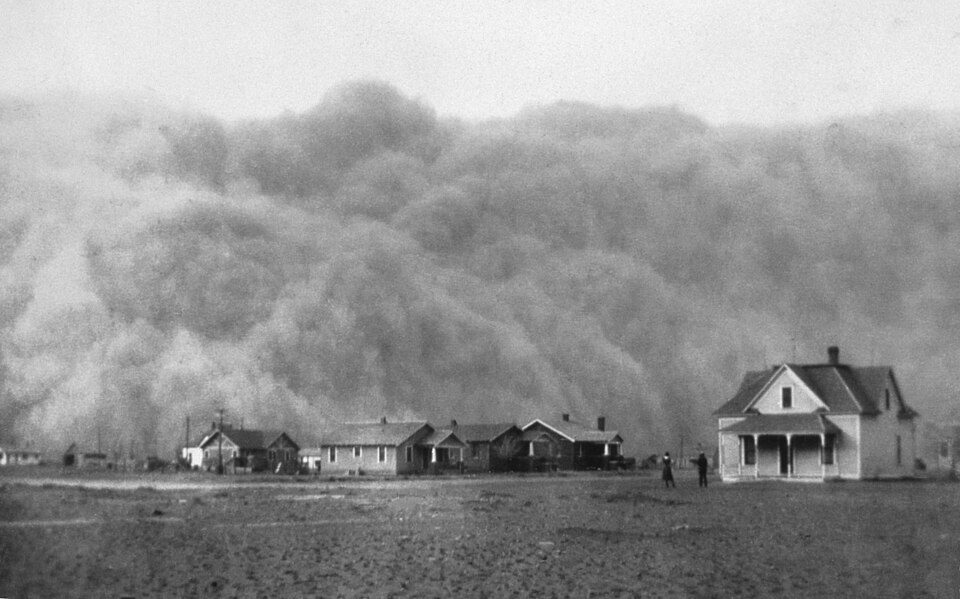
A wave of settlers plowed the prairie, using newfangled technology like the combine harvester. They ripped up the perennial native grasses whose deep, dense root networks held the soil together. The crops they planted to replace them, like wheat, were shallow-rooted annuals that couldn’t perform the same function.
When drought inevitably came, the soil dried out and crumbled, and Great Plains winds did the rest. They scoured the loose topsoil, catching it up into huge dust storms that darkened the daytime sky for miles. The dust smothered towns, made travel impossible, and killed people and animals who suffocated or contracted pneumonia from inhaling it. Millions of people lost their homes and their land, becoming penniless, hungry refugees.
The Dust Bowl can’t be blamed on regulation, government overreach, or political machinations. It was caused by—if you care to put it in these terms—too much freedom. Letting everyone do what they wanted led directly to ecological devastation and economic collapse. If the government had exercised a heavier hand, preserving some of the native prairie and keeping it off-limits to farming, it wouldn’t have been as big of a crisis.
You might be wondering, why hasn’t there been another Dust Bowl since the 1930s? The answer is that it’s because of government intervention.
The New Deal created agencies like the Soil Erosion Service, which taught farmers to use anti-erosion practices like terracing and cover crops. The states created soil conservation districts which made these practices mandatory.
Another government initiative, the Great Plains Shelterbelt, hired CCC workers to plant trees across hundreds of miles to serve as windbreaks. The Conservation Reserve Program paid farmers to take land out of production, replacing crops with native vegetative cover. The idea of paying farmers not to plant crops has been the target of endless mockery, but there’s sound ecological reasoning behind it.
The Dust Bowl is a dramatic example of how excessive freedom can lead to disaster, but there are others. Fishing fleets with no restrictions on the size of their catch have pushed commercially valuable fish species to the brink of extinction, causing the collapse of coastal economies.
Desert farms and settlements have pumped too much water from aquifers like the Ogallala, causing wells to run dry and harvests to fail. Drought and overuse has forced entire cities, from Cape Town to Mexico City to Tehran, to reckon with the prospect of running out of water. Governments in these places have had to impose rationing to keep the taps from going dry.
These are all Prisoner’s Dilemma situations: collective action problems where, when every individual makes the self-interested choice, it results in the worst-case outcome for everyone. If everyone voluntarily agreed to rein in their selfishness—leaving some land unplowed, catching fewer fish, conserving water—they’d all be better off. But any such agreement will collapse in the absence of any way to enforce it.
Smith’s cornucopian ideology (also seen in Ayn Rand) holds that the bounty of nature is inexhaustible—so the more people who work to extract resources, the more there’ll be for everyone. If you hold this belief, it’s a logical conclusion that government regulation can only decrease humanity’s output, never increase it. Of course, a libertarian has to say this, because it’s the only scenario that justifies the absence of government.
But cornucopianism is false. The reality is that we live on a finite planet where natural resources can be depleted. If money is the sole driving force, there’s no incentive to preserve something till tomorrow when you could make a profit from it today. That’s why, sometimes, we need a government—which just means an enforceable collective agreement—to conserve limited resources and prevent anyone from taking more than the planet can bear.
New reviews of The Probability Broach will go up every Friday on my Patreon page. Sign up to see new posts early and other bonus stuff!
Other posts in this series:
…Smith maintains his economically implausible insistence that everything is cheap and everyone is wealthy in the North American Confederacy.
Yeah, right — and no merchant or landlord ever looks at his prosperous neighbors and potential clients and says “You know, I can raise my prices a little, clearly my customers can afford it.” I guess Capitalist Magic just makes people stop thinking like capitalists…?
I wish there was a way to like comments. You deserved that one.
Thanks, and yes, a Like button would come in handy here sometimes.
.. Or not.
In reality.
You did set this up for that truth beng stated.
Now, if only Smith had realized that capitalists also need human misery for their very survival. His analysis is incomplete, and he builds a house on this incomplete foundation that surely falters. You can’t have a world where no one is poor and capitalist economics. It just doesn’t work.
The Dust Bowl remediation policies were good, and unlike libertarians I do not have to believe the state can never do good, just that its good things are always conditional and outweighed by the bad. But that “rain follows the plow” thing wasn’t some idiotic superstition that the dumbass farmers believed in spite of experts saying it would be disastrous, it WAS the scientific consensus at the time. So government action wouldn’t have prevented the Dust Bowl because they wouldn’t have known there was a problem either until it was too late. We shouldn’t retroject the science-denying and expert-disdaining views of (a vocal minority of) rural-dwelling people today onto the rural-dwelling people of a century and a half ago.
The Dust Bowl was a “tragedy of the commons” situation, but the research that led to that theory was inaccurate and no longer accepted. In real situations like this, UNLESS the people live under capitalism, they will manage common land to prevent its degradation. This sounds amazing to people who know nothing but capitalism, but it’s true. Of course, this means the uber-capitalist Smith-world should be an ecologically degraded hellscape. If it isn’t, that implies that people are rebelling against market forces.
Yes. Real commons existed into early modern times, while theory suggests they should be destroyed almost immediately, so obviously some social structures (other than unrestricted capitalism) can make commons possible
If rain really did follow the plough, why were there still deserts literally anywhere on Earth? Why weren’t stores full of produce from the hyper-fertile Sahara? Surely not for want of trying. Any of the neighbouring countries could have expanded into just a corner of the desert just by transporting enough water there, in animal skins on people’s backs, to get a crop established; and repeated the process to push ever further onwards as the rains came to the land they had already settled. Surely someone would have had the idea to try it in the intervening millennia? And the lack of result can best be explained by the original hypothesis being false: Rain did not, in actual fact, follow the plough.
Also, anyone who brewed alcoholic drinks would have known that if you give yeast more sugar, it just ends up poisoning itself with its own waste products. If you added distilled spirits to a fermentation in progress, it would stop sooner, and at the same strength it would have reached by itself. The yeast isn’t being killed by starvation, but pollution.
Before the Industrial Revolution, more people would have had to know this stuff, because there were fewer layers of abstraction between the producer and the consumer of any goods. It was just basic survival, when everything had to be sourced and finished locally; and if it wasn’t you or a member of your family doing a particular job, you’d have a friend or neighbour who would. If you were growing barley, a brewer would surely be buying some of it from you, and might tell you something about the brewing process. If you were breeding sheep, someone would be spinning your wool, dyeing it and weaving with it, and you would have heard something of textile manufacture.
But I suppose someone who had grown up in times when everything was made in a factory and bought in a supermarket might have the luxury of not knowing how whatever they did for a living fitted into the bigger picture. And it might just be feasible to appeal to exactly the right combination of arrogance and naïveté, by offering what sounds like a good reward for a task in which, for reasons they do not know, they are unlikely to succeed. In that light, it looks like an early use of information asymmetry against a population.
But that “rain follows the plow” thing wasn’t some idiotic superstition that the dumbass farmers believed in spite of experts saying it would be disastrous, it WAS the scientific consensus at the time.
Ehm, some citation required. Was that really a consensus of scientists, or a pop-science misinterpretation spread (knowingly or not) by people who wanted it to be true?
It’s true that “rain follows the plow” was something that some scientists of the time also believed. The Dust Bowl was one of the ways we learned that it wasn’t true.
Regardless, it shows that unrestricted access to a commons isn’t always going to produce a good result, which clashes with libertarian assumptions. Sometimes, we need an enforceable agreement about what level of resource usage is sustainable, to prevent people from taking more than their fair share and causing a collapse. That applies whether you’re growing crops for sale in a capitalist market, or even just farmers trying to feed themselves and their own communities.
Another problem that caused the Dust Bowl was in the government giving land to anyone who said they’d farm it for five years. People who had no experience in farming but a lot of unearned confidence took up the land, ruined the land, and abandoned it. The semi-truthful Little House books were all about Pa Ingalls repeatedly exhausting the shallow prairie soil and then abandoning the wasteland he created for greener pastures.
It’s almost like everyone would have been better off had they let the Native Americans keep their land, or something.
“In this section of the book, he tries to explain how that can be possible.”
Except he doesn’t. Saying Earth-Confederacy eliminated government, therefore no poverty, is not an explanation. Or is there more to come?
“We’ve also solved hunger, and by the same means. All you have to do is leave people alone.” Proving my point. That’s not an explanation unless you take it as an axiom that without government The Free People will automatically solve everything. And if everyone accepted that as an axiom there’d be no need for this book.
Also the Mexican chimp feels almost as racist a caricature as the Frito Bandito.
Side question: Does Smith ever explain how being armed at all time stops con men and fraudsters? Guns aren’t much use if you don’t know you’re being robbed.
Nope, that’s pretty much all the explanation we get. Next week, I’m going to cover one more line of dialogue to the effect that government leeches off people’s productivity while giving them nothing in return, so abolishing government makes everyone instantly much wealthier with no downsides.
He never discusses this topic at all. To extrapolate from his other ideas, maybe if you think you’ve been conned, you can challenge the fraudster to a duel, and the threat of that keeps businesses honest?
The cynic in me wonders if he’s much more concerned about street crime and armed robbery than financial fraud or scams because those fall into “it’s your responsibility not to be conned.”
Not for the first time reading your reviews I”m reminded of my first DM’s observation about some of the PCs: “You are not playing their intelligence.”
Modern Haiti is another example of ‘everybody makes the self-interested choice and results in worse outcomes for everybody’. Haiti is wracked by poverty, and for many families literally their only available source of income is selling firewood (largely because other sources of income have been bottled up by previous generations of autocrat cronies). Of course, that means cutting down trees. Which means destroying the windbreaks. Which means the next hurricane does even more damage, and which makes the poverty even worse…
They were aware of similar issues back in medieval times. The poem “Winner and Waster” debates whether cutting the forest should be restricted (the poor man needs to cut and sell firewood to feed himself!) or deregulated (there’ll eventually come a wood shortage!).