Do you?

You’ll have to go elsewhere to find out if you don’t.

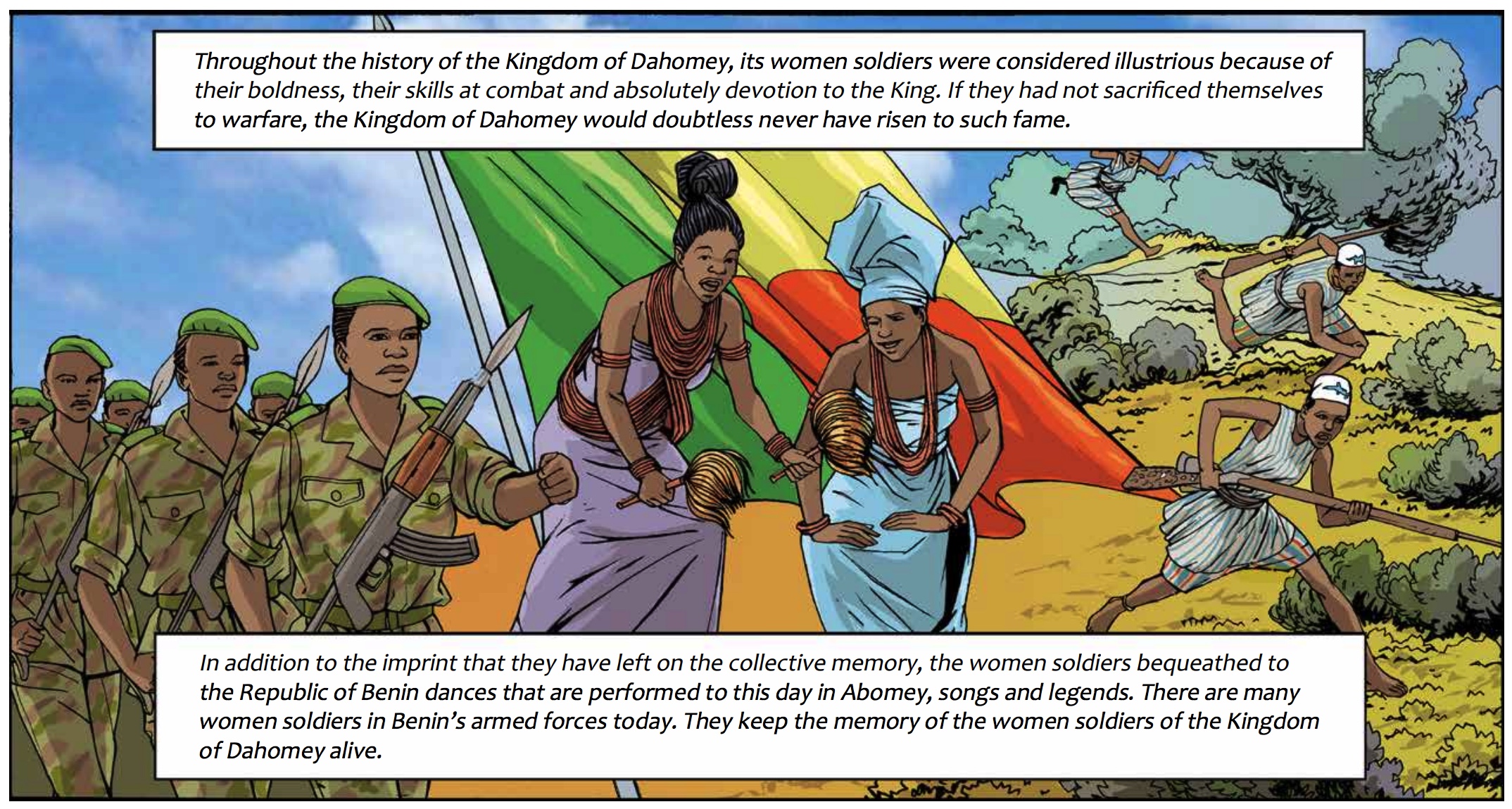
It’s not exactly a pretty story, saturated as it is with slavery, colonialism and war, but it turns out that the Kingdom of Dahomey maintained an elite force of warrior women, the N’Nonmiton, in the 19th century. The comic book linked above tells their story, and these were definitely not put on for show — they were an active fighting force.
The Dahomey Warriors were known to be especially skillful, competitive, and brave. Their drills and military parades were always performed to dancing, music, and songs and their weapons were sometimes used as choreographic props. As expressed in their songs, their goal was to outshine men in every respect, and European travelers observed that they were better organized, swifter and much braver than male soldiers. As such, the King would send them to war as opposed to their male counterparts and European soldiers would also hesitate to kill them as they were often young women.
More details at the Smithsonian.

But we have to imagine, don’t we? It’s the only way we can get change done.
I recently stumbled across a cell phone video made by a student at Parkland as they were fleeing their classroom. The teacher was dead in a pool of blood. Another student was dead. Yet another student was moaning in pain, wounded. They fled through a hallway with more students lying dead. It was so horrific that I could not in good conscience repost it, out of respect for the dead and the families who have lost people they loved. I closed my eyes and shut that window, unwilling to look at it again. It’s no wonder that those students are being so articulate in speaking out against this ongoing nightmare.
We are allowing kids to be slaughtered and traumatized so the gun industry can make more profits and so the NRA can prosper. When will we wake up and shut those ghouls down?


Minnesota Republicans are pushing a bill they say defends free speech on campus.
Introduced last week by State Sen. Carla Nelson (R-Rochester) and State Rep. Bud Nornes (R-Fergus Falls) at a press conference alongside members of the University of Minnesota College Republicans, the bill would make state-funded universities adopt policies that place a higher emphasis on free speech.
You will not be surprised to learn that the actual text of the bill does the opposite of that.
although faculty are free in the classroom to discuss subjects within areas of their competence, faculty shall be cautious in expressing personal views in the classroom and shall be careful not to introduce controversial matters that have no relationship to the subject taught, especially matters in which they have no special competence or training and in which, therefore, faculty’s views cannot claim the authority accorded statements they make about subjects within areas of their competence, provided that no faculty will face adverse employment action for classroom speech, unless it is not reasonably germane to the subject matter of the class as broadly construed, and comprises a substantial portion of classroom instruction.
So, placing a “higher emphasis on free speech” is to be accomplished by gagging college professors. That doesn’t sound like free speech to me. As usual, right-wingers use “free speech” as a code for limiting speech they don’t like.
This is also a bill that demonstrates a deep ignorance about how universities work. I am part of a team of faculty who have the mission of helping students acquire basic knowledge about a rich, complex subject. That knowledge is not imparted in a single class (why, not even my class); I rely on students learning preliminary information in the prerequisites to my courses, and my colleagues expect that students will emerge from my classes with knowledge they can build on. There is a tremendous amount of peer pressure to keep class content focused and substantial. I don’t need a law saying that I can’t spend hours and hours of class time talking about, oh I don’t know, Trump, atheism, lobsters, or feminism.
I really don’t need a bluenosed ideologue hovering over my should to police my class time in order to teach well, and in fact, that would be one other factor that would compromise my effectiveness.

Some good news, at least: James Damore had charged that Google violated labor laws by firing him, claiming that he was merely providing useful internal criticism of Google’s procedures, and you can’t fire someone for that. His claim has been thrown out. It seems Google was very careful to clearly state its reasons for the firing, and it wasn’t because he was trying to improve their training methods: it was because he was bigoted and promoting discrimination. Oops.
The NLRB memo includes talking points that Google prepared and read over the phone to Damore when he was fired. “I want to make clear that our decision is based solely on the part of your post that generalizes and advances stereotypes about women versus men,” Google’s talking points stated. “I also want to be clear that this is not about you expressing yourself on political issues or having political views that are different than others at the company. Having a different political view is absolutely fine. Advancing gender stereotypes is not.”
Now Damore still pursues “a class action lawsuit in which he accuses Google of discriminating against its white, male, and conservative employees.” You might think that maybe that has a better chance of success, since he’s arguing that he’s opposing discrimination against men, but look at what Google said. They’re against “stereotypes about women versus men”. Those hurt men as well as women, so they were also careful to insulate themselves against the charge that they were favoring one sex over another.

Would you believe it’s been 20 years since Andrew Wakefield published his disgraceful paper? It was retracted for undisclosed conflicts of interest, unethical treatment of children, and dishonest data manipulation. So Wakefield ought to be commemorating the destruction of his career from a nice ditch somewhere with a bottle of Thunderbird, right?
Wrong.
Wakefield got to celebrate the death by neglect of children with celebrity appearances on a tour for an anti-vaccination movie, the spawn of his bad study, and he attended an inaugural ball for Donald Trump. Last year, he was invited back for another round of talks in Europe.
Last week, Wakefield did not speak at a working men’s club, but at the supposedly reputable Regent’s University in London. To top that, he was invited to the European parliament, not by a neofascist know-nothing, but by an MEP from a Green party, which readers who have not been paying attention may think is filled with decent people.
And now he lives in a nice house near Austin, Texas, profiting off the conspiracy theory he instigated.
There is no justice in the world.

The paranormalists are all a-buzz right now because Brien Foerster has announced the results of a DNA analysis of the Paracas skulls — the extraordinarily deformed skulls of high caste Peruvians from several thousand years ago. The skulls look weird, warped into conical shapes, so they’ve long been the focus of people like Lloyd Pye, who wants to argue that they’re the remains of extraterrestrials. Or Nephilim, fallen angels. Or ancient hominids from a completely different lineage than Homo sapiens. They aren’t very consistent in their explanations.
Anyway, here’s Foerster announcing the ‘intriguing’ results of having sent off samples from Peruvian skulls to various commercial labs.
I can tell you what part has the fringe groups most excited: Foerster explains that all native american peoples…are of haplogroup A, B, C, and D
, but in this set of skulls, the most common haplogroups that showed up were U2, E, and also H, H1a and 2. If you look at where the most prevalent percentage of U2 and the H1s are, it is in between the Black and Caspian seas, as in, the Caucasus Mountains.
These people weren’t aliens, or supernatural beings, they were…WHITE PEOPLE. Ta-daa! As we all should know, brown people in South America, or Egypt, or the Mississippi river valley, or anywhere for that matter, could not possibly have developed sophisticated cultures, and white people, or Jews, must have traveled there in ancient times and taught them everything they know.
Man, it’s not surprising at all to discover racism rotting deep in the heart of the ancient astronaut community. He also seems oblivious to the fact that identifying human haplogroups in these skulls tells us that they were fully…human. Not angels, not aliens.
Foerster has a long history of obsession with these skulls.
Brien Foerster managed to persuade Juan Navarro Hierro, director (and owner) of the Paracas History Museum (sic: on the sign outside the museum, the name is given first in English, then, smaller, in Spanish) to part with some tissue samples. He claims that he did this because “[t]he only way to establish the actual age, and possible genetic origins of the Paracas people is through DNA analysis of the skulls themselves”. Dating human tissue by means of DNA analysis is such a new technique that I can find no other use of this remarkable development in any other archaeological investigation. Of course, there is no such dating technique: this is Brien Foerster displaying his ignorance of archaeological dating techniques!
Where did he choose to send the samples? To some prestigious university department, well known for its work on ancient DNA? No. Instead, he chose to send them to Lloyd Pye (1946-2013), a crank who believed in ancient astronauts, the extraterrestrial origins of humanity and, worst of all, touted the “Starchild Skull” as an alien/human hybrid. Why? This suggests that, far from being a dispassionate researcher, Brien Foerster has a preconceived agenda and it’s one that involves aliens. Although his original Academia.edu page lists his affiliation as “University of Victoria, Biological Sciences, Department Member”, his association with the university is as a graduate, not a member of faculty. [Update 11 April 2015: he has a new page that more honestly describes him as an undergraduate.]
That’s from a few years ago. I guess the accusation that his DNA analysis was done by a crank stung a bit, because these latest results were obtained by sending samples to professional, commercial labs. He mentions that one lab refused to send him results, which he attributes to malign motivations, but more than likely it’s because his samples were crap.
In 2016, Jennifer Raff gave a talk on the sloppy methodology of these pseudogenetics researchers, and specifically discussed the poor technique used by these cranks.
As you can see from the image, the individuals attempting to sample DNA from this mummy made some attempt to cover themselves, but it’s entirely inadequate for ancient DNA work. There is exposed skin on every individual in the room, the gentleman’s beard and hair are uncovered, and at one point they start squirting water all over the mummy, claiming that because it’s distilled, it won’t introduce contamination. Wrong. All water used in ancient DNA work has to be purchased from vendors who guarantee that it’s certified DNA free. Distilled water has lots of DNA present in it. Any one of these things could have (and probably did) introduced contamination to the sample they tested.
Yeah, so Foerster’s results are meaningless garbage, tainted with contamination from, no doubt, “Caucasian” investigators who slobbered all over the skulls. None of that will stop Foerster, or his ignorant followers. He promises to publish the results in a book with none other than LA Marzulli, another notorious crackpot. I’m sure we’ll be hearing more about this on the History Channel in the near future.

Really, it’s kind of creepy.
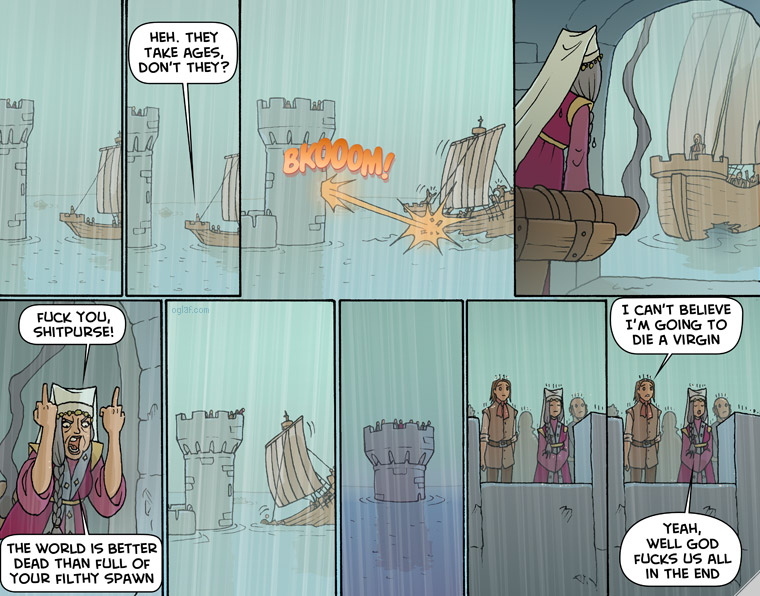
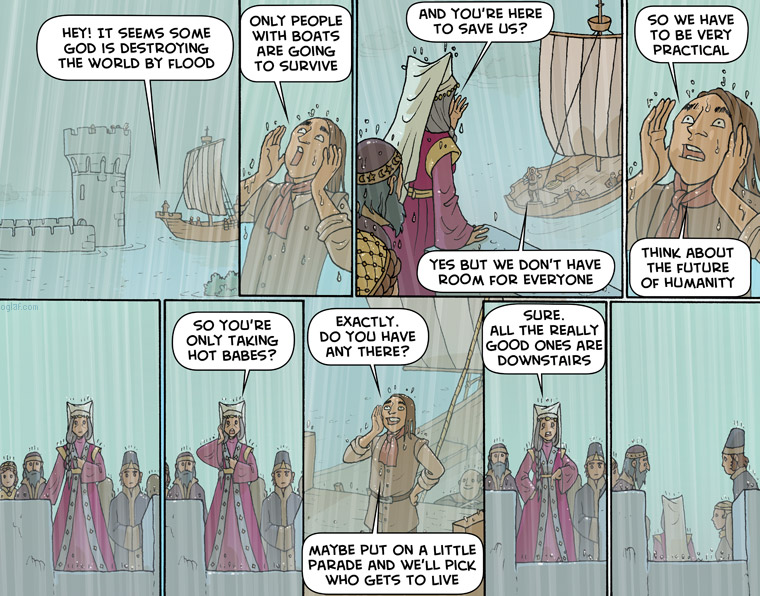
“The world is better dead than full of your filthy spawn” is exactly what I’d say to Peter Thiel.


I’ve known a few doomsday preppers — there’s even a TV show about them, and it’s part of the Mormon ethos — and they’ve always seemed tawdry and lacking in forethought, for all their obsession with an apocalyptic future. Let’s stockpile a 5 year supply of dried beans! Make sure you get the really good camping gear from REI! It’s as if they can sort of vaguely imagine a transition into chaos, but rather than adapting to it or building new cooperative institutional structures, they plan to ride it out by burrowing into their basements and chowing down on stockpiled canned goods until the crisis is over and they can re-emerge into their nice suburban tract home and resume watching TV. Armageddon will be a blip that will briefly derail their workday, but won’t perturb them much as long as they’ve mastered the art of canning pickles.
And then there are the macho American rednecks who fantasize about the fall of civilization, because then there will be no one to tell them that they can’t haul out their armory and run around shooting people — in fact, the path to glory and power will consist entirely of racking up the most kills, gunning down the weak and becoming the chief warlord. The more realistic end-of-the-world novels (The Postman comes to mind) recognize that the real danger that follows catastrophe is that kind of asshole, who will compound the problems and demolish the emerging social structures needed for humanity to recover. Although, I don’t know — maybe the endlessly repetitious, boring kill-and-be-killed chaos of The Walking Dead is more realistic…humans might just end up wandering from settlement to settlement, blowing them up and scattering violence further, hacking and slashing until blessed extinction comes.
They’re all thinking small, though. If you’re an obscenely wealthy Silicon Valley vampire, you have to dream big and wallow in the grand deadly visions of this book, The Sovereign Individual: How to Survive and Thrive During the Collapse of the Welfare State. Mark O’Connell summarizes the book.
It presents a bleak vista of a post-democratic future. Amid a thicket of analogies to the medieval collapse of feudal power structures, the book also managed, a decade before the invention of bitcoin, to make some impressively accurate predictions about the advent of online economies and cryptocurrencies.
The book’s 400-odd pages of near-hysterical orotundity can roughly be broken down into the following sequence of propositions:
1) The democratic nation-state basically operates like a criminal cartel, forcing honest citizens to surrender large portions of their wealth to pay for stuff like roads and hospitals and schools.
2) The rise of the internet, and the advent of cryptocurrencies, will make it impossible for governments to intervene in private transactions and to tax incomes, thereby liberating individuals from the political protection racket of democracy.
3) The state will consequently become obsolete as a political entity.
4) Out of this wreckage will emerge a new global dispensation, in which a “cognitive elite” will rise to power and influence, as a class of sovereign individuals “commanding vastly greater resources” who will no longer be subject to the power of nation-states and will redesign governments to suit their ends.
It’s a wealthy libertarian fantasy, and it’s just as much a fantasy as any bad apocalyptic novel. It’s the same structure. There will be a mighty disaster, all the people you don’t like will suffer and be slaughtered (but they don’t matter), while you hold the secret to survival, be it canned beans, bigger guns, or a ranch in New Zealand, and will emerge unscathed, and even stronger than before. They all rely on a disgust with the current order — the Mormons wanted godlessness and sin swept away to clear the path to an LDS theocracy, but it takes a libertarian to see roads and hospitals and schools as the worldly evil that must be destroyed. They all imagine an emergent New Order with themselves at the center, in this case a “cognitive elite”. How do you know they’re a cognitive elite? Because they have lots and lots of money. As we all know, wealth is always a sign of merit.
O’Connell’s story is all about the Arch Vampire, the selfish villain, Peter Thiel. He’s getting ready for the end of the world by modeling his world view on two fictions, as the “Cognitive Elite” do, The Sovereign Individual and The Lord of the Rings (there must also be a third, the works of Ayn Rand, but they aren’t mentioned in this article), and so he must of course buy up land for a bolt-hole in New Zealand. It’s remote, it’s beautiful, Peter Jackson filmed his Tolkien movies there, so it’s perfect. All the cool entrepreneurs who have profited off the information economy are eager to strip the current system bare so they can move on to the next fertile field, which they will strip bare to fuel their next assault. Sorry, New Zealand, it’s your fault for looking so lovely and attracting all the parasites.
The story discusses a sort of art installation, a set-piece game called the Founder’s Paradox that illustrates how the Thiels of the world operate.
The aim of Founders, clarified by the accompanying text and by the piece’s lurid illustrations, was not simply to evade the apocalypse, but to prosper from it. First you acquired land in New Zealand, with its rich resources and clean air, away from the chaos and ecological devastation gripping the rest of the world. Next you moved on to seasteading, the libertarian ideal of constructing manmade islands in international waters; on these floating utopian micro-states, wealthy tech innovators would be free to go about their business without interference from democratic governments. (Thiel was an early investor in, and advocate of, the seasteading movement, though his interest has waned in recent years.) Then you mined the moon for its ore and other resources, before moving on to colonise Mars. This last level of the game reflected the current preferred futurist fantasy, most famously advanced by Thiel’s former PayPal colleague Elon Musk, with his dream of fleeing a dying planet Earth for privately owned colonies on Mars.
The libertarian ideal is unregulated rapaciousness followed by moving on and abandoning what they’ve destroyed. It’s a locust’s dream. It’s what short-sighted opportunists fantasize about. Even some scientists are susceptible to it. If Earth becomes a dying planet, it’s because the greed of humans killed it…and in particular, the billionaires who think sucking the world dry is just fine because they’re planning to escape it. We have to recognize that the end game of capitalism is self-destruction.
All I can say is, if you meet the Sovereign Individual on the road, kill him. It’s a moral imperative.

A national school walkout has been proposed for 14 March, to protest the lack of action on gun control after yet another shooting.

I’d support it and tell my students they could stay home that day, except that they’ve scheduled it for our spring break so we’ll all be staying home anyway.