
Is it progress when a self-aggrandizing mad scientist performs a reckless experiment?

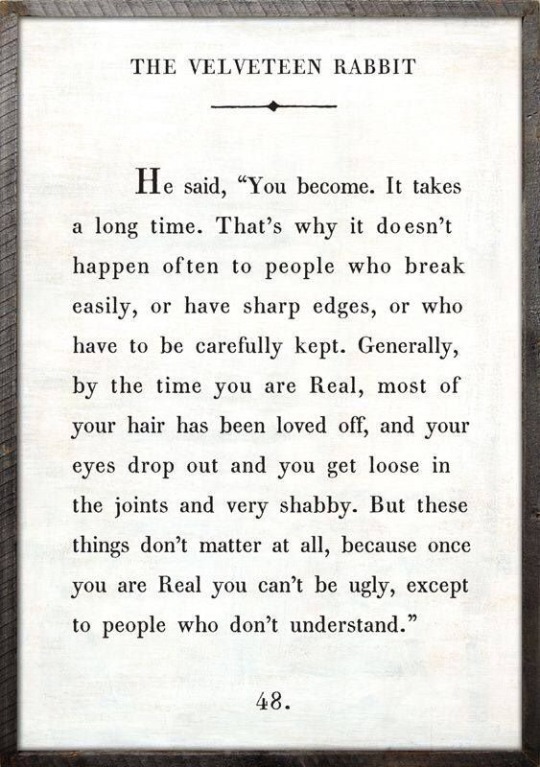
Does this look like your idea of a mad scientist?

China is racing ahead in human biotechnology — it really helps when you can disregard ethical concerns altogether. It especially helps when you pay lip service to bioethics while simultaneously carrying out a major research program that directly contradicts the ethical concerns you’re piously declaiming.

There is a heroic history of scientists engaging in self-experimentation. The example that comes to mind is Barry Marshall, who drank down a solution of Helicobacter pylori to prove that the bacteria was the causal agent behind stomach ulcers. No research review committee would have approved such an experiment, but it paid off in that he won the Nobel for it. He also made himself very sick. It was a dramatic and rather stupidly dangerous gesture — there are safer ways to evaluate pathogens, and we drill safety into our students all the time.

Maybe we’re wrong. Maybe we should be encouraging students to lick random slime they find on the lab benches. We might lose a few, but the tiny percentage who discover brand new drugs or new diseases will make the deaths worthwhile, right?

But that’s self-experimentation. The new era of gene editing really is meaningless when done on yourself. It’s got to be done on embryos, on someone else. Is modifying genes in some other helpless, innocent person still heroic, or even heroically stupid? I don’t think so. We’re at the stage where experimentation on human cells is important, but the ethical guidelines don’t allow you to grow up that blastocyst to birth, because at that point you have a person who did not consent to the manipulation, and they have to live their whole life with the consequences of your tinkering.

That didn’t stop He Jiankui from launching a research program in which he genetically modified IVF embryos with Crispr, implanted them back in their mothers, and then cheerfully announced when the first of them gave birth.

There are more than a few problems with this experiment.

  • We don’t know all the limitations of Crispr yet. He assures everyone that there were no spurious modification of the genome in this case. Were there other cases, though? Do we trust that failures would be reported?
  • The entire purpose of this modification was prophylactic. They knocked out a component of the immune system that HIV uses to infect cells, presumably giving the child resistance to AIDS. Was this a pressing need? The child did not have a disease, they deleted a molecule to make it less likely they would get a disease. (The father is HIV-positive, so there was greater risk of exposure…but how much fluid transfer were the parents expecting?)

  • The deleted gene is CCR, which provides a kind of latch between T cells of the immune system and antigens. Most humans have CCR, a small percentage do not, and they have a greater resistance to some specific pathogens. But are there trade-offs? Are they more susceptible to other pathogens, or does it generally weaken the immune response? We don’t know, but hey, maybe now there will be a bunch of kids in China who will have genetically engineered weaknesses!

  • The experimenter had rushed a paper on bioethics to publication before this conference where he announced his result. The paper states that this kind of experiment is unethical.

    On Monday, He and his colleagues at Southern University of Science and Technology, in Shenzhen, published a set of draft ethical principles “to frame, guide, and restrict clinical applications that communities around the world can share and localize based on religious beliefs, culture, and public-health challenges.” Those principles included transparency and only performing the procedure when the risks are outweighed by serious medical need.

    …

    He was actively pursuing controversial human research long before writing up a scientific and moral code to guide it.“We’re currently assessing whether the omission was a matter of ill-management or ill-intent,” says Barrangou, who added that the journal is now conducting an audit to see if a retraction might be warranted. “It’s perplexing to see authors submit an ethical framework under which work should be done on the one hand, and then concurrently do something that directly contravenes at least two of five of their stated principles.”

    It’s true. Patent dishonesty ought to be a good reason to pull a paper.

  • He doesn’t seem to be particularly aware of the limitations of genetics.

    He appeared to anticipate the concerns his study could provoke. “I support gene editing for the treatment and prevention of disease,” He posted in November to the social media site WeChat, “but not for enhancement or improving I.Q., which is not beneficial to society.”

    OK, I’ll bite. What genes for “improving IQ”? It’s easy to say you won’t do experiments on a gene that doesn’t exist, or involves modifying a very large number of mostly unidentified genes. I also don’t believe him. Of course improving intelligence would be beneficial to society — we try to do that all the time, it’s called education. If he had a target gene that was associated with greater intelligence, you know he’d be recruiting volunteers to do the study right now, which he’d carry out surreptitiously until he got a positive result that he could highlight at a major conference.

  • The lack of transparency while the experiment was ongoing is deeply troubling. If you don’t let people be aware of and monitor your potentially risky experiment, it’s too easy to literally bury (or cremate) results that you don’t like. It’s like p-hacking, where in this case the “p” stands for “people”.

  • This guy is a biophysicist and bioengineer. He is not qualified or trained in any way to assess ethical risks, but heck, we all know that the magic words “physicist” and “engineer” make one all-knowing, confident, and wise. I can only dream of having the degree of certainty that would allow me to publish a paper in a complex field which I know nothing about, and where my actual work flouts everything I say others should do. But then, I’m not a physicist.

I also have to add that this is not a particularly radical experiment. Crispr is now an established technique, and these sorts of experiments have been carried out in experimental animals. The only thing novel about it is that he rushed to execute an experimental technique, developed by other, more careful scientists, on a different experimental animal, human children. I expect there will be a day when gene editing on embryos is done to improve the quality of life for human beings, but that day doesn’t seem to be here yet, and reckless experiments don’t bring it any closer.

Tragedy strikes the NRA

Oh no! The NRA’s income is plummeting!

The nation’s leading gun-rights organization saw its income drop by $55 million last year, after a record-breaking 2016 in which the group and its political affiliates spent unprecedented sums to elect President Donald Trump.

The National Rifle Association of America reported $98 million in contributions in 2017, down from nearly $125 million in 2016, according to new tax records obtained by The Daily Beast. Nearly one-fifth of its contributions last year came from a single anonymous donor, who chipped in nearly $19 million to the group.

Although, to put that in perspective, their total income was $312 million, so they haven’t gone broke yet.

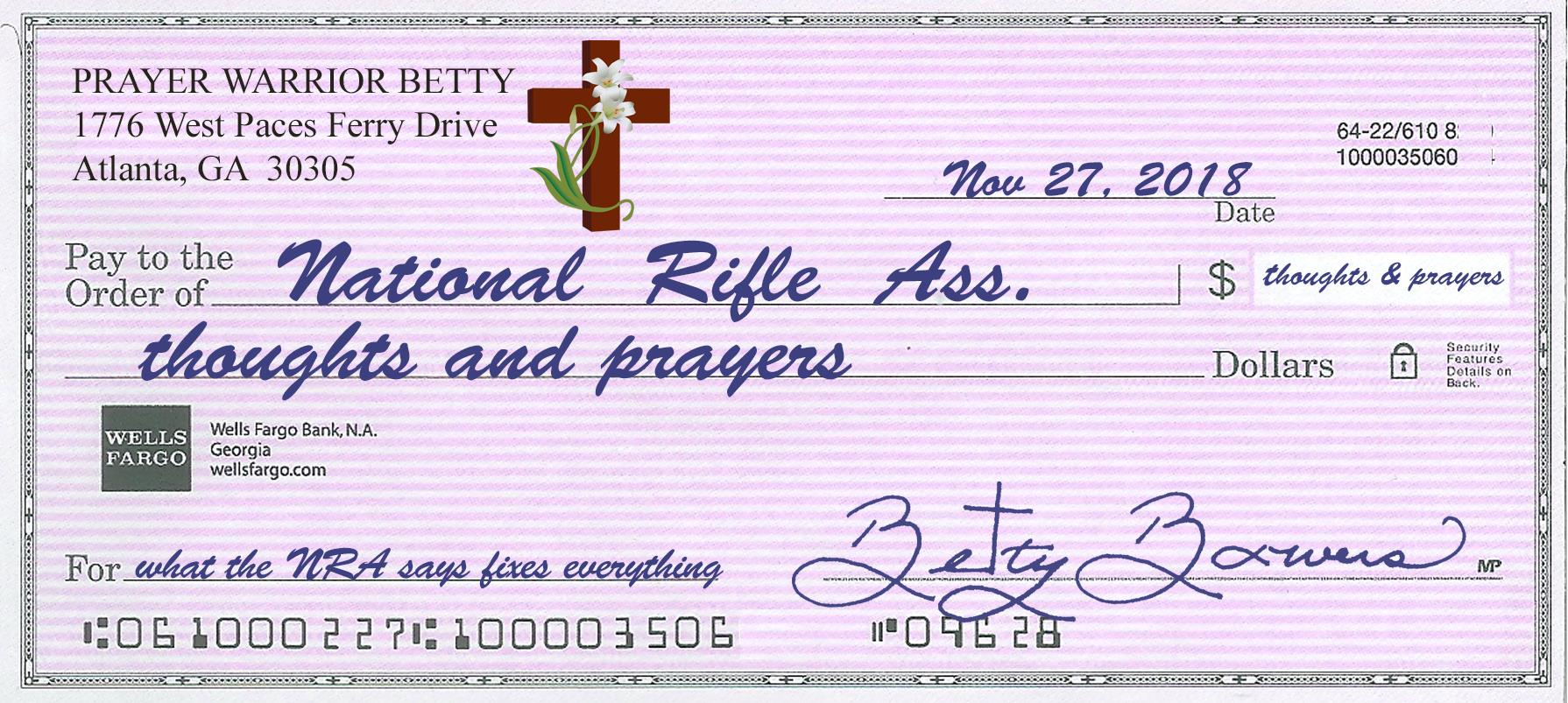
If you’re concerned about the future of the NRA, I like Betty Bowers’ solution:

The space people are getting busy

We have successfully invaded Mars again, this time to poke holes in it.

The InSight lander, operated by NASA and built by scientists in the U.S., France and Germany, touched down in the vast, red expanse of Mars’ Elysium Planitia just before 3 p.m. Eastern Monday.

There it will operate for the next two Earth years, deploying a seismometer, a heat sensor and radio antenna to probe the Red Planet’s interior. Scientists hope that InSight will uncover signs of tectonic activity and clues about the planet’s past. Those findings could illuminate how Mars became the desolate desert world we see today.

Oh. Practical knowledge, since we’ve got an ongoing experiment to see if we can turn Earth into a similarly desolate desert.

If you don’t want to learn about how to end all life as we know it, you could tune in here on Wednesday afternoon, when I’m getting together with some other space people, the Deep Astronomy channel, to talk about the origin of life. It’ll be fun! Space people are cool!

So now we’re a country that gasses children

Desperate refugees have arrived at the US border. They want to cross over to request asylum, which they have to do — they can’t stay in Mexico and make that legal request. So what do you do? Obviously, you close the border to everyone and fire tear-gas canisters at the families trying to cross.

Well, “obviously” for a fascist police-state run by racists, I guess.

Oh, America. How disappointing can you get? Don’t answer that, I’m afraid of the answer.

Facebook sucks, and it’s too big to die easily

If you’re a Facebook user, think about what you signed up for. I suspect that most of you are like me, you thought the idea of a hub for keeping in touch with family and friends was a good one, and that’s what you wanted — something like that old newsletter your Aunt Matilda used to send out every Christmas, only shorter and more casual and spread out over the year. Or like a bar where you’d stroll in and see friends from the community, and a few strangers, and you could strike up a little conversation. That sounds wonderful! Only it hasn’t turned out that way, because the barkeep has decided to be intrusive and obnoxious. He wants to introduce you to new friends, all the time, and it doesn’t matter if they’re a bit skeevy. He’s trying to sell you stuff on the side. He keeps asking you questions about your personal life, all with the helpful intent of trying to match you with more compatible friends (only he doesn’t seem to actually understand human interactions, and he’s more than willing to connect you to any guy who’ll tip him a dollar), or to better understand what he might be able to sell to you. And then he turns up the television news real loud because it’ll give all of his patrons something to talk about.

The problem with Facebook isn’t the idea, it’s the Facebook executives, like Zuckerberg, who want to control and profit from the conversation. It’s gotten so bad that even avaricious robots like Zuckerberg have noticed, but they haven’t realized that what the users want is for Zuckerberg to shut the fuck up and quit intruding.

In his February letter, Zuckerberg essentially acknowledged what was obvious to anyone who had a Facebook account during the 2016 election: the social network has not exactly enhanced our democracy. The News Feed, the main scroll of posts that you see when you open Facebook, fueled hoaxes (which were overwhelmingly “tilted in favor” of Donald Trump, according to an analysis by Hunt Allcott of New York University and Matthew Gentzkow at Stanford), and it overfed people stories and memes that fit preconceived notions. On social media, “resonant messages get amplified many times,” Zuckerberg wrote. “This rewards simplicity and discourages nuance. At its best, this focuses messages and exposes people to different ideas. At its worst, it oversimplifies important topics and pushes us towards extremes.”

He talks as if he understands, but the wheels in his head are spinning, and he’s trying to figure out how to keep his hooks in his userbase while acknowledging that maybe sometimes he’s an obnoxious ass, a little bit, occasionally (really, it’s always, a lot). This is not an indication that Facebook is a good place to find genuine communication:

For example, by cross-referencing your behavior on Facebook with files maintained by third-party data brokers, the company gathers data on your income, your net worth, your home’s value, your lines of credit, whether you have donated to charity, whether you listen to the radio, and whether you buy over-the-counter allergy medicine. It does this so that it can give companies an unprecedented ability to post ads that are presumably likelier to appeal to you. (I asked Facebook whether anything has changed to make the Post’s report no longer accurate; the company had no comment.)

They have “algorithms” to figure out what ads you’d like to see. But their algorithms suck, and are easily gamed, and even more easily bought. Every time they glean some scrap of information, like that recently I’ve been looking up camera gear, they use a sledgehammer and start throwing buckets of ads in my face for inappropriate stuff grossly out of my price range or not at all related to my specific interests, but it has the words “photography” or “camera” somewhere in it. The bartender here has a motor-mouth and low intelligence and is prone to manic obsessions. How about if you back off and just let me chat with friends?

So I’m backing off from Facebook instead. I’m going to stop interacting with Facebook at all for a while; I’m still going to do blogpost links there, but even that will go away eventually. And after a while, no hurry, I’ll just close my account altogether. I might skim through it once a day to see what everyone is up to — in particular, I get grandbaby updates for Knut there, although my other grandbaby has a mother who is very tech savvy and has mostly abandoned Facebook already. If you want to have a conversation with me, though, Facebook ain’t the medium for that.

I’ve been looking for alternatives, and Diaspora looks promising. I signed up for Pluspora this morning, and it’s already better. Not perfect, though. I said on signup I’d like to see various #science-related hashtags, and first thing in my face is a bunch of anti-vaxx bullshit…so my first experience with it involved learning how to filter out the garbage. I guess even if you’ve got a nice bar with an unobtrusive barkeep who isn’t poking his nose into your business all the time, you still have to deal with other customers.


Here’s an enthusiastic summary of the advantages of Diaspora.