It turns out to be true, at least for bustards, that the fast, flashy life leads to earlier burnout. So what’s my excuse? I dunno.

(Also on FtB)

It turns out to be true, at least for bustards, that the fast, flashy life leads to earlier burnout. So what’s my excuse? I dunno.
(Also on FtB)

After reading the responses to this article, I’ve reconsidered and decided it was too easily misconstrued, so it’s gone.
I will leave a link to the original news story, however.

I guess you lazy people who didn’t travel to Oslo still get to see me: here’s my talk at the World Humanist Congress.
(Also on FtB)

This is one beautiful plesiosaur, Polycotylus latippinus.

The unique aspect of this specimen is that it’s the only pregnant plesiosaur found; the fore and hind limbs bracket a jumble of bones from a juvenile or embryonic Polycotylus. It’s thought to actually be a fetal plesiosaur, rather than an overstuffed cannibal plesiosaur, because 1) the smaller skeleton is still partially articulated, and it’s large enough that it is unlikely it could have been swallowed whole, 2) the two sets are of the same distinctive species, 3) the juvenile is incompletely ossified and doesn’t resemble a post-partum animal, 4) the bones aren’t chewed, etched by acids, or accompanied by gastroliths. I think we can now confidently say that plesiosaurs were viviparous, which is what everyone expected.
There are other surprising details. The fetus is huge relative to the parent, and there’s only one — so plesiosaurs had small brood sizes and invested heavily in their offspring.

The authors speculate beyond this a bit, but it’s all reasonable speculation. That degree of parental investment in fetal development makes it likely that there would have been extended maternal care after birth, and rather more tenuously, that they may also have lived in larger social groups. The authors suggest that their lifestyle may have resembled that of modern social marine mammals — picture a pod of dolphins, only long-necked and lizardy.
O’Keefe FR, Chiappe LM (2011) Viviparity and K-Selected Life History in a Mesozoic Marine Plesiosaur (Reptilia, Sauropterygia) Science 333 (6044): 870-873.
(Also on FtB)

I guess you lazy people who didn’t travel to Oslo still get to see me: here’s my talk at the World Humanist Congress.
(Also on Sb)

This is one beautiful plesiosaur, Polycotylus latippinus.

The unique aspect of this specimen is that it’s the only pregnant plesiosaur found; the fore and hind limbs bracket a jumble of bones from a juvenile or embryonic Polycotylus. It’s thought to actually be a fetal plesiosaur, rather than an overstuffed cannibal plesiosaur, because 1) the smaller skeleton is still partially articulated, and it’s large enough that it is unlikely it could have been swallowed whole, 2) the two sets are of the same distinctive species, 3) the juvenile is incompletely ossified and doesn’t resemble a post-partum animal, 4) the bones aren’t chewed, etched by acids, or accompanied by gastroliths. I think we can now confidently say that plesiosaurs were viviparous, which is what everyone expected.
There are other surprising details. The fetus is huge relative to the parent, and there’s only one — so plesiosaurs had small brood sizes and invested heavily in their offspring.
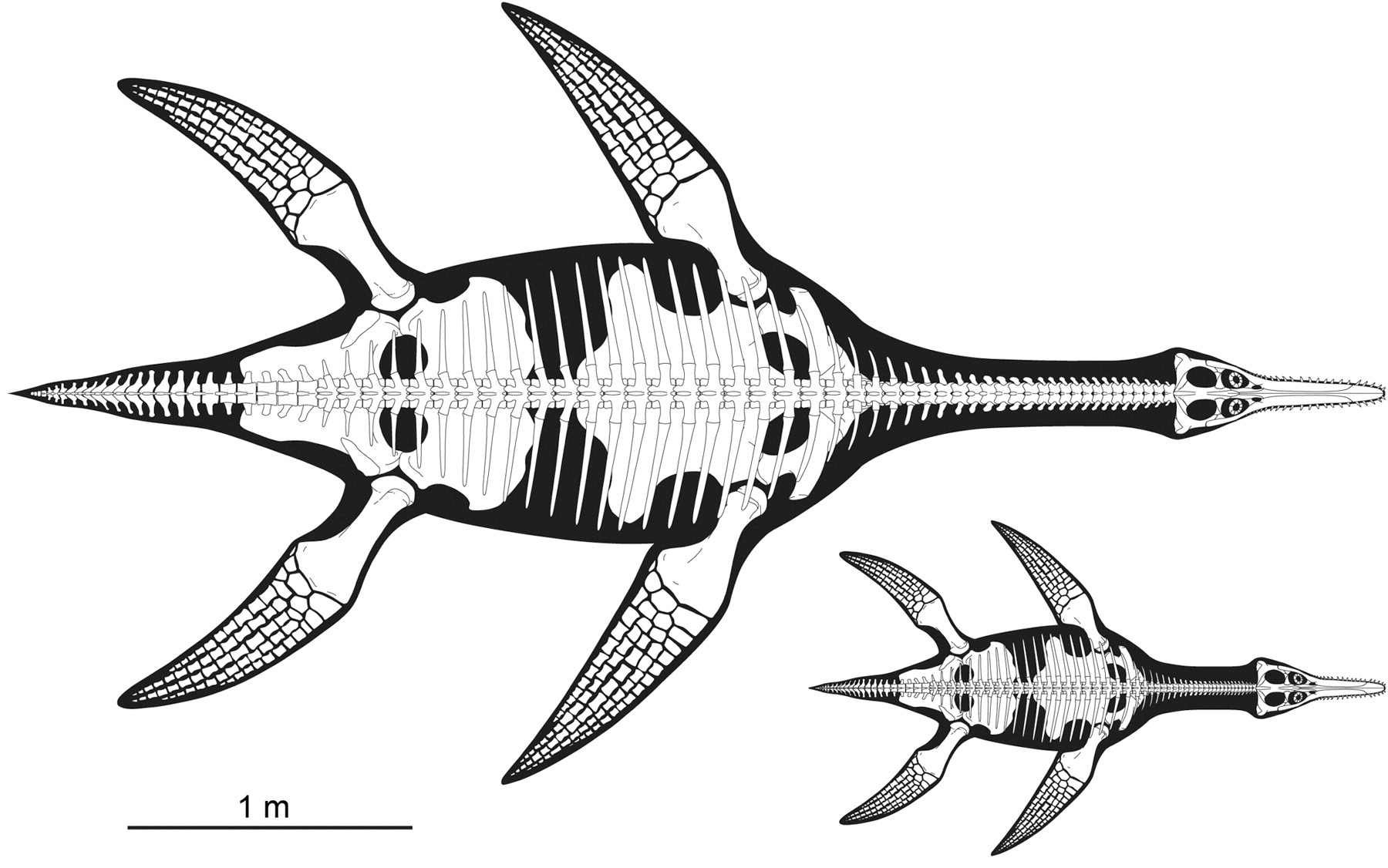
The authors speculate beyond this a bit, but it’s all reasonable speculation. That degree of parental investment in fetal development makes it likely that there would have been extended maternal care after birth, and rather more tenuously, that they may also have lived in larger social groups. The authors suggest that their lifestyle may have resembled that of modern social marine mammals — picture a pod of dolphins, only long-necked and lizardy.
O’Keefe FR, Chiappe LM (2011) Viviparity and K-Selected Life History in a Mesozoic Marine Plesiosaur (Reptilia, Sauropterygia) Science 333 (6044): 870-873.
(Also on Sb)

I have to rush off to more meetings today — Taslima Nasreen will be speaking this morning — but I got the day off to a laughing start with this review of Hawking’s Curiosity: Did god create the universe?. The reviewer is some conservative Christian minister, and he’s one of those fellows who is really annoyed by all this Big Bang talk. So he turned his television on to watch Stephen Hawking get in his face.
I’ve heard variants of this argument so many times…
Since there is no more proof that the universe began with the Big Bang than there is that Christ was resurrected from the dead we have to engage the element of faith to build the hypothesis. In fact there is a great deal more historical, archaeological and eye witness evidence for the resurrection of Christ than for the Big Bang but that is a subject for another time.
Historical evidence for the resurrection of Jesus: None. There are no contemporary accounts of this miracle; even the books of the bible that mention it were written long after his purported death by people who weren’t there.
Archaeological evidence for the resurrection of Jesus: None. I don’t think the market for ginned-up relics to gullible Catholics counts as archaeology.
Eyewitness evidence for the resurrection of Jesus: None. A book saying that there was a guy who saw the resurrection doesn’t count as eyewitness evidence, and witnessing something is actually very poor evidence anyway. Go to a Las Vegas magic show.
Evidence for the Big Bang: ubiquitous and replicable. Aim your radio telescope at the sky and measure the cosmic background radiation. Look at the red shift of the stars as a function of distance, and see that they’re all expanding away. This isn’t a point of dogma, but a product of observation and theory.
Hawking knows a little bit about black holes, and one part of the show explained that time would stop as one entered a black hole — this is another subject that annoyed the reviewer.
The biggest leap Curiosity takes is where it completely misses the mark. Interspersed with Hawking’s remarks and surmising about using the simple kinder alternative of science to explain the universe, we are subsequently taken on a swirling thrill ride through the entire universe to arrive at an un-named giant black hole. It is there we are told that everything, matter, stars, planets and even science’s revered creator, the original sub-atomic particle, will be sucked in and even time itself will cease to exist.
No allusions to the Bible or the science of homeostasis is relied upon to explain fully how, or why, time ceases to exist and the sense of the doom of all things manages to prevail. In some way the entire idea is like a scientifically inspired version of hell. It is hopeless, final and indescribable. Again the faith that would have to be mustered to accept this theory is incomprehensible. The Bible’s version certainly is less cerebrally taxing, has a real historical context, and is for most people still far more credulous.
Oh, no, the bible doesn’t say anything about black holes, therefore, it’s just not believable. The bible also doesn’t say anything about people flying, therefore I’m going to have a really tough time getting home from Oslo on Tuesday.
I snorted a bit when I read “the science of homeostasis”. I’m sure it just sounded good to him, but homeostasis is a biological term that refers to the property of physiological or ecological systems maintaining a stable, constant system by regulatory feedback. We biologists don’t really have anything to say about black holes, I’m sorry to say, except maybe to mention that conditions of intense radiation and tidal forces great enough to shred bacteria probably aren’t going to be conducive to organisms; even space medicine becomes irrelevant in such situations.
But it’s the last line that is a real winner. Yes, I will agree: the bible is less cerebrally taxing, and certainly is the source for people with a willingness to believe any ol’ thing. I suspect he probably meant to write “credible” there, but God must have guided his hand to write the truth, instead.

So I’m at this humanist conference in Oslo, and I’m having a good time at the delicious dinner with musical accompaniment at the Oslo Opera House, when they start giving out awards to all these fabulously accomplished people who have don so much to advance the cause, when they name me. It was a complete surprise and for a moment I was sure this was a joke, but there it is, it’s even got my name etched on it.
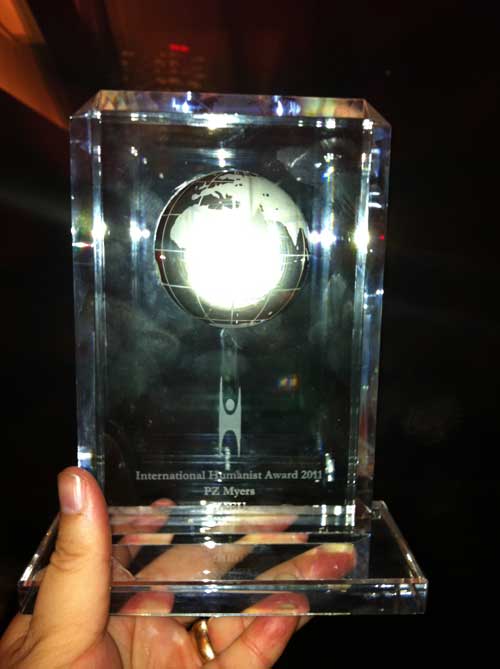
I’m the International Humanist of 2011.
How unexpected!
Now if only I were somewhat less discombobulated right now…the several glasses of wine at dinner didn’t help, either.

Valentin Abgottspon was a teacher in the Swiss public school system. He was fired because he removed a state-mandated crucifix from the wall of his classroom. It’s weird; apparently, the Swiss constitution requires religious neutrality, but the local canton thinks tradition trumps law.
Anyway, he’s up for a prize, the Prix Courage, which is apparently going to be determined by the result of an internet poll. You know what to do! In principle, at least: the poll is in German, so you might need some guidance.
Vote for the Prix Courage, a very prestigious Swiss prize for outstanding actions: http://www.beobachter.ch/?id=727 (choose Valentin Abgottspon, “Ich will an der Verlosung teilnehmen.*” choose “Nein”, that means you don’t want to win a week-end in a Swiss hotel, that way you won’t have to write down your name, then “Senden”)
Of course, maybe you want a weekend getaway to a Swiss hotel…also, as usual, always look over the other candidates and vote your conscience. I think going against religious dogma and losing your job over it is a great example of courage, though.

Since the president of the Norwegian Humanist Association, Åse Kleveland, is also a well-known singer over here, and since she did do a little tune for us at dinner tonight, I thought I’d share.
