Iowa caucus results

The Republican scores in Iowa are 25, 25, 21, 13, 10, 5, and 1. For an in-depth discussion of these remarkable numbers, we turn to our political analyst, Bob.

Thanks, Bob. These are very good numbers. 25 is clearly the winner, but the other 25 is very, very close. 21 is less than 25, but it’s still a good number, and I’m sure 21 is very pleased…although, of course, a bigger number would be even better. 13 and 10 are even smaller numbers.

5 and 1 are the littlest numbers. They are going to have to try much harder to get bigger if they want to stay in this race!

Excellent analysis, Bob. What does it mean that we have two 25s though?

It means that the election is very exciting so far, Bob, and that now more people will turn on our show to find out which one gets a bigger number. Compare it to the Democratic caucuses, where one person got 100. Boring, Bob, very boring.

So this means we get to keep our jobs, Bob?

Yes, Bob, and that is very good news indeed.

Now turning to our field reporter, Bob, we have an interview with one of the candidates.

“Sir, how do you feel about your number?”

“Well, Bob, it’s not a bad number, it could have been bigger, but it’s about where our polls predicted it would be. So we feel very good about our number.”

“Back to you, Bob.”

Thanks, Bob. And coming up after this commercial break, our chief political analyst Bob will explain these results to you with dazzling computer graphics.

<BUY OUR INSURANCE BEFORE YOU DIE. OUR DRUG WILL MAKE YOU HAPPY (side effects include dizziness, vomiting, wasting, exploding bowels, death, ennui, lack of ambition, impotence, and suicidal feelings.) HAPPY! ASK YOUR DOCTOR. THIS CAR IS VERY LARGE AND MANLY. STOCKPILE GOLD NOW. BUY OUR ALARM SYSTEM OR THIS VERY SCARY MAN WILL BREAK INTO YOUR HOUSE.>

Here is Bob, who will make these results meaningful by making them very bright and shiny and dynamic.

Thanks, Bob. We have created an animated chart of these results. Big numbers are shown as this very large, erect penis, much like yours if you got an offer to do a nude interview with Katy Perry, and small numbers are shown as this tiny little nubbin, like you’d see in a cold locker room after losing the big game. What this shows…

Bob, wait a minute. Isn’t one of the candidates a woman?

Ha ha, yes, Bob, but no clitoris is ever going to get as big as this magnificent purple monster, so it hardly matters, right?

Ha ha, of course. Go on.

As I was saying, Bob, we’ve illustrated all the candidates here, as you can see, and, well, they’re all pretty flaccid so far. None of them are even at half-mast yet, but the top candidates have clearly gotten a little tickle from Iowa and are beginning to stir.

Our job here on the Political Show in the next few months is to flatter and cajole these dicks until one is so aroused that he intimidates all the others into slinking away. We’ll be here every day, reporting on their relative turgidity until one is the biggest.

The power of the press, Bob. By the way, do you have a chart of the Democratic results?

We do, Bob, but the office here is pretty white and we found it too frightening to contemplate. Don’t worry, though, we’re ready, once the Republicans have sorted out who has the biggest number, to do what the media does best, and in the run up to the election we’ll be right here, fairly and objectively reporting the two penis sizes right down to the millimeter, right up to election day.

Good work, Bob. And may the biggest number win.

And that’s all from the election desk. Stay tuned as we bring in a series of pundits to talk about these numbers all day long.

So this is what skepticism has come to?

Jebus. After reading Ben Radford’s reply to the criticisms of his awful article denying sexism in the toy store, I feel even more repelled. It was ludicrous. It was ridiculous. It was pretentious.

Here’s Radford claiming the high ground.

So when I insisted that Riley was wrong in her claim that girls are forced or “tricked” into buying or liking pink items or princesses, my purpose was not to be pedantic, but instead to keep the discussion grounded and rooted in objective evidence.

[Read more…]

We still haven’t explained pink

There was something else that bugged me in that odd claim from Ben Radford that girls would just naturally like pink better than boys: it was the terrible evpsych rationale for it that just made no sense.

First was the argument that blue has always been associated with boys, and pink with girls, and therefore it was only natural to sustain the distinction.

The choice of blue for infants has its roots in superstition. In ancient times the color blue (long associated with the heavens) was thought to ward off evil spirits. Even today the tradition continues; in many parts of the world people paint their doorways and window frames blue. Originally [“Originally”? Like in Homo erectus, or are we going back to australopithecines?] only boys were swaddled in blue [apparently, no one cared if girls were possessed by evil spirits. By the way, what color were they swaddled in, “originally”?], and girls were later assigned the color pink for reasons that aren’t entirely clear. But the color distinction between the two genders dates back millennia [Oops. See below].

But what about pink toys for girls? It’s an interesting question, and there are several answers. One obvious reason is that dolls are by far the most popular toys for girls [And boys like fire trucks and little red sports cars and setting things on fire, so they ought to like red]. What color are most dolls? Pink, or roughly Caucasian skin-toned [Girls should favor beige, then]. There are, of course, dolls of varying skin tones and ethnicities (the popular Bratz dolls, for example, have a range of skin tones). But since most girls play with dolls, and most dolls are pink (a green- or blue-skinned doll would look creepy [And brown would be just horrible]), it makes perfect sense that most girls’ toys are pink [So their ovens and cooking utensils and cleaning tools and cosmetics all match their dolls’ complexions? That doesn’t make sense, that’s just weird].

Eh, what? The color distinction goes back millennia? Since when was 70 years equal to millennia?

The march toward gender-specific clothes was neither linear nor rapid. Pink and blue arrived, along with other pastels, as colors for babies in the mid-19th century, yet the two colors were not promoted as gender signifiers until just before World War I—and even then, it took time for popular culture to sort things out.

For example, a June 1918 article from the trade publication Earnshaw’s Infants’ Department said, “The generally accepted rule is pink for the boys, and blue for the girls. The reason is that pink, being a more decided and stronger color, is more suitable for the boy, while blue, which is more delicate and dainty, is prettier for the girl.” Other sources said blue was flattering for blonds, pink for brunettes; or blue was for blue-eyed babies, pink for brown-eyed babies, according to Paoletti.

In 1927, Time magazine printed a chart showing sex-appropriate colors for girls and boys according to leading U.S. stores. In Boston, Filene’s told parents to dress boys in pink. So did Best & Co. in New York City, Halle’s in Cleveland and Marshall Field in Chicago.

Today’s color dictate wasn’t established until the 1940s, as a result of Americans’ preferences as interpreted by manufacturers and retailers. “It could have gone the other way,” Paoletti says.

Pink for girls is a convention of the baby boomer generation. We’ve only had a couple of generations since, and I don’t think there has been much selection pressure to generate a sex difference.

But let’s be charitable here. Maybe there actually is a sex difference in how men and women perceive the colors blue and pink; that we dress baby girls in pink isn’t causal, but a consequence of a bias in how men and women see the world. Maybe, just maybe, these color preferences are a byproduct of a more significant evolutionary bias. At least, if you’re an evpsych proponent you’d like to imagine so. Which leads us to Radford’s citation of an amazing evolutionary hypothesis from Time magazine.

According to a new study in the Aug. 21 [2007] issue of Current Biology, women may be biologically programmed to prefer the color pink—or, at least, redder shades of blue—more than men…. [Researchers] speculate that the color preference and women’s ability to better discriminate red from green could have evolved due to sex-specific divisions of labor: while men hunted, women gathered, and they had to be able to spot ripe berries and fruits. Another theory suggests that women, as caregivers who need to be particularly sensitive to, say, a child flushed with fever, have developed a sensitivity to reddish changes in skin color, a skill that enhances their abilities as the “emphathizer.”

Really? I read that and thought it had to be some invention of the journalist at Time, so I had to go find the original article, and no, that was taken straight from the paper itself. What disappointing tripe.

It is therefore plausible that, in specializing for gathering, the female brain honed the trichromatic adaptations,
and these underpin the female preference for objects ‘redder’ than the background. As a gatherer, the female would also need to be more aware of color information than the hunter. This requirement would emerge as greater certainty and more stability in female color preference, which we find. An alternative explanation for the evolution of trichromacy is the need to discriminate subtle changes in skin color due to emotional states and social-sexual signals; again, females may have honed these adaptations for their roles as care-givers and ‘empathizers’.

I weep for all the African children who died or failed to reproduce because the enhanced red sensitivity of their mothers’ brains was insufficient to compensate for the reduced contrast caused by the color of their skin; I pity the poor African adults who bumble about romantically, unable to read potential partners’ social-sexual signals as well as their European peers. It’s also sad that even European males are less able, and have less need, to read their fellow human beings’ emotional states.

The utility of being able to evaluate when fruit is ripe isn’t in question, and I can see where that is a likely factor in the evolution of our color vision. But both males and females have that ability; there’s no reason to think that females have been selected for a slightly stronger preference for red, and that there’s some deep biological cause for this preference that is found in women, but not their sons.

But hey, I’ve got the paper from Hurlbert and Ling, so let’s look at the data.

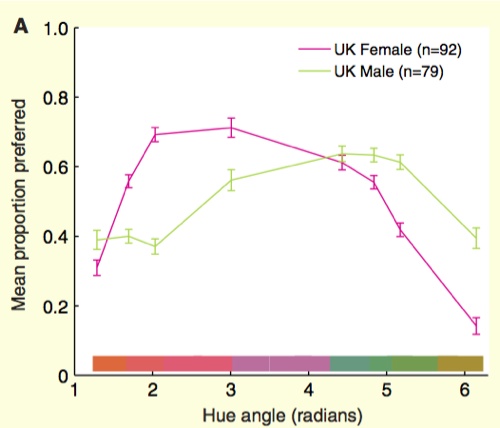
They do find a robust difference between the sexes in their study. It’s a simple experiment in which subjects are shown pairs of colored rectangles on a computer screen, and they are asked to select which of the two colors they like best. Do this many times, and you get a profile of favored colors. And what do you find? Most people like blue shades, but women tend to like a little more red in their colored rectangles.

Now hang on, you might say — those data are all from British subjects, and there’s no way to sort out the accumulated cultural biases from the biology. Maybe those British women had been brought up by baby boomers who told them from babyhood on that pink was the color for girls, and so all we’re seeing here is a reflection of that bias. To correct for that, the researchers sought out native Han Chinese who were recent immigrants to the UK, and tested them separately. And look! They also show a consistent difference, with Chinese women showing more preference for reds than Chinese men!

From this, they somehow conclude that the differences are biological. If that’s true, though, they missed another major conclusion: compare the color preferences of Chinese men, in the bottom graph, to UK women, in the top graph.

One obviously must conclude that Chinese men have experienced a long history of selection for the ability to make finely tuned distinctions in the ripeness of fruit, to detect delicate blushes in the cheeks of their lovers, and to diagnose childhood diseases at the first flush. I’m impressed.

Oh, wait — there’s another possibility. Could it be that color preferences are actually affected by one’s culture? The researchers even admit this!

Yet while these differences may be innate, they may also be modulated by cultural context or individual experience. In China, red is the color of ‘good luck’, and our Chinese subpopulation gives stronger weighting for reddish colors than the British.

I see absolutely no evidence in the paper that the differences are innate, but lots of evidence that color preferences are plastic and responsive to environmental influences. Even the title of the paper looks wrong: it claims to find “biological components”, but nothing in the methodology or the results exhibits any way to separate biological components from environmental responsiveness.

It’s a fine collection of data, filtered by an unjustifiable evolutionary interpretation, processed yet again by a credulous journalist in a mass market magazine, and then regurgitated without question by Ben Radford. Sorry, guy, it’s bad science, and all you saw was the implausible unacceptable bit.


Hurlbert AC, Ling Y (2007) Biological components of sex differences in color preference. Curr Biol. 17(16):R623-5.

(Also on FtB)


Wouldn’t you know Ben Goldacre already addressed this paper back in 2007?


Radford doubles down. Ugh.

Jerks love being reassured that being a jerk is OK

Real men listen to criticism and try to better themselves. A woman wrote a blog post saying that she loves “dick/fart/vagina jokes” and she wants everyone to “keep trying to fuck me” and doesn’t want any guy to ever change, and of course this will be extraordinarily popular with the crudest kind of PUA. To which I can only say that she and they are welcome to each other, and I hope they all find happiness together.

But some of us, like Jen and Megan, have somewhat higher expectations.

Why I am an atheist – James Stuby

The first reason for me is that church was boring. We had an old, nice man for a pastor who I distinctly remember recycling the same sermon at least three times (“Humble yourself and you will be exalted, exalt yourself and you will be humbled” – clear enough, right? But no, we need a half hour sermon relating this to some crap in the bible). There weren’t any fun activities that were church-related. I hated the boring old hymns and the old geezers I had to stand next to and listen to them sing awfully. My dad once made a joke about communion – “You get a little snack today, kids.” But it was actually a slight motivating factor – the communion bread was tasty. Little did dad know it really was the only thing my brother and I had to look forward to in church at times. Apart from the normal angst at having to get up early, I really hated having to dress up. For what? They say god loves you no matter what, so why the hell do I need to wear a nice sweater to impress him? Oh, it is not about impressing god, it is about impressing everyone else.

I remember a sunday where the ususal reverend couldn’t make it so they had some fire-and-brimstone asshole get up and run the show for a day. He told the men not to “look with lust” on women, for that was adultery. For some reason the phrase stuck with me, and when going through puberty I started noticing breasts on women of all ages, but at the same time feeling ashamed about it. I eventually got over that but it sure was annoying.

The only thing that made church tolerable in high school was the fact that they filmed the services, and I learned how to run the camera. This paid off in college when I easily got a job with the A/V department at minimum wage. Thanks religion!

In late elementary school, Carl Sagan’s Cosmos was on PBS. Now that show filled me with awe and wonder, and explained a lot of stuff that church glossed over or ignored. My jaw dropped at the sophisticated animation (for 1980 or so) of polymerase spiraling up some DNA, grabbing nucleotides, and building an exact copy of the split molecule on both sides. So that’s how it works! Awesome! I want to learn more about genetics! There were many other moments on that show that made things clear and inspired me to learn more. I brought it up in science class in 5th grade, “When I was watching Cosmos the other night, they explained that” and all the other students would roll their eyes, because they’d heard that line before.

In 8th grade I actually read almost all of my chemistry textbook over one weekend, again captivated by how the world actually works, with protons and electrons that have opposite charges, and how the charges seek to neutralize each other in chemical reactions. It explained why salt is a cube, why plastic is durable, and why metal conducts electricity, all at once. You never get this in church.

I had a close friend in high school. We were both extreme science nerds, and took three years of Latin as well, just because it was hard. But my friend went the way of creationism in 12th grade, believing the earth was 6000 years old and that Jesus was coming back after the rapture. At one point I went with him to some church where they had a ventriloquist/puppet operator who told christian jokes, bringing on the awkwardness of feeling obligated to laugh. I was still wavering at that point, and may have come close to making the circular connection in my brain that makes christians feel warm and fuzzy all the time, which they call “being saved.”

But later, I didn’t buy any of my friend’s arguments. He said it all came down to your assumptions, which I have heard other creationists retreat towards since that time. I saw him once after graduating high school, I think, and then pretty much didn’t bother tracking him after that. He was the poster boy of a wasted mind to me for two decades.

College was of course eye-opening. I took genetics, biogeography, anatomy, ecology, and evolutionary biology, and started reading Richard Dawkins’s books. I took a lot of anthropology, and I have to say it was more of a distraction than anything, but it did lead to some good times and interesting experiences. I learned about cultural relativism, which is the belief that cultures need to be understood on their own terms and that all are worthy of preservation and respect. I don’t buy that so much any more, given knowledge of people living under Sharia law, for example. But I did learn about archaeology which is about empirical evidence of past events. I worked as an archaeologist (“field tech”) for a few years after college.

I also took some geology in college, although somewhat late in my Junior year. Had there been enough time, I would have changed majors. The field trips taught me to see things in hills and along roads that my eye had glossed over before. The earth was clearly very old for such complexity to be present, no doubt about it, and I had only seen a very small portion of it. I started reading Steven Jay Gould’s books about that time.

I also had a good friend in college that was as nerdy as me and like-minded about a lack of a benevolent or even interactive god. We used call up christian hotlines and harrass the racist/sexist idiots at the other end with questions about morality that they gave extremely bad advice about. My friend asked if it was okay to have a freind that was a muslim who was gay. The answer was no, of course. I used to go off about design flaws in anatomy at them, such as the fact that the esophagus and trachea cross making it easy for humans to choke, to see if they had any sensible reply, and they never did.

Somewhere in early college I learned about Richard Feynman too. It is hard not to agree with that guy.

And I got into Rush – listen to Permanent Waves sometime.

I should mention a lapse into irrationality I had for a few years. This is embarrassing, but I read Whitley Streiber’s ‘Communion’ and its sequels, and I believed a lot of it, and was scared by it to the point that some nights I couldn’t sleep for fear of aliens hiding in the closet. But who do I have to thank for clearing my head of such nonsense? Carl Sagan. I read ‘The Demon-haunted World’ and was cured.

I got to grad school after my stint as a field archaeologist, and majored in geology. It mostly solidified my well-established atheism, through better understanding of the complexity of the geologic record and deep time required for it. Creationists have no adequate answer for the geologic record – they run away from it, or lie about it.

And of course, most recently I’ve been reading Pharyngula.

I saw my creationist friend from high school at the 20-year reunion, and things were amicable enough. I’m a geologist now, and guess what he is – an accountant. No science for him.

James Stuby
United States

Stop embarrassing me, Old White Guys!

There’s nothing really wrong with being an Old White Guy — it’s who I am — but every once in a while (OK, fairly frequently, but I never watch Fox News or read the Wall Street Journal, which helps) some other Old White Guy makes me ashamed of my tribe. I’m sorry, Ben Radford, you are so wrong, and look! Two girls, Julia Lavarnway and Rebecca Watson, just kicked your ass in public. They kick it hard. They kick it up and down the street. They gave it such a drubbing that I am feeling uncomfortable sitting down.