Why I am an atheist – mandrellian

Why am I not an atheist …

… and why I am.

I am not an atheist because:

  • I hate God
  • I prayed to God and my prayers weren’t answered
  • Militant/fundamentalist atheists converted me away from God
  • I worship science and the works of man instead of God
  • I’m rebelling against God like I rebelled against my parents & teachers in high school
  • I think I’m better than God
  • I had a bad experience with a priest or church or religious person
  • I can’t decide which religion to subscribe to
  • atheism is my religion
  • I think religious people are idiots
  • I worship Batman
  • I worship Satan
  • I’m immoral/amoral and would rather do what I want
  • I want to destroy religion

I distrust and criticise certain organised religions because:

  • they are human inventions and many seem to be more preoccupied with obsessively controlling aspects of peoples’ private lives than improving them
  • many Christian churches are primarily concerned with attracting money and then keeping it rather than using it charitably
  • many holy books get descriptions of the world & nature completely wrong, which you would not expect had they been dictated by the omnipotent creator of the universe
  • many holy books contain descriptions of human events that cannot be historically verified and in all likelihood never happened (eg. Exodus)
  • many holy books contain numerous laws, acts & stories of a morality that modern, free societies find repugnant; these societies have passed many of their own laws contradicting them
  • there are so many separate & often violently opposed sects of each religion that it is more likely that none of them are correct than just one of them being so
  • many religious groups demand special treatment such as the right not to be offended by statements, artworks, songs or anything else that may criticise or disagree with their dogma
  • religious groups frequently try to have laws passed which unfairly impose their narrow standards of behaviour, based on interpretations of specific holy commands, onto the rest of society
  • religious people often tend to pick & choose from, or “interpret” their holy texts, discarding what does not conform to modern standards of morality, law & political freedom; they then imply that modern morality, law and political freedom rests on the foundations of their particular religion
  • there is such a wide spectrum of religious belief & adherence to dogma, ranging from light, barely-existent deism to the kind of rigid fundamentalism that oppresses and kills many, many people in its name, that it leads me to conclude that either God wasn’t clear enough with his message, didn’t spread it to enough people or that humans have basically made their religions and associated rules up as they went along and have been in conflict with each other about them ever since
  • many religious people & groups wilfully mis-characterise atheists as immoral, empty beings with no appreciation for beauty or mystery simply because we prefer natural explanations for the universe’s phenomena rather than defaulting to “God did it”; they believe that any explanation, even a wrong one or one which explains nothing, is better than “we just don’t know yet”
  • many religious groups continue to deny long-accepted scientific facts such as the divergence of species through evolution and the verified age of the Earth; some wish their particular mythology taught as fact in science classes and go to extraordinary lengths to accomplish it; some even insist there’s a huge, dark Scientist conspiracy quashing “academic freedom”
  • some religious people & groups attempt to cherry-pick science (as they do their scriptures) for those parts which conform to their belief system while actively denying others, e.g. agreeing with “microevolution” while denying “macroevolution” or attempting to use the Second Law of Thermodynamics to debunk evolution
  • some religious groups deny the efficacy of modern medicine in favour of treating an ill person with prayer, a practice which has led to many preventable deaths, often of children
  • they all make extraordinary claims based on their scriptures, provide no evidence beyond referring to their self-confirming scriptures and then insist that the onus is on atheists to disprove their claims
  • many religions have become inextricably intertwined with the laws of the patriarchal cultures which spawned or adopted them, leading to divine justifications for such horrors as female circumcision and “honour killings”, which more often than not punish women, already under the thumbs of domineering males, for seemingly minute transgressions of law
  • when it comes to the hot-button issue of sexual abuse by priests, many religions seem more concerned with good public relations, shielding themselves from culpability and keeping numbers in churches than with compensating victims and being active about preventing further abuse

I am an atheist because:

  • any & all claims of and explanations for the existence of God or any other gods have thus far fallen far short of my standards of evidence
  • my understanding of the natural universe is that it functions in such a way that doesn’t require (or indicate) the presence of any supernatural entity intervening in either the laws of nature or selected peoples’ lives
  • That’s it. They are the only two things that I can say I absolutely have in common with any other atheist. In matters of sex, politics, architecture, gaming, interior design, pets, music, clothing, hobbies, language, philosophy, education, sports, typing speed, preferred drugs, affinity with beagles & frogs and any number of other categories I may be diametrically opposite to any other atheist in the world. To label one atheist with the same attributes you label another atheist is ignorant at best, flat-out dishonest at worst. But all of us, if “atheist” is to mean anything at all, do not accept theistic claims.

But what could steer me in the opposite direction? Probably the same things that could steer any atheist…

I could be converted to theism if:

  • God, or a god, showed himself or performed an act that unambiguously proved both his existence and his attributes as an immortal, omnipotent being. As to what that proof would constitute: that god himself, if omnipotent, would be the perfect arbiter of what would conclusively prove to six billion people that he existed.

Such things as tortillas depicting blurred silhouettes of Mary (or any other second-tier deity) do not count. If you’re there, God, you’re on notice! Any time is fine. No tricks – and come alone (if indeed there’s only one of you, otherwise, bring the whole parthenon).

mandrellian
Australia

True Science for Boys

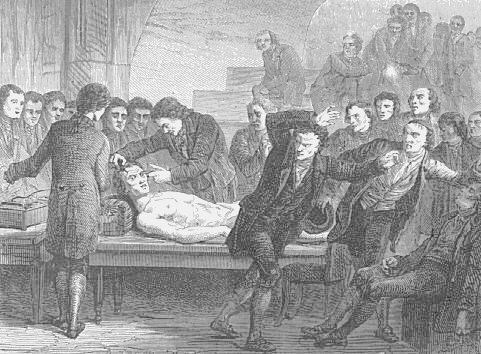
Ah, the 19th century…when mad scientists were really mad, and not only that, they were popular at parties. In 1818, Dr Ure and Professor Jeffray obtained the freshly killed corpse of Matthew Clydesdale, only an hour from the hangman’s noose, and proceeded to experiment on it with a battery in the Glasgow University anatomy theater before a crowd of spectators. In my youth, I had to settle for recent roadkill, a 9 volt battery, and a dark basement, all by my lonesome — my jealousy is acute.

Here is a small portion of the account of that day’s fun.

The supra-orbital nerve was laid bare in the forehead, as it issues through the supraciliary foramen in the eyebrow: the one conducting rod being applied to it, and the other to the heel, most extraordinary grimaces were exhibited every time that electrical discharges were made, by running the wire in my hand along the edges of the last trough, from the 220th, to the 270th pair of plates: thus fifty shocks, each greater than the preceding one, were given in two seconds. Every muscle in his countenance was simultaneously thrown into fearful action: rage, horror, despair, anguish, and ghastly smile united their hideous expression in the murderer’s face; surpassing far the wildest representation of a Fuseli or a Kean. At this period several of the spectators were forced to leave the apartment from terror or sickness, and one gentleman fainted.

The account of galvanic experiments on dead bodies is taken from The Young Man’s Book of Amusement, which on the cover promises to teach card tricks and how to make fireworks. You’d think an amusement in which the first step is to obtain a dead body would be listed a little more prominently, but I guess playing with cadavers was just commonplace in the year before Queen Vickie was born.

(Also on FtB)

Tentacular erotica for a good cause

Here’s a call for submissions for an anthology of erotic stories featuring tentacles. The deadline is 30 June, so get writing — I want some hot summer time reading. I’d send in something myself, but I’m afraid it would be so weirdly specific and technical that no one else in the world would want to read it.

Also, as a most excellent bonus, this is a charity anthology, and all proceeds go straight to Oceana, a cause I can definitely support.

Death to Elsevier!

You already know my feelings about that exploitive science publisher, Elsevier; I’m not the only one, and there’s been a long, long history of anger over their publishing model — and it’s not just scientists, but scholars in other disciplines who have been peeved.

Now a boycott has coalesced. If you publish, edit, or review Elsevier journal articles, make your opinion known and sign the petition.

(Also on Sb)

Darwin on the Palouse

Time is whipping by, I can tell — Darwin Day is next week! I’m going to have to whip up a talk for this event real soon, I think: it’s Darwin on the Palouse, and I’ll be talking at Washington State University in Pullman, WA a week from Thursday. They’ve paired me up with Dan Dennett that evening…which is daunting, since I know which of us people will be lining up to see. On Friday, it’ll be Jen McCreight and Fred Edwords speaking, so even more competition.

It should be a couple of good evenings of diverse and interesting talks, so all you folk in Eastern Washington and Idaho should make the trip.

Oh, and if you can’t make the February event, you could always drive a bit farther north in May and take another shot at me at Imagine No Religion 2, in Kamloops, BC. There I’ll only be standing in the shadow of Lawrence Krauss and a half dozen other luminaries.

(Also on Sb)

Why I am an atheist – mjr

I’m an atheist because I grew up in an environment free of the notion that religious teachings were true, in any sense. Whenever atheists who’ve recovered from religion talk about it, they seem to have had to sometimes struggle to reject the claims of faith – imagine how easy it was, for me, growing up with the opposite assumption: that it was a historical artifact and belonged with times gone by. When I was a kid I learned about the ancient Greeks and Zeus and Olympus, the Romans and Poseidon, the Vikings and Odin, the Jews and Yahweh, and the Egyptians and Bast – and it’s blindingly obvious that these myths are just stories to tell around the fire. For most of my life I largely ignored religion, until I started to study political philosophy and became uncomfortably aware of religion’s long role as a technique for political control. It was Seneca’s quip: “Religion is regarded by the common people as true, by the wise as false, and by the rulers as useful” that made me realize that if you’re going to engage in a political dialogue with another person, you will often need to address religious indoctrination just as you sometimes need to overcome national or tribal indoctrination. Since I realized that, I now am willing to engage in frank dialogue with another person regarding their religious beliefs in much the same way as I would with a person I encountered who held repugnant racist ideologies, xenophobic politics, or a counterproductive political philosophy. So, I’ve always been an atheist but now I am “strident” about it because I’ve realized that religion is one of the things that exacerbates ‘normal’ conflict and therefore needs to be argued against.

mjr
United States

Islamic science has come to this pitiful end

The words of the Prophet Muhammad (sallallahu ‘aleihi was-sallam) have been tested scientifically, and found hilarious. In work carried out under the direction of Dr. Jamaal Haamid, students at Qassim University examined a saying by the prophet, and have published it in a freely available pdf, The Hadeeth on the Fly, which you can download if you desire. Or you could just read this post, which summarizes entirely the complete content of the short paper, which is pretty much unpublishable and unbelievable anyway.

Here are the holy words.


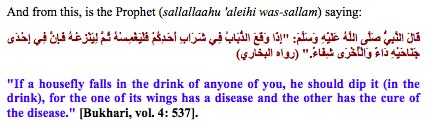
(Notice that I include the original Arabic so there can be no confusion!)

If a housefly falls in the drink of anyone of you, he should dip it (in the drink), for the one of its wings has a disease and the other has the cure of the disease.

I do find that rather disturbing: so in Arabia, if a fly touches your water, you’re supposed to catch it, dunk it in deeper and slosh it around, to prevent disease? Arabian flies buzz around with pathogens segregated to just one wing, while the other one is healthy? How do they do that?

OK, setting aside the sanitary habits of Arabians and the mechanism by which this holy aphorism could be true, our intrepid students do carry out the obvious experiment: they drop a fly in a flask of sterile water, and then they pluck out the fly and immerse it completely in a second flask of sterile water. But then it all goes horribly wrong.

Here is the result of experiment #1.


Plate 2- Cultured water sample taken from a flask containing sterilized water and where a fly fell (without submersion). Growth of pathogenic (disease causing) bacterial colonies of the E. coli type were identified after taking samples from the water in the flask for culture.
Plate 1- Cultured water sample from the same flask following the complete dipping of the fly. An entire disappearance of the bacterial growth seen in Petri-dish 2 is clear. The new bacteria growing in plate 1 was identified as Actinomyces, the one from which useful antibiotics can be extracted. This explains the complete inhibition of growth in plate 2

Plate 2 on the right is the one from water merely touched by a fly. There is no explanation for how the plate was produced, or how the bacteria were identified; the strange brown sludge suggests poor technique, though, and I’ve cultured E. coli myself — and that hideous thick fecal-colored glop looks nothing like E. coli.

Plate 1 on the left, made from water in which the fly was fully immersed, looks nasty too. It’s a poor photograph, but that looks like a thick lawn of colonies everywhere. How do they know it’s Actinomyces? I have no idea, they don’t say. It’s also a mistake to simply declare it beneficial — Actinomyces are opportunistic pathogens.

Experiment #2 was a different fly, two flasks of water, same result.

Experiment #3 was a third fly, two flasks of water, same result.

Having done the experiment to death, our brave students retired at the third repetition, wrote it up with no methods, no discussion, no literature cited (except for their holy book, of course), and no reliable, believable data. They also didn’t do the other obvious experiment, of snipping off the wings and examining the bacterial flora living on the left vs. right, but then, maybe they’re leaving that for the advanced students.

Any 10 year olds looking for a quick and easy science fair project, there it is. I’m sure you can replicate this experiment trivially — but please, talk to a real microbiologist first and learn how to streak a plate. You might also learn something about a control plate, which our U of Qassim students didn’t bother to do.

Of course, this work wasn’t carried out by 10 year olds. It was done by university students in a “Med 497” (a medical course?) in a department of medical microbiology. I strongly urge anyone visiting Saudi Arabia to avoid getting sick. They might try to treat you by swishing a fly around in your coffee.

(Also on Sb)

Rep. Larry Pittman of North Carolina: Christian, seminarian, and ordained minister

That mini-biography in the title is to help put this story in perspective; it’s also completely unsurprising. Pittman wears his Christianity prominently and proudly, and it seems to be the only qualification he thought important in his run for office. And now he’s using his blessed Christian morality to define his work in the legislature. He was very irate at the easy life of a death row inmate, so Pittman wrote a letter to the General Assembly with some suggestions. He thinks:

Doesn’t it warm the heart to know that the barbaric medieval mentality is still making the laws in America?

He does have some second thoughts about his list. He now regrets broadcasting it, and wishes he’d only sent it to a sympathetic fellow Republican. It’s the standard Christian sentiment: it’s not the sin of violent, uncharitable thoughts that is wrong, it’s being caught expressing them.