
(via NatGeo)
(Also on Sb)

Jeez…Rick Santorum, young earth creationist, climate change denialist, anti-stem cell research crusader, fundamentalist/evangelical Christian, has just accused liberals of being anti-science. He might have been right if he’d been talking about the liberals who are mushy-headed over alternative medicine, but in this case, he’s pinning his accusation on the fact that we don’t want to burn more coal.
Republican presidential candidate Rick Santorum charged on Monday that President Barack Obama and Democrats were “anti-science” because they refused to exploit the Earth’s natural resources to the limits of technology.
Over the weekend the candidate had been criticized for saying that President Barack Obama followed a theology that was not “based on the Bible.” He later insisted that he was talking about the president siding with “radical environmentalists.”
“I accept the fact that the president’s a Christian,” Santorum told CBS host Bob Schieffer on Sunday. “I just said when you have world view that elevates the Earth above man and says that we can’t take those resources because we’re going to harm the Earth — like things that are not scientifically proven like the politicization of the whole global warming debate.”
The scientific view is that global warming is occurring, and that it’s driven by anthropogenic production of greenhouse gases; the politicized, ideologically demented view is a denial of the evidence. Like Santorum’s nonsense.
This is a speech he gave to the crowds in Ohio:
But if we don’t provide those opportunities for those jobs that can sustain a family, for power in this country that is affordable, not just coal but all energy. It drove the economy of Southwestern Pennsylvania, Eastern Ohio for a long time. And through a variety of things — yes, problems with management, problems with negotiations — but actually there were bigger problems. The bigger problems of environmental regulation. In many cases environmental regulation that has gone extreme, particularly in this administration.
What they have done? And I referred to it the other day and I got criticized by some of our, well, less-than-erudite members of the national press corps who have a difficulty understanding when you refer to someone’s ideology to the point where they elevate Earth, and they say that, well, men and humanity is just of a variety of different species on the Earth and should be treated no differently.
Whereas, we all know that man has a responsibility of stewards of the Earth, that we are good stewards and we have a responsibility to be good stewards. Why? Because unlike the Earth, we’re intelligent and we can actually manage things.
Did Santorum just call the press “less-than-erudite” while arguing against the idea that humans are one of a variety of different species on the planet? What a maroon.
And yes, we’re intelligent, and we should try to manage things. So what does that make a head-in-the-sand denialist like Santorum who wants to allow unrestricted, unmanaged exploitation of natural resources? Not a good steward, I would say.

I am grading the first exam of my first year introductory biology course. The first question on the first exam is always a gimme, just to ease them in and lighten the mood a little. Here’s that first question:
The correct spelling of PZ Myers’ last name is
A. Meyers
B. Meier
C. Myers
D. Mayr
12% of the class answered “A”.
<sigh> I shall carry on with the rest of the exam. I hope the students don’t mind that I return them spattered with my tears.

The former Archbishop of Canterbury has come out to oppose gay marriage. He says he doesn’t “begrudge rights and benefits to homosexual couples”, and he also made this statement:
The state does not ‘own’ the institution of marriage. Nor does the church.
The honourable estate of matrimony precedes both the state and the church, and neither of these institutions have the right to redefine it in such a fundamental way.
So who got to define it in the first place? What makes an antique definition sacred? Why shouldn’t society adapt to reality?
And at the same time, Lord Carey calls gay marriage “cultural vandalism” and is supporting a group called the Coalition for Marriage, a new UK organization that makes the same tired old arguments.
If marriage is redefined, those who believe in traditional marriage will be sidelined. People’s careers could be harmed, couples seeking to adopt or foster could be excluded, and schools would inevitably have to teach the new definition to children. If marriage is redefined once, what is to stop it being redefined to allow polygamy?
You know, people’s careers are harmed and couples are excluded from adoption right now because of the existing anti-equality policies; the difference such a law would make is that instead of gay people being harmed, it would be bigots who would face the consequences of their beliefs. This isn’t a “save marriage” movement, it’s a “save the bigots” movement.
There’s a poll. Even if it is in that dumb rag, The Telegraph, it’s going the right way. How about pushing it further, and slapping the Telegraph around a little bit?
Should gay marriage by legalised?
Yes, everyone should have the right to get married no matter what their sexuality 81.12%
No, marriage should be between a man and a woman 18.88%

Here’s a wonderful project: a photographer is creating a book portraying the happiness of atheists. Titled A Better Life, he’s looking for support through kickstarter, where donations can also get you a copy of the completed book. Maybe you should get a couple of copies, so you can give them out as presents to those annoying fundy relatives.
The beginning of this video shows exactly why the book is necessary.

It’s not that I’m an atheist, it’s that god doesn’t exist.
Efilzeo
Italy

Remember that I complained about an obnoxious bug in the Mac OS, which was traced to the Samsung printer driver? I was gratified to see that the Mac update mechanism announced an upgrade to that printer driver (is it possible they actually pay attention to complaints on the web?), so I installed it tonight.
In case you were anxiously awaiting a bug fix yourself, I’ll tell you…it didn’t work. I’m watching printtool eat up all my memory right now, and am about to shut it down and go to bed.
(And you know what? If any idiots start pointless, stupid OS flame wars in this thread, I’ll delete you in the morning, and close thread comments.)
Aaaaand…of course I had to delete a half-dozen comments this morning, although it wasn’t as bad as I feared.
I also had some helpful email: at the suggestion of a correspondent, I also killed this stupid little startup item called SPanel that was installed when I got the printer. It’s behaving so far this morning.
Lots of people suggested that I simply drop-kick the printer into the nearest landfill, which may happen. I don’t trust it anymore; I’m reluctant to use the goddamned thing, because I feel like everytime I fire it up I have to monitor CPU activity to see if it is bleeding memory again, and I have to restart my computer afterwards…whereas I typically go months without a shutdown or restart.
Bottom line: treat Samsung devices as equivalent to vectors for viruses that will corrupt your system and degrade performance significantly. I’ll never buy anything from Samsung ever again — they’ve got plenty of competitors so there’s no reason to risk struggling with their incompetence.

What do you know? Richard Dawkins and I have something in common.
In a particularly slimy move, the Telegraph has posted an article that tries to tar Dawkins with the sin of slavery. Not that Richard Dawkins himself has slaves or endorses slavery, but that he had an 18th century ancestor who had a Jamaican estate with over a thousand slaves. The reporter also made the ludicrous suggestion that slave-holding was genetic.
I’d scarcely had time to re-open my lecture notes when he rang back: “Darwinian natural selection has a lot to do with genes, do you agree?” Of course I agreed. “Well, some people might suggest that you could have inherited a gene for supporting slavery from Henry Dawkins.”
So now there’s a slavery gene? That is quite possibly the dumbest assertion I’ve heard in a whole week…and I read creationist websites. As Dawkins points out, he had 512 direct ancestors in that same generation, and that he has a number of ministers in his lineage. Not only is it ridiculous to invent a slavery gene, but it’s a selective absurdity to cherry-pick members of a large population of remote relatives and claim that an individual is responsible for everything every ancestor did. That’s a rather biblical position to take, I think.
So what do we have in common? I poked around a bit in the genealogical records and found this: a piece of the 1820 US census.
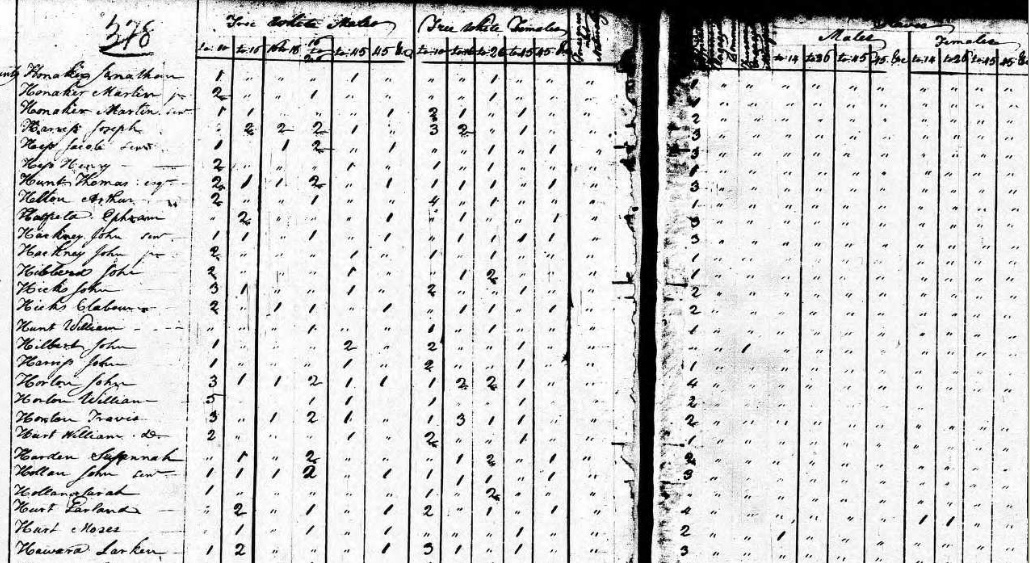
It’s not easy to read, but that’s a bit of the records for St Stevens Parish, King William, Virginia. I’ve mentioned before that I’m Scandinavian on my mother’s side, but on my father’s side, I’m English/Irish/Scots and an undefined mingling of who-knows-what, including a bit of Dutch, and they’ve been skulking around North America since somewhere in the 17th or 18th century, and some of them were even Southerners. My great-great-great-great-grandfather, Garland Hurt (1764-1839) was a Virginian married to Martisha Thurston (1768-1818), who had 3 sons and 3 daughters…and also 1 female slave under 14, and 1 female slave between 14 and 25.
Oh no! Do I carry the slave-master gene?
I suppose if I were interested and extremely ambitious (sorry, I’m not), I could trace all of Garland Hurt’s descendants forward, and then we’d find not only that some of you readers might be related to me. I suspect that some of the people who utterly despise me (if they even know of me) are distant cousins. We’re different from each other and from our ancestors.
My family is a bit down-class compared to those fancy-pants Dawkinses, but as you can see, it’s easy to find slave-owners for any of us among the swarms of ancestors we all have, just by going back far enough. I also have at least one ancestor who fought on the Union side (an Iowan who fought with Grant in the Mississippi campaign) in the Civil War. I deplore the slave-owner, but I don’t own his guilt, nor do I get to take credit for the great-great-grandfather who was mustered out in New Orleans. We’re all a great gemisch of subsets of genes from a bounded population. It’s simply silly to start parsing out characteristics from individuals in a complex cloud from the ancestral gene pool and arbitrarily assigning them to single contemporaries. The writer of that article, Adam Lusher, is an idiot…and the Telegraph ought to be embarrassed at publishing such tripe.

This is going to be a movie I’ll want to see.

I’m a female of the species Homo sapiens on the eastern coast of the United States who was brought up in a sometimes vaguely deistic, sometimes atheistic, sometimes anti-theistic family.
It just depended on who you asked.
I’m the oldest child and was born in a major city on the northeastern coast of the United States. My father was brought up Catholic in Ireland, while my mother was brought up in the southeastern United States in a non-churchgoing family. I think she is a deist or agnostic-it was just never discussed. Both of my siblings are too young to have formulated any opinion on religion yet-they’ve not been brainwashed, so I think they’ll be agnostic at very least, but I’m not entirely certain.
My father was very different. He worked from a young age to make sure I knew that it was wise to stay away from the clergy, particularly Catholics. He instilled from a young age that talking to any priest or parishioner was a bad idea. I’m almost entirely certain that was from his rough upbringing with devout Catholic parents and nuns and priests at the schools.
Because of an unfortunate circumstance, my father lost his job while I was young and was forced to journey away to find work. Since then he’s had to take jobs that left him little time at home and what he had was usually spent sleeping. That meant that he didn’t have any time to discuss his atheistic beliefs with me and my mother has permanently refused to discuss hers with the family.
I eventually became a vague deist after I picked up ideas from my peers. There had to be somebody up there, right? While I was still in elementary school, I had a friend that, trying to be just like her preacher and her parents (who were active in the pursuit of converting people to their particular Lutheran strain of Christianity), converted me to a vague form of Christian-esque deism. I prayed in my bed at night to God (who, I would learn later, was also known as Jehovah), I learned about the Nativity and believed it, and I learned about Heaven and a diluted form of Hell. Bad people would go to timeout, good people would be happy.
I didn’t ever go to any church, I never really read the Bible until I was a lot older, I didn’t realize the exact qualifications to go to Heaven, I didn’t know that the God of the Abrahamic trifecta was a childish tyrant, I had barely any knowledge of the crucifixion and resurrection, I just had no idea. I guess I wasn’t ever really a Christian. I did believe in God in my own childish way, but it was filtered. I proudly told people (outside of my family) that I was a Christian.
It took me a few more years to realize that I didn’t know what I was getting into.
My converting friend had long since vanished into the past. At the time, I was taking piano lessons with a Southern Baptist woman who is (to put it mildly) extremely devout and committed-she had played the organ for her congregation since she was a teenager. She’d gone to a Christian college and converted people for some time. She knew my parents were non-theistic and I was a Christian, though I’d asked her not to say anything to my parents and I’d tell them when I was older and knew how to articulate my beliefs to them.
I had just finished a song and was looking for a new one. As I flipped through a book of pop songs of the last 50 years or so, I chanced upon a simplification of “Imagine” by John Lennon. I knew of the Beatles’ music and enjoyed it, though I hadn’t yet heard that particular song. Recognizing the name, I said, “Ooh, John Lennon.”
She replied, with a sort of satisfaction, “No, we don’t play that here. He wasn’t a Christian, but he learned his lesson in the end.”
At the time, the comment confused me, but I let it go without continuing the conversation. We drifted elsewhere, but I didn’t forget the comment. I thought that maybe he’d eventually converted.
I got home and searched for “Imagine” and for “John Lennon” on Google.
While listening to “Imagine” and reading John Lennon’s Wikipedia biography, I chanced upon the fact that he’d been shot and killed at a fairly young age, but he’d never converted. After I’d listened to “Imagine” twice, I made the connection in a stroke of brilliance.
She thought that John Lennon’s death was a judgment from God for writing that song.
Suddenly, I didn’t want to be a Christian anymore.
Now, she’s generally a nice woman, though obviously she holds no sympathy for atheists (or homosexuals, or Muslims) and she watches Fox News.
But this hate, I found as I finally read the Bible, was supported openly. The Old Testament was just a compilation of the evil of Jehovah-the New just a contradictory set of tales of the purveyor of an immoral doctrine that was supposedly simultaneously the son of Jehovah and Jehovah.
It was terrifying and laughable at the same time. But I also realized that the idea of this God, the idea of Hell, of original sin, of resurrection, of believing an old story book, of trusting the nonsensical and often contradictory doctrines of Christianity was just absurd, ludicrous, preposterous!
But, for some reason, I stopped there. I didn’t renounce deism, though I realized that an interventionist God was also absurd. I became something of a Ben Franklin-like deist; it (whatever it was) existed but it didn’t do anything.
Eventually, through a rather strange route, I started watching Dara O’Briain’s standup comedy. I laughed and laughed until I reached the part where he said he’d take psychics, homeopaths and priests and put them all in a sack and hit them with sticks. The psychics and priests I could emphasize with, but I didn’t know what homeopaths were.
The next stop was to James Randi’s YouTube channel.
I found Thunderf00t on YouTube shortly afterward.
After that, I stumbled across the Atheist Community of Austin and the Atheist Experience, followed shortly thereafter by the Non-Prophets.
And then I found Pharyngula.
From there, the whole world of atheism and anti-theism opened up.
Since then, I’ve been commenting on the intertubes, I’ve been joining chatrooms and I’ve been reading and educating myself about evolution, about religion, about society in general and anything else I can get my hands on. I’ve just gotten into one of my first written debates with a theistic friend of mine (verbal sparring has been going on for a while) and I’m having a blast.
Once I started educating myself and enjoying it…everything fell into place. I finally understood why I found the Bible so absolutely absurd. I finally figured out why my father was so anti-theistic. I finally figured out why people were protesting church-state separation violation. I finally figured out why calling Jesus a madman or something worse was justified. I finally figured out why the line between what is comforting to believe and what is true is so important.
I’m going to end with one of the only quotes in the Bible, otherwise known as the Big Book of Multiple Choice, that has ever held any significance for me. Predictably, it does not come from the Old Testament (though Ecclesiastes is interesting at very least) nor does it come from the supposed sayings of Christ. Instead, it is from Paul. Also predictably, I had to take it (somewhat) out of context.
1 Corinthians, 13:11-When I was a child, I spake as a child, I understood as a child, I thought as a child: but when I became a man, I put away childish things. (KJV)
Fitting then, now that I am no longer a child, that I put away the childish god of Abraham, the childish reliance on imaginary friends, and the brutal yet still childish threat of pain that are all mainstays of the destructive and infantile organizations we call religions.
Xios the Fifth
United States

