It’s good advice.
Pharyngula
Evolution, development, and random biological ejaculations from a godless liberal

It’s good advice.

I’m mentioned in a newspaper, in a way that isn’t likely to send a pitchfork- and torch-wielding mob lurching in my direction. I don’t know if I like it; it’s not as exciting.

We have another new face at FreethoughtBlogs: Aron Ra has joined us. Stop by and say hello.

Danny Vendramini is a man with a vision…but absolutely no knowledge or competence. He has invented out of whole cloth a bizarre hypothesis that Neandertals were super-predators who hunted modern humans for food and sex. To support this weird contention, he builds up a tissue thin set of speculations, all biased towards this idea that Neandertals were giant, hairy brutes who looked like bipedal chimpanzees, and that were intent on raping and eating people.
If it sounds like the plot for a cheesy SyFy channel horror movie, you shouldn’t be surprised: Vendramini is not a scientist, but he is a “theatre director, TV producer and award-winning film director and scriptwriter“. He has no training in comparative anatomy, ecology, or evolutionary biology, and it shows.
He has written a book titled Them+Us. Here’s the promotional video. Prepare to simultaneously laugh and stand aghast at the abuse of science.
I’m just going to take apart one claim out of this mass of nonsense. He commissioned “one of the world’s foremost digital sculptors”, Arturo Balseiro, to reconstruct a Neandertal skull to meet his requirements. Poor Balseiro! He’s not going to be well regarded in scientific circles after selling out this badly.
One of his hilarious claims is that all other reconstructions have been biased because they’ve been done to make Neandertals look human — but, don’t you know, Neandertals are primates, so they should be made to look like other primates.
Contemplate that last sentence. Humans are apparently not primates, and the analog for reconstruction should not be modern humans, their closest relative, separated by a mere 100,000 years, but a random gemisch of miscellaneous apes and monkeys, separated from Neandertal for over 6 million years.
To support this unlikely comparison, he superimposes a Neandertal skull on the profile of a chimpanzee, and declares that they fit perfectly.

There are a few problems with this reconstruction. To get the slope of the skull’s face to align with that of the chimpanzee, he has completely ignored the position of the foramen magnum, at the base of the skull. In the image to the right, the Neandertal’s spine would be erupting out the front of his trachea. Note also the little details, like this orientation requiring that the chimp’s ears be yanked down to be coming out of his neck, and how the chimp’s neck has to be mostly filled with the bowl of the occiput. It doesn’t fit. It doesn’t fit at all.
You can also look at a chimpanzee skull and compare it to that of a Neandertal (strangely, an obvious comparison that he doesn’t bother to make on his web page). They don’t look anything alike, except in the general sense that they’re both apes.


But ignore all that! TV producer knows better.
The Neandertal skull above is actually the La Ferrassie specimen, the very same individual Vendramini uses to reconstruct his version of a Neandertal. And here it is, in all its ridiculous creature-feature glory.
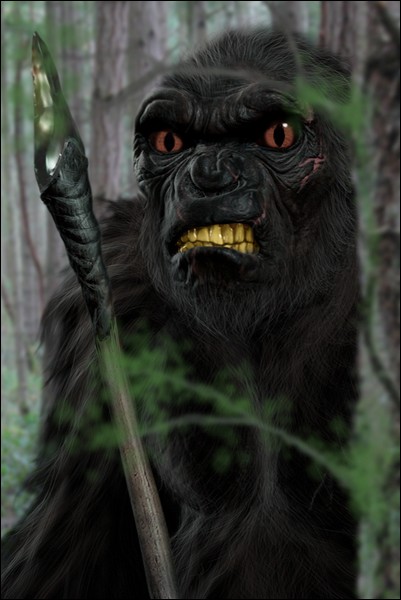
After all that complaining about how those scientists impose their human biases on all the other Neandertal reconstructions, Vendramini just decides on the basis of no evidence at all that they had to have been as hairy as a gorilla, with cat’s eyes because they hunted at night.
It’s all ludicrous, pseudo-scientific bullshit.

The other day, I wrote about this unfortunate case of a cancer researcher at UC Davis who was abused by his university for criticizing another department’s poor health advice. I said that that’s one of the things you have to protect with academic freedom: the right of scientists to make informed criticisms of others’ work.
Now I’m getting squeaked at by Casey Luskin of the Discovery Institute, who protests that I don’t give that same freedom to creationists.
So Myers doesn’t really believe in academic freedom — he only defends the freedom of scholars to agree with him. But without the liberty to dissent, the whole idea of “academic freedom” is pretty meaningless.
Scientists are supposed to use their intelligence, expertise, and knowledge to make evidence-based criticisms of claims. Since creationists lack all three characters, as well as having a dearth of evidence, it doesn’t apply. Academic freedom does not mean you are given carte blanche to make wild claims without an expectation that you’ll provide scientific reasoning behind them, and the thing is, in the UC Davis case, the cancer researcher was knowledgeable and discussed the best evidence.
There’s more to being an academic than having unfettered freedom, you know.

Growing up I had a vague notion that we were created by a supreme being. I never really probed the existence question, so the “creator” answer suited my brian just fine then. However, the idea of God was something that wasn’t reinforced in my house. We never went to church, prayed or kept any religious symbols. What I did have reinforced, on the other hand, was the wonderful altruistic care of my parents. My upbringing was enough to let me know how rational, humane beings ought to treat one another.

I found this very satisfying: Steven Pinker summarizes all the problems with group selection. It’s a substantial essay, but if you just want the gist of it, here’s the conclusion.
The idea of Group Selection has a superficial appeal because humans are indisputably adapted to group living and because some groups are indisputably larger, longer-lived, and more influential than others. This makes it easy to conclude that properties of human groups, or properties of the human mind, have been shaped by a process that is akin to natural selection acting on genes. Despite this allure, I have argued that the concept of Group Selection has no useful role to play in psychology or social science. It refers to too many things, most of which are not alternatives to the theory of gene-level selection but loose allusions to the importance of groups in human evolution. And when the concept is made more precise, it is torn by a dilemma. If it is meant to explain the cultural traits of successful groups, it adds nothing to conventional history and makes no precise use of the actual mechanism of natural selection. But if it is meant to explain the psychology of individuals, particularly an inclination for unconditional self-sacrifice to benefit a group of nonrelatives, it is dubious both in theory (since it is hard to see how it could evolve given the built-in advantage of protecting the self and one’s kin) and in practice (since there is no evidence that humans have such a trait).
Group selection is one of those ideas people succumb to all the time…but it’s also a fringe concept that demands really good evidence before anyone should believe it, and no one seems to be able to come up with any.


All I want to know is…who instigated this unholy coupling? Was it the dolphin getting kinky? Was it the octopus feeling amorous? Or was it possibly a mutually agreed-upon exploration of new sexual frontiers?

Talk about missing the point — now we’ve got someone declaring the TAM harassment problem solved — why, just call casino security, and they’ll take care of it!
Uh, yes. We know. We can go to a meeting, and if there is a jerk causing problems, we can seek out authorities and maybe get it resolved (although, in the case of women complaining of harassment, we’re more likely to see the problem treated dismissively). That’s always been an option, and it’s really patronizing to bring it up as if no other person on the planet ever even thought of it.
It’s not the issue. What’s wanted is a recognition of the fact that no one has the right to harass others at a public meeting, and that the meeting organizers have a zero tolerance policy towards sexual harassment, to discourage harassment before it happens.
Why is this so hard to understand?
These events are safe: they are well-bounded, contain security staff, and all the organizers want them to proceed with little disruption. Nobody has complained that there was no available recourse to deal with jerkwads.
The problem is that they are not safe spaces, which means a place where women can feel comfortable speaking without risk of unwelcome advances. You can’t just announce that there are security guards outside the door to create a safe space; it takes a bit more effort than that.
The author of that blog actually hit on the real problem by accident in a comment on that thread.
Honestly, if your a woman at an event like TAM, expect to be hit on.
EXACTLY!
You know, there’s a lot of whining that Rebecca Watson or myself have claimed that TAM is unsafe, a claim that we actually haven’t made at all. To the contrary, we’ve both supported TAM and encouraged people to attend. But we’ve also asked that it be better, and I do give DJ credit — it has improved in the representation of women speakers during his tenure.
But if you’re looking to pin the blame on people who have said TAM isn’t a good place for women, who might be spreading the word that women shouldn’t attend, you might want to start with people who declare that women ought to “expect to be hit on”.
Some people seem confused by the phrase “safe space”. They seem to be unaware of the fact that in English, one word in context can modify the meaning of another: like “parkway” is actually a place where cars drive, rather than park. But to help out those poor naive simpletons, here’s an explanation of “safe space”.
As usual, Cuttlefish distills the whole wrangle down nicely.

Ladies, aren’t you used to this yet? Marty Klein is a sex therapist who writes for Psychology Today; he’s also a dishonest hack who will distort the facts to make his case.
You may remember that strange incident in which Elyse of Skepchick was working at a conference, and out of the blue, was handed a card offering group sex by a pair of strangers. Klein has taken that story and turned it into a tale of a prude squawking hysterically at a kindly offer by a pair of friends. It’s one of the more egregious manglings of a story I’ve seen in a long time.
What I find particularly outrageous, though, is that Klein is exactly like Ken Ham: nowhere in his fractured fairy tale does he include a single link to the actual participant and witness to the story, where readers might have discovered how he lied, and of course his article doesn’t include comments, where readers might correct him.
