Bad argument #2: No more Poes

(This is part of a list of bad arguments I heard at the Texas Freethought Convention.)

There were a couple of fundagelical fanatics picketing the event. I got a few pictures taken posing with this one guy, and he was standard-issue boring creationist: he kept telling me “Darwin was a big dummy” and otherwise sneering at evolution. I just politely asked him what he’d read by Darwin, and for specific points Darwin made that he rejected, and he shut up hard. He was reduced to muttering “I’ll pray for you, brother” — trying to pin them down to specifics is usually a good tactic for exposing the vacuity of their position.

But the creationist is too obvious a source of bad arguments. I want to complain about a few of the atheists.

I heard several announce “He’s a poe” or “he must be a poe”. Dear god, but I’m sick of that stupid word. It’s become a standard response to batty stupidity — lately, it doesn’t matter how ordinary a comment is or who said it or how well verified it is — there’s always someone in the crowd who has to show off how insightful or cynical they are by declaring that it must be a pretense.

Look, people, we live in a country with Rush Limbaugh and Glenn Beck and Joseph Farah as prominent media sources; where Akin and Broun and Jindal get elected to high office; where every newspaper is full of common folk writing in to complain about those gays or those socialist commies or those egghead liberals. There is nothing unlikely or unbelievable about a down-home ministry that announces you’ll go to hell for believing in science. Bat-buggering bullshit is routine.

Declaring something to be a “poe” is a minimizing tactic; it’s a way to pretend that a real problem doesn’t exist. Are you really going to try to delude yourself and others into thinking that the Tea Party, Fox News, and the whole goddamned Repuclican party are an act put on by snarky liberals?

I’m hereby declaring the term “poe” to be anathema here. Don’t use it anymore. We don’t need denial, we need a confrontation with an ugly reality. I’ll probably start leaving rude remarks when I spot people throwing the term around in the comments from now on.

Oh, and for anyone who tries to mimic creationists, Republicans, or Christians as a clever mockery of their beliefs, if it isn’t clear what you’re doing, don’t try to dignify it as a “Poe” — all it is is bad fucking satire. Satire is a good and historically authentic method of speaking against power and foolishness, but if your schtick can’t be distinguished from the real thing, it’s contributing to the crapfest of idiocy we’re already drowning in, rather than opposing it.

So just stop it.

Bad argument #1: The Mormon exception

(This is part of a list of bad arguments I heard at the Texas Freethought Convention.)

Richard Dawkins gave a short speech on the Texas capitol steps, and for the most part, it was right on the money (or should I say, the Rmoney). He pointed out the bugfuck lunacy of Mormonism, and the patent charlatanry of its con-artist founder, Joseph Smith, as well as criticizing the media for failing to follow up on how nuts Romney’s religion is.

And he’s right! But some of his conclusions were, I think, a strategic error and simply wrong.

He came right out and said that he thought Mormonism was worse than the older, more established religions. That was the gist of his defense, actually: that Catholicism and Anglicanism and the various other protestant faiths were older, therefore less wacky…and that Mormonism’s clear mimicry of Elizabethan English, for instance, is a clear indicator that it was all fake. I don’t think that’s a good argument; I’d argue that Christianity could have been just as obviously bogus to a contemporary during its formation because they’d be as aware of its cultural context as we are of Mormonism’s origins; We benefit from sufficient proximity that the anachronisms leap out at us. But also, I think familiarity breeds complacency. Sure, Mormonism is nuts, but Catholicism is equally so. If you want deranged beliefs, I would merely cite the dogma of original sin — the pernicious doctrine that all people are born intrinsically evil, giving us a rich heritage of guilt and shame — as just as wicked and disturbing as anything Mormonism has come up with, and it’s far more pervasive, too.

Dawkins’ suggestion that the media should more thoroughly grill Romney on the details of Mormon belief has a germ of utility to it, but I don’t think he quite appreciates the depths to which the American electorate and the political process has sunk.

If you’re going to ask Romney if he believes Native Americans are descendants of the lost tribe of Israel, or whether Mormon underwear really stops bullets, or if Joseph Smith actually translated golden plates by staring at stones in a hat, you’re also going to have to ask Obama if he believes every line of the Nicene Creed. And when you start doing that, we atheists will be sitting smug and cocky laughing at both of them professing their faith, but the majority of the electorate will be seeing their religious identity challenged — and they won’t like it, not one bit.

Dawkins did mention Kennedy’s resolution of his Catholic problem, but I don’t think he really got it. Of course Kennedy’s views were shaped by his Catholicism, as Romney’s are by his Mormonism. But what Kennedy did was the only reasonable secular solution, since we can’t wipe our cultural influences out of our brains: he stated that he would not bring the papacy into the Oval Office, and would not entangle the institution of Catholicism with his duties as president. And that’s as much as we can ask of someone.

It is a question I’d like to see Romney smacked with, though. The Mormon church is a meddling church — witness their active interference in gay rights in states outside Utah, for instance. I’d like to see a clear statement from Romney that that scary office building just outside Temple Square in Salt Lake City will not be pulling the strings on a Romney presidency, and that he’ll be making political appointments on the basis of competence rather than religious cronyism (something Mormons are notorious for). Is he willing to stand up for the separation of church and state? Then I won’t make a big deal about his stupid beliefs.

And this goes for everyone. When the first atheist president is sworn in, I want evidence that he won’t simply be a puppet of the wizened, necrotic husk of David Silverman, Atheist Pope of 2060.

Three bad arguments

I just got back from the Texas Freethought Conference, which was excellent — lots of good speakers, great conversations, and a particularly dense day of brain fodder. In Texas! Maybe stereotypes aren’t universally true.

But I’m an atheist, and you know what that means: I’ve got to carp about my grievances. In the vast assortment of good talks, there were three bad arguments that peeved me, so I’m going to address those right here.


Oops, they got a little long and were so different from one another that I broke them into three separate posts.

Bad argument #1: The Mormon exception

Bad argument #2: No more Poes

Bad argument #3: Science says what?

Again, let me emphasize that the conference was great, but I’m just one of those obnoxious people who has to pick at the exceptions.

SciAm video whiffs it on this extinction event

Smilodon at the Page Museum at the La Brea Tar Pits

Kitty. Victim of the late-Cenozoic extinction at the Page Museum in Los Angeles.

I usually like Scientific American’s short science explainer videos, but this one — Instant Egghead – Are We Facing the Sixth Mass Extinction?” — bothers me for a few reasons.

Fred Guterl starts off by saying that we don’t know yet whether our current extinction event qualifies as a “mass extinction.” It’s a bit of a semantic question, as the threshold for what constitutes a mass extinction is debated, and some rankings put different events in the top five. But let’s just take Guterl’s statement as meaning “we don’t know whether this current extinction is as big as the really big ones we’ve had in the past.” It’s an excellent point. It’s become received wisdom among a certain crowd that we’re facing Big Dieoff 6.0, and reminders that this isn’t necessarily any worse an event than, say, the extinctions at the end of the Eocene are always good. Not that the end-Eocene extinctions were a kitten romp.

The video goes off rather quickly, though, starting with the quick “citation” of a UNEP estimate of up to 200 species extinctions per day, which seems to have been taken urban legend style from an estimate Norman Myers made in the 1970s. Myers gave the range as 50-200, and he was saying 50 in 2006. We’ve seen a lot of estimates by different biologists. In 1993 E.O. Wilson offered an estimate of 30,000 species per year going extinct, about 85 a day. It depends on what models you use, and those models are the topic of debate.

Still, that’s more an editing quibble than anything. Few maintain that species aren’t going extinct faster than is “usual” for the Cenozoic.

There are a couple other WTF moments in the video, chief among them the statement that the end-Permian extinction was caused by Siberian lava flows igniting large coal deposits, creating a atmospheric CO2 spike “on the order of what we’re seeing today.” There’s certainly lots of evidence to support the idea, but it’s not a slam dunk, and other mechanisms remain possible.

There’s also an interesting mention of passenger pigeons that goes nowhere. In the context of species extinction rate models Guterl mentions that there was a population of billions of passenger pigeons in North America for who knows how many millions of years, and yet only two fossils of the species are known. And then he drops it, not explaining the fact’s relevance. I mean, I got there, and you probably did too — it implies that for each species we know went extinct back in the day, there were likely many we don’t know of whose fossils we have not yet found. What that implies in terms of past extinction rates I’m not sure: it’scertain that species we don’t know of  went extinct and aren’t counted in the totals, but it would seem equally plausible that species we don’t know about survived the extinctions of the past, or that species we do know about that we now count as victims of mass extinctions actually survived those extinctions but left no trace for a few millon years afterward. Perhaps someone here with a better understanding of paleontology can help me out with this. In any event, it would have been nice to have Guterl finish his thought there.

My biggest problem with the video, though, is in Guterl’s suggestion that our changing the atmosphere’s composition — referring to the end-Permian extinction, as well as the “Great Oxygenation” of the Paleoproterozoic — is what’s got scientists worried about mass extinction these days, given that we happen to be adding CO2 to the atmosphere faster than the Siberian Traps did 252 million years ago. And scientists are indeed worried about the effects of climate change on biodiversity.

But scientists working on studying and preserving biodiversity — which after all is the positive way of saying “not having a mass extinction’ — are worried about a whole lot more than climate change. We could completely solve the atmospheric CO2 overburden on Tuesday and still be faced with an extinction crisis as we plow up grasslands, cut down forests, bottom-trawl the oceans, and build new sprawling cities on land that once supported wildlife.

The IUCN identifies habitat loss as the main threat to 85% of the species it lists as “Threatened” or “Endangered” on its Red List. The Red List includes 391 terrestrial plant species of all threat levels described as potentially threatened by climate change or severe weather, compared to 5,582  that may be threatened by human disruption of their habitat. The equivalent numbers for terrestrial animal species are 1,991 potentially threatened by climate change and 13,388 by habitat disruption.

There are errors inherent in the IUCN data that stem mainly from lack of resources to assess species, but the implication is clear. Climate change is thought to pose a serious threat to many species. Human-caused habitat disruption is likely a more serious threat.

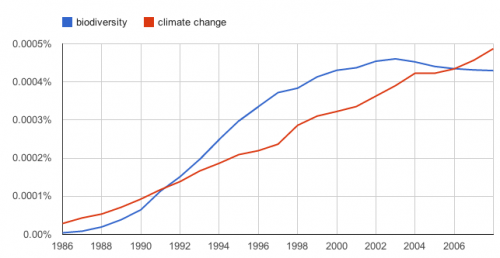
One of the problems I have with the mainstream environmental movement these days is that “environmental protection” has been conflated with “climate change mitigation.” You can search environmental publications in vain for a long time for mentions of other issues. When I started editing environmentalist publications in 1992 — the year of the first Earth Summit, in Rio — public attention was about evenly divided between the importance of preserving biodiversity and the threat of climate change. You can see evidence of this in the newly revamped Google Ngram viewer, by comparing mentions of the relevant phrases in books archived by Google as a function of time:

Expressed as a percentage of text in all books in the database, “biodiversity” peaks relative to “climate change” in 1997, then actually starts to decline in 2003. “Climate change” gains the lead the year the Al Gore’s movie came out. Google’s data runs until 2008. My personal anecdata would suggest that the lead “climate change” started developing in 2006 probably grew dramatically after 2009, with biodiversity likely to catch up a little bit sometime next year due to renewed attention to the issue on the UN front.

The point is that environment has become synonymous with climate in many minds. Thinking of biodiversity as of secondary importance (at best) to climate change has resulted in proposals to stem climate change that would actually harm biodiversity. They include everything from seeding oceans with iron to cutting down rainforests for biofuel soy plantations to siting utility-scale solar plants on intact and biodiverse desert habitat when there are former alfalfa farms in the neighborhood.

By mentioning only climate change in a video that purports to address whether we’re facing a mass extinction, Scientific American helps promote this emphasis on climate change — which is obviously a huge threat — to the exclusion of the greater causes of current extinctions. Yes, it’s a video lasting less than three minutes, but one could easily mention agricultural conversion and overfishing and forest clearcutting in a short video. They aren’t complicated concepts.

By all means, SciAm should rail against climate change. SciAm should persuade people to look at their carbon footprints, to demand changes in the way we run our industrial society, and to challenge the idiots in charge who’d deny any climate problem exists. But this was supposed to be a video on the current extinction event, and you somehow failed to mention the larger causes of that extinction. That does a disservice to SciAm’s viewers — and to the science.

Hanging out in Texas

Talk among yourselves, everyone. I’m in Austin — I’m actually right in front of the Capitol steps — for the Texas Freethought Convention, after getting in after 1am last night. I just heard Aron Ra shred the religious, and Matt Dillahunty and Richard Dawkins and Sean Faircloth are coming up. It’s good to be in Texas, a phrase I’m surprised to have ever written.

It sounds like the convention is close to being sold out, so you’re too late for the afternoon/evening sessions, but we’re going to be right out her in public all morning.


Oh, look…a picketer!

20121020-131420.jpg

A Texas poll

We haven’t crashed a poll in a while — and to be honest, it’s like they’re all trending our way anyway anymore — but since I’m on my way to Texas, sure, let’s do a Texas based poll on the recent court decision that public high school cheerleaders get to flash bible messages at spectators. It’s classic Texas: football, cheerleaders, and god, but good grief, even the Texans see through it as an endorsement of religion.

The Kountze High School cheerleaders’ use of religious messages on banners at football games:

amounts to a school endorsement of religion and should be banned. 58.7%

is freedom of personal expression and not representative of the entire school 41.3%

[Lounge #375]

This is the lounge. You can discuss anything you want, but you will do it kindly. Hey, it’s another long weekend of traveling for me, but you’re all going to be extra-specially nice to one another while I’m hindered from monitoring the threads, right?

Status: Heavily Moderated; Previous thread

Minnesota mooks don’t like MOOCs

Every once in a while, some news comes down from on high that reveals that the people we’re trusting to lead don’t have a clue about what they’re doing. Now Minnesota’s Office of Higher Education has banned online courses, specifically the excellent suite of free online courses from Coursera.

We do have a law on the books that has the goal of shutting down diploma mills — you shouldn’t get to browse a website and be awarded a Ph.D. in quantum neuroscience. But Coursera doesn’t do that: they don’t issue degrees or even credits, they just provide massive open online courses for free. So you can learn stuff. For free. You don’t go there so you can pretend to learn and get a fancy diploma to hang on your wall, it’s just free information.

This ban is utterly unenforceable and absolutely ludicrous. All you Minnesotans should take your laptop or iPad into the bedroom or bathroom or someplace private, turn off the lights, and browse Coursera — I recommend the biology section, obviously. Oh, look: Rosie Redfield has a course on practical genetics. That should be good. Sign up for something.

Now feel the thrill of being an outlaw. Go commit crimes: learn something.

Hey, maybe the Minnesota OHE is trying reverse psychology on us?