I think I’ve just been persuaded that MOOCs suck

I’m convinced. Physioproffe is right: MOOCs are a great big boondoggle. It wasn’t PP’s words (true as they are) that persuaded me, though — it’s that Thomas Friedman has endorsed them, in a godawful column complete with helpful discussion with his driver from the airport.

Just consider this claim:

We demand that plumbers and kindergarten teachers be certified to do what they do, but there is no requirement that college professors know how to teach. No more. The world of MOOCs is creating a competition that will force every professor to improve his or her pedagogy or face an online competitor.

Holy crap. Right now I’m in ‘competition’ with skilled colleagues who were selected for their position on the basis of their teaching skill — I’m evaluated in comparison with my peers. I’ve seen these MOOC-style lectures, and please please please, I would love to be assessed against some person whose interactions with students are entirely through a glass screen, in a format that favors linear lecturing, and considers email a marvelous way to communicate outside of class.

This is what Friedman considers an increase in competition for college teachers? I see a slackening and a reduction of standards…and what the administrators and mouth-breathing ignoramuses like Friedman see is a way to outsource and reduce the costs of the expensive part of an education…the part that is also the only real education component of the process.

DON’T TELL MY WIFE!

An organization called the Susan B. Anthony List — it’s an adamantly anti-choice group that has neatly named itself after an icon of women’s liberation — has a wonderful president, Marjorie Dannenfelser, who not only opposes abortion, but is dead set against contraception. She argues here that increasing availability of contraception leads to increasing rates of abortion (what?), apparently because all those frisky couples losing their fear of pregnancy will fornicate more, leading to more unwanted pregnancies.

But…but…abortion rates have been going down as pregnancy rates decline. We can’t therefore account for reduced pregnancy rates by claiming they’ve been terminated by abortion, and it seems kind of unlikely that people are having sex less often, so isn’t the correlation the reverse of what Dannenfelser claims?

teen-pregnancy-abortion-rates

Also, I am greatly concerned by the implications of the statement that “to lose the connection between sex and having children leads to problems”. There were precisely 3 periods in my life in which I intentionally had procreative sex, and they were both relatively brief because I married a fertile minx who got knocked up as soon as we both put our minds to it. So, maybe three months where I’ve had sex with reproductive intent, while the other 393 months of my married life I was entirely in frivolous sex-for-fun mode. Furthermore, we have not been the slightest bit interested in having more children for 23 years. Is Dannenfelser trying to suggest that having a monogamous and healthy sex life during those decades should be causing problems because we’ve lost the connection between sex and having children?

I remember that poster!

Back in the dim dark distant days of yore, Matt Groening actually did some promotional artwork for Apple — all at about the same time he started up with some little show called the Simpsons, and when he’d apparently doodle up a poster for them for the price of a Laserwriter.

Bongos-Dream-Dorm-aopg

Speaking of Groening and the Simpsons, Richard Dawkins will be making a cameo voice appearance this Sunday. Tune in!

What’s Jimmie Walker’s favorite arthropod?

“TRI-LO-BIIITE!”

Oh, no, that was a terrible opening. You’ll only know what the heck I’m talking about if you remember JJ from the television show Good Times, and it’s such a pathetic joke it’s only going to appeal to grade schoolers. So if you’re a time-traveling 8 year old from the 1970s, you’ll appreciate the reference. How many of those are reading this right now?

Maybe this will work better. Here’s a small chip of shale I keep at my desk.

trilobite

My son Alaric and I collected that on a trip to Delta, Utah over 20 years ago. We had permission from the owner of a commercial dig site to rummage around in their tailings*, and we ambled about picking up chunks of rock and splitting them with a hammer. Everywhere we looked were trilobites. We brought home a good haul, chiefly Elrathia, like that one, and lots of Peronopsis. I keep it at my desk as a token of a good memory, and also because it’s about half a billion years old.

I can reach over and touch a half billion year old fossil at will, which I find to be an awesome thrill. That it’s also from a subphylum that was so successful, swarming in our oceans for about 300 million years, yet that ended so finally in the Permian extinction, is humbling. Puny ephemeral humans — we can only dream of achieving the glories of the Trilobite empire.

trilobiterichness
Summary of the evolutionary history of the major trilobite clades plotted against stratigraphic time. The y-axis scale approximates a log scale to permit the more detailed illustration of the Cambrian and Ordovician diversifications. Numbers refer to age in millions of years (Ma). Although the spread along the x axis approximates the morphological diversity within a clade at any given stratigraphic level, horizontal distances between groups should not be interpreted to suggest degrees of phenetic difference. The diagram is not meant to imply that maximal phenetic variance was present in the early part of the Cambrian, even though groups such as Agnostida and Corynexochida form the extremes along the x axis. This is an artifact of the mode of representation. Trilobite color represents the condition of dorsal exoskeletal trunk tagmosis: orange is the homonomous condition, pink is the heteronomous condition in which the batch boundary occurs within the holaspid thorax, blue is where this boundary occurs within the holaspid pygidium, and green where it occurs at the thoracic/holaspid pygidial boundary. The representation is schematic and not meant to imply that all members of these clades younger than the image shown had that condition.

If you want to learn more about trilobites, I can’t recommend Richard Fortey’s book, Trilobite: Eyewitness to Evolution, highly enough. It’s an excellent, enthusiastic, readable overview of the group. There’s also a gorgeous online guide to the orders of trilobites that’s full of fossil photos and detailed information. But I also recently stumbled across a review paper by Nigel Hughes that looked at them from the perspective of development — O Rhapsody! It’s beautiful!

Despite being extinct for 250 million years, and despite being nothing but fossils, we still have a pretty good idea of the development of trilobites, because they were so numerous and we can find great drifts of entire populations of the animals embedded in lagerstätten. That allows us to see the range of variation and the distribution of different developmental stages, and further, because they’re arthropods, we can see well preserved cuticles of both intact animals and molted shells. And with almost 300 million years of recorded species, we’ve also got a good picture of their evolution. This is a classic evo-devo story.

So, quick, here’s a general introduction to trilobite anatomy. First thing to know is that the ‘three lobes’ of the word ‘trilobite’ refer to the longitudinal divisions of the animal: a central axis with a lateral or pleural lobe on either side of it. There are also, usually, three transverse divisions: cephalic (head) segments, thoracic segments in the middle, and a pygidium or tail.

trilobiteanat
Basic anatomy of the dorsal surface of two trilobites. (Left panel ) The figure is based on a generalized olenelloid trilobite, which had a boundary between two distinct or heteronomous batches of segments located within the thorax, dividing the protrunk from the opisthotrunk. (Right panel ) Aulacopleura konincki displayed the homonomous trunk condition in which all trunk segments shared a similar morphology. A, anterior; Opi, opisthotrunk; P, posterior; Pyg, pygidium.

Not usually shown are the limbs. If you flip over a trilobite, you discover that each segment, except the anterior- and posterior-most, has a pair of biramous appendages — they’re branched legs, with one branch functioning as the walking limb, and the outer branch being lamellate (thin and flat) and probably functioning as a gill. They’re surprisingly uniform and consistent in general structure, from head to thorax to pygidium. One of the curious features of trilobites is that most species are marked by this homonomous condition (that is, maintaining identity or close similarity between adjacent segments), while most of the extant arthropods are strongly heteronomous, making strong distinctions in the structure of adjacent segments.

trilobiteseg
Major divisions of the anterior-posterior (a-p) body axis in trilobites. The letter M indicates an individualized segment morphotype. Colors indicate major morphological divisions along the axis, with shading approximating the degree of morphological difference between adjacent segments. Segments in red are cephalic, those in light blue are thoracic, those in dark blue are pygidial, and the terminal piece is in purple. Thoracic segments articulate with one another, whereas those in the cephalon and pygidium are conjoined.

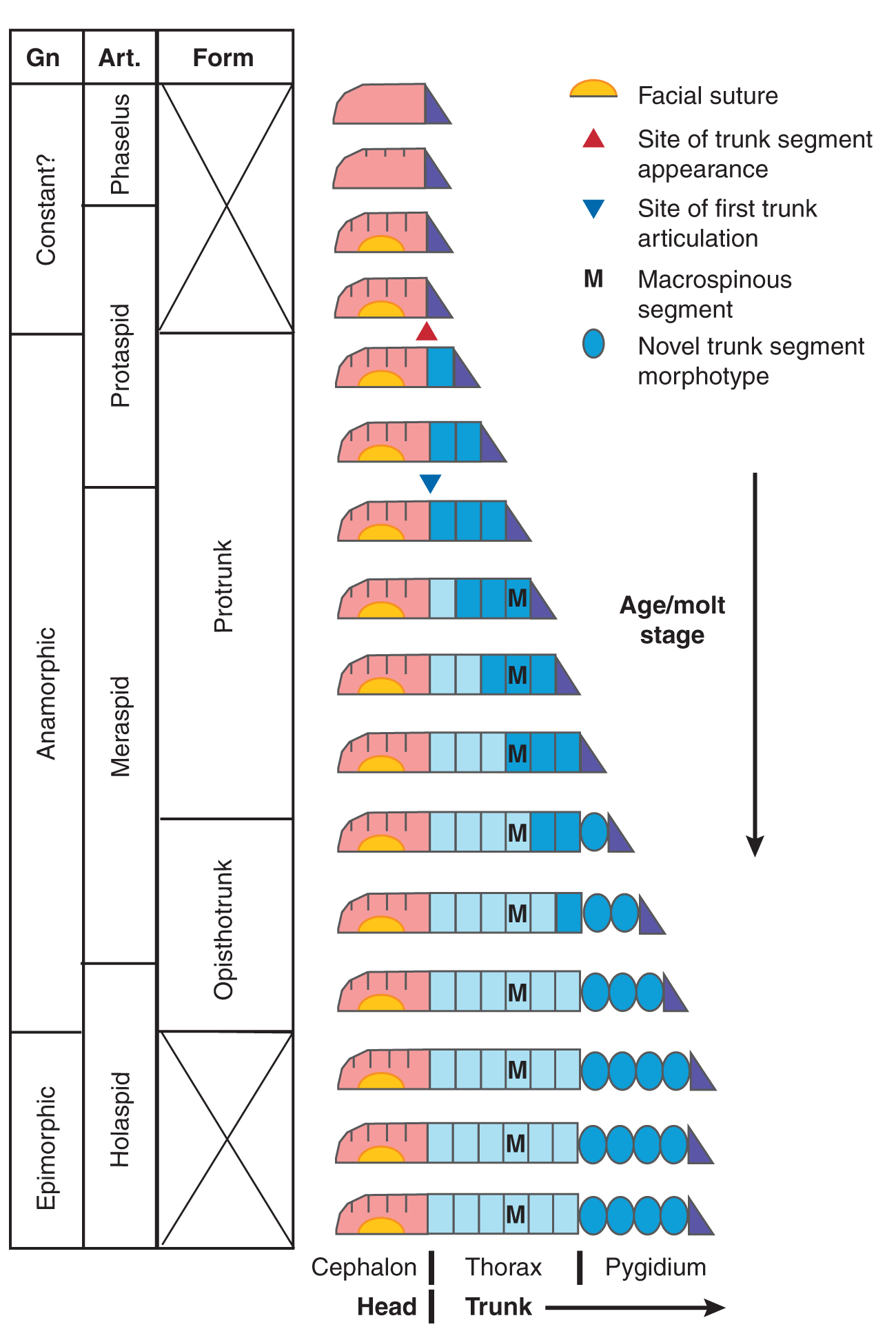
Now here’s the cool bit: a generalized staging series for trilobites. There are some broad terms for different stages — protaspid, then meraspid, then holaspid — but this diagram makes it clear that growth was by sequential addition of new segments to the posterior end of the animal. This is not an unusual pattern: vertebrates also build segments sequentially from front to back, as do many insects (the short germ band insects), but others, long germ band insects like flies, build the whole collection nearly simultaneously.

trilobitegrowth

Generalized trilobite ontogeny showing the boundaries of ontogenetic stages based on three aspects of the development of trunk segments: generation (Gn), articulation (Art), and morphology (Form). The generation state contains a poorly known initial stage that may have had a constant set of cephalic segments, the anamorphic phase during which new segments appeared in the trunk, and the epimorphic phase after which the exoskeletal segment number was constant despite continued molting. The articulation state is based on dorsal sclerite articulation pattern, with the onset of the protaspid stage marked by the development of the dorsal facial suture, onset of the meraspid stage marked by the onset of trunk articulation, and the onset of the holaspid stage marked by the completion of trunk articulation. The morphology state refers to the form of trunk segments, which in some trilobites are divided into discrete, heteronomous batches of anterior (protrunk) and posterior (opisthotrunk) segments. The site of the appearance of new trunk segments is shown for the first trunk segment only. Segment color scheme as in previous figure. Individualized segments, such as those that bore unusually large axial or pleural spines (i.e., a macrospinous condition), retained the same position relative to the cephalic margin following their first appearance, indicating that the site of appearance of new segments was subterminal, and the boundary between articulating and conjoined segments migrated posteriorly during the meraspid phase.

Development is the foundation of evolutionary change, and I can’t help but wonder how this pattern, and the unknown genetic constraints behind it, affected trilobite evolution. The early history of arthropods seems to be one of exuberant exploration of the potentials of that modular segmental organization, with trilobites tending to be more conservative than other arthropods. What that means is tricky to interpret: the more inventive arthropods still have descendants around, while trilobites are extinct without issue. But 300 million years is still a fantastically good run, and clearly they had the flexibility to survive major changes in geological history.

The real mystery is why the clade as a whole began to decline after the Ordovician, and how the end of the Permian could so thoroughly quench this gigantic group.


Hughes NC (2007) The Evolution of Trilobite Body Patterning. Annu. Rev. Earth Planet. Sci. 35:401–34.

*By the way, I recommend digging in fossil beds as a great way to connect with the history of the planet with your kids. You can’t make it to Delta? There are quarries that will sell you crates of unprocessed rock, 30 pounds for $75, and you can take them apart in your back yard.

For shame, TEDx

I thought they were going to clean up their act and stop highlighting crackpots and kooks. But oh look: there’s Rupert Sheldrake, listing all the things he finds wrong about science. How could we possibly accept the dogma that matter is unconscious? Or that genetics is measurable and material?

What I found particularly galling in the video besides the smug arrogance of Sheldrake postulating idiocy is that the audience joins in and laughs smugly at his smug assertions.

“Genes are grossly overrated.” “Species have a collective memory, even crystals do.” “Everything depends on evolving habits, not fixed laws.” Gaaah.

Oh my god: his evidence that the constants of the universe are not constant is that the reported speed of light in 1920 was 20 meters/sec greater than it is now.

Bora 1, Climate Denialist Kooks 0

This is really a thing of beauty: climate pseudoscientist Willis Eschenbach whines at the inadvertent comedy blog Watt’s Up With That that Bora Zivkovic has been moderating comments on his SciAm blog.

Eschenbach, who’s also a Mass Extinction denialist, objects to Bora’s having instituted some basic anti-troll measures at A Blog Around The Clock that relegate comments with certain field marks of the climate denialist loon to the spam bin. Says Bora, in a passage that apparently made Eschenbach’s cranial temperature spike like a Warmist hockey-stick graph:

If I write about a wonderful weekend mountain trek, and note I saw some flowers blooming earlier than they used to bloom years ago, then a comment denying climate change is trolling. I am a biologist, so I don’t write specifically about climate science as I do not feel I am expert enough for that. So, I am gradually teaching my spam filter to automatically send to spam any and every comment that contains the words “warmist”, “alarmist”, “Al Gore” or a link to Watts. A comment that contains any of those is, by definition, not posted in good faith. By definition, it does not provide additional information relevant to the post. By definition, it is off-topic. By definition, it contains erroneous information. By definition, it is ideologically motivated, thus not scientific. By definition, it is polarizing to the silent audience. It will go to spam as fast I can make it happen.

What Eschenbach doesn’t mention, and a basic point of Bora’s post on how trolls derail substantive conversation, is that climate denialism is just the most pernicious and prevalent of a number of kinds of pseudoscience that have afflicted some of the sites on SciAm of late:

I know that I used the example of Global Warming Denialism here the most – mainly because it is currently the most acute problem on our site – but the same goes for people harboring other anti-scientific ideas: creationists, anti-vaxxers, knee-jerk anti-GMO activists, and others.

This post is not about climate denial, it is about commenting and comment moderation. It is about the fact that eliminating trolls opens the commenting threads to more reasonable people who can actually provide constructive comments, thus starting the build-up of your own vigorous commenting community.

There are seven billion people on the planet, many of them potentially useful commenters on your site. Don’t scare them away by keeping a dozen trolls around – you can live without those, they are replaceable.

Eschenbach’s month-late response to Bora’s post is as pure and canonical a paean to the hallowed practice of JAQing off as I have seen. A sample:

I can only bow my head in awe. I mean, what better way is there to keep you from answering people from WUWT and other sites who might want answers to actual scientific questions, than not allowing them to speak at all?… See, Bora, the beauty of your plan is, you don’t even have to think about censorship once you do that. The computer does the hard work for you, rooting out and destroying evil thoughtcrimes coming from … from … well, from anyone associated with Watts Up With That, or with Steven McIntyre’s blog Climate Audit, or anyone that you might disagree with, or who is concerned about “alarmists”, you just put them on the list and Presto!

No more inconvenient questions!

I probably ought to feel sorry for Eschenbach: anyone who would proudly link to a piece like this alleged debunking of extinctions — as opposed to deleting it, salting the earth of the server on which it once resided, and denying under oath that you’d ever heard of the thing — is definitely more properly pitied than mocked. “No continental forest bird or mammal is recorded as having gone extinct from any cause,” Eschenbach says. That’s some Time-Cube-level obliviousness.

But I can’t help snickering, and feeling slyly jealous that Bora was able to elicit a response like that just by mentioning idly that he’s keeping his own comment threads on topic despite a massive campaign by a few fanciers of metallic haberdashery to disrupt them. Well done, my friend. Well done.

Christian hypocrisy…no surprise at all

Here’s a sign of women’s progress: you can’t get fired by a Christian school for getting pregnant anymore. That’s against the law. Unfortunately, you can still be fired for fornicating, along with a few other things.

The way that Christian organizations try to get around the Pregnancy Discrimination Act of 1978, which bars firing women for pregnancy, is to claim they’re not firing them for the pregnancy, but for the fornicating. San Diego Christian College went another step by making employees sign a pledge requiring employees to abstain from "abusive anger, malice, jealousy, lust, sexually immoral behavior including premarital sex, adultery, pornography and homosexuality, evil desires and prejudice based on race, sex or socioeconomic status." Also, drinking, which means that Jesus would not be able to teach at this college established in his name.

Which does make me wonder how the school would respond if some woman got pregnant via artificial insemination or worse, in vitro fertilization. Test case, anyone?

That doesn’t help Teri James, though. She got fired from SDCC for getting pregnant the old-fashioned way, via <gasp> fornicating with a man. Escape clause met! College has an out and can get rid of the wicked woman!

Except…in a fit of the stupids to which adherents of ridiculous religions are prone, the college turned around and offered the job to a man. The man who fathered Teri James child. Who is, presumably by the symmetry of the act, a fornicator himself.

Unless this is one of those things where it’s IOKIYAM — it’s OK if you are male.

Pricing, hell: I’ll never understand airline seating policies

For instance, why do they never give me the seat next to the panda?

pandaplane


Must be a smart panda, as it’s sitting in the emergency exit aisle and they only let competent individuals capable of assisting others do that. Remember, in the unlikely event that the oxygen masks are released from the overhead panel, always help the panda affix her mask securely before putting on your own.

Via.