Sing it, Carl

Blake Stacey has a good quote quoted at Science after Sunclipse:

The business of skepticism is to be dangerous. Skepticism challenges established institutions. If we teach everybody, including, say, high school students, habits of skeptical thought, they will probably not restrict their skepticism to UFOs, aspirin commercials, and 35,000-year-old channelees. Maybe they’ll start asking awkward questions about economic, or social, or political, or religious institutions. Perhaps they’ll challenge the opinions of those in power. Then where would we be?
— Carl Sagan, The Demon-Haunted World, Chapter 24.

–

Who needs science when you’ve got technology?

When we last encountered Virginia Heffernan, she was upset that hatefest science blogs had journalistic integrity, and encouraged everyone to read science denialist blogs instead; then the usual gang of anti-science frauds joined in, with Rod Dreher and various Catholics chiming in. It was all over the Pepsico debacle, in which the Scienceblogs management gave advertorial space to Pepsi without marking it as an ad, prompting a whole bunch of science journalists to promptly decamp…but Heffernan exposed herself as just generally anti-science in her reaction.

Now she’s back, declaring that she loves technology and dislikes science, and that she’s openly a creationist.

I assume that other people love science and technology, since the fields are often lumped together, but I rarely meet people like that. Technology people are trippy; our minds are blown by the romance of telecom. At the same time, the people I know who consider themselves scientists by nature seem to be super-skeptical types who can be counted on to denigrate religion, fear climate change and think most people—most Americans—are dopey sheep who believe in angels and know nothing about all the gross carbon they trail, like “Pig-Pen.”

Did I mention she’s a raving climate change denialist? Yeah, she’s a raving climate change denialist and a creationist, but she loves her little smart phone. And her entire argument against science is that she doesn’t understand it, it’s complicated enough to contain internal debates, and she has this bigoted stereotype of what scientists are like. Oh, and science stories are impersonal, while Bible stories are fun and amusing.

She also mentions that the just-so stories of evolutionary psychology are inconsistent BS, but she’s such a delusional twit that I can’t even agree with her there, just on principle, much as I’d like to.

You know, I don’t assume most Americans are dopey sheep. It takes a little evidence to convince me. But at least I can say that Virginia Heffernan has persuaded me that she, at least, is a dopey sheep. Maybe that’s her problem; every time she meets a scientist she opens her mouth and says something stupid, and they react appropriately.

So what else is new?

Now, not only has Ken Ham’s Ark Encounter boondoggle been delayed and delayed and delayed, but it has also shrunk. Cincinnati news reports money problems and that they’ve cut back on the grander version they proposed. You know, the big project that would create 900 jobs for the area, and got tax breaks from the state on that promise? Not going to happen. It’s been scaled down to almost a third of what was initially planned.

Answers in Genesis hoped to break ground on its "Ark Encounter" project nearly two years ago. Since then, the 172-million dollar project has been scaled back, redesigned and slowed down by a sluggish economy.

The Williamstown on the property the Ark will rest on doesn’t look much differently than it did in February of 2012. That was a few months after the original groundbreaking date. Planners insist it will be built, but they can’t say when.

…Ark Encounter’s project manager, Mike Zovath says they are working every day on the design for displays and content. They hope to get all the necessary permits for drainage and underground utilities by the end of November. But even if they had them today … "Right now we don’t have the money for construction, yet."

The Ark project has enough money to continue moving forward with the design and architecture work — but not enough to build it. They’ve raised between $12 and $15-million. " We need about $45-million to break escrow and start construction for a $60-million end project," Zovath says.

The scaled-down $60-million dollar project would include parking lots , a ticketing area and the Ark. The walled city and other features would come later. Zovath has faith in the project and points to the Creation Museum as something critics said would never be built. "I’m absolutely positive it’s going to happen."

We all know what faith is worth. Nothing at all.

Give it a few more years, and they’ll deliver a toy boat in a rubber tub with some plastic animals scattered around.

Why Cons Need Anti-Harassment Policies

Wired has an excellent article on why harassment policies are needed — it’s because the social dynamics of conventions can mess up people’s perspectives.

Conventions need anti-harassment policies. Not because convention attendees are disproportionately boorish or creepy–they’re really not–or because of social obliviousness. Rather, the difficulty lies in the very thing that makes conventions conventions: the social phenomena that come into play whenever humans gather in large groups.

Read the whole thing. It’s very thorough in discussing the psychology behind harassing behavior, and why it’s not just something evil psychopathic trolls do.

Did you know douchebags are full of dihydrogen monoxide?

Doing what I do for a living, I often find myself reading things on Facebook, Twitter, or those increasingly archaic sites called “blogs” in which the writer expresses concern about industrial effluent in our air, water, consumer products or food. Sometimes the concerns are well-founded, as in the example of pipeline breaks releasing volatile organic chemicals into your backyard. Sometimes, as in the case of concern over chemtrails or toxic vaccines, the concerns are ill-informed and spurious.

And often enough, the educational system in the United States being the way it’s been since the Reagan administration, those concerns are couched in terms that would not be used by a person with a solid grounding in science. People sometimes miss the point of dose-dependency, of acute versus chronic exposure, of the difference between parts per million and parts per trillion. Sometimes their unfamiliarity with the basic facts of chemistry causes them to make patently ridiculous alarmist statements and then double down on them when corrected.

And more times than I can count, if said statements are in a public venue like a comment thread, someone will pipe up by repeating a particular increasingly stale joke. Say it’s a discussion of contaminants in tap water allegedly stemming from hydraulic fracturing for natural gas extraction. Said wit will respond with something like:

“You know what else might be coming out of your tap? DIHYDROGEN MONOXIDE!”

!!!.999999999 . . .!

Dihydrogen monoxide is, of course, water. For the sake of quite likely wholly unnecessary but pro forma explanation, water molecules have two hydrogen atoms and one oxygen atom, hence the symbol H2O; “dihydrogen monoxide” is a way of saying “two hydrogens and one oxygen” in a way not wholly inconsistent wiith accepted chemical terminology, though not in a way anyone ever uses except as a joke.

Though I chuckled once or twice when I first heard the joke back in the end-1980s, back when kilometer-thick sheets of solid-phase dihydrogen monoxide occupied the Northern Hemisphere as far south as present-day Kentucky, it got old fast.

I recognize the temptation to poke mild fun of people who make embarrassing mistakes. I’ll cop to having done so myself, f’rinstance in the post I linked above on the phrase “patently ridiculous alarmist statements.” But it’s one thing to snicker at people who have made basic, easily correctable mistakes, especially when you offer them a way to make that correction.

The “dihydrogen monoxide” joke doesn’t do that. Instead, it mocks alleged “gullibility” in a way that dissuades the corrected from learning.

It may have been first used, as far as Wikipfftdia can tell, by students at UC Santa Cruz riffing on a very similar joke that warned people about the dangers of “hydrogen hydroxide”; the students responsible liked the joke and printed up fliers to post around campus, an early form of Tweeting. But they thought “hydrogen hydroxide” wasn’t quite viscerally scary enough to people unacquainted with chemical terminology, so they upped the ante. Everyone had heard of “carbon monoxide,” and everyone knows it’ll kill you, so the three decided on the dihydrogen monoxide synonym as much more scary.

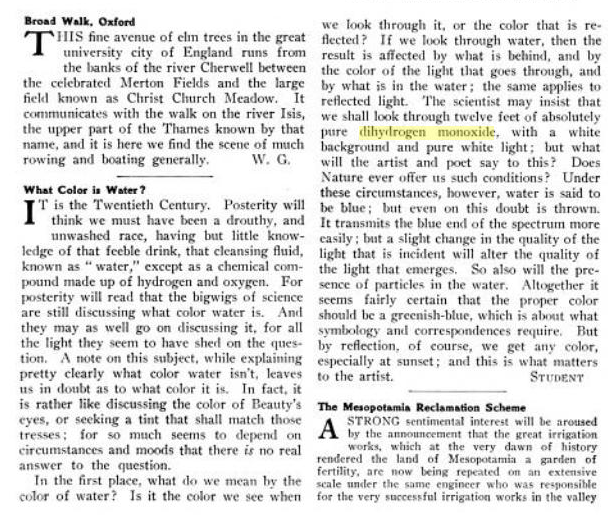
It wasn’t the first time the term had been used. Google Books records it being used as early as 1910, in a magazine snippet ironically poking fun at scientists for their abstruse technology:

Screen shot 2013-07-11 at 6.31.06 PM


There are a few other examples of the term before 1990, most of them seeming more or less innocuous. It took Usenet to make the joke version spread.

Here’s how the joke works:


  1. Someone makes a statement you find excessively ill-informed and credulous about the dangers of a real or imagined substance.
  2. You make the dihydrogen monoxide joke.
  3. Other people who are in on the joke laugh, or at least you imagine them doing so.
  4. You get a modicum of outside reinforcement of the value of your intellect, should yoou be insecure about same.
  5. The original target of the joke learns nothing, thus ensuring further opportunities for your own levity and morale-boosting.

And you know what? That’s fine if you’re fine with it. If you’re fine with a world in which there are intellectual castes, in which the Alphas get to sneer at the Betas and Gammas, who themselves have in-jokes they use to ridicule the Epsilons. For those that like that sort of thing, as Wilde said, that is the sort of thing they like.

And I understand the appeal. I know the appeal, for instance, of writing things that don’t give everything up to the casual reader, that reward the reader who’s willing to ponder, to look things up, to think about things for a while and be comfortable in not knowing what’s there all at once. That’s the whole point of literature, or poetry, of riddlles and puzzles. They’re fun. And they challenge intellectual laziness.

But ignorance — using the word in the strictly literal, non-pejorative sense — is different. Ignorance of science is an evil that for the most part is foisted upon the ignorant. The dihydrogen monoxide joke depends for its humor on ridiculing the victims of that state of affairs, while offering no solution (pun sort of intended) to the ignorance it mocks. It’s like the phrase “chemophobia.” It’s a clan marker for the Smarter Than You tribe.

The dihydrogen monoxide joke punches down, in other words. It mocks people for not having had access to a good education. And the fact that many of its practitioners use it in order to belittle utterly valid environmental concerns, in the style of (for instance) Penn Jillette, makes it all the worse — even if those concerns aren’t always expressed in phraseology a chemist would find beyond reproach, or with math that necessarily works out on close examination.

Besides, I find myself wondering how many of the people who use the dihydrogen monoxide joke would respond appropriately if they were told their Starbucks drink had been proven to contain significant amounts of oxidane. I suspect not many. If that applies to you: “oxidane” is one of two official names approved by the International Union of Pure and Applied Chemistry for a particular chemical substance. The other?  “Water,” and its equivalent in whatever your vernacular might be. See how easy that was to just explain?