Feminism is not an excuse for your racism, Pat Condell

I confess, I liked his early anti-religious rants, but as he became steadily more irate about the brown hordes invading Britain, I tuned him out…until now, when I happened to run across his latest video. Holy crap, what a racist cretin.

He’s chewing out those

…”progressive” feminists who confidently challenge everyday sexism but who are struck deaf and dumb by Islamic misogyny…they turn a blind eye to religiously endorsed wife-beating, forced marriage, honour killing, genital mutilation, organised rape gangs, sharia courts that treat women as less than fully human, and little girls forced to dress like nuns.

Turn a blind eye to Islamic misogyny, or you’ll be a racist, you racist.

Way to go, Pat! Teach those strawfeminists a thing or two!

I really don’t know of any feminists who think anything on that list is at all acceptable. Who are these mysterious feminists who have no problem with honor killing or rape gangs?

I’m looking around at my circle of progressive feminists — is it Taslima? Maryam? Ophelia? Sikivu? Heina? He seems to be flinging about wild accusations with no basis in fact here; it’s hard to even imagine a woman not deeply indoctrinated into Islam who would excuse murdering other women for infidelity, for instance.

I don’t see anyone turning a blind eye to Islamic misogyny. I do see plenty of conservative racist dorks turning a blind eye to the fact that the majority of the victims of Islamic misogyny are Muslim women, and using the abhorrent tactics of Islamic fundamentalists as an excuse to blame all Muslims for their pain.

Really. Pointing out that many Islamic cultures formally endorse hateful policies is not racism; looking at every immigrant and assuming they’re there to rape ‘your’ women is.

This kind of backward, ugly attitude towards women prevails throughout much of the Islamic world and it’s being deliberately imported wholesale into western society unchallenged and uncorrected thanks to the insane “progressive” view that all cultures are equal, except, of course, for western culture, which is inferior, and this is making life more dangerous for women.

You know that backward, ugly attitude? Islam didn’t invent it. We’ve got plenty of it to go around in the western world as well. To assume that it’s being imported by brown people into a white civilization that is innocent of sexism and misogyny is, well, racist.

It’s also a reflection of an attitude Pat seems to miss. Saying that Western culture is not necessarily superior to other cultures is not implying that we’re inferior. The attitude I see among progressive feminists is that fundamentalist Islam is well and thoroughly fucked up, as is fundamentalist Christianity and fundamentalist Judaism, and maybe we should reject all of that garbage.

The progressive part, of course, is that we also recognize that Muslims are human beings and they deserve equal rights. That’s the equality I endorse. Maybe Condell is confused because he thinks they don’t deserve that?

And now this is flaming racism.

Norway and Sweden used to be among the safest for women. Now they’re best known for their high levels of Islamic immigrant rape that nobody in power wants to acknowledge or do anything about that because that would be racist.

Consequently, Norwegian and Swedish women are no longer safe in their own countries, for cultural reasons. Indeed, Sweden has been so “enriched” by Islamic immigration that its women statistically have a 25% chance of being raped in their lifetime.

Oh, god. That is so dishonest; this is the kind of lies fed to a racist public by right wing tabloids. Sweden does have a remarkably high rate of reported rapes. But that’s because, as a progressive culture, they’ve taken great care to document all cases of sexual abuse. Nothing gets swept under the rug.

But that is a misconception, according to Klara Selin, a sociologist at the National Council for Crime Prevention in Stockholm. She says you cannot compare countries’ records, because police procedures and legal definitions vary widely.

"In Sweden there has been this ambition explicitly to record every case of sexual violence separately, to make it visible in the statistics," she says.

"So, for instance, when a woman comes to the police and she says my husband or my fiance raped me almost every day during the last year, the police have to record each of these events, which might be more than 300 events. In many other countries it would just be one record – one victim, one type of crime, one record."

Condell is holding the conscientious record keeping of Swedes against them. This misleading statistic has been widely reported, so there’s no excuse for this lie…unless he gets all of his news from the Daily Mail.

And to imply that this surge of Swedish rapes is a consequence of raping hordes of Muslim immigrants is simply unconscionable. Given that between one in five and one in six women in America (and one in three if you’re Indian!) will be raped in their lifetime, with the more stringent requirements for counting an act as rape here, a figure of one in four for Sweden does not sound remarkable in comparison. Remarkable that it’s so damn high, but not remarkable in that it’s so high everywhere, even in the US, where we can’t blame it on an invasion of Muslim rapists.

Wait, you do need a cherry on top of all this racism, don’t you?

So forgive me for being blunt about this, girls, but there are more important things to get angry about than offensive language on twitter or sexist comments about your appearance.

Fuck you, too, Pat. We can be angry about genital mutilation and honor killings at the same time we’re angry about cranky old racists who are still fussed about every new wave of immigration since the Normans, and about sexist dudes who think they should be given a free pass on calling women “bitches” and “cunts” because they can find someone else who did something worse. We’re also quite capable of evaluating the relative harm of each of those without you falsely telling us that some of them do zero harm and must be ignored. You don’t get to tell me what I’m allowed to be enraged over, and let me assure you, I’ve got enough anger at all of these cultural toxins to go around. My fury encompasses whole worlds, and you’re right there in the list with mullahs and popes and KKK members and Republicans and assholes on youtube and members of UKIP and the English Defence League.

Boy.


Rebecca Watson seems to be somewhat sarcastic, but wow there are some similarities here.

Why are all your speakers older white men?

We asked several women and people of color to participate but unfortunately none were able to make it. We’re not sure why, but it’s a shame because we were planning a workshop with Richard Dawkins titled, “Things Marginalized People Should and Should Not Be Angry About: Everyday Bigotry (No) and Religion (Yes).”

Villainy made interesting

Tauriq Moosa is writing about villains in computer games. It was weird, it started out reminding me of me.

Stereotype dictates he be male, control a horde of minions, and have a fortress somewhere lit by flashes of thunder. His plans are some unfathomably weird concoction of revenge and pure malice, directed at something unachievable and vague – like “world domination” – and born from some dark deed or horrid wrong done to him or a loved one. He probably is talented at creating weird gadgets and weapons which, without fail, will fail.

Except for that last sentence. My plans never fail! NEVER! Mwuahahahaha!

Moosa’s point, though, is that that kind of fictional villain is boring — there’s no depth, no motivation, he’s just there — and describes a couple of video games where the bad guys are more complex.

I thought of a transitional form: Dr Horrible. It’s done for humor, but the pieces of the stereotype are all there. The villain is just a villain for villainy’s sake at the start, and he’s also got all the toys of the stereotypical mad scientist, but then it slowly becomes clear that he’s really craving the prestige of being recognized by bigger villains, and it gets all messy and complicated with the introduction of a hero who is a manipulative stuffed shirt, and The Girl…who complete tangles up The Villain’s motivations. And then there’s the inevitable Tragedy.

What makes it interesting is that it’s all told from the villain’s perspective, and he goes from moral simpleton to…moral simpleton who’s aware of the magnitude of his mistakes. That’s what makes the story interesting, is that the character changes and grows a little bit, in this case just enough to realize what a screw-up he is.

Isn’t that really what we expect from a good story? That people change in interesting ways over its course?

You’re going to make me work again, aren’t you?

Donations to the Light the Night Fundraiser are getting awfully close to the next landmark of $5000; we’re at $4748. Get there and I’m going to have to write a post about tumor suppressors, and I know you’re all just panting away with lust for that.

Then there’s a long stretch to $10K, so maybe I should add something at $7500. A post on micro RNAs and cancer, I think?

By the way, we’re getting matching funds from Todd Stiefel, who has now promised to get a red buzz-mohawk if we hit $20K. That’s a really long stretch, but if we make that, I’ll have to think of something even better. What is it with everyone doing exotic things to their hair? We’re supposed to be public intellectuals, shouldn’t we be doing weird things with our brains?

That isn’t how diversity works

Some people didn’t like Bill Nye’s appearance on “Dancing With The Stars”. That’s OK, maybe he’s not such a great dancer…oh, wait, they didn’t like it because it was bad for science? What?

Nye wore a lab coat while he and his partner did the chachacha to the song "Weird Science," while dancing through a set of life-sized beakers. Nye’s appearance on Dancing was so bad it has him facing elimination, after getting the lowest score in the bunch.

His dance did end with fans cheering his name, and he had the biggest social media buzz of any contestants.

But I think his over-the-top performance on "Dancing With The Stars" on Monday night was a disservice to the science community by reinforcing stereotypes that scientists are nerdy, old white men who can’t dance. These stereotypes are what keep women and minorities out of science.

Hang on a minute there. I’m all for more diversity in science, and think there should be more women and minorities in the game. That does not mean that we nerdy old white men have to go crawl into a closet somewhere. The idea is that more women and minorities can get opportunities to do science and get promoted within their disciplines, not that old white men have to stop dancing. I don’t even see the connection here: is it the stereotype that black men are better dancers? That women are prettier on the dance floor? That dancing has anything at all to do with success in a science career?

Bill Nye is a very famous science popularizer (that the audience was chanting his name is a good sign of what he has done for science), and he apparently also likes to dance. Unless he beat up or intimidated a better woman to earn that slot on the show, or some kind of silent discrimination kept a more worthy black scientist from getting a chance to hoof it on the dance floor, I say good for Bill Nye, and yes, nerdy old white men are still allowed to be scientists and to dance. And that’s good for science, because it humanizes the people who are doing science.

Also, I thought Nye was a pretty good dancer…maybe not the best ever, but far, far better than I am. Are we really going to oppose the stereotype that nerdy scientists can’t dance by telling them to not dance?

“Mindy” sounds nothing like “Xena”

Have you heard about this book, Warrior Princess, by Mindy Budgor? It’s about a young California woman who spent a whole 3 months to become a mighty Warrior Princess of the Maasai. They’re discussing this blithe bit of cocksure cultural imperialism at Making Light. I rather liked this comment:

Some daft billionaire ought to sponsor scholarships for curious Masai and Amazonians who want to study the rich spiritual traditions of Ozarks auto mechanics, or take part in the initiation rites of Dakota wheat farmers.

I know about those Dakota rites. They all involve cow tipping, so there is a deep spiritual linkage with the Maasai already.

I’m not the troll, but I think they caught one in their sample

I got a strange email the other day.

Dear Troller

Dear Dr Myers, I note that you are trolling our work Please find attached a copy of our SPIE paper which we gave in San Diego. I would welcome the opportunity to give a talk at you Institution so that you, with all your infinite wisdom, could shoot me down in flames and make a fool of me. However, I doubt that you have the balls ! Professor Milton Wainwright

“Trolling” their work? And who the heck is Milton Wainwright? And then I looked at the paper and realized…

Earlier this week, someone had told me that there was another loony “organisms from space” paper touted as proof that British scientists had discovered alien life published in that joke journal, the Journal of Cosmology by this guy Wainwright, and I admit it, I took a quick look at his goofy blog. But that’s it! All I did was read it! I didn’t comment or write about it here!

For a moment I had this terrible thought that maybe the crackpots have finally figured out how to read our minds.

But then I realized that these guys get so little attention paid to them that they probably carefully scrutinize their tiny little referer logs, and they noticed that someone from Morris, Minnesota stopped by, and obviously, since I’m the sole inhabitant of this eerily empty ghost town on the prairie, it must have been me.

So now merely reading their work is trolling.

Well, now I guess I’m obligated to follow through. I had read their paper and decided it was more of the same ol’, same ol’ and hadn’t said anything then, but I’m willing to summarize it.

It’s crap.

The data collection is fine. They’re lofting balloons into the stratosphere, and at a designated altitude, are opening a trap that allows dust, debris, small organisms, and so forth to settle and adhere to EM stubs. Then the trap is closed, the balloon descends, and they put the stubs on the electron microscope and see what is floating around in the atmosphere.

So far, so good. The problem lies in the interpretation. They’re then sorting the material observed into known vs. unknown, where “known” is clearly material from earth, and “unknown” is immediately categorized as Possible Signs of Extraterrestrial Life. The logic doesn’t work. It makes no sense. You’re looking at low density airborne particles in the atmosphere of a planet; it’s not as if we’ve come even close to categorizing all the particles of terrestrial origin, so you can’t play this game of assigning subsets to some other source outside our world.

The authors also have a bad case of apophenia. Almost every bit of unrecognizable garbage they spot is called “life”. Here is one of their examples.

A, Sheet-like inorganic material recovered from the stratosphere which is clearly not biological; and B, a  clump of stratospheric cosmic dust which includes coccoid and rod shaped particles which may, or may not, be  bacteria.

A, Sheet-like inorganic material recovered from the stratosphere which is clearly not biological; and B, a clump of stratospheric cosmic dust which includes coccoid and rod shaped particles which may, or may not, be bacteria.

So the sheet-like stuff to the left is not biological (how they know that, I don’t know and they don’t tell us — I think it’s “it doesn’t look like it to my untrained eye”), while the amorphous blob to the right may or may not be biological. In other words, the information content in this image is precisely zero. (By the way, that mess on the right doesn’t look at all bacterial to me.)

In other cases they flat out claim that the blob they see is biological.

An unknown biological entity isolated from the stratosphere

An unknown biological entity isolated from the stratosphere

Unequivocally biological, no less. How they know, I again don’t know. It seems to be that when they stare at it and do a little subjective pattern matching, they call something a “neck” and something else a “body” — that is, they slap labels on things that conform to their beliefs about the morphology of organisms.

The structure shown in Fig.3 however is unequivocally biological. Here we see a complex organism which has a segmented neck attached to a flask-shaped body which is ridged and has collapsed under the vacuum of the stratosphere or produced during E/M analysis. The top of the neck is fringed with what could be cilia or a fringe which formed the point of attachment of the neck to another biological entity. The complexity of this particle excludes the possibility that is of non-biological in origin.

Complexity does not exclude a non-biological source. Also, just saying that things have names similar to the names we’d give a life form does not support the claim that it is anything other than a subjective interpretation of some debris.

They have another example that demonstrates my point.

A collapsed balloon-like biological entity sampled from the stratosphere. Note the “proboscis” to the left,  with nose-like openings and the “sphincter” present at the top of the organism

A collapsed balloon-like biological entity sampled from the stratosphere. Note the “proboscis” to the left, with nose-like openings and the “sphincter” present at the top of the organism

The structure shown in Fig.4 is also clearly biological in nature; here we see a somewhat phallic balloon-like structure which has presumably collapsed under low pressure. A “proboscis” is seen emerging from the left of the main cell which has two, nostril-like openings. At the top of the collapsed “balloon” is a sphincter-like opening. Again, this entity is clearly biological in nature, and is not an inorganic artefact. Although it is clearly not a bacterium it could well be an alga or a protozoan of some kind. The organisms shown in Figs. 3 and 4 are presumably clear enough for experts in the relevant branches of taxonomy to provide some kind of identification.

Why would an alga or a protist have a proboscis with nostrils? Do they have multiple samples that exhibit a similar shape? Isn’t it more likely to be a random scrap of material, rather than the patterned shape of an organism?

gnomish

Oh, wait. They missed something: look at that wrinkle at the bottom right of the object. It looks like…a pointy ear. And then there’s the nose, alright, and a robust jaw beneath it. By golly, it’s the tiny decapitated head of a gnome that was less than a tenth of a millimeter tall in life! And its forehead has been bashed in, no doubt in a great battle between microcosmic fairy tribes waged by thrip-mounted cavalry in the skies!

I think that’s a more plausible explanation than the authors’ similarly evidence-free guess that unidentified particles are signs of extraplanetary life.

Also, I thought Journal of Cosmology was defunct — it was up for sale, complete with crude slymepit-style parting shots at me. I guess it’s still dribbling on, providing a forum for the worst and dumbest kinds of pseudoscience.


By the way, Rawn Joseph, former(?) owner of the JoC, appears to have had a rather nasty falling out with Chandra Wickramasinghe, who he accuses of theft and plagiarism.

Smart talk about school sports

US schools are weird places where athletes, not scholars, are the stars — it was that way when I was growing up, it’s that way now. High schools spend huge sums of money on sports, and colleges are on their way to becoming professional sports franchises instead of institutions of learning (I was shocked in the grocery store yesterday to see Time’s cover story: It’s time to pay college athletes”. No, it’s not.) It erodes the purpose of education and skews priorities…and too often, the coach is the highest paid employee, and when they also acquire cult status, abuses follow. Think Penn State. Now go take a shower.

This story in the Atlantic, The Case Against High School Sports, starts off dismally, describing the sorry and familiar state of high schools across the country, where more money is spent on football than math. And just to make it even worse, we get a brief history lesson: would you believe our emphasis on sports is rooted in racism and Christianity? Of course you would.

At the time [1900s], the United States was starting to educate its children for more years than most other countries, even while admitting a surge of immigrants. The ruling elite feared that all this schooling would make Anglo-Saxon boys soft and weak, in contrast to their brawny, newly immigrated peers. Oliver Wendell Holmes Sr. warned that cities were being overrun with “stiff-jointed, soft-muscled, paste-complexioned youth.”

Sports, the thinking went, would both protect boys’ masculinity and distract them from vices like gambling and prostitution. “Muscular Christianity,” fashionable during the Victorian era, prescribed sports as a sort of moral vaccine against the tumult of rapid economic growth. “In life, as in a foot-ball game,” Theodore Roosevelt wrote in an essay on “The American Boy” in 1900, “the principle to follow is: Hit the line hard; don’t foul and don’t shirk, but hit the line hard!”

But that isn’t what the story is about. It’s about an experiment: a school in Texas shut down their athletic program in the face of a budget crisis.

Last year in Texas, whose small towns are the spiritual home of high-school football and the inspiration for Friday Night Lights, the superintendent brought in to rescue one tiny rural school district did something insanely rational. In the spring of 2012, after the state threatened to shut down Premont Independent School District for financial mismanagement and academic failure, Ernest Singleton suspended all sports—including football.

To cut costs, the district had already laid off eight employees and closed the middle-school campus, moving its classes to the high-school building; the elementary school hadn’t employed an art or a music teacher in years; and the high school had sealed off the science labs, which were infested with mold. Yet the high school still turned out football, basketball, volleyball, track, tennis, cheerleading, and baseball teams each year.

Football at Premont cost about $1,300 a player. Math, by contrast, cost just $618 a student. For the price of one football season, the district could have hired a full-time elementary-school music teacher for an entire year. But, despite the fact that Premont’s football team had won just one game the previous season and hadn’t been to the playoffs in roughly a decade, this option never occurred to anyone.

“I’ve been in hundreds of classrooms,” says Singleton, who has spent 15 years as a principal and helped turn around other struggling schools. “This was the worst I’ve seen in my career. The kids were in control. The language was filthy. The teachers were not prepared.” By suspending sports, Singleton realized, he could save $150,000 in one year. A third of this amount was being paid to teachers as coaching stipends, on top of the smaller costs: $27,000 for athletic supplies, $15,000 for insurance, $13,000 for referees, $12,000 for bus drivers. “There are so many things people don’t think about when they think of sports,” Singleton told me. Still, he steeled himself for the town’s reaction. “I knew the minute I announced it, it was going to be like the world had caved in on us.”

Texas was smarter than Minnesota. Our local schools had a budget problem a few years ago; they gutted a fantastic theater program in response. They still have a football team, so I guess that wasn’t cut.

People are always trying to argue that these sports programs pay for themselves, and I don’t believe it for a minute. There’s a fair amount of deceptive accounting going on: when a college is sinking millions into a new stadium and flying coaches and players to Hawaii for a bowl game, you know there is a tremendous amount of cash flowing all which ways, and that it’s not an indulgence the school would spend to send the chemistry club to Iowa for a conference.

In many schools, sports are so entrenched that no one—not even the people in charge—realizes their actual cost. When Marguerite Roza, the author of Educational Economics, analyzed the finances of one public high school in the Pacific Northwest, she and her colleagues found that the school was spending $328 a student for math instruction and more than four times that much for cheerleading—$1,348 a cheerleader. “And it is not even a school in a district that prioritizes cheerleading,” Roza wrote. “In fact, this district’s ‘strategic plan’ has for the past three years claimed that math was the primary focus.”

Many sports and other electives tend to have lower student-to-teacher ratios than math and reading classes, which drives up the cost. And contrary to what most people think, ticket and concession sales do not begin to cover the cost of sports in the vast majority of high schools (or colleges).

But the real question is, what was the result of the experiment? Did unspent testosterone lead to region wide riots? Did unhappy, depressed students slump into nihilism and despair? Nope.

That first semester, 80 percent of the students passed their classes, compared with 50 percent the previous fall. About 160 people attended parent-teacher night, compared with six the year before. Principal Ruiz was so excited that he went out and took pictures of the parking lot, jammed with cars. Through some combination of new leadership, the threat of closure, and a renewed emphasis on academics, Premont’s culture changed. “There’s been a definite decline in misbehavior,” says Desiree Valdez, who teaches speech, theater, and creative writing at Premont. “I’m struggling to recall a fight. Before, it was one every couple of weeks.”

Suspending sports was only part of the equation, but Singleton believes it was crucial. He used the savings to give teachers raises. Meanwhile, communities throughout Texas, alarmed by the cancellation of football, raised $400,000 for Premont via fund-raisers and donations—money that Singleton put toward renovating the science labs.

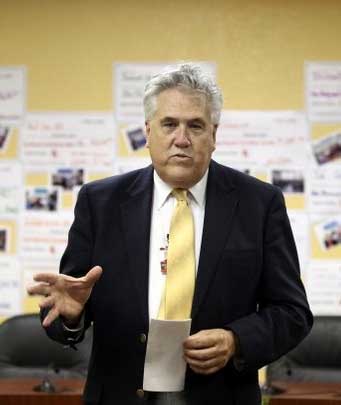
That last line? Ernest Singleton is my hero. Here’s his picture.

Michael Zamora/Caller-Times Ernest Singleton answers questions from school board members from across the state Thursday, March 7, 2013 at the Premont school district’s board room in Premont. On the wall hangs each of the large checks the district received from schools across the Coastal Bend to help Premont build their new science labs.

Michael Zamora/Caller-Times

Ernest Singleton answers questions from school board members from across the state Thursday, March 7, 2013 at the Premont school district’s board room in Premont. On the wall hangs each of the large checks the district received from schools across the Coastal Bend to help Premont build their new science labs.

Now if only more schools would follow suit. School athletics are fine, if they are regarded appropriately, as light entertainment and an exercise in community engagement. It’s when they become the focus of the school that they become a destructive distraction.

What are oncogenes?

I’m trying to raise money for the The Leukemia &amp Lymphoma Society, and I promised to do a few things if we reached certain goals. I said I’d write a post explaining what oncogenes are, while wearing a pirate hat, if we raised $2500. So here you go, arrr.

madpiratemyers

If you want more, go to my Light the Night fundraising page and throw money at it. I’ll write the next part when we hit $5000. Note that we’re also getting matching funds from the Todd Stiefel Foundation, so join in, it’s a good deal.

Cancer is not a creative, original disease; it has not been honed by ages of evolution to craft novel lines of attack on your body. Instead, it’s an opportunistic thief. Cancer misuses and perverts existing processes in your cells to send them out of control. Everything cancer does is simply the same thing your cells normally do, only amplified and unconstrained, driven by damage to the genes that would normally regulate their behavior.

Here’s a metaphor, a car with a dangerous defect. It has acquired a glitch in the accelerator so that every time you start it up, it immediately roars up to full speed, as if you’d floored the pedal. The problem hasn’t created anything new in the car, it’s just taken something you normally need to do, that is, regulate the speed of the machine, and stripped you of all ability to control it. That’s what an oncogene does; it is a gene that is normally involved in controlling the rate of cell proliferation, for instance, and a mutation has broken it in such a way that it now tells the cell to divide as rapidly as possible.

Now if you were driving down the freeway and suddenly your accelerator were stuck and you couldn’t slow it down, you’d have alternative strategies to stop (and so does the cell). You could hit the brakes or shift gears or turn off the ignition key. Cancers acquire another set of mutations that destroy the ability to shut off cell processes, analogous to breaking the brake pedal or snapping off the gear shift handle. These genes that can block the effects of out-of-control cell regulators are called tumor suppressors, and I’ll write about those at another time. Today I focus on oncogenes, regulators of the cell that must be damaged by mutation to produce an excessive response.

The first concern that comes to everyone’s mind is that you don’t want to have your cells running amuck — no one wants cancer. Just as you can do your best to maintain your car, you can also live sensibly — eat in moderation, avoid carcinogens or other behaviors that expose you to radiation, and get regular checkups — to reduce the likelihood of deleterious mutations. But they can happen anyway, through no fault of your own. Every time your cells divide, there is a very small chance of an error in replication that inserts a mutation into an oncogene. Just existing, even while doing everything exactly right to maximize your health, brings with it a base chance for a mutation. Given normal rates of cell division, every single one of you reading this is going to acquire about 20,000 DNA lesions today and every day. Almost every one of them will be patched up by DNA repair mechanisms (you have no idea how important DNA repair is to your continued health), but even so, one will occasionally slip through — over your lifetime, your cells will acquire an estimated 10,000 mutations. Live long enough, playing these odds, and cancer is essentially inevitable.

So cancer is fundamentally a chance process. There is no reason people get cancer, no purpose behind it, and everyone is susceptible. Some behaviors can increase the odds — smoking, failing to use sunblock — and you can also inherit genetic predispositions that increase the likelihood of acquiring a full set of mutations that lead to cancer, but ultimately, no one is at fault for cancer.

So what can go wrong? The diagram below is a simplified illustration of the various signaling networks in the cell. These are some of the pathways by which cells are told to regulate their behavior.

signalingnetwork

I’m going to focus on just the greenish box in the middle, the one labeled “Proliferation Circuits”, just to keep it simple. Think of that as the accelerator peddle for your cells. Sometimes your cells need to be encouraged to proliferate. For example, during childhood there are general signals to encourage stable patterns of growth, and during adolescence there may be novel hormonal signals to encourage new growth of selected populations of cells. If you’re injured, local growth factors are secreted to encourage cells to divide and repair the damage. So that’s what you’re seeing on the far left: growth factors and hormones can send a signal to the cell to give it permission to grow.

In order for a signal to be received, the cell has receptors on its surface that can bind to the growth factors and hormones. When a receptor binds to a signal, it changes to send a signal to other proteins (all those green circles) inside the cell. Think of it as like a doorbell; growth factor comes calling, presses the doorbell/receptor, the bell rings/sends a chemical signal into the interior, all the proteins get busy.

You can probably imagine how this system could get broken already. What if the receptor were damaged in such a way that it constantly sent a signal inwards, even if no growth factor were present (this is called becoming constitutively active)? What if one of the internal proteins were damaged in such a way to become constitutively active, so that it acted as if it were seeing the receptor as bound to a growth factor, even if it wasn’t? Now the cell is being constantly lied to by its sensory apparatus, and behaves as if it were being constantly told by the body to divide and divide and divide — it is on the road to being cancerous.

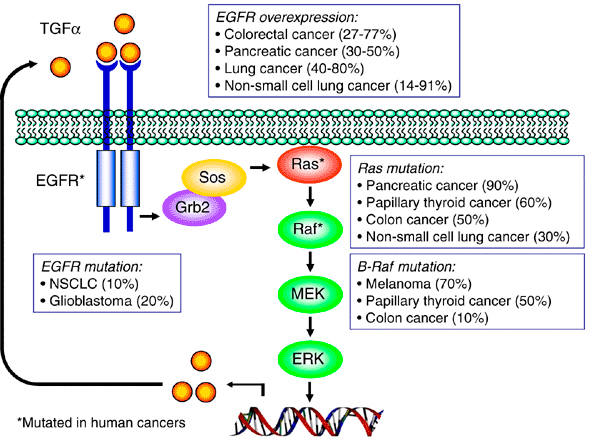
Let’s look a little bit closer at that pathway and give some of those green balls a name. This is the Ras-Raf signaling pathway.

ras-raf

It’s a bit Rube-Goldbergian, but hey, that’s biology. In the top left corner you see something called EGFR, short for epidermal growth factor receptor. That’s our doorbell; the asterisk after the name in this diagram means that you see it mutated fairly frequently in human cancers. The box explains that it is seen to be damaged in 10-20% of certain kinds of cancers; when it’s mutated, it acts as if its signal, TGFα (Transforming Growth Factor Alpha) is always present. EGFR may also be perfectly normal, except that it is overexpressed, that is, present in a far greater number of copies on the cell surface, which makes the cell particularly sensitive to tiny quantities of growth factor. This happens even more frequently in many cancers.

The next steps in the pathway involve switching on Sos/Grb2, which activates Ras (look at the box; Ras is very commonly mutated in a great many cancers), which activates Raf, which activates MEK, which activates ERK, which promotes DNA replication. This is called a signaling cascade, and these kinds of sequences are all over the place in the cell. The advantages of this pattern is that many steps can be amplification steps, where one activated protein switches on many copies of the next protein in the sequence, and also each step is an opportunity for regulation.

Now be strong: I’m going to look even more closely at a key oncogene, Ras. Ras is important; it’s a central regulator of proliferative processes in the cell, and it is commonly one of the proteins made constitutively active in cancers.

ras

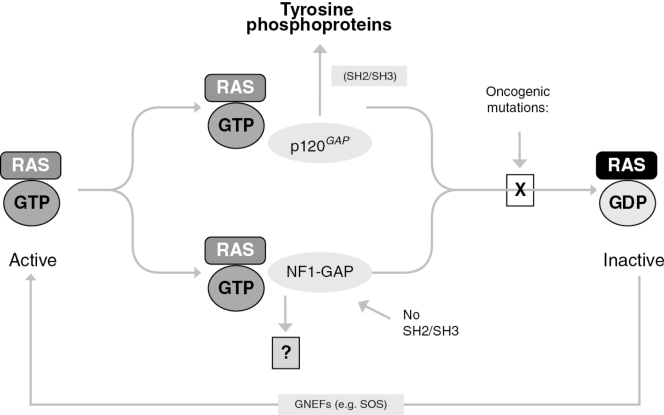
How is Ras switched on and off? In order to be active, Ras needs to be bound to a small molecule called GTP, guanine triphosphate, a base with three phosphate groups attached to it. It must be three; anything less, it isn’t active, so if it is bound to GDP, guanine diphosphate, it is inert. When it is bound to GTP, Ras changes shape to open up a binding site that can dock with the next protein in the chain, Raf, and activate it in turn.

Ras is switched on by the previous protein in the chain, SOS. SOS is a guanine exchange factor, and from the name, you can guess what it does: it swaps out the stultifying GDP molecule from Ras and replaces it with the energizing GTP molecule. Which allows it to bind with Raf, which then activates MEK, etc.

What switches Ras off? Ras is also an enzyme, specifically a GTPase — it cleaves its own GTP into a GDP. It turns itself off! What this means is that it acts as a kind of momentary switch. When a growth factor molecule arrives at the cell, Ras will respond by briefly initiating the cell division machinery, and then shutting itself down. It needs a sustained signal to keep cell division humming — a little triggering flicker of a random molecule bumping into the cell is not enough. This makes a lot of sense for cell cycle control. Ras is a reluctant activator, always hesitating and drawing back, and it needs constant prodding from external signals to keep doing its job.

Except when it’s mutated.

The most common cancer-inducing mutation in Ras is a single amino acid change in the 12th codon of its gene that greatly reduces the effectiveness of its GTPase activity. It binds GTP, becomes active, and then does not cleave the GTP — it clings to it instead. It switches from being a reluctant activator of cell division to instead being an avid, hyperactive activator — any transient signal, even a bit of noise, becomes an excuse to tell the cell to start dividing madly.

And that’s the beginning of a cancer, a rogue protein, made by an oncogene, that’s telling the normal, healthy cellular machinery to do its thing when it shouldn’t.

There’s much more to cancer than that, of course — cancer is more than just excessive cell division, and also the cell has many fail-safes, the tumor suppressor genes, that are supposed to put the brakes on when renegade proteins are going wild. But — oh, and this is cruel of me — to hear that part of the story, you’ll have to donate to my Light the Night fundraising page. When we get to $5000, I’ll tell you all about tumor suppressors.


Croce CM (2008) Oncogenes and cancer. N Engl J Med. 358(5):502-11.

Hanahan D, Weinberg RA (2011) Hallmarks of cancer: the next generation. Cell 144(5):646-74.

Hesketh R (2013) Introduction to Cancer Biology. Cambridge University Press.