Smart talk about school sports

US schools are weird places where athletes, not scholars, are the stars — it was that way when I was growing up, it’s that way now. High schools spend huge sums of money on sports, and colleges are on their way to becoming professional sports franchises instead of institutions of learning (I was shocked in the grocery store yesterday to see Time’s cover story: It’s time to pay college athletes”. No, it’s not.) It erodes the purpose of education and skews priorities…and too often, the coach is the highest paid employee, and when they also acquire cult status, abuses follow. Think Penn State. Now go take a shower.

This story in the Atlantic, The Case Against High School Sports, starts off dismally, describing the sorry and familiar state of high schools across the country, where more money is spent on football than math. And just to make it even worse, we get a brief history lesson: would you believe our emphasis on sports is rooted in racism and Christianity? Of course you would.

At the time [1900s], the United States was starting to educate its children for more years than most other countries, even while admitting a surge of immigrants. The ruling elite feared that all this schooling would make Anglo-Saxon boys soft and weak, in contrast to their brawny, newly immigrated peers. Oliver Wendell Holmes Sr. warned that cities were being overrun with “stiff-jointed, soft-muscled, paste-complexioned youth.”

Sports, the thinking went, would both protect boys’ masculinity and distract them from vices like gambling and prostitution. “Muscular Christianity,” fashionable during the Victorian era, prescribed sports as a sort of moral vaccine against the tumult of rapid economic growth. “In life, as in a foot-ball game,” Theodore Roosevelt wrote in an essay on “The American Boy” in 1900, “the principle to follow is: Hit the line hard; don’t foul and don’t shirk, but hit the line hard!”

But that isn’t what the story is about. It’s about an experiment: a school in Texas shut down their athletic program in the face of a budget crisis.

Last year in Texas, whose small towns are the spiritual home of high-school football and the inspiration for Friday Night Lights, the superintendent brought in to rescue one tiny rural school district did something insanely rational. In the spring of 2012, after the state threatened to shut down Premont Independent School District for financial mismanagement and academic failure, Ernest Singleton suspended all sports—including football.

To cut costs, the district had already laid off eight employees and closed the middle-school campus, moving its classes to the high-school building; the elementary school hadn’t employed an art or a music teacher in years; and the high school had sealed off the science labs, which were infested with mold. Yet the high school still turned out football, basketball, volleyball, track, tennis, cheerleading, and baseball teams each year.

Football at Premont cost about $1,300 a player. Math, by contrast, cost just $618 a student. For the price of one football season, the district could have hired a full-time elementary-school music teacher for an entire year. But, despite the fact that Premont’s football team had won just one game the previous season and hadn’t been to the playoffs in roughly a decade, this option never occurred to anyone.

“I’ve been in hundreds of classrooms,” says Singleton, who has spent 15 years as a principal and helped turn around other struggling schools. “This was the worst I’ve seen in my career. The kids were in control. The language was filthy. The teachers were not prepared.” By suspending sports, Singleton realized, he could save $150,000 in one year. A third of this amount was being paid to teachers as coaching stipends, on top of the smaller costs: $27,000 for athletic supplies, $15,000 for insurance, $13,000 for referees, $12,000 for bus drivers. “There are so many things people don’t think about when they think of sports,” Singleton told me. Still, he steeled himself for the town’s reaction. “I knew the minute I announced it, it was going to be like the world had caved in on us.”

Texas was smarter than Minnesota. Our local schools had a budget problem a few years ago; they gutted a fantastic theater program in response. They still have a football team, so I guess that wasn’t cut.

People are always trying to argue that these sports programs pay for themselves, and I don’t believe it for a minute. There’s a fair amount of deceptive accounting going on: when a college is sinking millions into a new stadium and flying coaches and players to Hawaii for a bowl game, you know there is a tremendous amount of cash flowing all which ways, and that it’s not an indulgence the school would spend to send the chemistry club to Iowa for a conference.

In many schools, sports are so entrenched that no one—not even the people in charge—realizes their actual cost. When Marguerite Roza, the author of Educational Economics, analyzed the finances of one public high school in the Pacific Northwest, she and her colleagues found that the school was spending $328 a student for math instruction and more than four times that much for cheerleading—$1,348 a cheerleader. “And it is not even a school in a district that prioritizes cheerleading,” Roza wrote. “In fact, this district’s ‘strategic plan’ has for the past three years claimed that math was the primary focus.”

Many sports and other electives tend to have lower student-to-teacher ratios than math and reading classes, which drives up the cost. And contrary to what most people think, ticket and concession sales do not begin to cover the cost of sports in the vast majority of high schools (or colleges).

But the real question is, what was the result of the experiment? Did unspent testosterone lead to region wide riots? Did unhappy, depressed students slump into nihilism and despair? Nope.

That first semester, 80 percent of the students passed their classes, compared with 50 percent the previous fall. About 160 people attended parent-teacher night, compared with six the year before. Principal Ruiz was so excited that he went out and took pictures of the parking lot, jammed with cars. Through some combination of new leadership, the threat of closure, and a renewed emphasis on academics, Premont’s culture changed. “There’s been a definite decline in misbehavior,” says Desiree Valdez, who teaches speech, theater, and creative writing at Premont. “I’m struggling to recall a fight. Before, it was one every couple of weeks.”

Suspending sports was only part of the equation, but Singleton believes it was crucial. He used the savings to give teachers raises. Meanwhile, communities throughout Texas, alarmed by the cancellation of football, raised $400,000 for Premont via fund-raisers and donations—money that Singleton put toward renovating the science labs.

That last line? Ernest Singleton is my hero. Here’s his picture.
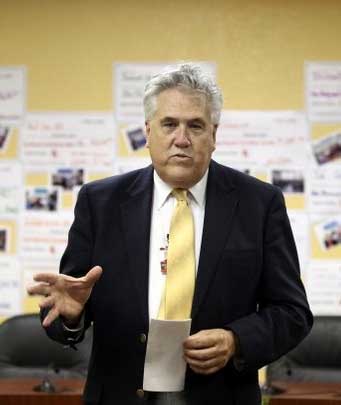
Michael Zamora/Caller-Times Ernest Singleton answers questions from school board members from across the state Thursday, March 7, 2013 at the Premont school district’s board room in Premont. On the wall hangs each of the large checks the district received from schools across the Coastal Bend to help Premont build their new science labs.

Michael Zamora/Caller-Times

Ernest Singleton answers questions from school board members from across the state Thursday, March 7, 2013 at the Premont school district’s board room in Premont. On the wall hangs each of the large checks the district received from schools across the Coastal Bend to help Premont build their new science labs.

Now if only more schools would follow suit. School athletics are fine, if they are regarded appropriately, as light entertainment and an exercise in community engagement. It’s when they become the focus of the school that they become a destructive distraction.

What are oncogenes?

I’m trying to raise money for the The Leukemia &amp Lymphoma Society, and I promised to do a few things if we reached certain goals. I said I’d write a post explaining what oncogenes are, while wearing a pirate hat, if we raised $2500. So here you go, arrr.

madpiratemyers

If you want more, go to my Light the Night fundraising page and throw money at it. I’ll write the next part when we hit $5000. Note that we’re also getting matching funds from the Todd Stiefel Foundation, so join in, it’s a good deal.

Cancer is not a creative, original disease; it has not been honed by ages of evolution to craft novel lines of attack on your body. Instead, it’s an opportunistic thief. Cancer misuses and perverts existing processes in your cells to send them out of control. Everything cancer does is simply the same thing your cells normally do, only amplified and unconstrained, driven by damage to the genes that would normally regulate their behavior.

Here’s a metaphor, a car with a dangerous defect. It has acquired a glitch in the accelerator so that every time you start it up, it immediately roars up to full speed, as if you’d floored the pedal. The problem hasn’t created anything new in the car, it’s just taken something you normally need to do, that is, regulate the speed of the machine, and stripped you of all ability to control it. That’s what an oncogene does; it is a gene that is normally involved in controlling the rate of cell proliferation, for instance, and a mutation has broken it in such a way that it now tells the cell to divide as rapidly as possible.

Now if you were driving down the freeway and suddenly your accelerator were stuck and you couldn’t slow it down, you’d have alternative strategies to stop (and so does the cell). You could hit the brakes or shift gears or turn off the ignition key. Cancers acquire another set of mutations that destroy the ability to shut off cell processes, analogous to breaking the brake pedal or snapping off the gear shift handle. These genes that can block the effects of out-of-control cell regulators are called tumor suppressors, and I’ll write about those at another time. Today I focus on oncogenes, regulators of the cell that must be damaged by mutation to produce an excessive response.

The first concern that comes to everyone’s mind is that you don’t want to have your cells running amuck — no one wants cancer. Just as you can do your best to maintain your car, you can also live sensibly — eat in moderation, avoid carcinogens or other behaviors that expose you to radiation, and get regular checkups — to reduce the likelihood of deleterious mutations. But they can happen anyway, through no fault of your own. Every time your cells divide, there is a very small chance of an error in replication that inserts a mutation into an oncogene. Just existing, even while doing everything exactly right to maximize your health, brings with it a base chance for a mutation. Given normal rates of cell division, every single one of you reading this is going to acquire about 20,000 DNA lesions today and every day. Almost every one of them will be patched up by DNA repair mechanisms (you have no idea how important DNA repair is to your continued health), but even so, one will occasionally slip through — over your lifetime, your cells will acquire an estimated 10,000 mutations. Live long enough, playing these odds, and cancer is essentially inevitable.

So cancer is fundamentally a chance process. There is no reason people get cancer, no purpose behind it, and everyone is susceptible. Some behaviors can increase the odds — smoking, failing to use sunblock — and you can also inherit genetic predispositions that increase the likelihood of acquiring a full set of mutations that lead to cancer, but ultimately, no one is at fault for cancer.

So what can go wrong? The diagram below is a simplified illustration of the various signaling networks in the cell. These are some of the pathways by which cells are told to regulate their behavior.

signalingnetwork

I’m going to focus on just the greenish box in the middle, the one labeled “Proliferation Circuits”, just to keep it simple. Think of that as the accelerator peddle for your cells. Sometimes your cells need to be encouraged to proliferate. For example, during childhood there are general signals to encourage stable patterns of growth, and during adolescence there may be novel hormonal signals to encourage new growth of selected populations of cells. If you’re injured, local growth factors are secreted to encourage cells to divide and repair the damage. So that’s what you’re seeing on the far left: growth factors and hormones can send a signal to the cell to give it permission to grow.

In order for a signal to be received, the cell has receptors on its surface that can bind to the growth factors and hormones. When a receptor binds to a signal, it changes to send a signal to other proteins (all those green circles) inside the cell. Think of it as like a doorbell; growth factor comes calling, presses the doorbell/receptor, the bell rings/sends a chemical signal into the interior, all the proteins get busy.

You can probably imagine how this system could get broken already. What if the receptor were damaged in such a way that it constantly sent a signal inwards, even if no growth factor were present (this is called becoming constitutively active)? What if one of the internal proteins were damaged in such a way to become constitutively active, so that it acted as if it were seeing the receptor as bound to a growth factor, even if it wasn’t? Now the cell is being constantly lied to by its sensory apparatus, and behaves as if it were being constantly told by the body to divide and divide and divide — it is on the road to being cancerous.

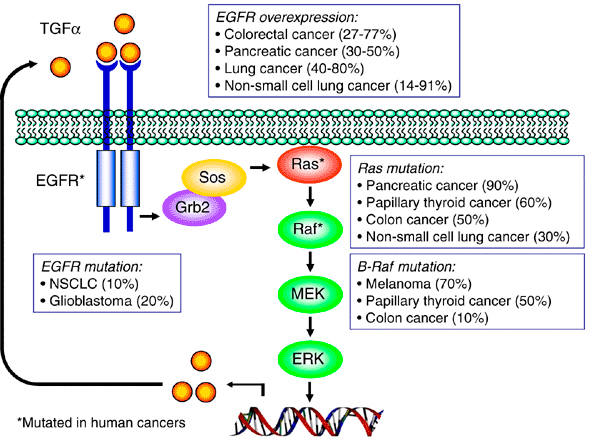
Let’s look a little bit closer at that pathway and give some of those green balls a name. This is the Ras-Raf signaling pathway.

ras-raf

It’s a bit Rube-Goldbergian, but hey, that’s biology. In the top left corner you see something called EGFR, short for epidermal growth factor receptor. That’s our doorbell; the asterisk after the name in this diagram means that you see it mutated fairly frequently in human cancers. The box explains that it is seen to be damaged in 10-20% of certain kinds of cancers; when it’s mutated, it acts as if its signal, TGFα (Transforming Growth Factor Alpha) is always present. EGFR may also be perfectly normal, except that it is overexpressed, that is, present in a far greater number of copies on the cell surface, which makes the cell particularly sensitive to tiny quantities of growth factor. This happens even more frequently in many cancers.

The next steps in the pathway involve switching on Sos/Grb2, which activates Ras (look at the box; Ras is very commonly mutated in a great many cancers), which activates Raf, which activates MEK, which activates ERK, which promotes DNA replication. This is called a signaling cascade, and these kinds of sequences are all over the place in the cell. The advantages of this pattern is that many steps can be amplification steps, where one activated protein switches on many copies of the next protein in the sequence, and also each step is an opportunity for regulation.

Now be strong: I’m going to look even more closely at a key oncogene, Ras. Ras is important; it’s a central regulator of proliferative processes in the cell, and it is commonly one of the proteins made constitutively active in cancers.

ras

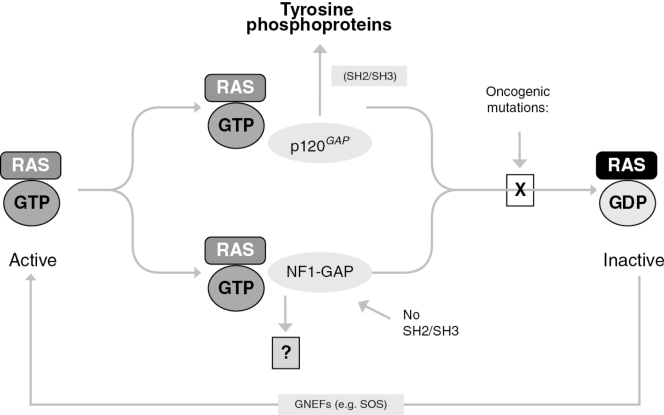
How is Ras switched on and off? In order to be active, Ras needs to be bound to a small molecule called GTP, guanine triphosphate, a base with three phosphate groups attached to it. It must be three; anything less, it isn’t active, so if it is bound to GDP, guanine diphosphate, it is inert. When it is bound to GTP, Ras changes shape to open up a binding site that can dock with the next protein in the chain, Raf, and activate it in turn.

Ras is switched on by the previous protein in the chain, SOS. SOS is a guanine exchange factor, and from the name, you can guess what it does: it swaps out the stultifying GDP molecule from Ras and replaces it with the energizing GTP molecule. Which allows it to bind with Raf, which then activates MEK, etc.

What switches Ras off? Ras is also an enzyme, specifically a GTPase — it cleaves its own GTP into a GDP. It turns itself off! What this means is that it acts as a kind of momentary switch. When a growth factor molecule arrives at the cell, Ras will respond by briefly initiating the cell division machinery, and then shutting itself down. It needs a sustained signal to keep cell division humming — a little triggering flicker of a random molecule bumping into the cell is not enough. This makes a lot of sense for cell cycle control. Ras is a reluctant activator, always hesitating and drawing back, and it needs constant prodding from external signals to keep doing its job.

Except when it’s mutated.

The most common cancer-inducing mutation in Ras is a single amino acid change in the 12th codon of its gene that greatly reduces the effectiveness of its GTPase activity. It binds GTP, becomes active, and then does not cleave the GTP — it clings to it instead. It switches from being a reluctant activator of cell division to instead being an avid, hyperactive activator — any transient signal, even a bit of noise, becomes an excuse to tell the cell to start dividing madly.

And that’s the beginning of a cancer, a rogue protein, made by an oncogene, that’s telling the normal, healthy cellular machinery to do its thing when it shouldn’t.

There’s much more to cancer than that, of course — cancer is more than just excessive cell division, and also the cell has many fail-safes, the tumor suppressor genes, that are supposed to put the brakes on when renegade proteins are going wild. But — oh, and this is cruel of me — to hear that part of the story, you’ll have to donate to my Light the Night fundraising page. When we get to $5000, I’ll tell you all about tumor suppressors.


Croce CM (2008) Oncogenes and cancer. N Engl J Med. 358(5):502-11.

Hanahan D, Weinberg RA (2011) Hallmarks of cancer: the next generation. Cell 144(5):646-74.

Hesketh R (2013) Introduction to Cancer Biology. Cambridge University Press.

Skepchick joins the race

When I announced our participation in the Light the Night fundraising drive, I mentioned that another network would be joining in, too, and that we might have to set up another challenge award for beating them. Well, here they are: Skepchick has formed a team, and since our goal is to raise $10,000, they’ve set their goal to $10,001. Ooooh, it’s on.

So what should I do if Freethoughtblogs outdoes Skepchick? Given that we’ve raised $4000 so far, and they’ve raised less than $100, I think it should be a very very small forfeit, don’t you? Just to be fair?

Cool free stuff

I’ve mentioned the Earthviewer app from HHMI before: think of it as a bit like Google Earth, only you can dial it back to any period in the planet’s history. There have been a couple of developments: it’s also available for Android, and it’s added some new features, including tracking for major fossils. So now you can see the long strange journey of Tiktaalik’s bones on the screen.

They’re also making available a lovely big poster of earth’s history. This year, we here at UMM are putting together a teacher training program to be implemented in the summer of 2015, and it’s going to be a lot of work for us — but I’m realizing that HHMI has already done a lot of material preparation that will help a great deal.

I’ve been known to moan in chagrin over all the multimedia garbage that Answers in Genesis provides to corrupt education in this country — you can just pop into AiG’s website and download lesson plans and powerpoint slides to teach creationism. But now HHMI makes them look feeble as well as wrong.

Scholars live on a lean diet

The story of Margaret Mary Vojtko brought out quite a few adjuncts with their own tales of exploitation by universities. It really is shameful how the current system often takes people who love learning and want to teach and treats them like crap, when they should be regarding them as the heirs to the university tradition.

There were also a few clueless twits babbling in dumb incomprehension: why don’t you just get a real job? Meaning, of course, some kind of work, any kind of work, that pays you more money. I come from a blue collar, union family, and I know I baffled my father a bit, too; before I went off to college, he had made tentative arrangements for me in a union apprenticeship in refrigerator repair, which, if I’d taken it, would mean I’d be making twice as much money now, and it would come with long paid vacations and all kinds of benefits, and I would have started earning when I was 19. In the ’90s, I had a shot at jobs in software that paid three times what I make now (that was the bubble, though, so maybe it’s just as well I didn’t take one). In every case, I went for the pittance I’d earn in academia, because I love biology.

If you want to know the sacrifices every college professor makes for his profession, read this summary of the economics of a science career. I tell all my students that an academic career is the most fulfilling, happiest job you can get (if you can get it), but the last reason you should go for it is to make money, because you won’t. Especially now that the United States is flatlining its research budget and building more sophisticated bombs, instead.

What you also have to understand, though, is that even now we aren’t complaining that we want to get paid as much as an experienced expert in refrigeration maintenance of software development — all we want is a living wage and that our colleagues are treated equally and with respect — I don’t want to work in a divided environment where some of us have tenure and the freedom to do more than grade papers all day long, while others are stuck in the scut work of overloads in service courses.

Everyone should think to the future. The professoriate represents the stem cells of an intellectual culture. Starve us into extinction and you won’t see the great progress of a sophisticated society; we make poets and engineers and doctors and leaders and scientists. And we do it for dirt cheap because we love our work, so why are people demanding that we do it for less?